Published on
June 6, 2026

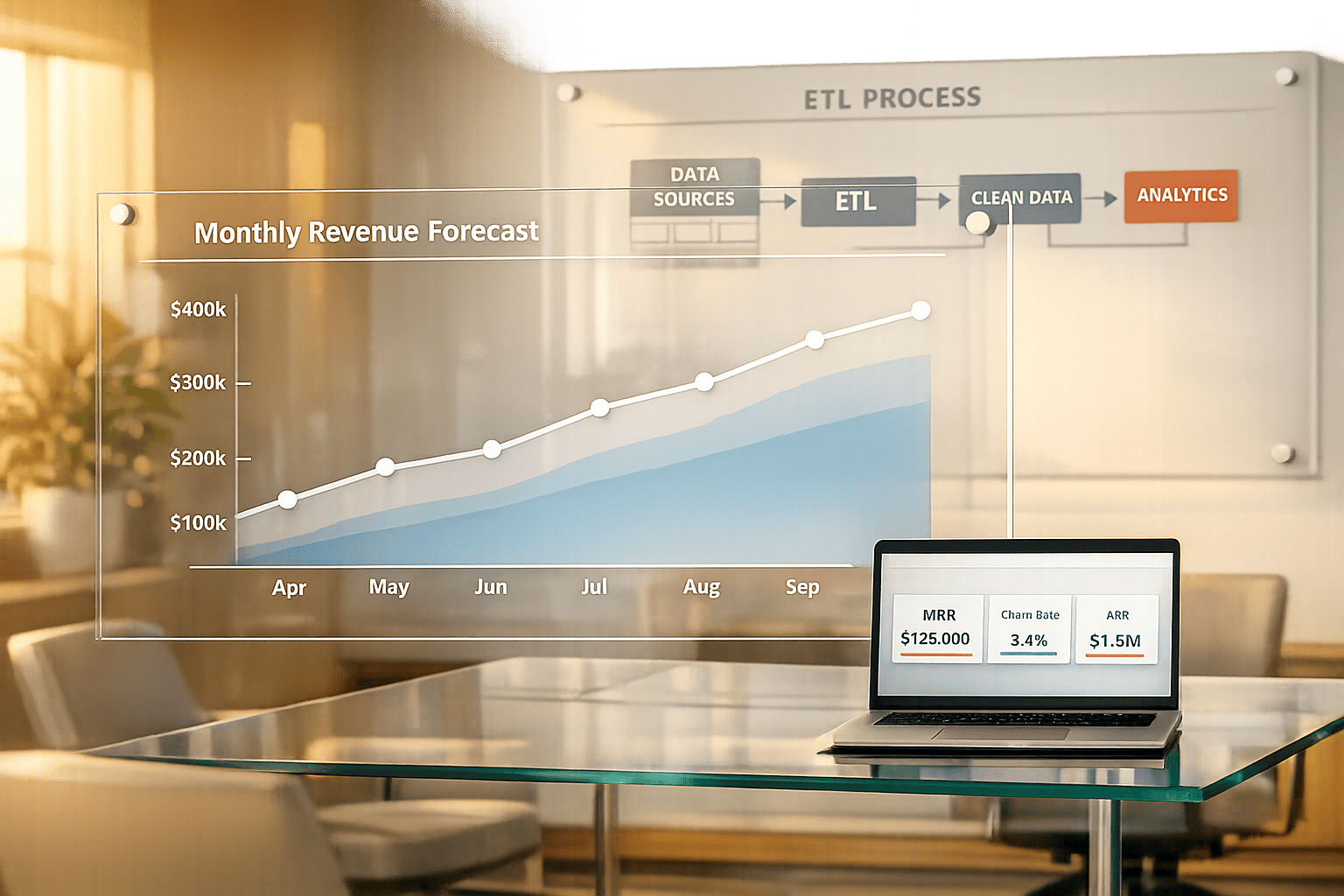
AI revenue forecasting transforms how SaaS companies predict their earnings by leveraging advanced models to process complex data. Unlike traditional spreadsheets, AI integrates CRM, billing, and usage data to identify patterns and predict metrics like churn, expansion, and bookings with greater precision. This approach is especially effective for SaaS businesses dealing with recurring revenue, usage-based pricing, and nuanced customer behaviors.
AI-driven forecasting helps SaaS companies make informed decisions, anticipate risks, and optimize growth strategies. However, its effectiveness hinges on high-quality data and cross-team collaboration.
AI models thrive on high-quality data, and for SaaS businesses, this starts with metrics like Monthly Recurring Revenue (MRR) and Annual Recurring Revenue (ARR). These numbers serve as the backbone for tracking growth. Retention metrics, such as Net Revenue Retention (NRR) and Gross Revenue Retention (GRR), are equally crucial because they show how well you're holding onto your customers. For example, the median NRR for SaaS companies is 105% [4], indicating that many businesses manage to grow revenue from their existing customers despite churn.
Other key metrics include Expansion MRR (from upsells and cross-sells) and Contraction MRR (from downgrades). These should be modeled separately, as they follow unique patterns and drivers.
Sales pipeline data is another essential input. Metrics like deal value, pipeline stage, historical win rates, and sales cycle length are critical for short-term bookings forecasts. For companies with usage-based pricing, product engagement data - such as API calls, seat utilization, or storage consumption - becomes a key driver. Behavioral signals like days since last activity, stakeholder seniority, number of contacts engaged, and even competitor mentions also play a role [9][10]. This is because revenue recognition in usage-based models depends on actual usage rather than contract terms [6][8].
"MRR is the metric that keeps you honest. It does not care whether a customer paid annually upfront or monthly. It tells you the actual rate at which your business is generating value." - Ayush Agarwal, Co-founder & CPTO, Dodo Payments [2]
With these metrics clearly defined, the next challenge is integrating them into a seamless data pipeline.
Even the most accurate metrics lose their value without proper data integration. Effective AI forecasting relies on a combination of four key data sources. Here's a breakdown:
| Data Source | Role in AI Forecasting | Key Metrics |
|---|---|---|
| Billing System | Tracks revenue events | Active subscriptions, plan changes, failed payments [2] |
| CRM | Predicts future bookings | Opportunity stages, win rates, sales cycle length [4][3] |
| Product Analytics | Monitors churn and growth potential | Usage frequency, feature adoption, capacity limits [4] |
| General Ledger | Ensures financial accuracy | Recognized revenue, deferred revenue, cash settlement [4][1] |
Automating integration between these systems is critical. Relying on manual data imports, like CSV exports, often leads to version control issues and subtle errors that can undermine AI model accuracy [3].
Data quality is just as important as quantity. AI models typically need at least 50 closed deals per quarter to identify reliable trends [9][10]. With fewer data points, simpler statistical methods often outperform machine learning. Additionally, CRM data requires regular upkeep - B2B contact data decays at a rate of 2.1% per month, meaning about 25% of records become outdated every year [9]. Regular data hygiene is non-negotiable.
Once you've secured high-quality data, segmenting revenue streams can take your forecasting to the next level. Aggregating all revenue types into a single pipeline can hide critical insights. For example, combining renewals, expansions, and new business makes it harder to distinguish between healthy growth and churn that's offset by upsells.
"One pattern we consistently observe at Forecastio is that many SaaS companies combine renewals, expansions, and new business into a single pipeline. This creates a distorted picture of performance and significantly reduces forecast accuracy." - Alex Zlotko, CEO at Forecastio [7]
The solution? Maintain separate pipelines for new business, renewals, and expansions. Each stream has unique win rates, deal dynamics, and probability curves. Churn should also be segmented by factors like customer size, product tier, and contract type. For instance, an 8% monthly churn rate in your SMB segment tells a very different story compared to the same rate in your Enterprise segment [1][7].
Forecast accuracy often declines as the time horizon extends, especially when data quality is lacking. Here's how clean versus average data impacts AI/ML accuracy over different time horizons:
| Forecast Horizon | AI/ML Accuracy (Clean Data) | AI/ML Accuracy (Average Data) |
|---|---|---|
| 30-day | 88–93% | 80–87% |
| 60-day | 78–85% | 70–78% |
| 90-day | 68–77% | 60–70% |
| Full-year | 60–72% | 52–65% |
Source: [9]
Investing in clean, well-segmented data not only improves forecast accuracy but also lays the groundwork for selecting the right AI models and tools to act on these insights.
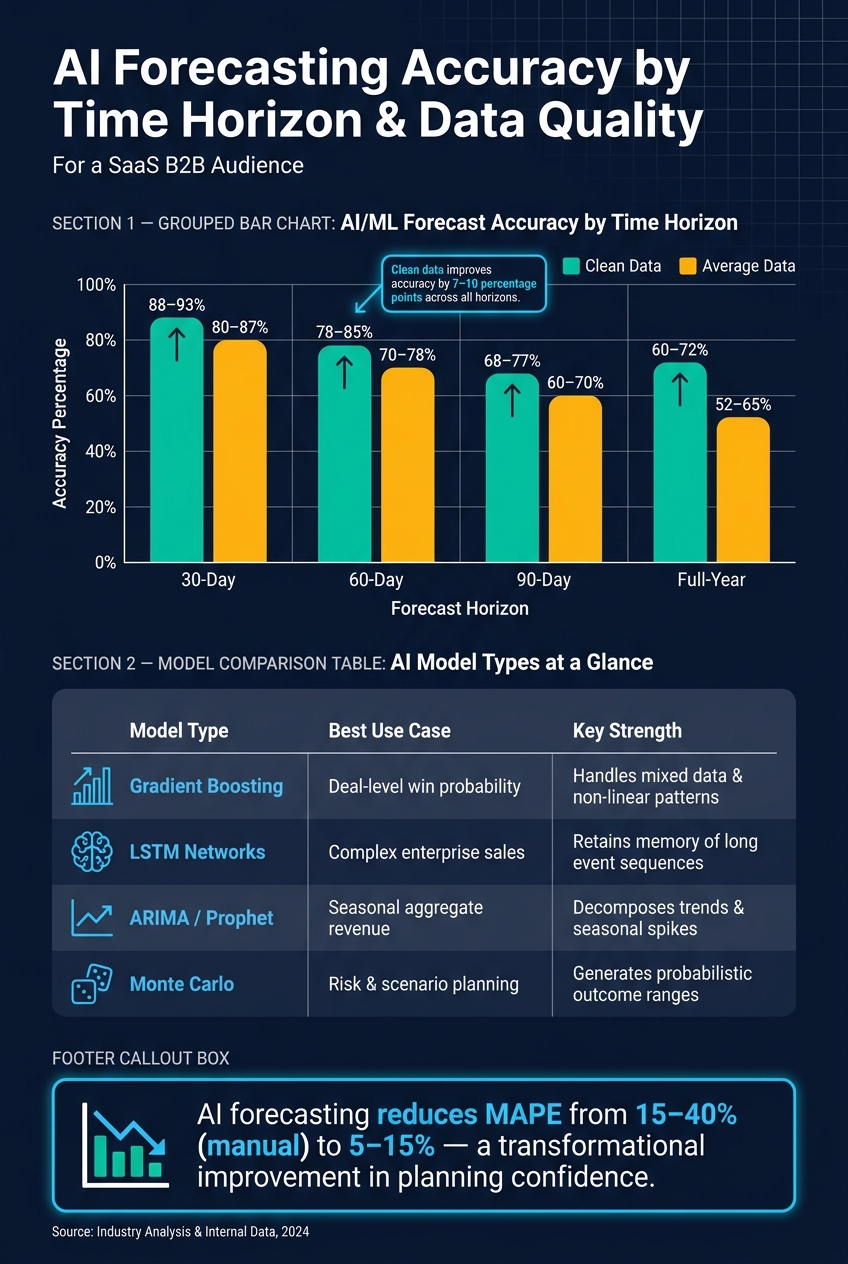
AI vs Traditional Revenue Forecasting Accuracy by Time Horizon
Time series models like ARIMA and Prophet break down historical revenue data into trend and seasonal components, helping to predict future outcomes. These models are ideal for SaaS businesses with steady billing cycles, where seasonal patterns - like predictable dips or growth spurts - recur annually. While they won't pinpoint why a specific deal might close, they excel at highlighting when your overall revenue trajectory starts to deviate from expectations.
While aggregate forecasts show the overall revenue direction, customer-level machine learning (ML) models dive deeper, identifying which customers are driving revenue growth - or possibly leaving. Tools like XGBoost and LightGBM analyze a mix of signals, such as days since the last interaction, stakeholder seniority, and feature adoption rates, to predict outcomes like deal closures, expansions, or churn events [10].
For more intricate enterprise sales cycles, where sequence and timing are critical (e.g., a product demo followed by a legal review, then a period of inactivity), LSTM (Long Short-Term Memory) neural networks are better suited. These models "remember" earlier events in the sales process, making them effective for long, multi-step cycles that unfold over several months [10].
"A forecast without a confidence range is an opinion formatted as data. The question is not just what the number is - it is how sure you are, and what would have to change to break it." - Siddharth Gangal, Founder, Fairview [10]
Here’s a quick comparison of model types and their strengths:
| Model Type | Best Use Case | Key Strength |
|---|---|---|
| Gradient Boosting | Deal-level win probability | Handles mixed data types and non-linear patterns |
| LSTM Networks | Complex enterprise sales | Retains "memory" of event sequences over long cycles |
| ARIMA / Prophet | Seasonal aggregate revenue | Decomposes trends and recurring seasonal spikes |
| Monte Carlo | Risk and scenario planning | Generates probabilistic ranges instead of point estimates |
One critical point: most ML models need at least 100 closed deals to deliver reliable results [10]. If you're working with smaller datasets, simpler statistical methods might actually perform better.
Forecasting is never about guarantees, which is where Monte Carlo simulations come into play. These simulations don’t just spit out a single number; they create a probability distribution of outcomes by running thousands of iterations with varying inputs - like close rates, deal sizes, and churn assumptions. Instead of saying, "We’ll hit $4.2M next quarter", Monte Carlo offers something more actionable: "There’s an 80% chance we’ll land between $3.8M and $4.6M" [3][10].
A practical approach involves maintaining three core scenarios at all times:
Pairing churn models with expansion forecasts is essential. Without both, strong upsell numbers could hide a deteriorating retention rate [1]. And when your business undergoes significant changes - like adopting new pricing models or targeting a different ideal customer profile (ICP) - it’s smart to retrain simulations using the most recent six months of data to ensure relevance [10].
When implemented well, these AI-driven techniques can cut Mean Absolute Percentage Error (MAPE) from 15–40% down to 5–15% compared to manual forecasting methods [10]. That difference can mean the gap between planning based on confidence and planning based on guesswork. For many SaaS companies, implementing these models is a core responsibility of fractional CFO services that bridge the gap between data and strategy. This probabilistic approach lays the groundwork for more effective revenue forecasting.
AI forecasts are only as reliable as the data they’re built on. Poor data quality is a major obstacle, costing businesses an average of $12.9 million annually [10]. If your model is trained on incomplete or inconsistent data, its predictions will reflect those flaws.
Start by centralizing data from all systems tied to revenue. This includes your CRM (deal stages, activity logs), billing and ERP systems (actual revenue, renewal dates, churn history), HRIS (rep tenure, ramp-up times), and product analytics (feature usage, login frequency). Then, create a data dictionary to ensure consistent definitions for pipeline stages, product names, regions, and currencies across teams. Without this, terms like "Closed Won" might mean one thing to sales and something slightly different to finance, leading to subtle but damaging inconsistencies in the training data.
Aim for at least 80% completeness in key deal fields such as stage dates, activity logs, and contact records before relying on AI-generated outputs. Regular CRM data cleanups can improve forecast accuracy by up to 30% [9]. Ideally, your architecture should integrate CRM data into a centralized data warehouse where forecasts are computed, with results fed back into the CRM for easy access.
Once your data foundation is solid, the next step is to validate and monitor your AI models to maintain their accuracy over time.
Deploying an AI model is just the beginning - it’s an ongoing process that requires regular validation to ensure the outputs remain accurate. One common mistake is treating AI forecasts as static, rather than as dynamic systems that need continuous fine-tuning.
For the first quarter, run AI-generated forecasts alongside human-generated ones [9]. This side-by-side comparison helps identify areas where the model excels and where it falls short. Use the MABE framework to measure performance across four key metrics:
If the model consistently over-forecasts by more than 5%, apply a correction factor while investigating potential issues in the training data [10].
"Accuracy improves most from better inputs (definitions, hygiene, SLAs) and cadence, not exotic algorithms." - Luca Martial, CEO, Kaelio [13]
Set up automatic retraining triggers for when significant changes occur, such as a 15% shift in segment close rates [10]. Rolling retraining on a 12–18 month window ensures the model stays aligned with evolving factors like your ICP, pricing, or market trends [9][11].
Even with strong data systems and accurate models, success hinges on aligning your teams. Finance, RevOps, and sales often interpret key terms differently, which can undermine trust in the forecasts.
To avoid this, create a unified revenue taxonomy. Standardize definitions for pipeline stages, "commit" categories, and revenue events, ensuring everyone agrees on these terms before the model goes live [11][15]. Assign clear roles for adjusting forecasts and require justifications for manual overrides [11].
"AI is designed to augment human judgment, not replace it. The technology handles heavy data analysis and pattern recognition, which frees revenue leaders to focus on strategy, coaching, and timely intervention where it matters most." - Nathan Thompson, Fullcast [14]
Organizations like Phoenix Strategy Group specialize in creating this type of alignment, bridging technical infrastructure with financial decision-making. This ensures forecasts aren’t just numbers on a report - they become actionable insights that drive real business decisions.
Once your AI forecast is up and running, it's critical to assess its performance using multiple metrics. Relying on a single accuracy percentage can hide important issues. Here are some key metrics to focus on:
Your MAPE targets should reflect your company's stage. For example, a seed-stage business with less than $5M ARR might accept an error margin of ±20–25%. In contrast, a pre-IPO company should aim for a tighter range, around ±5% or better [16]. Trying to achieve enterprise-level precision too early can become a distraction if you lack the necessary data.
Another helpful metric is the pipeline coverage ratio, which measures how much qualified pipeline exists relative to your revenue target. A ratio below 3x can often signal a forecast miss before the quarter even begins [12][16].
Together, these metrics not only help you measure accuracy but also guide your strategic decisions.
Forecasts only matter if they influence decisions. A more precise forecast range enables smarter planning in areas like hiring, marketing campaigns, and allocating funds for product development.
The level of confidence in your forecast should match the decision being made. For short-term decisions - like approving a new hire or greenlighting a marketing budget - AI forecasts with clean data can achieve 88–93% accuracy over 30 days [9]. However, for longer-term, 90-day commitments, accuracy typically drops to 68–77%. In those cases, it's better to rely on a confidence range rather than a single number [9].
"Forecast accuracy isn't a modeling issue: It's an organizational design issue. When Sales, Marketing, and Customer Success operate with misaligned incentives... the forecast becomes a reflection of internal bias rather than buyer reality." - Warren Zenna, Founder, The CRO Collective [17]
Using confidence intervals is key to making forecasts actionable. For example, a forecast like "$4.2M" offers little context about risk. But a range such as "$3.9M–$4.5M at 80% confidence" provides a more practical foundation for financial planning [10][19].
To ensure forecasts stay relevant, they must evolve with your business.
Even the best AI forecasting models need ongoing refinement to stay effective. One common mistake is treating the model as "finished" after deployment. As your business changes - whether through new pricing structures, shifts in customer profiles, or sales team reorganizations - your model's performance can drift.
After each forecasting period, review the variance by segment and look for consistent biases over 5%. This can help you uncover issues like:
To address these challenges, consider using a rolling window of the most recent 12–18 months for training and include data from lost deals. This ensures your model reflects current trends and challenges.
As your dataset grows, you might also want to create separate models for distinct segments, such as SMBs versus Enterprise customers. Combining these into a single model can lead to distortions, as shifts in one segment may skew overall forecasts [10]. The aim is to build a system that continuously adapts and improves, rather than chasing perfection right from the start.
AI-powered revenue forecasting is changing how SaaS companies make decisions. When forecasts update automatically as new CRM and billing data come in, you move from simply reacting to problems to anticipating them. This shift allows for smarter hiring, more strategic marketing investments, and better cash management by providing a clearer view of your cash runway. These benefits pave the way for the actionable insights mentioned earlier.
However, achieving this requires more than just technology. It depends on clean data pipelines, collaboration across Sales, Finance, and Customer Success, and a commitment to valuing accuracy over overly optimistic projections. The real hurdle isn’t revenue unpredictability - it’s relying on outdated forecasting methods.
The foundation of accurate forecasting starts with strong systems and expert guidance. Aligning these systems is where Phoenix Strategy Group steps in. By integrating Finance and RevOps into one cohesive system - and ensuring the data engineering and CRM architecture provide accurate inputs - PSG helps growth-stage SaaS companies gain a competitive edge.
"When finance and RevOps operate as one integrated system instead of separate departments, founders gain the clarity to make smarter growth decisions, protect cash, and build a more scalable, valuable business." - Phoenix Strategy Group [5]
To get started with AI-driven revenue forecasting, you'll need at least 12 months of clean, standardized historical data. While that's the minimum requirement, training the system on your specific data for around six months can significantly improve its accuracy.
For sales forecasting, having at least 100 closed deals is necessary to generate meaningful insights. Ideally, maintaining 18–24 months of data allows for a deeper understanding of seasonal patterns, growth trends, and cyclical changes.
To build a dependable AI-powered revenue forecast, start by gathering data from your most important systems into a single, unified database. Pull in information from your CRM to track sales activities and deal values, your accounting software for revenue and cash flow insights, and billing tools to manage subscription data. Don’t forget to include HR data for payroll and headcount details, along with marketing metrics to assess demand generation efforts. Companies like Phoenix Strategy Group specialize in simplifying these integrations, ensuring your forecasting process has a solid foundation.
To keep your AI revenue forecasts on point as your SaaS business grows, it’s essential to take a flexible, data-focused approach. Use APIs to pull real-time data from tools like CRMs, billing systems, and accounting software. This not only reduces manual errors but also ensures your forecasts adapt to changes like churn rates or shifts in sales momentum.
Make it a habit to conduct variance analyses. This helps fine-tune your assumptions and zero in on critical metrics such as MRR (Monthly Recurring Revenue), NRR (Net Revenue Retention), and customer health. By breaking these metrics into smaller, actionable parts, you can achieve a much sharper and more reliable forecast.