Published on
December 2, 2025

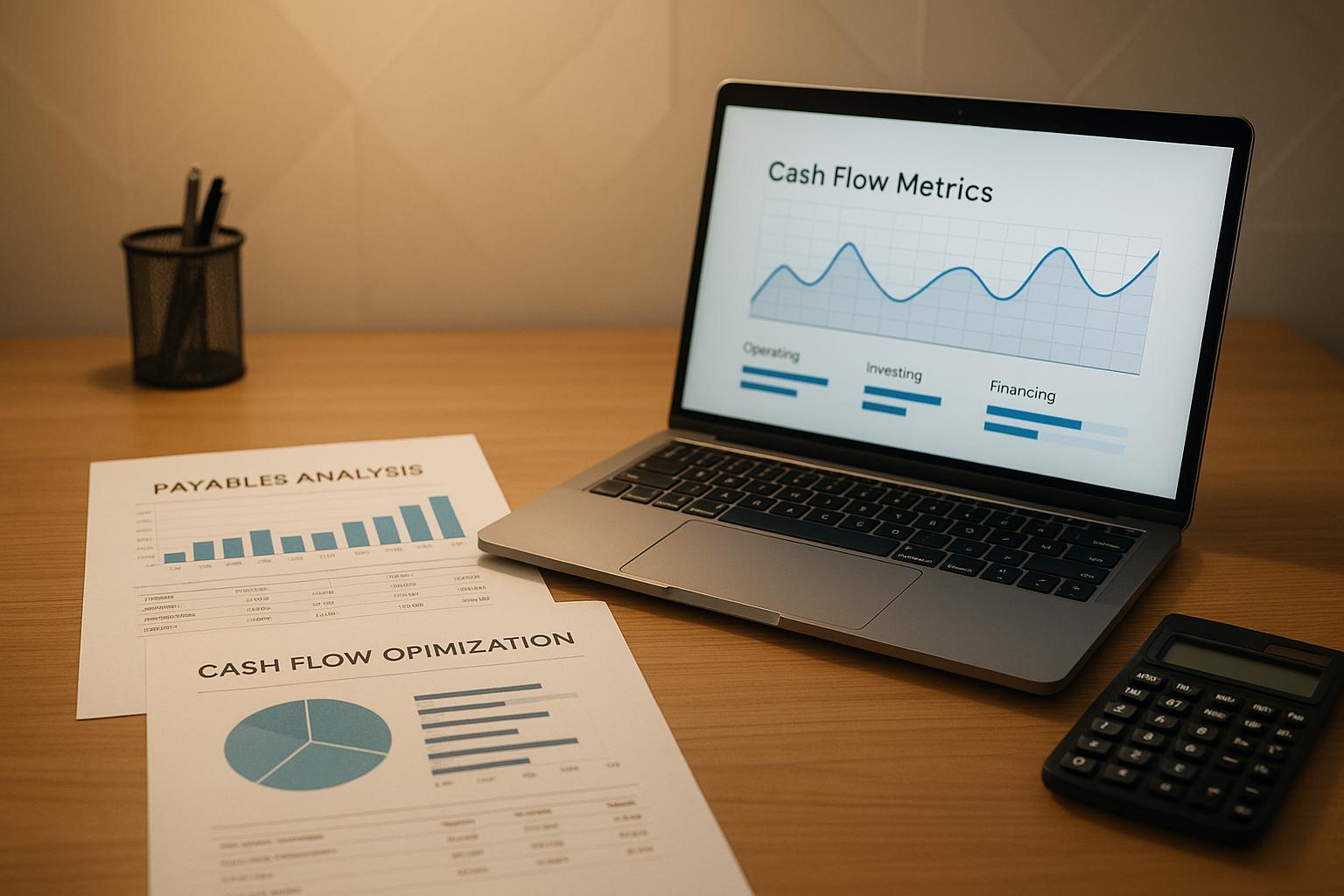
Managing accounts payable (AP) effectively can transform your cash flow and strengthen supplier relationships. Businesses often lose money due to outdated processes, missed discounts, late fees, and inefficiencies in payment management. This guide outlines how to optimize AP by focusing on key metrics, improving workflows, segmenting vendors, and leveraging real-time tools.
Key Takeaways:
To streamline your accounts payable (AP) process, focus on three essential metrics: Days Payable Outstanding (DPO), early payment discounts vs. late fee avoidance, and invoice processing cycle time. While it's tempting to track a long list of metrics, these three are the most impactful for understanding and managing cash flow. Together, they reveal where your money is going, when it’s leaving your account, and how efficiently your AP team operates.
By tracking these metrics, you can transform your AP function from a reactive back-office task into a strategic financial tool. Instead of scrambling to handle unexpected payments or missing opportunities to save, you'll gain clarity on your payment patterns and their effects on your bottom line.
DPO measures the average time your company takes to pay invoices after receiving them [5]. The formula is straightforward: divide accounts payable by the cost of goods sold (or operating expenses), then multiply by the number of days in the period. For example, with $500,000 in accounts payable and $3,000,000 in annual cost of goods sold, your DPO would be about 61 days. This means it takes roughly two months to pay your vendors.
A higher DPO can free up cash for other business needs, like inventory or marketing. However, delaying payments too much might strain vendor relationships or signal financial trouble. On the flip side, a lower DPO suggests quicker payments, which could help you secure early payment discounts but might limit your available cash.
The goal is to find the right balance. For instance, you might prioritize paying a key supplier within 15 days to maintain a strong partnership, while less critical vendors could be on Net 60 terms. Comparing your DPO to industry benchmarks is also important. If your DPO is much lower than competitors, you might be missing opportunities to hold onto cash longer. If it’s higher, you risk damaging supplier relationships.
Early payment discounts are incentives vendors offer for paying invoices before the due date [1][5]. A typical example is "2/10 Net 30", where you get a 2% discount if you pay within 10 days instead of the standard 30 days.
Taking advantage of these discounts requires solid cash flow management and visibility. To make the most of these opportunities, track how many vendors offer discounts and review the payment terms across your vendor base.
Here’s the math: a 2% discount for paying 20 days early translates to an annualized return of approximately 36%. That’s a compelling reason to prioritize these savings over other short-term investments.
On the flip side, late payments can lead to penalties, which reduce profitability and harm supplier relationships. For example, if your company pays invoices 5–10 days late and racks up $500 in monthly late fees, you’re looking at $6,000 in unnecessary annual costs. Monitoring your compliance with payment terms helps you avoid these penalties. By tracking both early payment discounts captured and late fees incurred, you’ll get a clear picture of how your payment timing decisions impact your finances.
Invoice processing cycle time measures how long it takes from receiving an invoice to completing the payment [5]. This metric directly affects when cash leaves your account and how well your AP team performs. Long processing times can delay payments, reduce cash flow visibility, and make strategic planning harder.
For example, compare a 14-day processing cycle to a 3-day cycle. The difference is huge. By automating your AP process, you can drastically cut down processing time, improving cash flow visibility and aligning payment timing with revenue cycles.
To gauge your efficiency, track metrics like average processing time, approval cycle duration, payment method delays, exception rates, and processing costs. Implementing AI-powered AP automation software can eliminate manual tasks, speeding up processing from weeks to just days. This not only boosts efficiency but also enhances your ability to manage cash flow effectively.
Use these insights as a foundation to refine your AP processes in the next step.
After identifying your key metrics, it's time to take a closer look at how your accounts payable (AP) process actually functions. Many companies believe they have a solid grasp of their AP workflow, but a detailed review often uncovers hidden inefficiencies, workarounds, and bottlenecks that quietly drain resources and slow operations. This step establishes a clear foundation for making targeted improvements and builds on the metrics identified earlier.
Mapping your AP workflow is crucial for improving cash flow management. Start by outlining every step of the process - from the moment an invoice is received to when payment is completed. This includes tracking how invoices arrive (email, supplier portal, or paper), how they’re entered and coded, routed for approval, matched with purchase orders, and ultimately paid.
Create a visual flowchart to highlight responsibilities, systems involved, and the time required at each stage. For example, if invoices arrive via email, determine whether they go directly to the AP department or sit in an inbox waiting for action. Note how long data entry and approval typically take.
Document the approval hierarchy in detail. Identify approval thresholds based on invoice amounts. For instance, does a $500 invoice need one signature or multiple approvals? What happens if an approver is on vacation or unavailable? These details help you spot potential delays and inefficiencies.
Pay special attention to manual handoffs between departments. Each time an invoice moves from one person or system to another, there’s a risk of delays or errors. Document both the ideal process and any workarounds your team currently uses, such as maintaining separate spreadsheets or bypassing slower systems. This provides a clear picture of where improvements are most needed.
Standardizing your workflow and setting up clear internal controls creates a solid starting point for measuring progress and implementing changes.
With your workflow mapped, the next step is identifying problem areas. Common bottlenecks include slow approval cycles, manual data entry errors, duplicate invoices, and gaps in system integration.
Use aging reports to identify overdue invoices. These reports help prioritize payments and reveal where delays occur, whether during approval, matching, or coding. If invoices are aging past their due dates, trace them back through the workflow to uncover the root cause.
Track metrics like late payment fees, approval rejection rates, payment discrepancies, and missed early payment discounts over several months. For instance, if late fees are costing $500 per month, that’s $6,000 annually - money that could be better spent elsewhere.
Break down your invoice processing cycle into specific stages: time from receipt to data entry, time in approval queues, time from approval to payment scheduling, and time from scheduling to actual payment. Companies with efficient AP processes typically process invoices within 5–10 business days. If your cycle takes longer, it’s a clear sign of room for improvement.
Set a defined timeframe - 2 to 4 weeks - for this review. Analyze a representative sample of 50–100 recent invoices to gather meaningful insights without getting overwhelmed by excessive details. Document findings with concrete examples and numbers. For instance, instead of simply noting that approvals are slow, you could report that invoices spend an average of 12 days in approval, leading to missed early payment discounts worth $15,000 annually.
These insights are essential for improving vendor payment timing and enhancing cash flow management. By thoroughly analyzing your AP workflow, you’ll be ready to tackle vendor segmentation and payment strategies in the next step.
Once you’ve mapped your workflow and identified bottlenecks, the next step is to segment your vendors. This helps you manage cash flow more effectively while maintaining strong supplier relationships. Vendor segmentation allows you to tailor payment strategies to meet both financial and operational goals.
Start by organizing your vendors into categories based on clear criteria. This helps you determine which suppliers should be prioritized and where there’s room for flexibility in managing payments.
First, consider strategic importance. Identify critical suppliers - those providing essential raw materials, services, or products that are key to your operations. These vendors should be treated differently from less critical or occasional suppliers. Ensuring timely payments to strategic suppliers minimizes the risk of supply chain disruptions and maintains strong relationships.
Next, categorize vendors by their payment terms. Group them into categories like Net 30, Net 60, and Net 90, and identify those offering early payment discounts, such as 2/10 Net 30 (a 2% discount for payments made within 10 days). This helps you spot opportunities for savings and determine which vendors provide natural cash flow benefits through extended terms.
Also, factor in purchase volume and frequency. High-volume vendors - those with annual spending of $50,000 or more - warrant closer analysis compared to smaller vendors with lower purchase amounts. The impact of payment timing decisions is greater with larger suppliers, making it worth the effort to optimize these relationships.
To get a clearer picture, calculate the percentage of vendors in each category. For example, if 60% of your vendors operate on Net 30 terms, 25% on Net 60, and 15% on Net 90, you’ll know where most of your flexibility lies. Similarly, if 40% of your vendors offer early payment discounts, you can estimate the potential savings if your cash flow allows you to take advantage of them.
This segmentation process creates a roadmap for balancing priorities. Critical suppliers can receive faster payments to ensure reliability, while occasional vendors provide flexibility in payment timing. Vendors with extended terms help stretch your payment cycle, while those offering early payment discounts can lead to immediate savings when managed properly.
Once your vendors are grouped, the next step is to analyze historical payment data to uncover trends and opportunities for improvement.
With your vendors segmented, it’s time to examine your payment history. This analysis helps you identify gaps between agreed payment terms and your actual practices, highlighting areas where adjustments can be made.
Start by reviewing payment data from the past 12 months. Focus on metrics like payment timing, Days Payable Outstanding (DPO) by vendor, compliance rates, missed early payment discounts, and late fees. For example, if Net 30 vendors are being paid in 25 days, you’re paying earlier than necessary and reducing your working capital. On the other hand, paying Net 30 vendors in 40 days risks late fees and strains relationships.
Track your payment term compliance rate to see how often you’re meeting agreed terms. If you’re paying 95% of invoices on time for critical suppliers but only 70% for others, this could signal potential relationship risks with non-critical vendors.
Identify missed opportunities for early payment discounts. For instance, if vendors offer $100,000 annually in potential 2% discounts but you only capture half due to cash flow constraints, you’re leaving $1,000 in savings on the table. This highlights the need to improve cash management to unlock these savings.
Evaluate the cost of late payments by tracking fees and penalties over the past year. Even small amounts add up - if late fees total $500 per month, that’s $6,000 annually eating into your profits. Pinpoint which vendor categories are generating these costs to prioritize improvements.
Seasonal patterns are another key factor. Many businesses face predictable fluctuations in purchasing needs. A retailer, for instance, might see higher inventory costs in late summer, while a construction company may experience increased material expenses in spring. Understanding these patterns allows you to plan for cash demands during peak periods.
Use these insights to develop custom payment strategies for each vendor segment. For example, critical suppliers might receive payments within 25 days to secure supply chain stability, even if terms allow 30 days. For vendors offering 2/10 Net 30 discounts, it makes sense to prioritize payments for high-volume suppliers where the savings are significant. Meanwhile, vendors with Net 60 or Net 90 terms can be paid closer to the deadline to maximize liquidity.
Document your findings with specific numbers and examples. Instead of saying, “some vendors are paid late,” report that “15% of invoices to non-critical vendors are paid 5–10 days past terms, resulting in $4,200 in annual late fees.” This level of detail makes it easier to identify priorities and measure progress over time.
Once you've segmented your vendors and analyzed payment patterns, the next step is to adopt real-time visibility tools. These tools allow you to monitor and tweak your strategies on the fly. Managing dozens - or even hundreds - of vendors with varying payment terms and deadlines is no small feat, and spreadsheets or manual tracking just can't keep up. Real-time tools provide instant access to critical data, helping you manage accounts payable smarter and faster.
Unlike static reports, real-time tools offer up-to-the-minute insights. For example, when FirstBlood's team adopted AP optimization tools with real-time capabilities, they reduced their close time by 150% and saved 40 hours per month [3]. This isn't just about saving time - it's about making smarter cash flow decisions before any issues arise.
Real-time visibility also eliminates guesswork in cash flow management. Instead of scrambling to find vendor details or worrying about whether you can cover next week's payments, these tools give you a complete, instant view of your payables. This clarity helps you avoid liquidity crunches and make informed financial decisions [1].
A dynamic dashboard acts as your central hub for managing accounts payable. It not only provides a snapshot of your current financial position but also highlights trends that could impact your cash flow.
Key metrics to include on your dashboard:
Color-coded visuals make it easy to see which payments are coming due or overdue, helping you stay on top of deadlines and avoid penalties [1][5].
Your dashboard should also include cash outflow forecasts for the next 30, 60, and 90 days, giving you a forward-looking view of your payment obligations. A cash flow calendar can further align your inflows with outflows, ensuring you're neither tying up too much cash nor missing payments [5].
Exception reports are another must-have. These reports flag issues like duplicate payments, delayed invoices, or discrepancies that require manual review [4]. A well-designed interface ensures your team spends less time searching for information and more time analyzing it.
"When you put the right data in front of an empowered team, they get better." – Phoenix Strategy Group [6]
To stay proactive, set up automated alerts for critical triggers. Here are some examples:
These alerts should be customizable by role and integrated with tools like email or Slack, ensuring the right people get the right information at the right time [4][1].
Dynamic dashboards are only as good as the data feeding into them. Integrating your AP tools with accounting systems ensures a single, real-time source of truth. This seamless connection between AP tools, accounting software, and ERP platforms eliminates data silos, allowing financial information to flow automatically. The result? Processing times shrink from weeks to days [1].
Integration centralizes data, giving your finance team a clear view of outstanding liabilities, upcoming obligations, and cash flow trends [1][4]. For instance, when procurement issues a purchase order, that commitment immediately updates your cash flow forecasts. Similarly, when an invoice is coded to a general ledger account, the data syncs across platforms. Payments processed by AP instantly update your cash position.
With integrated analytics, you can effortlessly track metrics like AP turnover ratio, overdue payables, and average invoice processing time - no more exporting data or manual calculations [3][4]. Integration also creates a robust audit trail, reducing risks by documenting all payables activities. Cloud-based solutions further enhance collaboration, enabling your team to work together in real time from anywhere [4].
Advanced features like AI-powered tools take integration to the next level. For example, automatic invoice scanning eliminates manual data entry, while AI-assisted coding suggests expense categories based on past transactions. Automated two-way matching simplifies reconciliation, saving time and reducing errors [3].
By connecting procurement, finance, and AP teams, these integrated systems break down silos that often slow down approvals and lead to payment delays. They also provide predictive insights, such as forecasting cash needs for the next year, factoring in seasonality and material cost fluctuations [3].
Phoenix Strategy Group specializes in building the infrastructure needed for this level of financial visibility. Their services include setting up ETL pipelines, data warehouses, analytics, and dashboards. This foundation enables consistent monitoring, with weekly tracking and monthly planning to refine financial forecasts and targets [6].
"Hire PSG if you want to make your life easier and have accurate data." – Michael Mancuso, CIO, New Law Business Model [6]
With the right real-time visibility tools, adjusting payment timing and terms becomes a powerful way to improve cash flow while also strengthening vendor relationships. This approach shifts the accounts payable (AP) process from being a reactive task to a strategic asset. By aligning payment schedules with cash availability and negotiating better terms, you can transform your AP team into a source of savings and efficiency [5].
A payment calendar helps you schedule payments to align with your revenue cycles and cash flow, rather than paying invoices immediately or at the last possible moment [1].
Start by analyzing your company’s cash inflow patterns. For example, if most of your revenue comes in during the first week of the month, plan larger payments for days 5–10, when cash is readily available, instead of spreading payments unevenly throughout the month. Payment scheduling tools can help automate this process, ensuring that payments align with available liquidity, vendor terms, and Days Payable Outstanding (DPO) targets [1].
For instance, you could configure your system to pay key suppliers within five days of receiving an invoice, while scheduling payments for standard vendors closer to the end of their Net 45 terms. Centralizing these schedules into a shared calendar can further streamline coordination. This calendar should group payments by due date and vendor, and it can include batch payment options for similar due dates or recurring bills for predictable expenses.
Transparent payment schedules not only build trust with suppliers but can also lead to better terms or priority treatment during times of supply constraints [1].
"PSG saved my dream. They helped us get our financials in order and renegotiate our lending agreements, pulling us through a tough financial crunch." – Norman Rodriguez, Founder/CEO of ElevateHire [6].
To make your payment calendar even more effective, collaborate with other departments. For example, check with procurement about upcoming equipment purchases, consult operations on inventory needs, and align with marketing on campaign budgets. This ensures your payment forecasts account for all major expenses [5].
Once your calendar is in place, the next step is to refine your strategy by setting clear DPO goals.
Days Payable Outstanding (DPO) measures how long your business takes to pay its suppliers, expressed in days. The formula is:
DPO = (Average Accounts Payable × 365) / Cost of Goods Sold [2].
Start by reviewing 6–12 months of payment data to determine your current DPO [2]. This baseline gives you a clear picture of how efficiently your business handles outgoing payments. For example, if your DPO is 30 days but your industry peers operate at 45 days, this could signal an opportunity to extend payment terms without damaging vendor relationships.
Optimizing DPO is about finding the right balance - freeing up working capital while maintaining strong vendor partnerships. A higher DPO gives you more time to hold onto cash, while a lower DPO might help you capture early payment discounts but reduces available funds [5].
Research industry norms to guide your strategy. For instance, manufacturing companies often have longer DPOs due to their procurement cycles, while service-based businesses may operate on shorter timelines [2]. Tailor your targets based on vendor importance, seasonal spending patterns, and available payment terms [5].
Analyzing which vendors offer early payment discounts can lead to immediate savings and improved cash flow [2]. Use accurate forecasting to decide which discounts to prioritize based on your cash position [5]. For other vendors, negotiate extended terms to increase your DPO while maintaining open communication to avoid straining relationships.
Regularly track compliance with payment terms to ensure you’re meeting vendor expectations. Metrics like the percentage of vendors offering early payment discounts and the distribution of payment terms (e.g., Net 30, 60, 90) can reveal areas for improvement [5]. Additionally, calculate the Accounts Payable Turnover Ratio to see how often you’re paying off your average AP balance each year [2].
Automating your AP processes can make a big difference. Modern software can flag unusual payment trends, highlight seasonal spikes, and recommend optimal timing for disbursements [2]. Automation not only speeds up processing but also frees up working capital for strategic investments, such as supplier development and new opportunities [1].
Review your DPO benchmarks monthly and adjust as needed. For instance, if a tight cash flow is forecasted, you might accelerate collections or negotiate extended terms to better align payment obligations with expected inflows [2]. Weekly tracking and monthly planning ensure your AP strategy stays on track and supports long-term financial health [6].
Forecasting accounts payable (AP) obligations shifts your cash management strategy from reactive to proactive. Instead of scrambling to cover unexpected bills or missing out on early payment discounts, accurate forecasting gives you a clear picture of upcoming expenses. This clarity allows for better planning, quick adjustments, and improved vendor relationships.
But AP forecasting isn't just about predicting what you'll owe. It's about timing. By knowing when payments are due, you can avoid late fees and take advantage of early payment discounts - those savings can really add up over time.
To get the most accurate forecasts, many businesses use a mix of methods. Start by analyzing 6–12 months of past invoices to identify recurring costs and seasonal trends. Then, refine your predictions with tools like cash disbursement models, insights into vendor behavior, and even regression or percent-of-sales methods. Comparing your data to industry trends can also help you factor in broader economic conditions.
According to Brex and PLANERGY, keeping an optimal cash balance through AP forecasting ensures businesses maintain liquidity without tying up too much in reserves [2]. This flexibility not only helps you meet your obligations but also positions you to take advantage of early payment discounts.
Once you’ve nailed down your forecasting methods, take it a step further by coordinating with other departments. Accurate AP forecasting thrives on collaboration between accounts payable, procurement, and enterprise resource planning (ERP) systems. By integrating these systems, you can get real-time insights into financial commitments and better predict cash outflows.
For example, if the marketing team plans a major campaign in Q2, your forecast should account for increased spending on ads, creative services, and promotional materials. Similarly, if operations expects to ramp up production for seasonal demand, your forecast should reflect higher inventory purchases and supplier payments. By working closely with departments like procurement, operations, and sales, you can align forecasts with planned expenses, production schedules, and revenue projections. This cross-departmental approach ensures your financial forecasts guide company-wide activities effectively.
"The failures always happen because - finance and revenue teams working in silos." – Phoenix Strategy Group [6]
Breaking down silos between finance and revenue teams is key to success. When finance actively collaborates with revenue operators and aligns through clear KPIs and regular check-ins, the company’s vision can translate into actionable daily goals.
Advanced payment scheduling tools also play a big role here. They help balance liquidity needs with supplier expectations while keeping everyone on the same page. Reliable forecasts that are clearly communicated build trust and strengthen vendor relationships. In this way, AP forecasting evolves from a back-office function into a strategic asset that supports business growth.
Modern AP automation tools add even more value. They can calculate important financial metrics like Days Payable Outstanding (DPO), AP ROI, overdue payables, and average invoice processing time. For instance, the DPO formula:
(Average Accounts Payable × 365) / Cost of Goods Sold [2]
helps establish when cash is likely to leave your business. Automation also streamlines invoice approval, reminders, and processing, ensuring payments are handled quickly and consistently. Regular reviews - like weekly tracking and monthly planning - allow your team to refine forecasts and adapt to changing conditions. Comparing forecasts against average AP values further enhances accuracy.
This collaborative and methodical approach lays the groundwork for adjusting forecasts to account for seasonal and cyclical trends.
Factoring in seasonal and cyclical trends can make your AP forecasts even sharper. Start by reviewing historical payment data to uncover patterns in vendor payments and invoice cycles. Analyzing 6–12 months of data often reveals seasonal fluctuations and recurring expenses that should be included in your forecasts.
For instance, a retail business might see higher payables in Q3 due to inventory purchases for the holiday season. A manufacturing company could experience peaks aligned with production cycles, while service-based businesses might face increased costs at the start of fiscal quarters for contract renewals or during busy seasons when temporary staffing is needed. Recognizing and planning for these trends ensures your forecasts align with predictable business cycles, keeping your cash flow strategy on point.
Optimizing accounts payable (AP) isn't just about managing bills - it’s about turning AP into a powerful tool for improving cash flow and driving growth. By taking a systematic approach, businesses can improve their cash position, strengthen relationships with suppliers, and free up working capital for essential growth initiatives.
The strategies outlined earlier work together to create a well-rounded framework for AP management. These include tracking key metrics, mapping workflows to spot inefficiencies, segmenting vendors based on payment terms, integrating real-time visibility tools with your ERP system, aligning payment schedules with revenue cycles, and forecasting obligations while accounting for seasonal trends. Together, these steps create a clear path to better financial health.
The impact is undeniable. For instance, FirstBlood reduced its close time by 150% and saved 40 hours monthly after adopting AP optimization practices [3]. Companies that prioritize payables analysis consistently see reduced costs per invoice, avoid late fees, and improve overall efficiency [3].
Immediate actions can yield quick results. Automating invoice processing significantly reduces handling time. Payment calendars help visualize and manage upcoming obligations. Capturing early payment discounts - even small ones - can lead to substantial savings over time. These simple steps not only improve visibility but also free up working capital in a matter of weeks.
The long-term benefits are equally compelling. Predictable and timely payments build trust with suppliers, reducing the risk of supply chain disruptions. Improved financial visibility enables smarter decision-making across the organization. Plus, the time saved through operational efficiency allows finance teams to focus on more strategic, high-value tasks.
For companies in growth stages, this disciplined approach is even more essential. Regular AP analysis fosters a deep understanding of your cash flow dynamics, which becomes critical when preparing for fundraising, mergers, acquisitions, or strategic shifts.
Even if your resources are limited, you can start small. Use spreadsheets to analyze historical payment data, categorize vendors, and create basic payment schedules. As cash flow improves, reinvest savings into automation tools that deliver the highest return on investment. The key is consistency - set up a weekly or monthly review process to compare actual performance against your forecasts and adjust as needed [4].
AP data holds the potential to transform your financial outlook. By systematically applying these strategies, you can maintain strong cash reserves, meet supplier commitments, and create the financial balance necessary for sustainable growth.
Finding the right balance for your Days Payable Outstanding (DPO) is crucial for maintaining healthy cash flow while keeping strong relationships with your suppliers. Essentially, you’re aiming to hold onto cash long enough to support your liquidity needs without jeopardizing trust or favorable payment terms.
To start, take a close look at your current DPO and compare it with industry standards. From there, consider your business's cash flow requirements, the terms your suppliers offer, and whether early payment discounts are available. While extending DPO can give you more breathing room financially, pushing payments too far might risk damaging supplier relationships or incurring late fees.
For businesses seeking expert advice, Phoenix Strategy Group offers tailored financial strategies. They can help you analyze your payables, improve cash flow, and align your financial practices with long-term growth goals.
Negotiating better payment terms with vendors can make a huge difference in managing your cash flow. The first step? Build strong relationships with your vendors. When there's trust and open communication, they're often more willing to consider flexible arrangements.
One option is to ask for extended payment terms. For example, shifting from 30-day terms to 45 or even 60 days can give your business extra breathing room to handle outgoing payments. On the flip side, if you have the cash on hand, consider taking advantage of early payment discounts. Some vendors might offer something like a 2% discount if you pay within 10 days instead of the usual 30 - those small savings can add up over time.
Before heading into any negotiation, take a close look at your accounts payable data. Identifying patterns or key areas where adjustments would have the biggest impact can help you craft a strong case. Knowing your financial position inside and out will make your proposals more convincing and show vendors you're serious about creating a win-win partnership.
Real-time visibility tools can transform how you manage accounts payable by offering instant insights into cash flow, pending payments, and vendor interactions. With this level of transparency, businesses can make smarter decisions, dodge late fees, and better manage working capital.
When choosing a tool, focus on features like automated invoice tracking, customizable dashboards, and seamless integration with your accounting software. Tools with advanced analytics and reporting can help you spot patterns and find ways to simplify payment processes. Opt for solutions that are easy to use and can grow with your business to maintain efficiency over time.