Published on
December 1, 2025

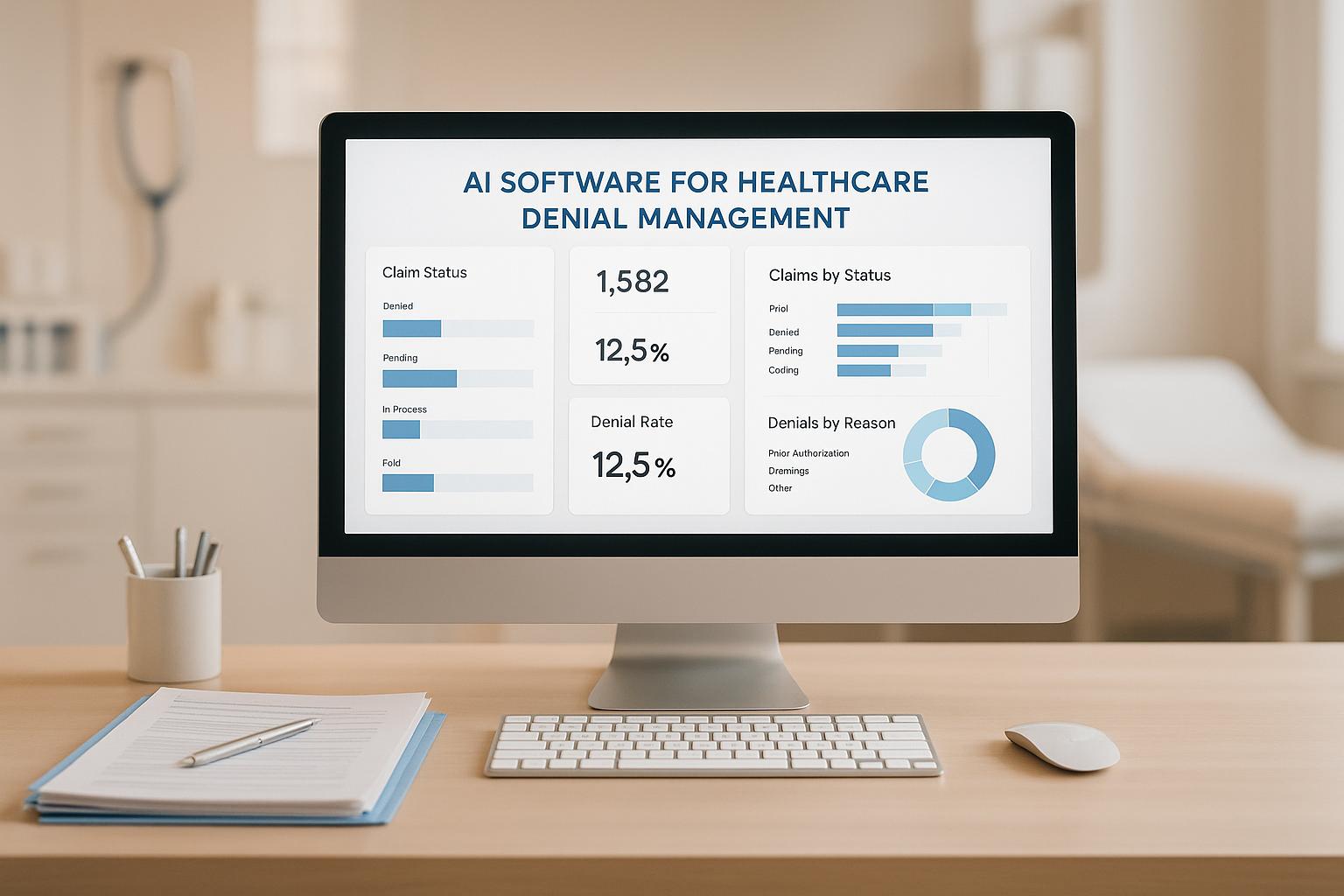
AI is transforming healthcare denial management by reducing claim denials, increasing cash flow, and improving operational efficiency. Here's what you need to know:
Whether you're dealing with routine errors or complex clinical denials, AI-powered tools can streamline processes and recover lost revenue. The right solution depends on your organization's denial patterns, resources, and goals.
AI-driven denial management systems come with a range of features, but the best ones focus on improving clean claim rates, recovering more revenue, and streamlining operations.
Predictive analytics uses machine learning to dig into historical claims data, payer responses, and denial codes. It generates risk scores for claims that are more likely to be denied. By analyzing factors like patient insurance, provider details, service location, relevant codes, and payer history, these systems flag claims that need extra attention before submission.
Real-time claim scrubbing ensures potential issues are caught early, while payer-specific intelligence lets the AI adapt to each payer's unique rules. This means teams can spot high-risk claims and address gaps in documentation well in advance. Risk scoring, based on patterns learned over time, helps staff make adjustments - whether it's modifying codes, securing pre-authorization, or revising documentation - before sending claims out.
This proactive approach sets the stage for smoother recovery processes, including automated appeals.
When a claim is denied, how quickly and effectively an appeal is handled can make or break recovery rates. Automated appeal generation leverages generative AI to craft personalized appeal letters tailored to payer policies and coding guidelines. The process includes gathering medical records, drafting compelling narratives that address denial reasons, and assembling complete appeal packets in line with payer submission standards.
For example, Aspirion’s AI technology enhances both legal and clinical workflows by standardizing responses across teams. This automation significantly reduces manual workloads and costs, especially since managing denials manually can exceed $100 per claim when legal fees are included. Tools that can navigate various payer portals further streamline the process, saving both time and resources.
The benefits grow even further when these systems integrate seamlessly with existing healthcare platforms.
Connecting denial management software with electronic health records (EHR) and revenue cycle management (RCM) systems eliminates redundant data entry, minimizes errors, and enables real-time tracking of claims. With this integration, clinical documentation is readily available for claim submission and appeals, while predictive analytics and payer-specific rules are applied instantly before claims are sent out.
Top-tier platforms work with major EHR systems, creating a feedback loop where every appeal outcome informs and improves the AI. This continuous learning refines prediction models, updates risk scoring, and enhances root cause analysis. It also helps identify systemic issues and preserve effective processes, boosting overall productivity across teams.
Healthcare organizations face the challenge of balancing two critical approaches: proactive denial prevention and reactive denial management. Choosing where to focus - whether on stopping denials before they happen or addressing them after they occur - impacts staffing, technology investments, and revenue recovery. Understanding these approaches helps organizations decide on the best strategy or combination for their needs. When integrated, these strategies form a feedback loop, where insights from managed denials improve prevention efforts.
Denial prevention takes a proactive approach, leveraging AI to catch and fix potential claim issues before they’re submitted to payers. Instead of dealing with denials after the fact, this method stops problems at their source. AI systems analyze claims in real time, flagging errors or missing elements while there’s still time to correct them.
These systems review multiple data points at once - patient insurance details, provider information, service locations, diagnosis and procedure codes, and even historical payer behavior. By identifying patterns from past denials, AI can flag claims that might be problematic and suggest solutions, such as adding modifiers, securing pre-authorization, or revising codes.
The financial benefits of prevention are hard to ignore. Organizations that adopt AI-powered denial prevention often see clean claim rates rise by 10–20 percentage points within six months. Additionally, days in accounts receivable decrease significantly. Prevention is also more cost-effective: appealing denied claims can cost over $100 each, not to mention the time staff spend on these tasks instead of other priorities.
At the heart of denial prevention is real-time claim scrubbing. This process uses payer-specific intelligence to review claims before submission. High-risk claims are flagged and routed to specialized staff, who receive tailored suggestions for corrections. While prevention minimizes issues upfront, there’s still a need for effective management to recover revenue from inevitable denials.
Denial management focuses on addressing claims that have already been denied, using AI to streamline appeals and resubmissions. These systems extract the necessary clinical documentation and align appeals with payer policies. Generative AI can even draft detailed, physician-level narratives tailored to specific denial reasons and payer requirements, ensuring complete appeal packets meet submission standards.
AI also prioritizes denials based on urgency and complexity, assigning scores to determine which claims need immediate attention. Some denials can be handled through automation, while others - especially those involving clinical or legal nuances - might require human review.
The results of effective denial management speak for themselves. Up to 54% of denied claims can be recovered. A BDO survey found that 68% of revenue cycle management executives reported AI-powered solutions improved net collections, with 39% seeing cash flow increases of over 10% within six months. Currently, 46% of healthcare organizations use AI for revenue cycle management, and another 49% plan to adopt it within the next year.
For organizations with high denial rates but limited resources for appeals, focusing on prevention to reduce future denials is key. On the other hand, organizations managing large volumes of denials may need to adopt both strategies - using prevention to lower denial rates while deploying management tools to handle the backlog. The complexity of denials also plays a role; routine administrative denials are well-suited for automation, while complex clinical cases may require more advanced appeal capabilities.
AI denial management software can be grouped into three main categories. Understanding these categories is key for healthcare organizations to align their specific denial challenges and staffing needs with the right solution. This framework helps providers choose tools that effectively address their unique denial patterns.
The categories cover distinct needs: tools designed for automating routine denials, solutions tailored for complex, clinically detailed appeals, and comprehensive revenue cycle management (RCM) platforms that integrate denial management into broader financial workflows. Picking the right type of software is crucial - choosing the wrong one could lead to wasted resources or gaps in functionality.
For healthcare organizations frequently dealing with routine denials caused by coding errors or missing documentation, automation-focused tools are a game-changer. These solutions use machine learning to identify common denial reasons and automatically correct or flag issues before claims are submitted. Real-time claim scrubbing ensures potential problems are caught early, reducing the likelihood of rejection.
These platforms also incorporate payer-specific intelligence to highlight high-risk claims. For example, a system might identify that a particular procedure and diagnosis code combination has a 78% denial rate with a specific payer[3]. This insight allows staff to address issues like missing modifiers or pre-authorization documentation before submission.
Examples include Dime AI, which automates referral processing and explanation of benefits (EOB) handling, and Mandolin, an AI-powered platform that streamlines tasks like document intake, benefits verification, and claims tracking. Organizations using these tools often see clean claim rates improve by 10–20 percentage points[3], while staff can focus on more meaningful tasks instead of repetitive corrections.
Not every denial is straightforward. Practices in specialties like radiology, oncology, and cardiology often face denials that require detailed clinical documentation and careful interpretation of policies. For these cases, advanced solutions leverage generative AI to create tailored appeal letters. These tools extract relevant clinical evidence from patient records and align it with coding guidelines, clinical protocols, and payer policies, producing high-quality, case-specific narratives.
For instance, SmarterDx analyzes all patient charts to help hospitals identify missing or incorrect diagnoses[1], while Cheista simplifies claim approval by summarizing clinical findings and using AI chatbots for payer interactions. Many of these platforms also offer searchable databases of payer policies. For example, N of 1 provides access to over 10,000 policies, and Policybot aggregates more than 100,000, ensuring appeals are crafted to meet current coverage criteria.
Some organizations prefer integrated solutions that combine denial management with other revenue cycle functions, such as prior authorizations, claims submission, and accounts receivable tracking. These all-in-one RCM platforms offer seamless integration with electronic health records (EHR) and practice management systems, reducing data silos and streamlining processes. They also provide unified reporting, making it easier to spot trends and track improvements across the entire revenue cycle.
A standout example is Denials 360, which offers end-to-end denial management powered by generative AI and machine learning. Features include real-time dashboards, predictive models, prioritized worklists, one-click appeal automation, and continuous policy updates - all within a single framework. These platforms often support flexible integration options, such as REST APIs, enabling compatibility with various existing systems.
However, comprehensive platforms can come with higher implementation complexity and a steeper learning curve for staff. They may also include features that some organizations don't need, leading to unnecessary expenses. As a result, these solutions are often best suited for larger healthcare systems with the resources to handle deep integration and ongoing maintenance.
Ultimately, the right choice depends on your organization's denial patterns and operational structure. High-volume, routine denials are best addressed with automation tools, while specialty practices with complex cases benefit from evidence-based solutions. Larger healthcare systems managing a mix of denial types across multiple locations may find that all-in-one platforms provide the integration and visibility they need.
Efficient AI-powered solutions are game-changers for handling denial prevention and management. But selecting the right software can make or break your efforts. Healthcare organizations face unique challenges - whether it’s varying denial patterns, limited staff, or financial pressures. What works for a large hospital dealing with complex clinical denials might not suit a small practice addressing routine coding errors. Picking the wrong tool can waste resources and leave your revenue cycle exposed. The real question isn’t whether to adopt AI for denial management, but which solution fits your operational needs best. Let’s dive into the key factors to consider when making your choice.
Start by checking if the platform offers real-time claim scrubbing. This feature ensures claims are analyzed before submission, flagging potential issues immediately rather than after denials occur [3]. Another must-have is payer-specific intelligence. Since every insurance company has its own rules, the AI should adapt to these patterns and apply them effectively to your claims [3]. Look for systems with root cause analysis that not only identify high-risk claims but also explain the reasons behind potential denials and suggest specific fixes [3]. A platform that merely flags issues without actionable insights won’t save your team much time.
Integration capabilities are equally important. The solution should work seamlessly with your existing systems - whether it’s Epic, Cerner, Meditech, Allscripts, or Athenahealth. This eliminates duplicate data entry and reduces errors [3]. Additionally, the AI should improve over time as it processes more of your historical claims data [3].
Consider your organization’s denial mix and staffing model. If most denials stem from routine coding or documentation errors, automation-focused solutions deliver better returns, especially for teams with limited resources. On the other hand, if complex clinical determinations or policy disputes dominate, you’ll need a system with evidence-based appeal capabilities [4].
Think about your appeal intensity - how often your team appeals denied claims. For organizations with a low appeal volume, advanced appeal tools might not add much value. But if you handle frequent appeals, automated appeal generation can significantly lighten the workload [4].
When evaluating vendors, ask for real-world performance metrics. For example:
Verify that the system integrates with your EHR and practice management tools, ensures data security, and aligns with your organization’s growth. Also, discuss pricing scalability and the expected timeline for seeing a return on investment.
Your business goals should guide your choice of AI denial management software. For organizations focused on reducing denial rates, prioritize systems with strong predictive analytics and pre-submission claim analysis. These tools flag high-risk claims early, provide actionable insights, and help staff proactively correct issues before submission [2][3].
If your goal is to improve cash flow, look for platforms with advanced denial prioritization and appeal success modeling. AI-powered scoring models can identify which denials are worth pursuing, ensuring your team focuses on claims with the highest payment potential [2].
For organizations aiming to boost staff productivity, choose solutions that automate repetitive tasks like eligibility checks, claim submissions, and payment postings. These systems can increase clean claim rates by 10–20 percentage points and shorten accounts receivable cycles, freeing up your team to handle more complex cases [3].
Your organization’s current denial management maturity also matters. If you’re still relying on manual processes or basic rules-based systems, start with foundational features like real-time claim scrubbing and payer-specific intelligence. More advanced organizations can explore features like generative AI for appeal letters and predictive modeling [3][4].
Rolling out a new AI solution requires careful planning. Start with a phased approach: integrate the platform with your existing systems, configure payer-specific rules, and train staff on new workflows [3][4]. During the initial phase, run the system alongside your current processes to validate its accuracy before fully transitioning [3]. Focus on quick wins - specific denial types or payers where the system delivers immediate results - to build confidence and support for broader adoption [3].
Staff training should emphasize that AI tools are designed to enhance human expertise, not replace it [2]. Managing expectations is also crucial. While some organizations see results within six months, full optimization typically takes 12–18 months as the AI learns your specific patterns and your team becomes proficient with the new workflows.
When the right solution aligns with your denial patterns, integrates smoothly with your systems, and supports your business goals, it becomes a natural extension of your operations. This alignment not only simplifies adoption but also accelerates results.
AI-driven denial management provides clear financial benefits by improving revenue recovery and streamlining operations. These outcomes highlight the growing importance of AI in handling claim denials effectively.
Healthcare organizations leveraging AI for denial management see notable improvements in recovering denied claims, which directly enhances cash flow. According to a Black Book Market Research study, 83% of healthcare organizations reported that AI-driven automation lowered claim denials by at least 10% within six months. Additionally, 68% of revenue cycle management (RCM) executives noted improvements in net collections, with 39% seeing cash flow increases exceeding 10% during the same period[5].
AI also boosts clean claim rates - claims approved on the first submission - by 10–20 percentage points[3]. This improvement not only speeds up cash flow but also reduces the time claims spend in accounts receivable and cuts costs associated with reprocessing. By identifying and fixing high-risk claims upfront, AI minimizes the likelihood of denials[2].
Adoption rates further underscore AI's value. In BDO's 2025 Healthcare CFO Outlook Survey, 46% of healthcare organizations already use AI for revenue cycle management, and another 49% plan to adopt it within the next year[5].
To evaluate the financial impact effectively, healthcare providers should monitor key metrics such as:
Tracking staff productivity - such as the number of claims processed per employee and time spent on rework versus new claims - also provides valuable insights into operational efficiency[3].
These revenue gains not only enhance cash flow but also enable organizations to operate more cost-effectively. Beyond revenue recovery, AI delivers significant cost savings through automation.
The cost of manual claim appeals can exceed $100 per claim when legal fees are included[5]. AI systems simplify this process by automatically generating detailed appeal letters, pulling relevant clinical evidence in line with coding guidelines, clinical protocols, and payer policies[2]. For organizations managing thousands of claims annually, this automation significantly boosts staff efficiency and justifies the investment.
AI also optimizes workflows by routing high-risk claims to experienced staff and suggesting specific corrections. This allows revenue cycle professionals to focus on tasks that add more value, rather than spending time on repetitive manual reviews[3]. The result? Savings on overtime, reduced staffing needs, and the ability to reallocate resources to revenue-generating activities.
Integration with electronic health record (EHR) systems further improves efficiency by eliminating duplicate data entry and reducing errors[5].
Preventing claim denials altogether is the most cost-effective approach. AI-powered predictive analysis uses machine learning to identify claims at high risk of denial, enabling corrections before submission. For instance, an AI system might flag a claim with a 78% likelihood of denial based on historical data, allowing staff to address the issue upfront[3]. By avoiding the costly cycle of rework, appeals, and potential write-offs, organizations save both time and money.
Even smaller practices benefit significantly. A practice processing 100–200 claims daily can recover thousands of dollars each month through reduced denial rates and faster collections. With these improvements, the return on investment for AI denial management typically becomes evident within 6–12 months[5][3]. Moreover, automating denial management frees up resources that can be redirected toward patient care or business growth, providing indirect financial advantages alongside direct revenue gains.
The financial benefits of AI in denial management are no longer theoretical - they’re proven. Organizations adopting these tools are better equipped to navigate the complexities of today’s reimbursement landscape, while those that delay risk falling behind[3].
AI-powered denial management has become a must-have for healthcare organizations navigating the complexities of today’s reimbursement processes. By turning manual, reactive tasks into automated, proactive workflows, AI improves clean claim rates, shortens accounts receivable cycles, and boosts staff efficiency. The numbers back this up: 46% of healthcare organizations already use AI for revenue cycle management, and another 49% plan to adopt it within the next year[5]. These trends underline AI's growing role in shaping financial strategies.
Unlike traditional methods that only address denials after they occur, AI takes a proactive approach. It identifies high-risk claims before submission, allowing for corrections upfront. This capability is powered by advanced analysis of patterns and historical payer behaviors, something manual reviews simply can’t replicate[2][3].
The financial benefits are clear. Organizations using AI to manage denials report significant improvements in key metrics, with results that directly enhance profitability[3]. Considering that appealing a denied claim can cost over $100 when legal fees are factored in[5], automation isn’t just efficient - it’s essential.
Healthcare providers that adopt AI tools to optimize workflows and recover revenue are better positioned to succeed in today’s challenging reimbursement environment. On the other hand, those sticking to manual processes or basic rules-based systems risk falling behind[3]. By integrating AI-driven denial management, organizations can secure financial stability and maintain operational effectiveness in an ever-evolving landscape.
AI is transforming how healthcare organizations handle claim denials, making the process faster and more efficient. Instead of relying on manual reviews, which can be slow and error-prone, AI systems can quickly sift through massive amounts of claims data, spot trends, and even predict which claims are likely to be denied. This means providers can tackle potential issues before they become problems.
By using advanced machine learning algorithms, AI helps streamline workflows, cut down on mistakes, and focus attention on the claims that matter most. The result? Faster resolutions, better management of the revenue cycle, and more time and money saved for healthcare organizations.
When selecting AI-powered denial management software, healthcare organizations should aim for a solution tailored to their operational demands and challenges. The right software can help automate claim reviews, cut down on manual errors, and offer insights that can boost reimbursement rates.
Key features to look for include real-time analytics, customizable reporting options, and smooth integration with existing systems like EHRs and billing platforms. It's also crucial to ensure the software adheres to industry regulations, such as HIPAA, to protect sensitive patient data. Focusing on these elements can simplify denial management processes and contribute to better financial outcomes.
AI-powered systems have made huge strides in improving denial management by simplifying tasks like claim analysis, spotting errors, and using predictive analytics. These tools excel at managing repetitive work and identifying patterns, saving time and reducing errors. However, they aren't the whole solution.
Healthcare claims often involve intricate situations that demand human judgment and expertise. Policies, regulations, and individual patient circumstances can be complex, requiring a level of understanding that AI alone can't provide. By combining AI's efficiency with human insight, where AI tackles routine tasks and humans focus on exceptions, organizations can achieve better results in denial management. This teamwork strikes the right balance between speed and accuracy.