Published on
December 16, 2024

A comptroller is a senior financial executive who oversees accounting, budgeting, and internal controls for an organization, most often a government agency, a nonprofit, or a public body. The title is a 15th-century variant spelling of 'controller,' and in practice the two words describe nearly the same job: keeping the books accurate and making sure money moves where it's supposed to [5].

Even the people who hold the title can't agree on how to say it. The Texas Comptroller's office says either 'controller' or 'comp-troller' is fine, and they respond politely to both [6]. That inconsistency traces back to a scribal error: 'compt-' got blended into 'controller' centuries ago and just stuck [5].
Where you actually see comptrollers is telling. Texas's comptroller acts as the state's chief financial officer, tax collector, and revenue estimator, issuing more than 12 million payments a year [6]. Illinois's comptroller is the state's chief fiscal control officer, processing over 15 million transactions annually and pre-auditing every state expenditure [7]. New York City's comptroller audits every city agency at least once every four years and oversees $194.5 billion in pension assets [8]. These are public accountability roles first, accounting roles second.
The real difference isn't seniority or skill, it's sector. Controllers work almost entirely in private, for-profit businesses and report to a CFO or CEO. Comptrollers work in government and nonprofit organizations and report to elected officials, boards, or executive directors [1]. The job itself, accounting oversight and financial reporting, is nearly identical.
Both roles handle financial reporting, auditing, account reconciliation, forecasting, and oversight of the accounting team [9]. Both need someone who can close the books cleanly and defend the numbers to an outsider, whether that outsider is an auditor, a board, or a taxpayer. The difference shows up in what they're optimizing for: a controller is watching the bottom line, a comptroller is watching compliance with a budget or a legal mandate.
One wrinkle worth knowing: in smaller companies, the line blurs completely. A comptroller may also function as the CFO, or a CFO may simply absorb comptroller-style duties without ever holding that title [2]. Corporations and nonprofits both use the comptroller title too, it's just far more common in government [10]. So if you see 'comptroller' on a private-company org chart, don't assume it means something different from 'controller' -- ask what the person actually owns.
A controller and a comptroller both own the accuracy of the books; a CFO owns what the business does with that information. Scope, reporting line, typical company size, and pay all shift as you move from controller to comptroller to CFO, and mixing them up is how founders end up asking a bookkeeper to build a fundraising model.
| Role | Typical sector | Reports to | Typical scale | Key deliverables |
|---|---|---|---|---|
| Controller | Private business | CFO or CEO | $5M-$500M+ revenue | Monthly close, GAAP financials, internal controls, tax filings |
| Comptroller | Government, nonprofit, some legacy or PE-backed firms | Elected official, board, or executive director [1] | Any size, often large public entities | Fund accounting, budget compliance, public transparency, audits |
| Fractional CFO | Growth-stage private companies | Founder or CEO, board | $2M-$50M revenue | Forecasting, fundraising, board reporting, strategy |
| Full-time CFO | Larger private or public companies | CEO, board | $50M+ revenue | Capital strategy, M&A, investor relations, finance team leadership |
Private companies keep the comptroller title mostly out of habit, not because the job is different. It shows up most in government contractors (where the language sticks from federal reporting requirements), older family-owned businesses (where the title was set decades ago and never changed), and some private-equity portfolio companies that inherited the term from a public-sector-adjacent history or simply prefer the more formal sound.
None of this changes what you should hire for. Only the title of 'comptroller' is required in government settings; nowhere does the private sector require it [2]. If you inherit a business, buy one, or interview a candidate whose last title was 'comptroller,' evaluate them the same way you'd evaluate a controller: can they close the books on time, do they understand your revenue recognition, can they defend a number to a lender or a board. Don't read extra authority into the word just because it sounds more formal.
Most growth-stage companies need a controller before they need a CFO, and they need a fractional CFO before they need a full-time one. The trigger for a controller is operational: the close is slow, the books are unreliable, or you're spending your own time on transactions instead of decisions. The trigger for a CFO is strategic: you're raising money, buying or selling, or a board wants a forecast, not just a report.
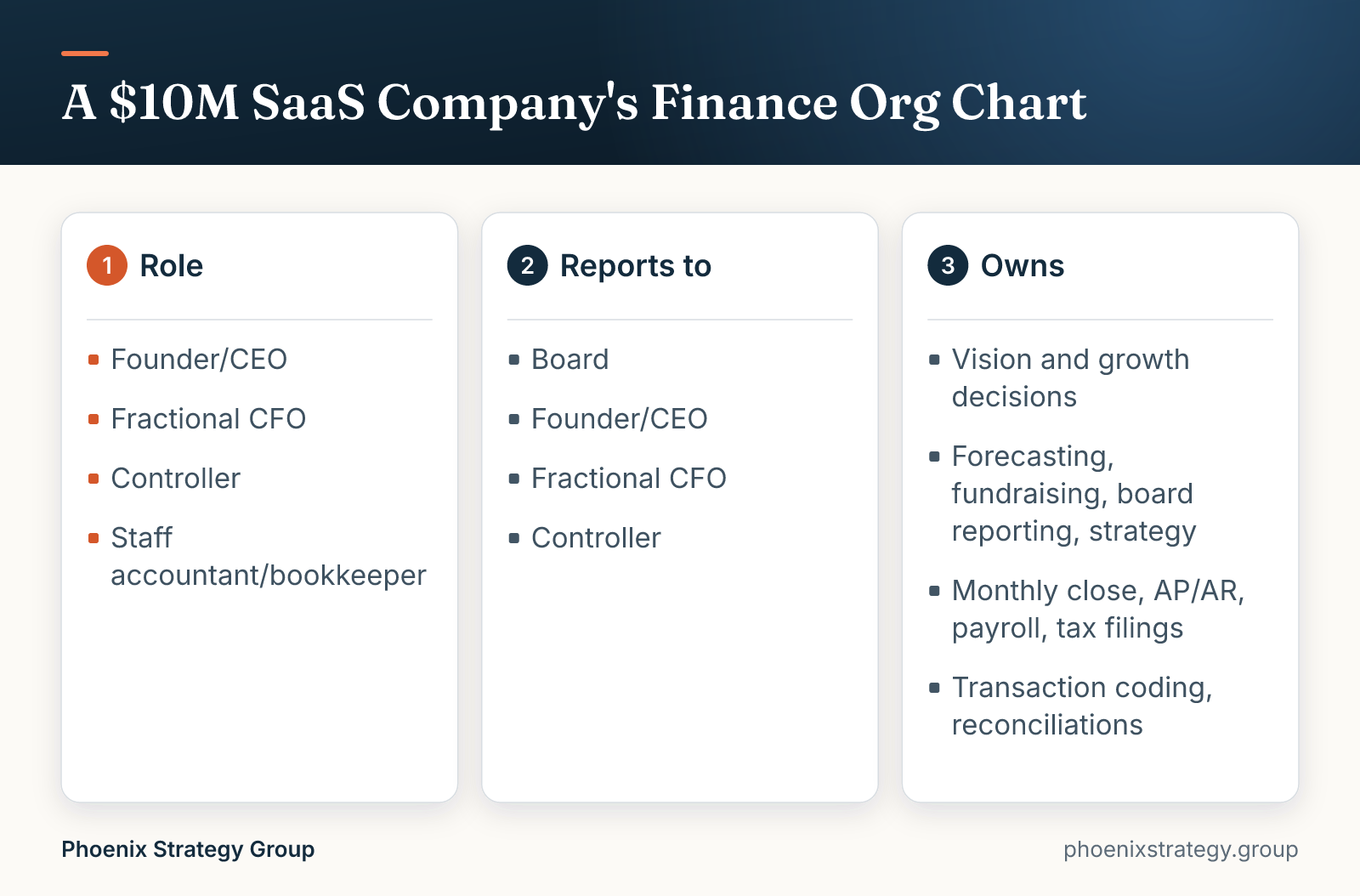
Picture a $10M ARR SaaS company that just closed a Series A. The founder was doing the books herself through $3M, hired a bookkeeper at $5M, and now at $10M the close takes three weeks and the board wants monthly reporting she doesn't trust. That's the signal to bring in a controller to own the close, reporting into a fractional CFO who owns the model, the board deck, and the next raise.

In-house controllers at growth-stage private companies earn more than public-sector comptrollers, and a fractional CFO usually costs less than either a full-time controller or a full-time CFO once you account for hours actually needed. That gap is the whole argument for staging your finance hires instead of jumping straight to a full team.
Public-sector comptroller pay averaged roughly $81,400 as of May 2026 [9], and federal comptroller roles fall in the GS-13 to GS-15 range, about $91,000 to $164,000 depending on step and location [11]. Corporate controllers earn considerably more: $152,000 to $213,250 is a common range [12], and SaaS controller pay specifically runs from a median of $125,500 up to $180,000-$270,000 at venture-backed companies, because scope and stage matter more than the title [3]. The median financial manager overall, a category that includes controllers, earned $166,570 in May 2025 [13].
On the CFO side, a full-time CFO typically costs $200,000 to $500,000 a year in salary and benefits [14], while a fractional CFO engagement runs $110,000 to $250,000 a year depending on stage and reporting demands [4]. If you only need part-time controller support, fractional controller services run $2,000 to $10,000 a month, 60-75% less than a fully loaded full-time controller at most growth-stage companies [15]. Neither controllers nor CFOs are required to hold a CPA: it's optional for controllers [16], and the share of S&P 2000 CFOs with a CPA fell from 55% to 43% between 2012 and 2022 [17].
Strip away the sector and the spelling, and a comptroller is just a controller who works in government or a nonprofit instead of a private business. Neither is a CFO. A controller (or comptroller) keeps the books accurate and the close on time; a CFO decides what the business does with that information. As you scale from $2M to $50M in revenue, the practical question isn't which title sounds more senior, it's whether you need someone owning the close, someone owning the strategy, or both. Most companies need a controller first and a fractional CFO layered on top once the board, the bank, or a raise starts asking harder questions.
If you'd rather not guess at the right sequence, Phoenix Strategy Group's bookkeeping and accounting services can help you figure out what your books actually need before you hire anyone.
They do nearly the same job: overseeing accounting, financial reporting, and internal controls. The difference is sector. Controllers work in private businesses and report to a CFO or CEO; comptrollers work in government and nonprofit organizations and report to elected officials, boards, or executive directors [1].
Not inherently. In a government agency, a comptroller can be the top financial official, effectively the CFO, treasurer, and chief accountant combined [6]. But the words describe similar seniority levels; the difference is sector, not rank.
Sometimes, especially in smaller organizations where the comptroller doubles as the CFO or absorbs CFO-level duties without holding that title [2]. In a large public agency, the comptroller functions as that entity's chief financial officer [6]. In most private companies, though, a comptroller-equivalent controller reports to a separate CFO.
No. A controller manages the accounting function, closes the books, and ensures compliance. A CFO sets financial strategy, manages fundraising and capital decisions, and typically has the controller reporting to them.
In most private companies, a CFO outranks a controller or comptroller-equivalent role. In government, the comptroller can be the most senior financial official in the organization, since many public bodies don't use a separate CFO title at all [6].
Most comptroller roles require a bachelor's degree in accounting or finance, and a CPA credential is common, along with strong skills in financial forecasting and auditing [9]. Requirements track closely with what's expected of a private-sector controller.
A CFO sits above a controller in most private companies, owning strategy, capital decisions, and investor relations while the controller owns the close and compliance. In smaller companies, a controller may report directly to the CEO if there's no CFO yet.
A comptroller oversees financial reporting, budgeting, auditing, account reconciliation, and forecasting, typically for a government agency or nonprofit [9]. In practice that can mean estimating state revenue, auditing agencies, managing pension funds, or serving as a fiscal watchdog over public spending [6][7][8].

About the author
Partner, Phoenix Strategy Group
Ethan Lu is a Partner at Phoenix Strategy Group, where he works as a fractional CFO helping founder-led companies maximize their exit value. He currently oversees more than $200M in client enterprise value and has been part of multiple eight-figure exits. Before PSG he was an asset manager and investor for a San Diego family office, where he sat on the investment committee for more than $1B in assets. A data scientist by training, he holds a B.S. in Mathematics with a minor in Accounting from UC San Diego.
Talk to a PSG CFO about your numbers
Phoenix Strategy Group does CFO work for growth-stage companies.
Schedule a call