Published on
June 6, 2026


Cross-border disputes are becoming more complex as global trade grows. Legal tech tools like blockchain, AI, and online dispute resolution (ODR) platforms are now essential for resolving these conflicts efficiently. Here's what you need to know:
While these technologies offer major benefits, challenges like enforceability, data privacy, and ethical concerns remain. Businesses should focus on drafting tech-ready dispute clauses, maintaining accurate records, and working with experts to navigate legal tech effectively.
Key takeaway: Legal tech is reshaping dispute resolution, and businesses that prepare now will be better equipped to handle future conflicts.
In cross-border disputes, ensuring the authenticity of evidence and maintaining a secure chain of custody is absolutely critical. Blockchain technology offers a direct solution to this challenge.
By using distributed ledgers, evidence like transaction records, contracts, or multimedia files is stored with features such as SHA-256 hashing and immutable timestamps. This means that once data is recorded, any attempt to alter it becomes immediately detectable. Research highlights that blockchain-based evidence management achieves a 99% accuracy rate in identifying tampering [4]. For instance, a 2025 experiment on Ethereum and Hyperledger Fabric testnets - analyzing 1,200 arbitration cases - showed that AI-generated rulings matched expert human decisions 92.4% of the time [4]. While AI doesn't replace human judgment, it reinforces the reliability of blockchain-stored evidence, forming a solid base for dispute resolution. This secure system also paves the way for smart contracts to streamline the resolution process.
Smart contracts take things a step further by embedding dispute resolution mechanisms directly into agreements. Written in programming languages like Solidity, these contracts are self-executing and can automatically trigger arbitration protocols when a breach occurs, eliminating the need for manual involvement.
The efficiency improvements are striking. AI-enabled arbitration frameworks linked to smart contracts have reduced resolution times by 99.5% compared to traditional methods [4]. Platforms such as Kleros and Aragon have capitalized on this by creating decentralized systems for resolving disputes, which minimize reliance on intermediaries and lower costs for businesses, particularly smaller ones that may benefit from fractional CFO services.
"The synergy between AI and blockchain is especially compelling. While smart contracts ensure enforceability and transparency in contractual obligations, AI systems introduce adaptability, contextual understanding, and learning capabilities." - Scientific Reports [4]
Blockchain also helps resolve jurisdictional challenges. When dealing with digital assets, pinpointing the correct legal forum can be tricky due to the lack of a clear geographic location. Blockchain-based arbitration frameworks solve this by offering a neutral, pre-agreed "seat" for resolving disputes [6]. For example, Binance updated its international terms in January 2026 to designate the Abu Dhabi Global Market (ADGM) as its arbitration seat, reflecting a growing trend of crypto-related disputes being resolved in the UAE [7].
Despite its many advantages, blockchain adoption isn't without hurdles.
Technological rigidity is a key issue. Smart contracts execute exactly as programmed, which means they can't interpret ambiguous terms or adapt to unforeseen situations like a human arbitrator can. As Scientific Reports noted:
"A gap between technical capability and legal enforceability bottlenecks intelligent arbitration." - Scientific Reports [4]
Another concern is oracle vulnerabilities. Smart contracts depend on external data feeds, known as oracles, to function. If an oracle provides inaccurate or compromised data, it could disrupt the entire dispute resolution process. Using decentralized or multiple oracles can help mitigate this risk [5].
Enforceability is also not guaranteed. For instance, in February 2026, a Shenzhen court overturned an arbitral award in the case of Gao Zheyu v. Shenzhen Yunsilu Innovation Development Fund Enterprise (LP) and Li Bin. The court ruled the award invalid because it required payment in Chinese RMB based on a Bitcoin amount, which violated public policy by facilitating a prohibited crypto-to-fiat exchange [8].
Finally, evidence admissibility varies across jurisdictions. Ensuring that digital evidence meets local forensic standards is crucial. Using SHA-256 hashing and timestamping can enhance the credibility of such evidence [4].
| Challenge | Specific Risk | Practical Mitigation |
|---|---|---|
| Technological rigidity | Code can't handle ambiguity or unforeseen events | Incorporate hybrid models with human oversight [5] |
| Oracle vulnerabilities | Inaccurate or compromised data feeds | Use decentralized or multiple oracles [5] |
| Enforceability | Awards may conflict with local public policy | Align contract terms with regulatory requirements [8] |
| Evidence admissibility | Jurisdictional differences in digital forensics | Use SHA-256 hashing and timestamping for data integrity [4] |
Overcoming these challenges is essential for businesses aiming to fully leverage blockchain's potential in resolving international disputes efficiently and securely.
While blockchain ensures the integrity of evidence, AI is reshaping how legal teams analyze and apply that evidence.
AI is helping legal teams make more informed decisions before hearings even begin. Predictive analytics tools analyze historical arbitral awards, arbitrator profiles, and jurisdictional trends to forecast potential outcomes. Platforms like Lex Machina and Arbitrator Intelligence offer even deeper insights, highlighting individual arbitrators' procedural habits and award histories. This reduces uncertainty during the arbitrator selection process.
Why does this matter? Historically, arbitrator selection has been a bit of a guessing game. These tools allow parties to see if an arbitrator has a pattern of favoring claimants or respondents in specific cases, enabling them to adjust their strategies. However, there's a downside: relying too heavily on historical data could inadvertently reinforce biases, potentially sidelining newer or less traditional arbitrators.
AI also plays a role in early case assessment. Using Natural Language Processing (NLP), it can extract structured information from contracts and legal documents in multiple languages - an essential feature for disputes that span different legal systems.
Once strategic insights are in place, AI also takes on the heavy lifting of operational tasks.
AI is slashing the time and cost of routine legal work. Technology-assisted review (TAR) platforms like Relativity, Brainspace, and Disco can analyze millions of documents in multiple languages, achieving levels of accuracy that rival or surpass human reviewers [13].
Generative AI tools are stepping into the drafting process, synthesizing cross-jurisdictional precedents and even preparing submissions. For example, in November 2025, the American Arbitration Association (AAA) introduced its "AI Arbitrator" tool. Designed for two-party, document-only construction disputes, this tool summarizes claims and evidence for human review and drafts proposed awards. Initial results showed cases were resolved 20–25% faster while maintaining full human oversight for final decisions [4][16]. Similarly, in July 2025, the Hong Kong International Arbitration Centre (HKIAC) launched a "Case Digest" service using "Jus AI" technology to summarize procedural decisions, making the process more transparent for users [14].
However, generative AI isn't without flaws. Its tendency to produce hallucinations - fabricated information - can lead to serious consequences. In April 2026, Justice Martin F. Sheehan of the Quebec Superior Court overturned an arbitral award in ARIHQ v. Santé Québec (2026 QCCS 1360) after discovering that the arbitrator had relied on generative AI. The tool had fabricated doctrinal references, including non-existent articles and court decisions. The court ruled this as an improper delegation of the arbitrator's authority [15].
"The preponderant evidence therefore leads to the conclusion that the Arbitrator's authority was delegated and that he abdicated his role of reviewing the result." - Justice Martin F. Sheehan, J.S.C., Quebec Superior Court [15]
These developments highlight the growing need for ethical and regulatory safeguards.
The ARIHQ case serves as a wake-up call for the field. As AI becomes more integrated into dispute resolution, ethical challenges are becoming harder to ignore.
One major concern is the "black box" problem. Deep learning models often operate without revealing how they reach their conclusions, making it difficult for parties to challenge AI-generated outputs. This lack of transparency could undermine the fundamental right to be heard. The EU AI Act has classified AI used in justice administration as "high-risk", requiring strict transparency and human oversight. This has direct consequences for disputes involving EU parties [11][9].
Institutions are taking notice. The Chartered Institute of Arbitrators (CIArb) has issued clear guidance:
"Arbitrators should not relinquish their decision-making powers to AI but may use AI to support more accurate and efficient processing of submitted information, always ensuring independent judgement." - Chartered Institute of Arbitrators (CIArb) [10]
Data confidentiality is another pressing issue. Many AI tools operate in cloud-based environments, which could expose sensitive case information to unauthorized access or conflict with regional data protection laws. To address this, firms handling cross-border disputes should use closed-loop AI systems and ensure vendor contracts include guarantees like no-training-on-content clauses and data residency specifications.
The table below outlines how major institutions currently handle AI disclosure:
| Institution | Disclosure Stance | Key Requirement |
|---|---|---|
| AAA-ICDR | Broad View | Encourages disclosure when AI materially impacts the process or arbitrator reasoning [12] |
| SVAMC | Targeted View | General use doesn't require disclosure; specific outputs may be required if appropriate [12] |
| CIArb | Discretionary | Arbitrators may require disclosure if AI use could impact proceedings' integrity [10] |
| SCCAI | Encouraged | Tribunals should disclose AI use in interpreting facts or law; delegation is prohibited [10] |
AI is undeniably transforming cross-border dispute resolution. But while it speeds up analysis and reduces costs, it remains a tool - not a replacement for human judgment. As blockchain and ODR platforms continue to evolve alongside AI, the legal community will need to balance technological innovation with accountability and ethical oversight.
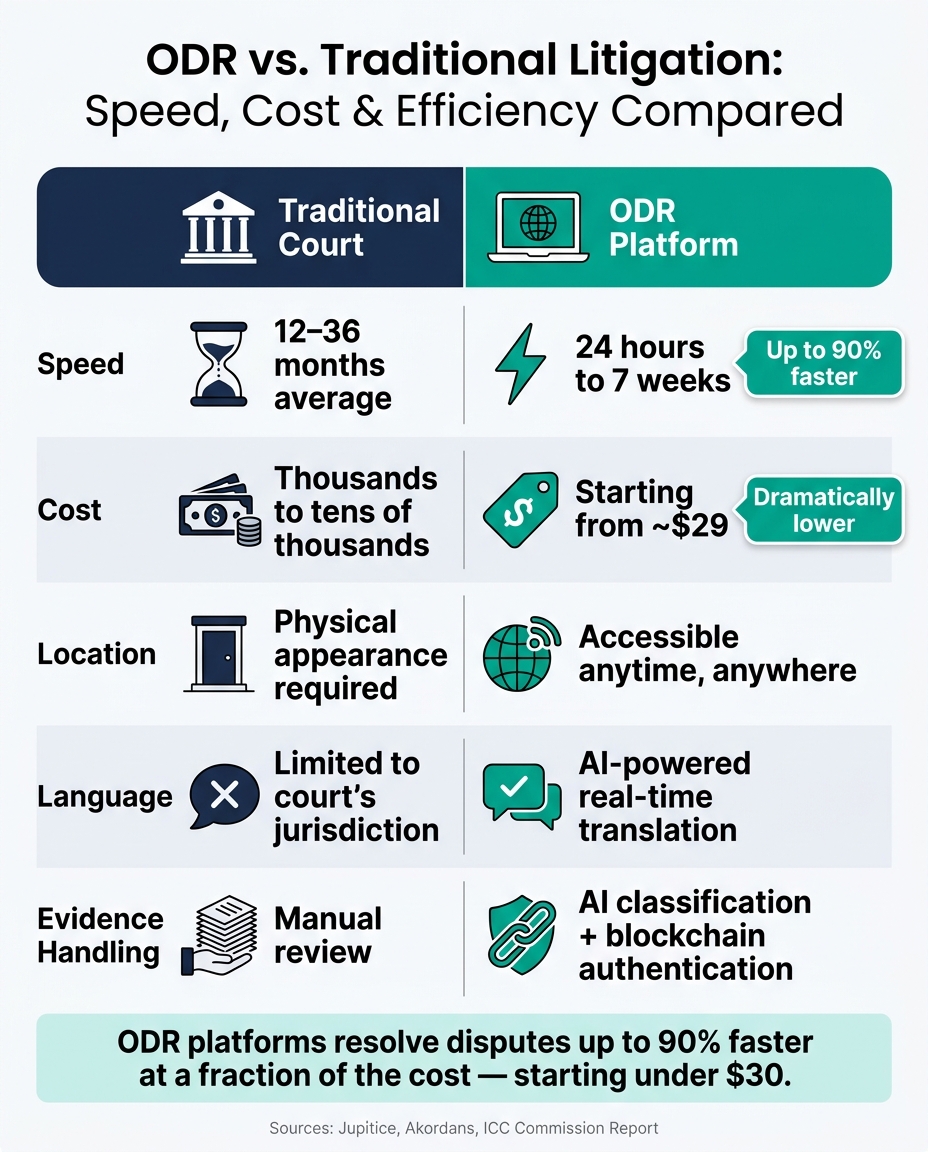
ODR vs. Traditional Litigation: Speed, Cost & Efficiency Compared
As technology transforms the legal world, online dispute resolution (ODR) platforms are changing how cross-border conflicts are managed. These platforms shift disputes from physical courtrooms to secure digital spaces, offering a faster, more cost-effective, and accessible alternative for parties separated by geography. Like blockchain and AI, ODR is reshaping how international disputes are resolved.
ODR platforms are designed with tools that make resolving cross-border disputes practical and efficient. At the heart of these platforms is a secure digital portal where parties can file documents, share evidence, and communicate with the tribunal. Virtual hearing rooms equipped with reliable video conferencing eliminate the need for travel, while AI-powered real-time translation helps overcome language barriers that could otherwise delay proceedings.
Platforms such as eBRAM and Jupitice streamline administrative tasks. For example, smart calendars track deadlines across different time zones, automated notifications keep participants informed, and e-KYC (Know Your Customer) verification ensures the identities of remote users are authenticated. Many platforms also follow a structured, tiered approach - starting with negotiation, then moving to mediation, and finally arbitration if necessary. This step-by-step process helps resolve disputes at the earliest possible stage. Additional features, such as automated settlement drafting and electronic signatures, make the process seamless and legally binding.
ODR is becoming a go-to solution for commercial B2B disputes, institutional arbitration, and complex cases involving multiple jurisdictions. For example, eBRAM, certified under the APEC Collaborative Framework for ODR, ensures its awards are enforceable in over 170 jurisdictions, including the People's Republic of China. This makes it an attractive option for businesses operating in Asia-Pacific markets [17]. Meanwhile, platforms like Jupitice offer a pay-as-you-go pricing model for flexibility, and Akordans handles cross-border disputes with filing fees starting as low as $29 [18][19].
These examples show how ODR is being applied in real-world scenarios, though they also reveal certain challenges that come with its use.
ODR platforms come with clear advantages, but they also face some hurdles. For one, they are significantly faster than traditional court proceedings - resolving disputes up to 90% quicker [18]. They are also far more affordable; while court cases can cost thousands, ODR services can start at under $30 [19]. Here's a quick comparison of ODR and traditional litigation:
| Factor | Traditional Court | ODR Platform |
|---|---|---|
| Speed | 12–36 months average | 24 hours to 7 weeks |
| Cost | High (thousands to tens of thousands) | Low (starting from ~$29) |
| Location | Physical appearance required | Accessible anytime, anywhere |
| Language | Limited to court's jurisdiction | AI-powered real-time translation |
| Evidence Handling | Manual review | AI classification + blockchain authentication |
However, ODR isn't without its challenges. The enforceability of online settlements can vary, as parties must ensure their platform's awards are recognized under international treaties like the New York Convention or regional frameworks like the EU Directive 2025/2647 [17][19]. Another issue is the "digital divide": unequal access to technology can create an imbalance between parties. The ICC Commission has raised concerns about this disparity, warning it could lead to an "inequality of arms" [1].
"An imbalance in the technology resources available in different regions or between the parties... could contribute to a 'digital divide' broadly or an inequality of arms." - ICC Commission Report [1]
Data privacy is another pressing concern. Nearly half (47%) of practitioners cite confidentiality risks as a major issue with digital platforms [3]. Before filing a case, parties should verify that their ODR provider has robust data residency policies in place to safeguard sensitive information.
When drafting dispute resolution clauses, many companies focus on governing law and jurisdiction but often overlook how rapidly evolving technology can impact these processes. This oversight can lead to costly consequences. Legal advisors suggest avoiding commitments to specific platforms during the drafting stage, as technology may change significantly between the signing of an agreement and the resolution of a dispute [1]. Instead, it’s wise to include provisions for electronic notifications, e-signatures, and videoconference hearings. These steps help ensure enforceability, even in jurisdictions that might still rely on traditional written procedures, without duplicating technical details already covered elsewhere in the agreement.
For smart contracts, clarity is essential. Arbitration clauses should be easy to locate within the contract, and consent must be traceable through private keys tied to Know Your Customer (KYC) verification. This approach satisfies the "written agreement" requirement under the New York Convention [20]. A practical strategy here is leveraging Article VII of the New York Convention to enforce agreements under the most favorable domestic law on electronic writing - a tactic often referred to as drafting for the "most favorable port" [20]. These measures prepare growth-stage companies for a future where legal tech plays a central role in dispute resolution.
Beyond legal language, maintaining accurate and comprehensive financial and operational records is equally critical.
In international disputes, success often hinges on the quality of data, not just the strength of legal arguments. For growth-stage companies, well-structured financial and operational records can make or break a case.
A key principle is creating an "integrity narrative" - a clear, documented trail that verifies when and by whom digital evidence was created [23]. Systems should be configured to preserve metadata, timestamps, and hash values at the moment of creation. Static document images won’t cut it; data must be stored in searchable electronic formats to work effectively with AI-powered review tools and Technology-Assisted Review (TAR) [1][13]. This ensures that your data supports AI analysis and blockchain-anchored evidence, reinforcing its reliability throughout the dispute resolution process.
"The challenge is no longer simply finding relevant documents; it is establishing their authenticity and reliability across legal systems that rarely speak the same language." - Luciano Castelli, LCA Studio Legale [23]
For companies using blockchain in their transactions, linking on-chain code with off-chain documentation is crucial. This is typically achieved by anchoring cryptographic hashes of physical contracts into the blockchain record [20]. Avoid referencing external documents through mutable URLs, as they can weaken evidentiary reliability and jeopardize an otherwise strong case.
Even with strong dispute resolution clauses and robust data systems, partnering with experts is essential to stay ahead of evolving legal tech challenges. For instance, in 2024, the American Arbitration Association reported 180,000 mass arbitration filings against tech companies [22]. Meanwhile, the EU AI Act, effective as of August 2026, classifies AI tools used in the "administration of justice" as high-risk, imposing strict transparency and human oversight requirements [2]. Companies that haven’t mapped their data infrastructure or reviewed vendor agreements risk falling behind.
Data residency is a frequent blind spot. Using AI-powered review platforms that process data outside its country of origin can lead to violations of regulations like GDPR or China’s PIPL. GDPR fines, for instance, can reach up to €20 million or 4% of annual global revenue [2]. The emerging best practice is to process data locally, ensuring classification happens in-region before cross-border transfers [21][2]. This requires collaboration between legal counsel and technical architects who understand the regulatory nuances.
"Cross-border e-discovery with AI requires treating data location as a first-order architectural decision, not an afterthought." - Manu Ayala, Founder, AI Vortex [21]
For growth-stage companies handling cross-border transactions, preparing financial and operational data is just as important as crafting a sound legal strategy. Phoenix Strategy Group (phoenixstrategy.group) works with scaling businesses to integrate legal, financial, and operational strategies. By building strong data infrastructure, financial systems, and governance frameworks, companies can be ready for scrutiny in boardrooms, due diligence, or international tribunals. Proactive preparation is far less expensive - and far more effective - than scrambling to fix issues during a dispute.
Blockchain, AI, and online dispute resolution platforms have moved from being experimental tools to becoming essential components in handling international commercial disputes. Institutions like the International Chamber of Commerce (ICC) are already adapting to these advancements by creating specialized task forces and refining their procedures to address new challenges.
The biggest transformation, however, isn’t just in the tools themselves - it’s in how and when businesses use them. Traditionally, companies dealt with disputes only after they arose. Now, the focus has shifted to a more proactive approach. Sophisticated businesses are prioritizing enforcement strategies, data management, and well-crafted dispute resolution clauses right at the contract drafting stage. As A&O Shearman counsel Katrina Limond explains:
"Getting your dispute resolution clause right is one of the most effective ways of managing transaction risk and avoiding a fight. And the drafting doesn't have to be complex - in fact, recent developments reinforce that simplicity is often the best policy." [24]
This forward-thinking mindset offers clear, actionable steps for companies navigating international operations.
For growth-stage businesses, it’s crucial to act now by auditing contracts, mapping data systems, and setting up strong governance frameworks to be ready for potential disputes. Partnering with experts like Phoenix Strategy Group (phoenixstrategy.group) can help businesses develop the robust financial and data infrastructures needed to withstand international scrutiny. As this article has shown, legal tech won’t eliminate the complexity of cross-border disputes, but it will increasingly become the dividing line between companies that are prepared and those that are left vulnerable.
Blockchain records are not automatically accepted as evidence everywhere. Whether they are admissible depends on the laws of the specific jurisdiction. In many cases, there must be statutory recognition or particular authentication processes in place. Courts typically require evidence that links the blockchain record to real-world events, often needing expert testimony to verify its accuracy. While blockchain technology is known for creating tamper-resistant records, its acceptance in legal settings relies heavily on meeting the local standards for authenticity and reliability.
To reduce errors or bias when using AI in disputes, think of it as a supportive tool, not a decision-maker. Always ensure rigorous human oversight by cross-checking AI-generated outputs - like legal citations, quotes, and facts - against trusted, authoritative sources. Instead of relying on AI to confirm your assumptions, craft prompts that challenge your analysis, helping you uncover potential weaknesses or compliance risks. Remember, the final responsibility for decisions and filings rests entirely with you.
An Online Dispute Resolution (ODR) or arbitral award can be enforced internationally under the New York Convention of 1958. This treaty obligates member states to recognize and enforce foreign awards, with only a few exceptions. These exceptions typically involve conflicts with the enforcing country's public policy or mandatory legal rules.
For an award to be enforceable, it must also meet certain procedural requirements. For instance, valid digital signatures may be necessary, but their acceptance depends on the procedural laws of the enforcing country.
Navigating these international legal frameworks can be daunting. That’s where Phoenix Strategy Group steps in, offering guidance to companies dealing with the complexities of cross-border enforcement.