Published on
March 30, 2026

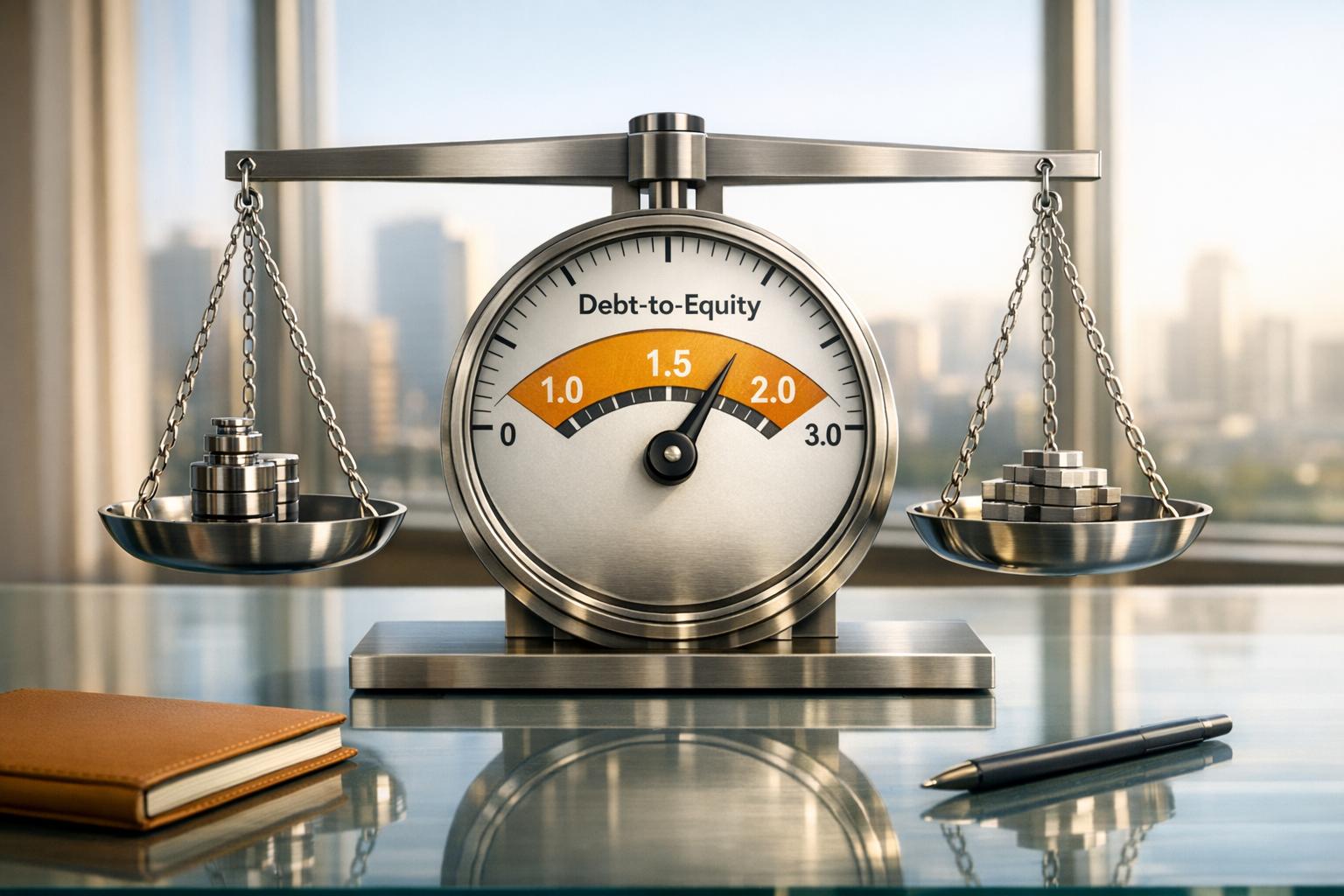
The debt-to-equity (D/E) ratio tells investors how much a company relies on debt versus equity to fund its operations. A balanced ratio can signal financial health, while extremes - too high or too low - raise concerns about risk or missed growth opportunities. Here’s the key takeaway:
Industry norms matter. For example, tech companies often have lower ratios compared to capital-heavy industries like utilities or real estate. Growth-stage companies should aim for a ratio between 1.0 and 2.0 to show they’re expanding responsibly while managing risk.
Investors also evaluate how companies allocate resources, manage cash flow, and handle debt obligations. Missteps, like borrowing too much or using debt for non-growth purposes, can erode trust and limit future funding opportunities. The D/E ratio is a critical metric that reflects a company’s financial discipline and ability to navigate challenges.

Debt-to-Equity Ratio Benchmarks: What Different Ratios Mean for Investors
A low ratio (below 1.0) indicates a capital structure heavily reliant on equity financing. While this reduces financial risk, it might also signal that management isn't taking full advantage of debt to fuel growth [9][5]. A moderate ratio (1.0–2.0) strikes a balance, suggesting the company is expanding sustainably while keeping financial risks under control [9][5]. On the other hand, a high ratio (above 2.0) points to a heavy dependence on borrowed capital. For instance, a ratio of 2.0 means two-thirds of the company’s capital comes from debt, leaving only one-third from shareholder equity. This setup increases the risk of insolvency during economic downturns or when interest rates rise [8][9].
Financial analysts generally agree that a D/E ratio above 2.0 is concerning [8]. Joe Fiorica, Head of Global Equity Strategy at Citi Global Wealth, explains why lower ratios appeal to investors:
"A lower debt-to-equity ratio implies that equity holders have a greater chance of benefiting from growth in retained earnings over time and a lower risk of default" [2].
However, these benchmarks can vary widely depending on the industry.
The ideal D/E ratio differs significantly across industries due to varying capital needs and business models. For example, Software-as-a-Service (SaaS) companies often have low D/E ratios since their value is tied to intangible assets like software and customer contracts rather than physical infrastructure [9]. In contrast, manufacturing firms typically show higher ratios because they take on substantial debt to fund factories, machinery, and equipment [9][5].
Industries such as utilities, financial institutions, and real estate investment trusts (REITs) naturally operate with higher ratios, often exceeding 2.0. These sectors rely on stable, predictable revenue streams and use large fixed assets as collateral [6][1]. For instance, a 5.0 ratio might be acceptable in an industry where the average is 7.0, but it would be a red flag in a sector where the norm is closer to 0.5 [8][5]. Investors always compare a company’s D/E ratio to its industry standard to assess its financial health.
Recognizing these differences is essential, as the D/E ratio directly impacts how investors perceive a company’s stability and risk.
The D/E ratio is a key indicator of solvency, showing how well a company can meet its long-term financial obligations. It also reflects how effectively management allocates resources and whether the business is prepared to navigate economic challenges or seize growth opportunities. With rising interest rates, the cost of servicing debt has grown, making the D/E ratio even more important for evaluating financial health. Stash Graham, Managing Director at Graham Capital Wealth Management, highlights this shift:
"As debt becomes more expensive to service, companies with larger than average debt burdens must allocate more cash towards paying down debt instead of returning that cash to shareholders through cash dividends or share repurchases" [2].
To get a clearer picture, many investors calculate net debt, which subtracts cash and cash equivalents from total debt. This adjustment offers a more accurate view of a company’s leverage [2]. The energy sector provides a telling example: after experiencing two waves of bankruptcies, many energy companies have shifted toward lower debt levels. Management teams now prioritize paying down debt over aggressive expansion [2].
For companies in growth phases, balancing the need for expansion with financial discipline is critical to attracting and retaining investor confidence.
Growth-stage companies often face a crucial decision: should they take on debt to fuel expansion or raise equity and dilute ownership? Debt financing can be an attractive option for founders who want to maintain control while funding key initiatives like hiring, product development, and market expansion. Unlike equity rounds, debt avoids dilution and the potential loss of decision-making power [10].
That said, this approach works best when a company has strong unit economics. Investors need to see that the profits generated from debt-financed growth will exceed the cost of servicing that debt [1]. For this, a short customer acquisition cost (CAC) payback period is essential, ensuring that every borrowed dollar delivers measurable returns [10]. When used strategically, venture debt can accelerate scaling while allowing founders to preserve ownership [9].
These choices in financing directly impact the debt-to-equity (D/E) ratio benchmarks that investors expect.
For companies in the growth stage - typically those with annual revenues between $500,000 and $10 million - investors generally look for a D/E ratio between 1.0 and 2.0 [9]. This range reflects a balanced approach to funding, signaling that the company is expanding while keeping financial risks under control. As explained by the Carta Team:
"A moderate ratio (1.0–2.0) might be seen in a growth-stage company that has strategically taken on venture debt. This can be a positive signal, showing a sophisticated approach to funding expansion without giving up more ownership through dilution." [9]
On the other hand, a D/E ratio below 1.0 could raise red flags. It might suggest that the company isn’t leveraging debt effectively to scale its operations. The British Business Bank elaborates:
"Investors can be unwilling to invest in a company with a very low ratio, as it suggests the business isn't realising the potential profit or value it could gain by borrowing and increasing the scale of its operations." [5]
At the other extreme, ratios above 2.5 or 3.0 may indicate excessive financial risk. However, in certain industries, higher ratios might be the norm [5][7]. Staying within the 1.0–2.0 range typically demonstrates both financial discipline and an appetite for sustainable growth.
In addition to ensuring target D/E ratios, investors pay close attention to how companies allocate their capital. They evaluate whether growth initiatives align with operational sustainability, often relying on metrics like the Rule of 40 and the Labor Efficiency Ratio [10].
Clear cash flow management is another priority. Investors expect practices like 13-week rolling forecasts to ensure that companies can meet debt obligations while continuing to fund growth [10]. Real-time financial reporting is also critical. Tools like automated accounts payable/receivable systems and dashboards that track metrics such as CAC and customer lifetime value (CLV) help provide a transparent view of the company’s financial health [10].
Pierre Lemieux, Director of Major Accounts at BDC, emphasizes the importance of striking the right balance:
"There is no doubt that the level of risk that shareholders can support must be respected, but it is possible that a very low ratio is a sign of overly prudent management that does not seize growth opportunities." [3]
When a company's debt-to-equity (D/E) ratio exceeds 2.0, it often signals trouble meeting debt obligations, as revenues may fall short of covering these commitments [5]. An even more concerning scenario arises with a negative D/E ratio, which occurs when liabilities surpass assets. This situation is a clear marker of financial distress and is frequently a precursor to bankruptcy [1].
Other warning signs include struggling to meet payment deadlines or allocating most of the cash flow toward interest payments rather than reinvesting in growth opportunities [2]. Additionally, owing to a single lender across 10 or more separate debts can point to deeper financial instability [6]. Companies in these circumstances are particularly vulnerable to rising interest rates, which can significantly increase the cost of servicing or refinancing existing debt [5].
These red flags not only indicate immediate financial strain but also severely limit a company's ability to secure future funding.
Excessive debt creates a ripple effect, making it increasingly difficult for companies to access new capital. Banks and institutional investors often rely on the D/E ratio as a key metric, and a high ratio can act as an immediate disqualifier for loans or equity financing [5]. High leverage undermines a company's solvency, discouraging equity investors from getting involved [2]. During due diligence, this financial instability can erode trust and confidence in the company [9].
Joe Fiorica, Head of Global Equity Strategy at Citi Global Wealth, explains:
"A lower debt-to-equity ratio implies that equity holders have a greater chance of benefiting from growth in retained earnings over time and a lower risk of default." [2]
For companies with D/E ratios exceeding 5.0, the challenges multiply. These businesses often face significant obstacles in securing new capital and may even be forced into debt restructuring [3]. In fact, nearly 52% of management equity grants in private equity-backed companies are tied to financial metrics like MOIC (Multiple on Invested Capital) or IRR (Internal Rate of Return), both of which are heavily impacted by high debt levels [9].
Poor borrowing practices can worsen the risks associated with high debt levels, compounding financial and operational challenges. One of the most critical errors is borrowing beyond the company's capacity to service the debt, particularly without accounting for potential revenue declines or interest rate increases [5]. Another risky move is using borrowed funds for share buybacks, which inflates the D/E ratio by increasing debt while reducing equity [4].
Mismatched debt maturity is another frequent misstep. Relying on short-term borrowing to fund long-term projects creates liquidity issues when those short-term liabilities come due [4]. Additionally, using debt to cover everyday operational expenses instead of funding strategic growth initiatives can lead to a downward spiral of increasing debt and diminishing returns [4].
Investment analyst Pat McKeough highlights the risks:
"A high ratio of debt to equity increases the risk that the company won't survive a business slump." [11]
These issues are particularly pronounced in cyclical industries like energy. During periods of low commodity prices, high leverage has driven numerous companies into bankruptcy [2]. Without strong financial controls and real-time insights into spending, businesses risk unnecessary borrowing that could lead to defaults on bank covenants [4].
When managing your capital structure, striking the right balance between debt and equity financing is crucial. For growth-stage companies, this often means navigating a trade-off: debt preserves ownership but requires regular payments, while equity avoids immediate cash outflows but dilutes control. The challenge lies in determining the right mix for your business. Debt capital is often cheaper than equity because of tax-deductible interest payments, making it an attractive option for companies with steady cash flows [8].
However, numbers alone don’t tell the full story. Industry norms vary significantly - tech companies often maintain lower debt-to-equity (D/E) ratios, while sectors like REITs operate with much higher benchmarks. Generally, a D/E ratio between 1.0 and 1.5 is considered healthy for most businesses, with 2.0 marking a point where investors may start to worry [5][8]. On the flip side, a near-zero ratio might indicate missed opportunities to leverage growth potential [5][7]. Before taking on additional debt, it’s essential to model how rising interest rates might impact your ability to manage repayments. Ensuring you have enough working capital to weather tougher financial conditions is equally important [5]. This measured approach to leverage, paired with strong financial oversight, can build trust among investors and set your business on a stable path.
Investors want more than just a solid D/E ratio - they need to see that you can handle debt responsibly over time. Clear, transparent financial reporting, coupled with accurate forecasting, is key to earning their trust. Demonstrating a clear distinction between short-term liabilities (due within a year) and long-term obligations helps investors understand your immediate and future financial commitments [7].
As of 2026, real-time financial visibility is a must. Investors increasingly expect standardized reporting that tracks not only D/E ratios but also metrics like ARR growth, net revenue retention, and cash runway. Automating processes such as accounts payable, accounts receivable, and month-end closes reduces errors and speeds up reporting, ensuring your financial data remains accurate and timely. Tools that generate financial health metrics on demand can further demonstrate your proactive approach to managing debt and capital [12].
For many growth-stage companies, optimizing a capital structure requires external expertise. Financial advisors, especially fractional CFOs, bring the tools and experience needed to streamline capital allocation while maintaining investor-ready reporting. These professionals can help you weigh the trade-offs between debt and equity based on their impact on ownership, control, and cash flow [12].
One example is Phoenix Strategy Group (https://phoenixstrategy.group), which provides fractional CFO services, FP&A systems, and M&A advisory tailored to growing businesses. Their offerings include real-time data synchronization, rolling cash flow forecasts, and preparation for funding rounds or exits. By automating processes like bookkeeping, they can reduce manual work by up to 80%. Additionally, AI-driven invoice processing can deliver a 200–600% ROI in the first year alone [12]. These efficiencies not only strengthen your capital structure but also free up your team to focus on scaling the business rather than managing routine financial tasks.
Your debt-to-equity ratio paints a clear picture for investors about how you balance risk, allocate resources, and drive growth. For most growth-stage companies, a balanced ratio - generally between 1.0 and 2.0 - shows you’re leveraging debt wisely to fuel expansion without compromising long-term stability [9]. It highlights your understanding of key trade-offs: while taking on debt can preserve ownership and offer tax advantages, equity financing avoids the pressure of fixed repayment schedules [8].
Investors pay close attention to this metric during due diligence because it reflects your financial discipline. A ratio exceeding 2.0 can raise concerns about your ability to handle economic downturns or rising interest rates [2]. On the flip side, a very low ratio might suggest excessive caution, potentially missing out on growth opportunities. As Pierre Lemieux, Director of Major Accounts at BDC, puts it, “A very low ratio is a sign of overly prudent management that does not seize growth opportunities” [3].
Striking the right balance isn’t just about hitting a specific number - it’s about showcasing your ability to manage capital responsibly. A well-optimized debt-to-equity ratio not only makes your financial structure appealing to investors and lenders but also provides a buffer to navigate periods of uncertain cash flow [1].
The right ratio builds trust, boosting lender confidence and reassuring equity investors that you can deploy capital effectively. By benchmarking against industry standards, keeping a close eye on your ratio, and being ready to explain your financial strategy, you enhance your credibility and turn funding discussions into successful partnerships [3].
For expert guidance on managing your capital structure and fine-tuning your debt-to-equity ratio, Phoenix Strategy Group offers personalized financial advisory services to help growth-stage companies secure funding and achieve sustainable success.
To figure out the debt-to-equity ratio, you simply divide a company's total debt by its total equity. This ratio helps you understand how much of the company's operations are funded by debt compared to shareholders' equity.
How to Calculate It:
This calculation gives you a clear picture of the company's financial leverage.
The ideal debt-to-equity ratio depends on factors like your industry, where your business is in its growth journey, and how much risk you're willing to take on. Companies in a growth phase often strive for a ratio that allows them to handle debt effectively while maintaining financial stability. To get it right, it's a good idea to look at what’s typical for your industry and seek advice from financial experts to make sure your ratio matches your business objectives and risk tolerance.
Net debt provides a better perspective on a company's leverage compared to total debt. By subtracting cash and cash equivalents from total debt, net debt highlights the financial obligations that remain after considering liquid assets. This approach gives a clearer picture of the company's overall financial position.