Published on
June 11, 2026


Struggling with cash flow visibility? For growth-stage companies, real-time liquidity insights are vital to avoid cash shortages and ensure smooth operations. Modern FP&A tools address this by integrating data from bank feeds, ERPs, and AR/AP systems, offering live financial views, dynamic forecasts, and actionable insights. Here’s a quick breakdown of three top options:
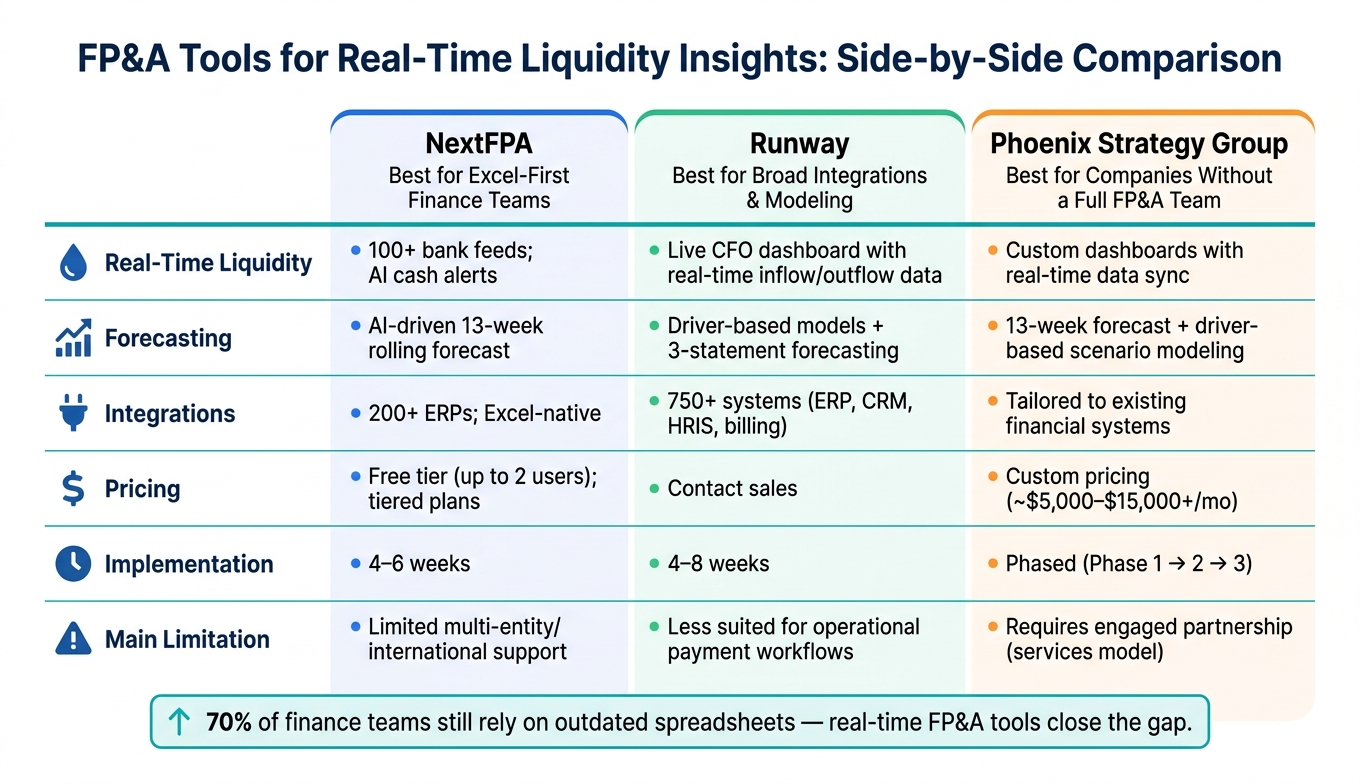
| Feature | NextFPA | Runway | Phoenix Strategy Group |
|---|---|---|---|
| Real-Time Liquidity | AI cash alerts, 100+ bank feeds | Live inflow/outflow dashboard | Custom dashboards w/ real-time data |
| Forecasting | AI-driven 13-week rolling | Driver-based, 3-statement models | 13-week w/ driver-based scenarios |
| Integrations | 200+ ERPs, Excel-native | 750+ systems | Tailored to existing systems |
| Pricing | Free tier, tiered plans | Contact sales | Custom pricing (starting ~$5,000/mo) |
| Best For | Spreadsheet-heavy teams | Broad integrations, modeling | Companies needing CFO support |
Choose based on your team’s structure, integration needs, and forecasting complexity. These tools simplify liquidity management, helping you focus on growth.
FP&A Tools Compared: NextFPA vs Runway vs Phoenix Strategy Group
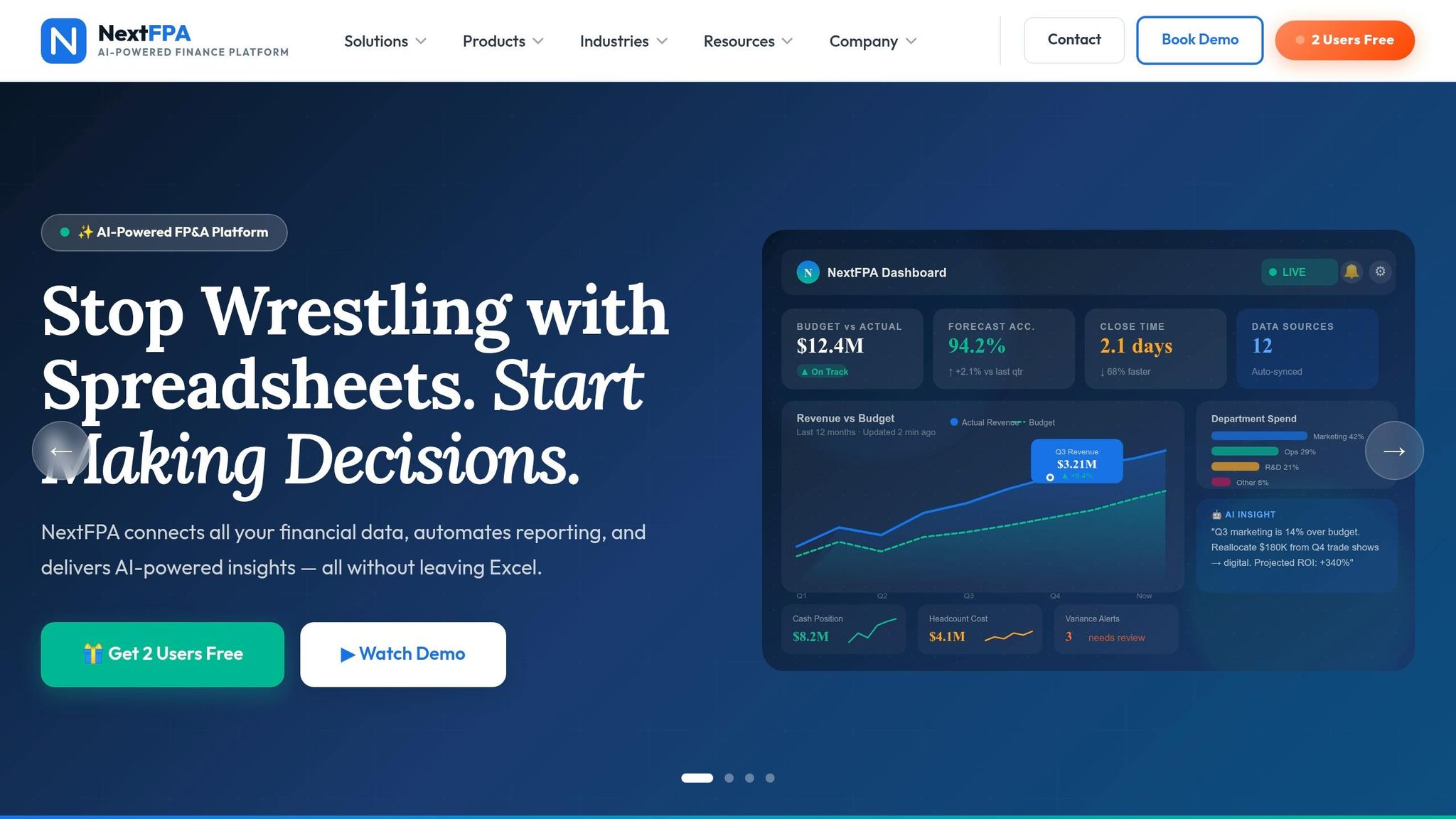
For companies in their growth phase, keeping an eye on liquidity is critical. NextFPA addresses this by offering features that prioritize speed and clarity. The tool provides finance teams with a live, constantly updated view of cash balances across all accounts and entities. Transactions are automatically reflected as they occur. Users can set custom alerts to maintain a minimum safe cash threshold, allowing the system to flag potential shortfalls and even suggest corrective actions. The "cash waterfall" feature offers a detailed drill-down, moving effortlessly from high-level board summaries to individual transactions. This ensures clear explanations of cash gaps to executives or investors [1].
NextFPA takes forecasting to the next level with AI-driven 13-week rolling forecasts. These are based on AR/AP aging schedules, payroll timelines, committed expenses, and over 90 days of historical data. This lets finance teams anticipate how contract delays or budget overruns could impact cash flow before it reaches critical levels [1]. The platform's forecasting tools integrate seamlessly into its broader functionality, streamlining financial planning.
NextFPA's integration capabilities enhance its forecasting and liquidity features by connecting with a wide range of banks and ERP systems. It supports over 100 bank feeds and integrates with more than 200 ERP and data sources. For teams reliant on spreadsheets, the Excel-native interface ensures a smoother transition. Implementation is efficient, taking just four to six weeks, with a dedicated success manager who understands finance guiding the process [1].
"Cash Management transformed how our finance team operates. What took days now takes seconds. Implementation was smooth. The team is strategic advisors now." - Finance Director, Mid-market enterprise [1]
NextFPA offers an "Everything Included" pricing model, which means no escalating costs as the team grows. This approach is particularly beneficial for growth-stage businesses that need to manage expenses carefully [1].
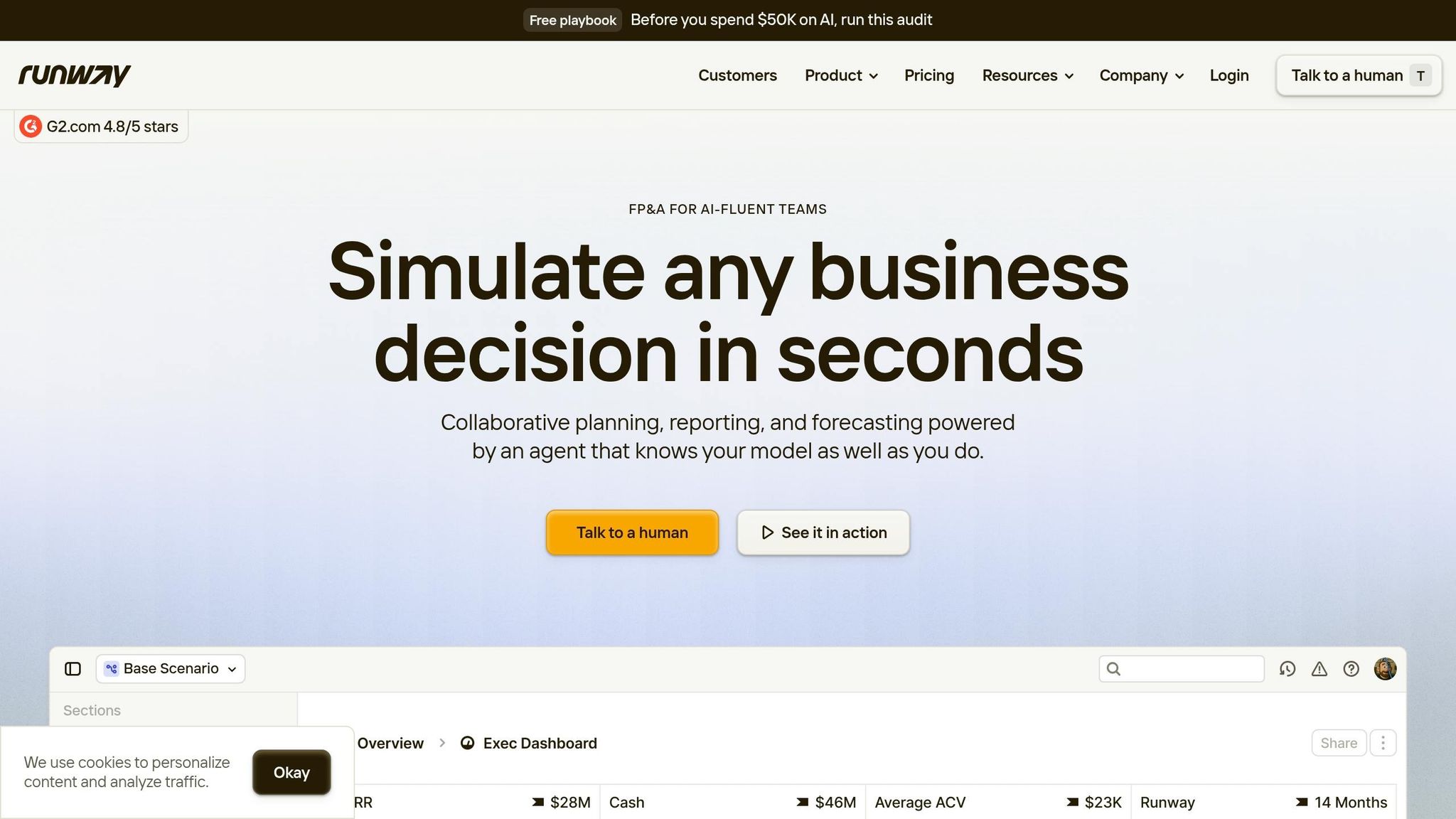
Runway’s CFO Dashboard brings together cash flow, expenses, forecasts, and scenario models - all updated in real time [3]. Forget about waiting on manual spreadsheet updates. The platform automatically pulls live inflow and outflow data from connected systems, ensuring your numbers are always up-to-date. It also highlights working capital insights, making it easier for finance teams to track receivables and payables with clarity [3].
Runway’s formula engine is a game-changer for forecasting. Teams can create driver-based models, rolling forecasts, and full three-statement models that include profit and loss, balance sheets, and cash flow. The "visual diff" comparison tool is especially handy, letting you test various growth assumptions side by side without altering your main model [2]. This feature pairs perfectly with its real-time liquidity tools, giving you a complete picture of your financial health.
Runway doesn’t just stop at forecasting - it takes financial insights further with seamless integration capabilities. It connects with over 750 systems, including ERP, CRM, HRIS, and billing platforms, syncing data effortlessly [2]. Implementation is structured into four phases - Kickoff, Model Design, Integration, and Go-live. While the process typically takes 4–8 weeks, it’s marketed as achievable in 4–6 weeks [2].
Phoenix Strategy Group addresses a pressing challenge for U.S. growth-stage companies: the need for real-time visibility into cash flow. By blending fractional CFO and FP&A expertise with advanced data engineering, the firm delivers actionable liquidity insights.
Phoenix Strategy Group creates dashboards that bring together key financial data - like bank feeds, AR/AP aging, and short-term cash forecasts - into a single, easy-to-use view. These dashboards pull daily cash balances and transactions from multiple accounts, converting them into U.S. dollars for consistency. On top of this, they layer 12–13 week cash flow projections. This forward-looking tool not only alerts users when projected cash dips below 1.5× the monthly burn rate but also provides granular insights by entity, business unit, or product line. This level of detail is especially useful for companies juggling multiple subsidiaries or revenue streams [4].
This comprehensive liquidity view lays the groundwork for sophisticated forecasting and scenario planning.
The firm builds financial models that tie key revenue drivers - like pricing, churn, volume, and DSO (days sales outstanding) - directly to cash collections. These models allow users to toggle between base, conservative, and aggressive scenarios, instantly showing the impact on runway and minimum cash balances. They also account for event-driven scenarios, such as new funding rounds or debt arrangements, pinpointing liquidity effects on specific dates. These insights are often used in board presentations, lender updates, and fundraising materials to support data-driven decisions [4].
Phoenix Strategy Group ensures a seamless integration of core systems, including accounting platforms (QuickBooks Online, NetSuite, Xero), banking platforms via APIs, CRM and billing tools (Salesforce, Stripe), and data warehouses (Snowflake, BigQuery, Looker). They follow a phased implementation approach:
For companies lacking a full FP&A team, Phoenix Strategy Group often steps in as a fractional FP&A and data resource [4].
The firm uses a scope-based proposal model with monthly retainers, typically ranging from $5,000 to $15,000 or more. Pricing depends on factors like company size, complexity, and transaction volume. Separate fees apply for specific projects, such as building a new liquidity model or preparing Series B/C fundraising materials [5].
Here's a closer look at how each tool shines and where it may fall short, based on the detailed analysis above.
Tool A (NextFPA) is a great option for finance teams that are already comfortable working with spreadsheets. Its Excel-native design eliminates the need for retraining while offering robust ERP and bank integrations. One standout feature is its AI-powered 13-week rolling forecast, which delivers actionable insights for cash planning. As a Finance Director from a mid-market enterprise put it:
"Cash Management transformed how our finance team operates. What took days now takes seconds." [1]
NextFPA also includes a free tier for up to two users, making it a budget-friendly choice for startups or small teams. However, it may not be the best fit for businesses with complex multi-entity setups or international treasury requirements.
Tool B (Runway) focuses on speed and accuracy. Its formula engine supports driver-based models, rolling forecasts, and full three-statement models. With over 750 integrations, it drastically reduces manual work. That said, companies needing in-depth operational payment workflows might find its emphasis on modeling and forecasting somewhat restrictive.
Phoenix Strategy Group offers a unique approach by blending data-driven insights with expert human judgment. Their fractional CFO and FP&A model provides more than just software - an experienced finance professional builds your dashboards and interprets the data to guide strategic decisions. This phased approach, starting with a basic 13-week cash forecast and advancing to driver-based scenario modeling, is perfect for growth-stage companies without a dedicated FP&A team. Pricing is tailored to the size and complexity of your business.
Here’s a side-by-side comparison of how these tools measure up for liquidity management:
| Dimension | NextFPA | Runway | Phoenix Strategy Group |
|---|---|---|---|
| Real‑Time Liquidity | 100+ bank feeds; AI cash alerts | Real‑time CFO dashboard with live inflow/outflow data | Custom dashboards with real‑time data synchronization |
| Forecasting | 13‑week rolling; AI‑driven | Driver-based models; three-statement forecasting | 13‑week forecast with driver‑based scenario modeling |
| Integrations | 200+ ERPs; Excel‑native platform | 750+ systems including ERP, CRM, HRIS | Tailored integrations with your existing financial systems |
| Pricing | Free tier for 2 users; tiered plans | Contact sales for pricing | Custom pricing available |
| Best For | Excel‑first finance teams | Teams needing broad integrations and visual modeling | Growth‑stage companies without a full FP&A team |
| Main Limitation | Limited support for multi‑entity structures | Less suited for operational payment workflows | Services‑based model requiring a more engaged partnership |
The choice boils down to your organization's specific structure and forecasting needs. Whether you prioritize real-time liquidity tracking, advanced modeling, or expert guidance, there’s a tool designed to meet those demands.
When choosing an FP&A solution, focus on your financial structure's complexity, the maturity of your data systems, and how quickly you need deployment. These factors are crucial to maintaining clear, real-time visibility into liquidity during periods of rapid growth.
If your team is accustomed to spreadsheets but ready to move beyond them, look for tools that offer a familiar interface paired with AI-driven 13-week forecasting. This combination provides fast and effective results. On the other hand, if your needs include broader integrations and advanced driver-based modeling, opt for a solution that ensures strong data connectivity without the burden of enterprise-level complexity.
With more than 70% of finance teams still relying on outdated spreadsheets, this reliance becomes riskier as businesses scale. When liquidity is on the line, a customized approach that enhances data visibility while incorporating expert insights is critical. A service-oriented strategy that combines cutting-edge FP&A technology with experienced financial guidance ensures not only immediate liquidity management but also long-term strategic planning. This transforms raw data into actionable insights rather than just static numbers.
In urgent liquidity crises, prioritize solutions that deliver rapid visibility. For businesses planning multi-entity expansions or international growth, it’s worth starting with a solution designed for more complex structural requirements. As fractional CFO Josh Aharonoff aptly said:
"It's not about managing cash. It's about keeping profitable companies alive." [6]
To get a clear, real-time view of your cash, you need to bring together data from all your financial systems. This means connecting bank feeds, ERP systems, accounts receivable and payable, and payroll platforms. Having these systems linked and updated continuously is key to gaining accurate insights into your cash flow.
To create a dependable 13-week cash forecast, begin by ensuring you have a precise view of your current cash position. This means reconciling your bank balances with internal records to eliminate discrepancies. Automating data updates can help minimize errors and keep the information up-to-date.
Break the 13-week period into weekly intervals, making it easier to track and manage. Regular updates are crucial to keep the forecast relevant and aligned with the needs of your stakeholders. Additionally, refine your model continuously by comparing actual results against your projections. This ongoing adjustment improves accuracy and supports better decision-making.
Think about bringing in a fractional CFO to handle liquidity management during times of rapid growth or market uncertainty. They can provide the precision and efficiency needed to manage ever-changing factors like receivables, payroll, and COGS payments. This becomes especially important when quick, real-time insights are essential for keeping operations running smoothly and ensuring financial stability.