Published on
March 10, 2026


Psychographic segmentation helps SMBs understand why customers make purchasing decisions by analyzing values, beliefs, and lifestyle choices. This deeper insight enables businesses to create marketing strategies that resonate emotionally, boosting customer loyalty and reducing churn. While some methods can be costly, there are budget-friendly options to gather actionable insights.
Here are five methods SMBs can use to understand customer motivations:
Each method has strengths and limitations. Combining them provides a more complete customer understanding, starting with low-cost approaches like internal collaboration and scaling up as needed. Focus on identifying what truly matters to your audience.
One-on-one interviews provide a deeper understanding of customer motivations by uncovering the "why" behind their decisions. While surveys can tell you what customers are doing, interviews dig into the emotional drivers and challenges influencing those behaviors. They help reveal the friction points and values that shape customer choices.
To get the most out of these interviews, talk to both loyal customers and those who have churned. Use open-ended questions like, “What was happening in your business that made you search for a solution?” or “What does success look like for you six months from now?” Pay attention to the exact words they use - phrases like “clunky onboarding” or “reliability” can serve as the foundation for crafting more compelling marketing messages. These conversations set the stage for applying other psychographic techniques later on.
For example, in summer 2021, Glofox Product Manager Francisco Ribeiro discovered through interviews that a gym's size played a major role in determining its feature priorities. This insight helped shape a data-informed product roadmap tailored for small and medium-sized businesses (SMBs). It’s a clear example of how qualitative insights can fuel strategic decisions.
Interviews take time. You’ll need to schedule sessions with each participant, dedicate 30 to 60 minutes per interview, and spend several weeks analyzing the results.
All you need are some basic tools: a recording platform like Zoom and a CRM system such as HubSpot. Use custom CRM fields like "Pain Points" or "Key Decision Makers" to organize insights and track recurring themes across conversations.
While interviews aren’t easily scalable due to the time and effort required for one-on-one interactions, they’re invaluable for uncovering a broad range of psychographic factors - like pain points, values, and friction areas. These findings can later be validated and quantified through more scalable tools like surveys.
Interviews go beyond the numbers, exposing the emotional triggers and psychological drivers that shape customer behavior. This level of understanding allows for personalized, trust-building messaging that resonates on a deeper level.
Surveys are a powerful way to take qualitative insights and scale them into quantifiable trends. The key is to start with a clear objective, focusing on psychographic factors that drive customer behavior. These can include positive factors like motivations and values, or negative factors such as pain points, friction, and risks [4]. The goal is to uncover why customers make certain choices - not just what they do. Avoid generic personality questions that don’t lead to actionable insights. As Daniel Kyne, Founder of OpinionX, explains:
"Knowing whether your customer is an introvert or extrovert is unlikely to help you sell a product like B2B software! Instead, we focus on the triggers that cause someone to search for a new product" [4].
This approach allows small and medium-sized businesses (SMBs) to design surveys that pinpoint the triggers behind customer decisions.
To get reliable, actionable data, use discrete-choice models like Pairwise Comparison or MaxDiff. These methods help respondents prioritize what matters most, avoiding the pitfalls of standard multiple-choice questions. A great example comes from summer 2021, when Glofox’s Francisco Ribeiro used OpinionX to survey gym owners. The findings? A whopping 96% of gym owners on an "Individual" plan identified gym size as their main challenge. With this insight, Glofox calculated the financial impact for each segment and adjusted their product roadmap accordingly [4].
For best results, keep surveys short - 10 to 15 questions that take no longer than five minutes to complete [5] [6]. Use a mix of Likert scales, a few open-ended questions, and key identifiers (like job title or company size) to segment your audience effectively. To encourage participation, offer incentives like discounts or prize draws. And don’t forget: make the survey mobile-friendly, since many respondents will use their phones to complete it [6].
While the survey itself collects data passively once it’s live, you’ll need time upfront to craft thoughtful questions. Plan for a few weeks to gather enough responses. Afterward, set aside time to clean the data - removing duplicates and incomplete entries [1].
The cost per response typically ranges from $0.95 to $5.00. For a survey with 500 responses, this means spending between $475 and $2,500 [1]. Tools like SurveyMonkey, SurveyPlanet, and OpinionX offer pricing options to suit different budgets, with some free plans available for basic needs [1] [4] [6]. Once responses are in, tools like HubSpot or Salesforce can help you organize and analyze the data [3] [5].
Surveys are far more scalable than interviews. They require less manual effort and can reach thousands of respondents at once [1] [5]. By building on interview findings, surveys allow SMBs to apply psychographic segmentation on a larger scale. Distribution is simple too - use email platforms like Mailchimp or embed the survey directly on your website [3].
While surveys may not capture the emotional depth of interviews, they excel at answering the "why" behind customer behavior. They help identify key segments and validate their potential for targeted marketing [1] [6].
Social media analysis adds another layer to understanding customer behavior, complementing insights from interviews and surveys. By observing real-time actions, this method provides a direct window into what customers do, rather than just what they say.
Platforms like Facebook, TikTok, and X offer a treasure trove of psychographic data that’s both accessible and budget-friendly for small and medium-sized businesses (SMBs). Unlike traditional methods that depend on self-reported data, behavioral analysis focuses on actual user actions - what they click on, share, or support online. Tools such as Facebook Audience Insights, TikTok Trends, and X analytics help uncover audience interests and engagement patterns.
As Rohan Rajpal from Spurnow aptly explains:
"Demographics explain who your buyer is, while psychographics explain why they buy." [8]
This highlights the power of combining digital observations with traditional methods to gain a full picture of customer behavior.
Blending multiple data sources helps uncover richer insights. For example, monitoring ad accounts can reveal clusters of interests and engagement trends, showing what customers truly value. Adding social listening - like tracking discussions on Reddit or Facebook Groups - can further illuminate your audience’s organic identity. AI tools can even categorize customers by psychographic traits such as "eco-conscious" or "value-seeker", based on their interactions across platforms like Instagram or WhatsApp.
Why does this matter? Because 71% of consumers now expect tailored experiences, and personalized offers make them 80% more likely to complete a purchase [7].
Setting up social listening tools is quick, and meaningful patterns can emerge within a few weeks of monitoring [1]. Once configured, these tools collect data passively, requiring minimal ongoing effort.
Social media analytics are often free or low-cost, making them an excellent starting point for SMBs. Many businesses begin with free tools provided by platforms before exploring more advanced third-party solutions for deeper insights.
This approach scales effortlessly. Unlike manual interviews, digital tools can analyze thousands of users at once, significantly reducing costs while leveraging existing online activity [1].
Social media analytics shine in identifying broad patterns and key Activities, Interests, and Opinions (AIO) variables [8]. Because these insights are based on observed behavior rather than self-reported data, they often reveal more authentic and subconscious traits, providing a clearer view of what drives your audience.
Focus groups bring together 4 to 12 participants for structured discussions aimed at uncovering customer benefits, frustrations, and the language they use to describe their experiences [9]. Unlike one-on-one interviews, this group dynamic encourages participants to share more openly and build on each other’s thoughts.
The true strength of focus groups lies in understanding the "why" behind customer behavior - insights that digital analytics alone often miss. These discussions can reveal disagreements among market segments, highlight which psychographic factors resonate most with your brand, and uncover the deeper motivations behind buying decisions. Edward Boon, a university professor and former marketer for P&G and BMW, emphasizes:
"You don't need to hire an agency, prepare for weeks, or know statistical analysis. You can plan and conduct research by yourself in a couple of days." [9]
Running a focus group involves about 2 to 3 days of preparation, with each session lasting 60–90 minutes [9]. To get the most out of your efforts, plan at least two sessions - ideally four - so you can refine your discussion guide based on early findings. Once the sessions are complete, transcribe the recordings and work with your team to analyze the insights [9].
To conduct a focus group, you’ll need a moderator, a private space, basic recording tools, and a well-structured discussion guide. Aim to invite 10 to 12 participants to ensure at least 4 show up, and offer a $50 incentive plus refreshments to encourage participation [9]. While professional focus groups can cost anywhere from $4,000 to $15,000 [1], running sessions in-house with your own resources can significantly reduce expenses.
Focus groups aren’t as scalable as digital methods since they require participants to be physically or synchronously present, and the insights demand manual analysis [1]. However, the depth of understanding they provide often makes up for the smaller sample sizes. These sessions can uncover emotional triggers, specific language, and conflicts within segments that can later guide larger surveys or digital strategies.
Focus groups excel at providing rich qualitative data, capturing the motivations and personal expressions that surveys or analytics might miss [1]. They allow you to hear customers describe your brand in their own words, explore their aspirations, and identify the personality traits or values they associate with your product. That said, because of the small sample size, the findings should act as a foundation for broader research. Use these insights to pinpoint key variables, then validate them with larger-scale methods to develop a well-rounded segmentation strategy.
Leverage the expertise of your internal teams to enrich your understanding of customer psychographics. Sales teams, for example, often have a direct line to customer preferences, hearing which product features resonate most and what objections arise during the buying process. At the same time, customer service teams gather valuable insights through complaints, feature requests, and feedback, all of which shine a light on customer needs and expectations. Pulling these insights together can help you uncover patterns that are crucial for understanding customer behavior.
This approach is also cost-effective, as it relies on existing team resources rather than expensive external research. For small and medium-sized businesses (SMBs) operating on tight budgets, this can be a practical and efficient solution [1].
Start by hosting a brainstorming session with your frontline teams to map out customer lifestyles, attitudes, and common pain points. You can quickly gather actionable insights by reviewing support tickets, CRM notes, and sales call records. These findings can then guide your segmentation and targeting strategies.
This process requires collaboration from sales, customer service, and marketing teams. To streamline efforts, designate a team lead to collect and organize qualitative feedback. Create a shared document where team members can continuously log customer insights from their day-to-day interactions. Additionally, using a centralized CRM system ensures that essential details don’t get trapped within individual departments.
As your team and customer base expand, this approach grows with you. Unlike external research, which demands fresh budgets for every new study, internal collaboration becomes increasingly valuable over time as your teams gain deeper knowledge of your customers. The key is to establish ongoing feedback loops, treating psychographic research as an evolving process rather than a one-off task. When combined with external research, these internal insights create a more complete picture of your audience for sharper, more targeted messaging.
Internal teams can uncover customer motivations and needs that automated tools might overlook. However, since this data is often anecdotal and qualitative, it’s essential to cross-check it with quantitative methods like web analytics or social media sentiment analysis. By blending internal observations with broader data, you can validate key psychographic variables and build a more accurate and actionable customer profile.
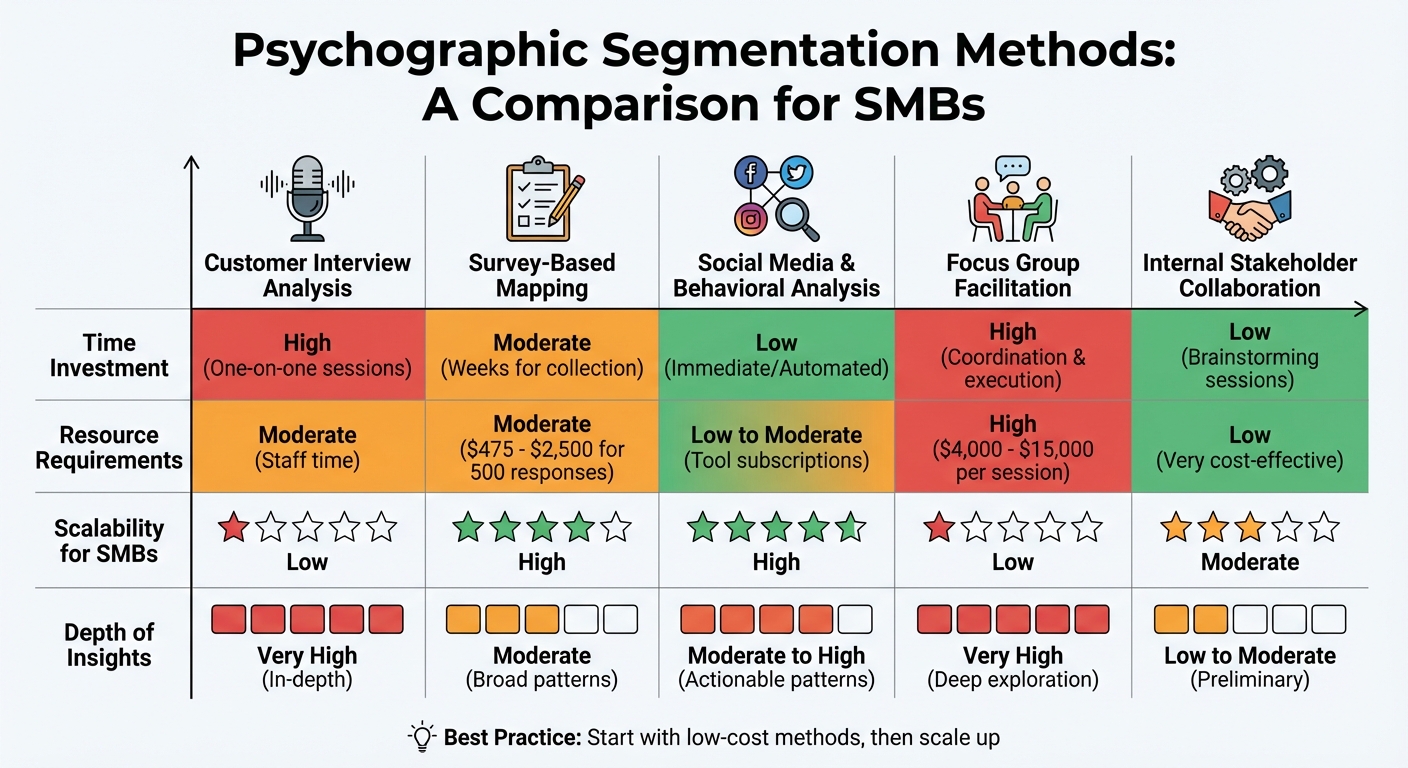
Comparison of 5 Psychographic Segmentation Methods for SMBs
The following table compares five methods for psychographic segmentation, focusing on their time demands, costs, scalability for small and medium-sized businesses (SMBs), and the level of insights they provide.
| Method | Time Investment | Resource Requirements | Scalability for SMBs | Depth of Insights |
|---|---|---|---|---|
| Customer Interview Analysis | High (One-on-one sessions) | Moderate (Staff time) | Low | Very High (In-depth) |
| Survey-Based Mapping | Moderate (Weeks for collection) | Moderate ($475 - $2,500 for 500 responses) | High | Moderate (Broad patterns) |
| Social Media & Behavioral Analysis | Low (Immediate/Automated) | Low to Moderate (Tool subscriptions) | High | Moderate to High (Actionable patterns) |
| Focus Group Facilitation | High (Coordination & execution) | High ($4,000 - $15,000 per session) | Low | Very High (Deep exploration) |
| Internal Stakeholder Collaboration | Low (Brainstorming sessions) | Low (Very cost-effective) | Moderate | Low to Moderate (Preliminary) |
Each method has its strengths and limitations. Customer interviews and focus groups deliver rich, detailed insights but demand significant time and financial investment, making them less scalable for smaller businesses. Surveys offer a balance, providing broad data patterns at a manageable cost. On the other hand, social media and behavioral analysis tools stand out for their speed and scalability, delivering actionable insights quickly. Lastly, internal collaboration is an efficient, cost-effective way to tap into your team's existing knowledge, though its insights may be more preliminary.
For SMBs, a layered strategy works best. Start with low-cost methods like internal collaboration to identify trends, validate findings with scalable tools such as surveys or social media analysis, and reserve resource-intensive options like interviews or focus groups for deeper exploration when necessary [1][10]. This approach ensures a tailored, effective psychographic segmentation process.
Psychographic segmentation offers SMBs a way to stand out in crowded markets. By understanding why customers make their purchasing decisions - whether it’s their values, motivations, or lifestyles - you can craft marketing campaigns that connect on a deeper, emotional level. As Salesforce highlights, understanding customers psychographically means communicating in a way that speaks directly to their hearts [12].
Using the five methods outlined earlier, you can design strategies that tap into these emotional insights. Each method brings its own advantages, but combining them gives you a fuller picture of your audience. Start small with low-cost approaches like collaborating with internal teams or analyzing social media and behavioral data to identify patterns. From there, validate your findings through surveys or customer interviews to add context and depth. Take ScottsMiracle-Gro as an example - they expanded beyond basic demographics to include psychographic and behavioral triggers, leading to an 11x campaign lift and a doubling of "buy" actions [14].
Since customer preferences are constantly evolving, it’s crucial to revisit your psychographic segmentation regularly. Changes in competition, societal shifts, and new product launches can all impact what drives your audience. Daniel Kyne, Co-Founder of OpinionX, advises:
"Refreshing your psychographic segmentation at least once per year is necessary to ensure that your insights are up-to-date and relevant" [4].
To stay ahead, set up systems that continuously gather feedback - encourage your sales team to document customer insights, monitor engagement metrics, and compare current data with historical trends.
If you’re just starting out, tools like Google Analytics interest categories or quick social media polls can uncover valuable psychographic insights [13][2]. Test your assumptions with A/B campaigns before making large investments, and integrate psychographic data with demographic and behavioral insights to create a well-rounded understanding of your customers [11][14].
At the end of the day, knowing why your customers choose your brand is what turns data into actionable strategies. The companies that succeed aren’t necessarily the ones with the most data - they’re the ones that truly understand what drives their audience. Pick one of these methods and start gathering insights this week. You’ll likely see a boost in your marketing ROI.
For more expert advice, check out Phoenix Strategy Group (https://phoenixstrategy.group).
To craft marketing messages using psychographic insights, start by collecting data on your customers' traits, values, and interests. This can be done effectively through surveys, analytics, or interviews. Once you have this information, identify distinct audience segments based on shared characteristics.
Tailor your messages to resonate with each group's beliefs and motivations. For instance, if you're targeting customers who prioritize sustainability, emphasize your product's eco-friendly features. Use language that appeals to emotions and reflects the values of your audience.
Finally, keep an eye on engagement metrics like response rates and conversions. These insights will help you fine-tune your messaging for each segment, ensuring it continues to connect effectively with your audience.
The fastest and most budget-friendly way to start psychographic segmentation is by leveraging the customer data you already have. Tools like surveys and social media analytics can provide valuable insights. Surveys allow you to directly ask customers about their needs, interests, and opinions. Meanwhile, social media analytics can reveal patterns in traits, lifestyles, and preferences. By combining these approaches, small businesses can build detailed customer personas for more focused marketing efforts - without breaking the bank.
When it comes to psychographic segmentation, there’s no magic number of interviews or survey responses needed. What truly matters is collecting qualitative insights that reveal your audience's motivations, values, and behaviors. Tools like surveys, focus groups, and customer feedback are excellent ways to dive into this. The goal isn’t about how much data you gather - it’s about how deep your understanding goes.