Published on
March 9, 2026


Managing cash flow is one of the biggest challenges for SaaS companies. Why? Because subscription billing, deferred revenue, and recurring payments create complexities that traditional tools like spreadsheets can't handle. Poor cash flow management is a leading cause of failure for 82% of startups, with SaaS businesses being particularly vulnerable due to timing gaps between cash collection and revenue recognition.
The solution? Real-time cash flow tools. These platforms provide live dashboards, automate forecasting, and integrate with systems like Stripe and QuickBooks to eliminate manual errors. Companies using these tools report up to 40% better forecasting accuracy and save hours of work every month.
Here’s what you need to know:
Quick Comparison:
| Tool | Best For | Key Feature | Starting Price |
|---|---|---|---|
| Trezy | Early-stage startups | 2,000+ bank connections | Free tier, $390/year |
| Jirav | Growth-stage companies | Driver-based modeling | Custom pricing |
| Mosaic | Small to mid-sized teams | Pre-built templates | Custom pricing |
| Runway | High-growth companies | Collaborative simulations | Custom pricing |
| Abacum | Mid-market operations | AI-powered automation | Custom pricing |
Switching to a real-time cash flow tool doesn’t just save time - it helps SaaS companies make informed decisions, avoid liquidity gaps, and stay on track for growth.
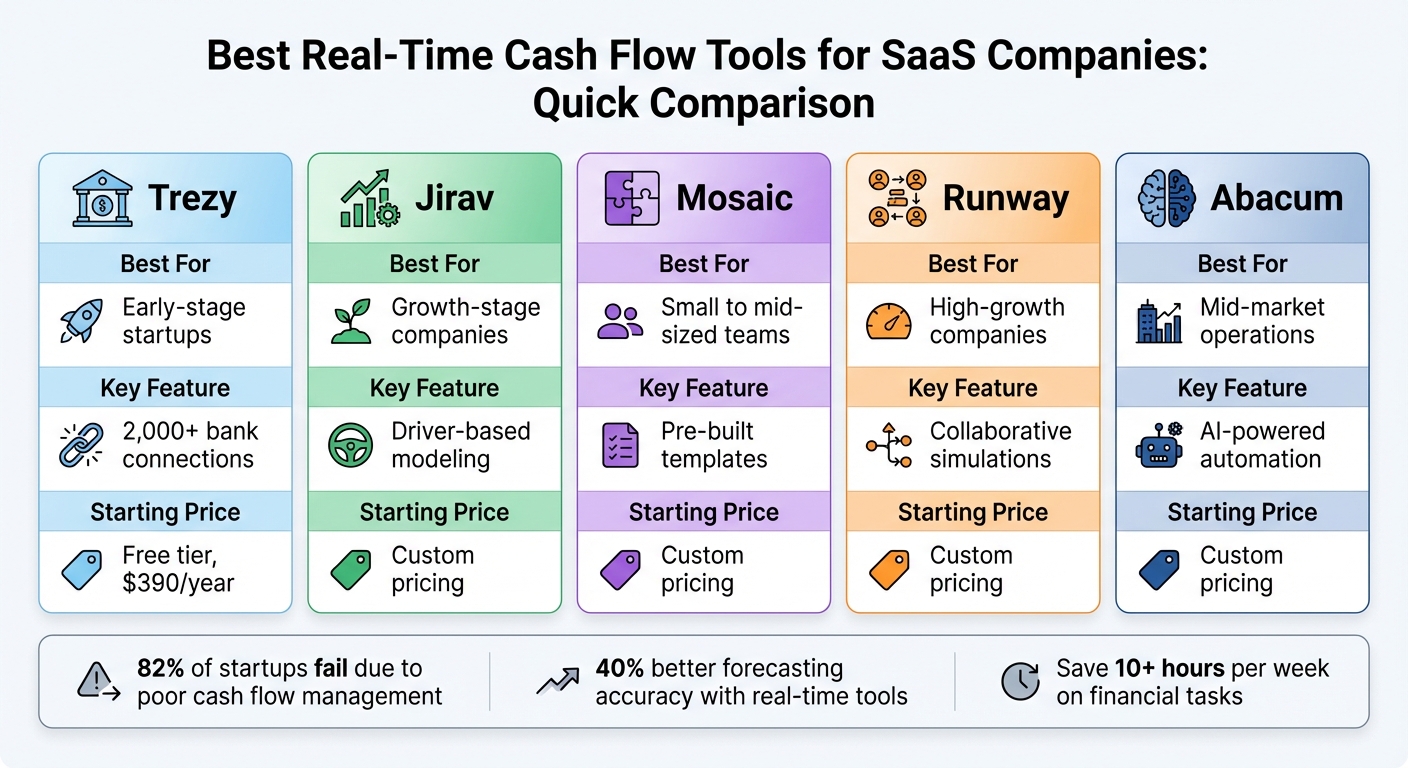
Real-Time Cash Flow Tools Comparison for SaaS Companies
Standard cash flow tools often fall short for SaaS companies. Why? Because they don’t account for the unique challenges of subscription billing, recurring revenue, and deferred recognition. To find the right fit, focus on three key areas: real-time integrations, SaaS-specific metrics, and automation capabilities. Many companies leverage fractional CFO services to oversee these complex implementations. Let’s break these down.
Start by ensuring the tool connects seamlessly with your existing systems. Direct integrations with bank accounts, payment processors, and ERP platforms are a must. Real-time syncing eliminates the need for tedious manual exports and error-prone spreadsheets. Tools leveraging PSD2/Open Banking offer live multi-currency visibility - critical for SaaS businesses operating globally [1][8].
The difference real-time syncing makes is huge. Take Merlyn Mind, for example. In 2025, Mike Kwak, their Director of GTM Systems Engineering, saved 8 to 10 hours monthly on reconciliations after adopting Nue’s real-time revenue analytics platform [9]. The best tools also unify data across systems like Stripe and Chargebee, creating a single source of truth for revenue, billing, and contract data [1][9]. Automated workflows can even slash Days Sales Outstanding (DSO) by an average of 33 days [1]. Plus, these tools help bridge the gap between actual cash flow (when money hits your account) and accrual-based revenue, ensuring a clearer view of liquidity [5].
Generic tools focus on simple inflow and outflow tracking. SaaS-focused platforms go deeper, monitoring metrics like Monthly Recurring Revenue (MRR), Annual Recurring Revenue (ARR), churn rates, CAC payback periods, and LTV:CAC ratios. These metrics are essential for forecasting and understanding the recurring nature of SaaS revenue [5][6][7].
For instance, a monthly churn rate of just 5% can lead to a staggering 46% annual revenue loss [5]. Tools with AI-powered forecasting analyze past trends, seasonality, and recurring patterns to predict cash flow up to 12 months ahead with 95% accuracy [5][8]. This is especially important for SaaS companies, where upfront customer acquisition costs often precede revenue. Automated calculations of CAC payback periods help you determine how much you can safely spend on growth without risking your runway [5][11]. Some tools even let you model hypothetical scenarios - like hiring new engineers or switching billing cycles - to test strategies before making big decisions [5][8].
Manual processes, like categorization and reconciliation, eat up valuable time. Automated platforms can save finance teams up to five days of work each month [7].
Michael Key, Director of Finance and Accounting at Datarails, put it best:
"Datarails Cash is a game-changer for Cash-Flow Management. What once took hours now takes about 15 minutes per week." [10]
Look for tools that offer features like AI-driven bank reconciliation, automated transaction categorization, and anomaly detection. Advanced platforms use machine learning to flag duplicate payments, fraud, or missing transactions with up to 99.5% accuracy, reducing costly errors [1]. Automated revenue recognition is another must-have for SaaS, as it processes deferred revenue and prepayments directly from invoices to ensure accurate forecasting [6][7]. Finally, prioritize no-code tools that allow finance teams to tweak workflows and models without relying on engineers [1].
| Feature Category | Critical SaaS Requirement | Business Impact |
|---|---|---|
| Integrations | Bank feeds (PSD2), Stripe, Chargebee, ERP, CRM | Real-time cash visibility; no manual data entry [1][8] |
| Metrics | MRR, ARR, Churn, CAC Payback, Runway | Investor-ready insights; clear growth tracking [5][7] |
| Forecasting | AI-powered predictive modeling (12 months) | 95% accuracy; early warning for cash gaps [5][8] |
| Automation | Revenue recognition & transaction categorization | Saves 10+ hours per week [7] |

Phoenix Strategy Group tackles the challenges of managing SaaS cash flow in real time by building the infrastructure needed to turn tools into a strategic edge. Before diving into investments, it’s crucial to have systems and expertise ready to handle real-time data. That’s where Phoenix Strategy Group steps in, providing the foundation you need.
Phoenix Strategy Group sets up a Weekly Accounting System that ensures your books are closed every week. This gives you a clear, real-time view of your cash position, burn rate, collections, and runway. On top of that, their Integrated Financial Model connects cash forecasts with operational drivers like sales pipeline conversion, billing schedules, churn rates, and hiring plans. These driver-based models update automatically as new data comes in, giving SaaS companies the insights they need to stay ahead. Considering that a 2023 CB Insights analysis revealed 38% of startup failures stem from running out of cash or failing to secure new funding, this system is a game-changer. It ensures that every real-time tool feature works seamlessly to deliver actionable insights.
To support these financial models, their data engineering team integrates all your financial data into one streamlined system. Using tools like dbt, Fivetran, Snowflake, Looker, and Power BI, they create a centralized data hub. This hub acts as a single source of truth, bringing together CRM, billing, accounting, and bank feeds. The result? Near real-time dashboards that eliminate the need for manual exports or reconciliations. With this setup, your finance team can effortlessly track metrics like MRR, ARR, churn, CAC payback, and runway - keeping everything up to date without extra hassle.
Their fractional CFOs take this real-time cash data and turn it into actionable strategies for hiring, fundraising, and capital allocation. Using live dashboards, they help drive smarter, faster decisions. They also handle board and investor reporting, scenario planning, and due diligence materials, all grounded in live, accurate data. Research from Bessemer Venture Partners highlights that SaaS companies with disciplined cash burn management are far more likely to achieve premium valuations during an exit. Similarly, a SaaS Capital survey found that companies with dedicated FP&A and regular cash forecasting improved forecast accuracy by 20–30%, compared to those relying solely on ad hoc spreadsheets.
SaaS companies often face unique financial challenges, and having the right tools can make all the difference in managing cash flow effectively. Below are some of the top tools designed to simplify and optimize real-time cash flow monitoring.
Abacum is an AI-powered FP&A platform that integrates with over 700 tools, including Stripe, Chargebee, Salesforce, and Snowflake. It automates data classification and anomaly detection, which means no more manual spreadsheet updates. Tailored for mid-market finance teams, Abacum streamlines workflows and cleans data automatically.
The platform has proven to save users significant time. For instance, Cortex cut its budget cycles in half, while FirstVet shaved five days off its monthly reporting. Abacum is particularly effective for rolling forecasts and scenario planning, reducing forecasting cycles from 6–8 weeks to just 2–4 weeks. Rated 4.8/5, it’s highly recommended for companies with complex, multi-region operations that need AI-driven automation.
"Abacum brought all the data together so I could see my rolling forecast at any point in time, reducing manual reporting by around five days per month."
– Ryan Shon, Director of Strategic Finance [15]
Mosaic focuses on providing clear, standardized metrics through a dashboard-first approach. Designed for small to mid-sized teams, it offers pre-built templates and automated reporting, eliminating the need for heavy customization. This tool is ideal for teams looking for streamlined visibility into both financial and operational data.
While Mosaic standardizes metrics, Jirav takes a different route by emphasizing driver-based modeling.
Jirav specializes in driver-based, three-statement forecasting across P&L, Balance Sheet, and Cash Flow. Trusted by over 4,000 companies, it integrates seamlessly with accounting, workforce, and operational systems, enabling automated pro forma modeling.
In 2024, Arteria used Jirav to reduce its planning cycle from two weeks to just a few hours. CFO John Wallace highlighted the efficiency, completing forecasts and sensitivity scenarios ahead of board meetings. Another success story comes from Weatherford Capital, which tripled its assets under management after adopting Jirav. Users report saving an average of 50 hours compared to manual Excel modeling, making it an excellent choice for variance reporting and analytics.
"Before Jirav, forecasting cycles took about two weeks... Now with Jirav, I'll complete the base forecast in hours."
– John Wallace, CFO, Arteria [13]

Runway simplifies financial planning with collaborative, human-readable modeling. It connects to over 750 tools, including HRIS, ERP, and CRM systems, for automated data ingestion and real-time simulations. Built for high-growth companies, Runway aligns finance teams with Sales, Marketing, and Operations through shared dashboards and side-by-side scenario comparisons.
Rated 4.8/5 on G2, Runway is praised for its intuitive interface and quick onboarding. Users can easily access any part of their model and benefit from flexible segmentation options. The platform shines when it comes to "what-if" simulations, which are invaluable for strategic decision-making.
"Runway is what Excel should have always been."
– Will Simon, CFO, Mainspring [14]
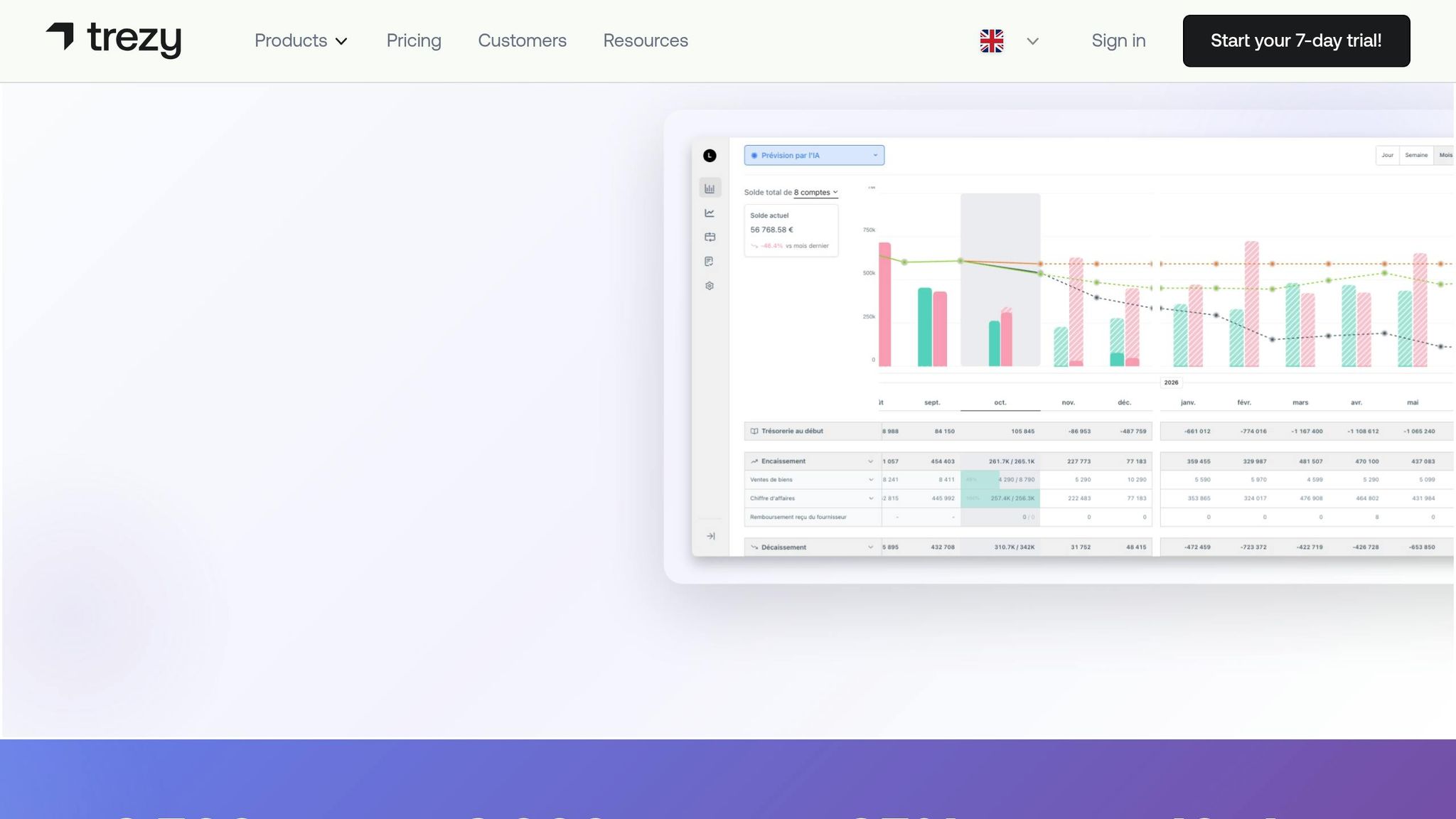
Trezy is designed for early-stage SaaS businesses, focusing on cash flow management. It connects with over 2,000 banks for real-time synchronization and uses AI-powered forecasting to predict cash flow with 95% accuracy up to 12 months ahead.
Trezy emphasizes SaaS-specific metrics like MRR, ARR, churn, CAC payback period, and runway. It claims to save users more than 10 hours per week on financial tasks. Rated 4.8/5 by over 2,500 businesses, Trezy offers a "Free Forever" plan for basic features, alongside premium options for more advanced needs. Emma Martinez, CFO of a tech startup, leveraged Trezy’s scenario planning to secure $2M in funding by presenting a clear growth strategy to investors.
"Trezy saved us from a cash crisis. We can now see 6 months ahead and make informed decisions."
– Sarah Johnson, CEO, Digital Agency [5]
The features you need in a cash flow tool depend heavily on your business's current stage. Here's a breakdown:
After identifying tools suited to your stage, make sure they integrate well with your existing systems.
When choosing a cash flow tool, integration capability is crucial. Depth matters more than the number of integrations. For SaaS companies, the tool should seamlessly connect with:
Avoid tools that rely on outdated CSV uploads instead of real-time syncing [12]. During synchronization, the platform must maintain your financial logic to prevent discrepancies between your cash flow tool and ERP [1].
Before committing, test the tool using real data in a free trial or sandbox environment [1]. Additionally, ensure it supports payment service providers like Stripe or PayPal for real-time inflow tracking. This eliminates the need for manual updates and ensures accuracy [4].
The following table highlights key features of various tools, helping you align them with your business needs.
| Tool | Best For | Setup Time | Key Strength | Starting Price |
|---|---|---|---|---|
| Trezy | Early-stage SaaS | 30 seconds | 2,000+ bank connections for instant visibility | Free tier available; Premium at $390/year [16] |
| Jirav | Growth-stage | A few weeks | Driver-based three-statement modeling | Custom pricing |
| Mosaic | Small to mid-sized teams | A few weeks | Dashboard-first approach with pre-built templates | Custom pricing |
| Runway | High-growth companies | Quick | Collaborative modeling with 750+ integrations | Custom pricing |
| Abacum | Mid-market with complex operations | Moderate | AI-powered automation across 700+ tools | Custom pricing |
Selecting the right tool means considering both your current needs and where your business is headed in the next 12–24 months. Even a modest 15% improvement in cash forecasting accuracy can lead to more than a 3% increase in pre-tax profits, making this investment worthwhile [3].
Real-time cash flow tools have become a cornerstone for SaaS companies. The complexities of deferred revenue and recurring billing make manual tracking nearly impossible to manage effectively [17][19]. The consequences of poor cash flow visibility are evident when businesses fail to meet their financial targets [2].
Switching from static spreadsheets to dynamic financial systems changes the game for finance teams. As DNA Growth aptly put it:
"Growth is only as sustainable as the numbers behind it... a SaaS financial model isn't just a spreadsheet anymore. It's a strategic lens that brings clarity to decisions, investors, and outcomes" [19].
Companies leveraging predictive analytics in their financial processes report a 40% boost in forecasting accuracy [1]. Meanwhile, businesses with highly automated finance systems save 20% of their time previously spent on transactional tasks [18].
Addressing these challenges, Phoenix Strategy Group offers tools that turn raw financial data into actionable insights. Their Integrated Financial Model and Weekly Accounting System eliminate the usual 2–3 day data lag, enabling quicker, more informed decisions [1]. By integrating bank reconciliation, ERP, CRM, and billing systems into one unified platform, Phoenix Strategy Group provides a single source of truth for financial data [1].
With the right tools and expert implementation, finance teams can shift from being spreadsheet managers to strategic advisors. Whether your choice is Trezy, Jirav, or Mosaic, the ultimate goal is the same: transforming data into actionable financial intelligence [17][19].
This shift replaces uncertainty with clarity, making real-time cash flow visibility a must-have for companies looking to scale effectively.
To ensure your cash flow data stays up-to-date, look for systems that offer instant or near-instant updates, typically syncing every 15 to 60 minutes. Real-time tools automatically connect with your bank accounts and financial systems, providing live dashboards that update continuously without requiring manual intervention. This way, your financial position reflects actual inflows and outflows, avoiding reliance on outdated or static reports.
Key metrics for accurate cash forecasting in SaaS include Monthly Recurring Revenue (MRR), Annual Recurring Revenue (ARR), churn rate, renewal rates, and customer payment timing. These figures are essential for predicting cash inflows and outflows, as they consider factors like revenue recognition schedules and payment delays. Additionally, understanding customer behavior - such as trends in late payments or growth from expansion revenue - plays a crucial role in refining forecasts. This insight helps subscription-based businesses anticipate potential cash shortfalls early on.
The fastest way to move away from spreadsheets without causing disruptions is by adopting a cash flow automation or forecasting tool that works effortlessly with your existing systems. These tools handle repetitive tasks automatically, deliver real-time insights, and integrate with platforms like QuickBooks, Xero, ERP, and CRM. Look for a solution that aligns with your current workflows, transfer your data, and start enjoying smoother operations immediately.