Published on
January 12, 2026


Activist investors influence mergers and acquisitions (M&A) by addressing inefficiencies, improving governance, and advocating for better deal terms. They typically acquire minority stakes in companies and push for changes that maximize shareholder value. For example, in 2023, 40% of activist campaigns were tied to M&A, with these efforts delivering higher returns compared to non-M&A activism. Key tactics include:
Activists often achieve better shareholder returns, with M&A-related campaigns outperforming non-M&A activism by a median of +1.9%. Their efforts reshape corporate strategies, enforce discipline, and uncover hidden opportunities for growth.
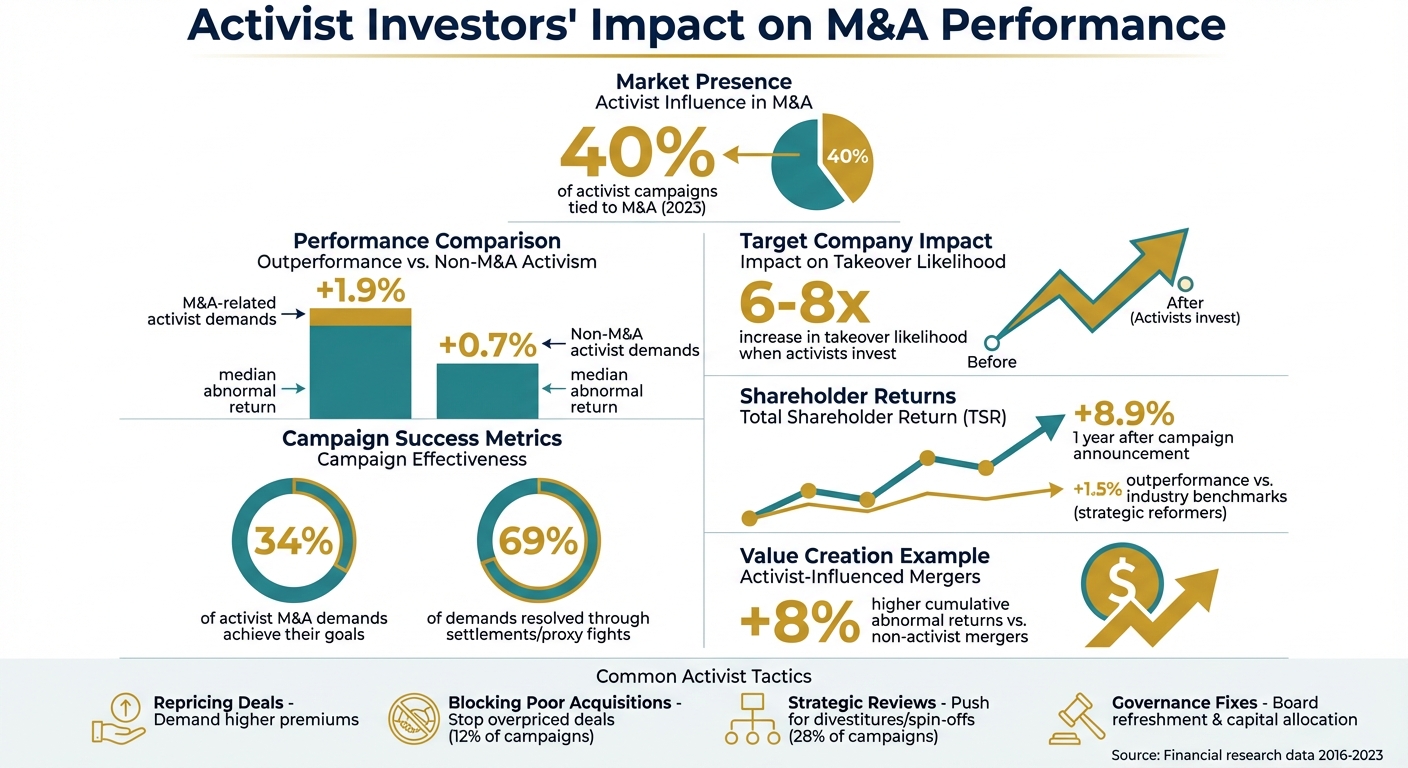
How Activist Investors Drive Alpha in M&A: Key Statistics and Performance Metrics
Mergers and acquisitions (M&A) often stumble due to overpayment, weak negotiation tactics, and poorly designed deal structures. These missteps not only erode value but also create openings for activist investors to step in. Identifying these common pitfalls is the first step toward addressing them and understanding the challenges activists aim to resolve.
Overpayment is a frequent issue in M&A, often driven by overly optimistic synergy projections, flawed incentives, or inadequate due diligence. For example, in 2018, the median deal multiple hit around 14x EBITDA, significantly above the historical average of 12x [3]. This trend tends to worsen during periods of abundant capital, when market enthusiasm can mask underlying risks. Once economic conditions shift, these overvalued deals can lead to cash flow problems [5].
Another problem is the lack of thorough stress-testing in strategic plans. According to BCG, many boards fail to receive the independent performance evaluations they need to make informed decisions - despite 69% of directors expressing a desire for such assessments, only 40% actually receive them [2]. This gap in oversight often leads to the approval of acquisitions that destroy value, drawing the attention of activist investors who aim to impose greater discipline in deal-making.
On the flip side, undervalued companies sometimes accept offers that don’t reflect their true worth. This often happens because of poor preparation or conflicting incentives within management. When executives prioritize personal benefits over shareholder interests, it weakens their negotiating position and reduces the premiums shareholders could receive [4].
Another factor is the "conglomerate discount", where companies fail to divest underperforming or non-core assets. This oversight can obscure potential value that could be unlocked through spinoffs or asset sales [3][7]. Without activist involvement, shareholders may struggle to evaluate whether a third-party offer is fair. Interestingly, data shows mergers influenced by activists yield cumulative abnormal returns that are 8% higher than those without activist involvement, highlighting the hidden value that can be captured with better oversight [4].
Even when deals are priced correctly, poor structuring and execution can undermine long-term value. While activist campaigns often provide an initial boost to total shareholder return (TSR), the first 90 days are critical in determining the deal’s overall success [2][8].
However, these campaigns can also double the likelihood of CEO turnover, which introduces additional risks [2]. Companies targeted by activists often experience TSR losses ranging from 4% to 25% within a year of intervention [2]. By the two-year mark, these companies typically underperform their sector by 13 percentage points [7]. Without a disciplined approach to deal structure and execution, even well-intentioned transactions can turn into value traps, paving the way for activists to step in and push for governance reforms and operational improvements.
Activist investors step into the M&A landscape to address inefficiencies and uncover hidden opportunities for value creation. Their efforts typically revolve around three main tactics: repricing undervalued deals, blocking transactions that could harm value, and driving strategic reviews to unlock shareholder gains. Here’s a closer look at how these approaches work in practice.
Activists excel at spotting undervalued deals by identifying blind spots like poor expense management, weak governance, or underused balance sheets [2]. They also step in when shareholders lack the full picture to properly assess bids, signaling whether an offer is fair or needs adjustment [4].
"The endorsement of a third-party bid by an activist hedge fund represents a credible signal that the bid is fair because activists are informed investors."
- Journal of Financial Economics [4]
Their involvement can significantly influence outcomes. For instance, when activists invest in a target company, the likelihood of a takeover rises six to eight times [4]. A striking example is Elliott Management’s $4 billion stake in PepsiCo back in September 2025. Elliott identified inefficiencies in the company’s bottling network and non-core assets, arguing that addressing these issues could boost the stock’s potential by 50% through a sharper focus on high-growth areas [10].
Another tactic, known as "activist arbitrage", involves targeting acquirers with low returns on invested capital (ROIC) who announce new deals. By purchasing shares in these companies, activists pressure management to either lower bid prices or abandon deals that could erode value [9].
When activists identify acquisitions that are overpriced or strategically flawed, they don’t hold back. Since 2006, about 12% of activist campaigns have aimed to block such deals [7]. Their playbook includes hiring investment bankers to produce detailed critiques of a deal’s logic, nominating directors with relevant expertise to challenge supportive board members, and organizing campaigns to withhold votes from directors backing poor transactions [1][6].
"Activism has fully rebounded from the brief pandemic dip... regardless of industry, size or performance, no company is too large, too popular, too new or too successful to consider itself immune from activism."
- Martin Lipton, Founding Partner, Wachtell, Lipton, Rosen & Katz [6]
The effectiveness of these strategies has grown since the SEC’s Universal Proxy Rules took effect in September 2022. These rules allow shareholders to mix and match nominees from management and activist slates on a single ballot [1][7]. Activists also leverage legal tools like Section 220 of the Delaware General Corporation Law to access non-public records for challenging deals [1][6]. In some cases, they even partner to present alternative "stalking-horse" bids, highlighting the inadequacy of existing offers [6].
Activists frequently push companies to conduct independent strategic reviews aimed at maximizing shareholder value [15]. These reviews often lead to actions like divestitures, spin-offs, or full company sales, helping to unlock value buried within complex corporate structures. The impact is clear: M&A-related activist demands have generated a median abnormal return of +1.9% around announcement dates, significantly higher than the +0.7% seen with non-M&A activist demands [3].
Take Yahoo’s case in 2016. After pressure from Starboard Value LP, the company spun off its Alibaba stake, added four independent directors (two of whom were Starboard nominees), and ultimately sold its core business to Verizon for $4.48 billion in 2017 [3][14]. Similarly, Third Point LLC, led by Daniel Loeb, pushed Nestlé to offload underperforming assets. In 2018, Nestlé sold its U.S. confectionery business to Ferrero for $2.8 billion and committed to returning $21 billion to shareholders through buybacks [14].
Activists also advocate for "go-shop" clauses, allowing companies to seek competing offers to secure the best price [12]. Beyond influencing the terms of a deal, they shape how proceeds are used, often favoring share buybacks or dividends over additional acquisitions [12][13]. About 34% of activist demands in M&A achieve their goals, with spin-offs and divestitures delivering stronger shareholder returns than typical corporate transactions [3]. These efforts not only reshape individual deals but also pave the way for broader governance reforms, which will be explored next.
Activists focus on tackling governance and structural shortcomings that hold companies back from being fully prepared for mergers and acquisitions (M&A). Issues like outdated board structures and poor capital allocation strategies can prevent businesses from driving long-term value. By addressing these challenges, activists aim to create sustainable improvements.
Activists analyze board composition, looking at factors such as director tenure, age, and involvement in multiple boards (overboarding) [6][11]. They often advocate for board refreshment, pushing for the removal of directors with long tenures who may lack independence or fresh perspectives. A notable example is Starboard Value’s 2014 campaign with Darden Restaurants. Their nearly 300-page analysis proposed strategies like real estate sales, franchising, and asset spin-offs, leading to the removal of CEO Clarence Otis Jr. and a complete board overhaul [11].
Activists also push for greater accountability by encouraging independent directors to directly engage with major shareholders [16].
"The board of directors is - or ought to be - a central player in shareholder engagement."
- Mary Jo White, Former Chair, U.S. Securities and Exchange Commission [16]
Another key focus is aligning executive compensation with actual performance and shareholder interests. Activists ensure that incentive structures support sound decision-making, particularly in M&A scenarios.
Effective capital allocation is a cornerstone of activist strategies. They identify areas where value is being lost - such as excess cash reserves, underperforming business units, or poorly planned acquisitions - and push for corrective measures [6]. Common tactics include increasing leverage, initiating share buybacks, or issuing special dividends, all while enforcing strict return thresholds [6][7].
Since 2006, the most frequent demand from activists has been for companies to separate businesses through spinoffs or divestitures, accounting for 28% of campaigns. Additionally, 12% of campaigns focused on returning cash to shareholders, while 7% aimed to adjust leverage [7]. A case in point is McGraw-Hill’s 2011 encounter with Jana Partners. To avoid a costly proxy battle, McGraw-Hill announced a portfolio review and share repurchase plan, conceding only one additional board seat [11]. This example highlights the importance of having disciplined capital allocation frameworks in place before activists intervene. Such frameworks not only improve financial discipline but also enhance preparedness for potential deals.
Once governance and capital allocation reforms are in place, companies must strengthen their financial systems to support M&A readiness. High-quality, integrated financial data is essential for evaluating M&A opportunities. Activists often spot weaknesses in financial planning by identifying arbitrage opportunities [11]. Implementing real-time analytics and robust internal valuation models can help close these gaps and present a stronger narrative to investors.
"Most companies are vulnerable not because they lack a plan, but because their plans lack rigor."
- BCG [2]
To ensure deal readiness, companies should conduct quarterly vulnerability screenings. These screenings compare operational metrics, expense management, and governance practices against industry peers [11]. Another useful tool is the "red team" exercise, where an independent group evaluates the company’s 3- to 5-year outlook as if they were private equity owners or activists. These exercises can uncover quick wins, like outsourcing or optimizing trade spend, that deliver immediate returns [2].
For businesses looking to strengthen their financial systems, Phoenix Strategy Group offers fractional CFO services, financial planning and analysis (FP&A) systems, and data engineering solutions. Their integrated financial models and real-time data tools help align intrinsic and market value, reducing the gaps that often attract activist scrutiny.
Let’s wrap up by examining how activist investors drive and manage alpha in mergers and acquisitions (M&A), building on the tactics and governance reforms discussed earlier.
Activist investors create alpha through deal repricing, blocking acquisitions that could harm shareholder value, and initiating strategic reviews to uncover untapped potential. Their success is often measured by share price performance, with activist campaigns delivering an average 8.9% increase in total shareholder return (TSR) one year after being announced [8]. Strategic reformers - those who push for changes in financial structure, business strategy, or M&A plans - typically outperform industry benchmarks by 1.5 percentage points within the first year [11].
The type of demand activists make plays a huge role in determining outcomes. For instance, pushing for board representation is statistically linked to improved profitability, while demands for immediate, sweeping strategic changes may cause short-term declines in profitability [17]. Activists identify "hidden value" by benchmarking targets against forward-looking metrics like revenue and free cash flow (FCF), zeroing in on companies trading at steep discounts compared to their peers [18].
The first 90 days after a campaign launch are critical in shaping the TSR trajectory. Poor management of activist engagements during this window can lead to sharp TSR declines [2]. To mitigate risks, companies often conduct structured "red team" exercises to pinpoint vulnerabilities and stress-test their value drivers [2][8]. While activist campaigns can cause an immediate dip in profitability, the long-term impact often becomes evident only years later [17].
Private, early engagement with activists can prevent costly and value-destroying proxy battles. In fact, 69% of activist demands are resolved through settlements or proxy fights [8]. Companies that proactively address activist challenges often fare better and minimize the risks of prolonged disputes. Expert guidance is key to navigating these complexities effectively.
To sustain activist-driven alpha, companies must address governance gaps and rely on expert advisors for support.
"You must meet the activists on their own terms, with facts and analysis that are as detailed and well supported as theirs."
Strong financial data is essential for building internal valuations that remove the arbitrage opportunities activists often exploit [11]. Many boards fall short in this area due to gaps in objective data [2]. Managing activist campaigns requires a well-rounded team that includes legal advisors, investment bankers, PR experts, and proxy solicitors to tackle the intricate technical and interpersonal dynamics [6].
Phoenix Strategy Group offers fractional CFO services, FP&A systems, and data engineering tools that help companies prepare for M&A challenges. Their real-time analytics and robust internal valuation models bridge the gap between intrinsic and market value, reducing vulnerabilities and positioning companies to seize alpha opportunities rather than merely defend against activist pressures.
Activist investors hunt for undervalued M&A opportunities by blending in-depth financial analysis with strategic thinking. They focus on companies trading at lower valuation multiples - like EV/EBITDA or price-to-earnings - compared to competitors, even when these businesses show strong cash flow or promising growth potential. Often, they dig into business portfolios to pinpoint underperforming assets or divisions that could be sold off to generate additional value.
To back up their strategies, these investors study how similar deals have been received in the past and estimate potential synergies. This might include operational upgrades or smarter capital allocation. By putting numbers behind the potential benefits of a deal, they illustrate how it could outperform market expectations. Companies anticipating activist interest can gain a competitive edge by seeking expert advice, such as the M&A advisory services offered by Phoenix Strategy Group, to fine-tune their valuation approaches and better align with investor priorities.
Activist investors are pivotal during mergers and acquisitions, stepping in to ensure better governance by holding management accountable and pushing for meaningful changes. They scrutinize underperforming leadership, call for improved board structures, and demand smarter strategies for allocating capital.
Through these efforts, activist investors promote transparency and a focus on results, creating an environment where businesses are more likely to deliver stronger returns for stakeholders.
Activist investor campaigns can reshape a company’s trajectory, influencing its strategy, board dynamics, and overall valuation. To stay prepared, businesses should approach activism as a strategic risk to manage proactively, rather than merely reacting when challenges arise.
Here are some essential steps to consider:
Incorporating these practices into everyday operations not only reduces risks but also helps companies stay focused on growth. It can even transform activist challenges into opportunities to build stronger shareholder trust and confidence.