Published on
May 15, 2026


Managing financial data across various platforms can be overwhelming. Accounting APIs simplify this process by enabling real-time data exchange between tools like QuickBooks, Xero, and NetSuite with CRMs, HR systems, and more. They eliminate manual data transfers and ensure up-to-date financial insights, saving businesses time and resources.
| API | Best For | Notable Feature | Starting Price |
|---|---|---|---|
| Apideck | SaaS financial dashboards | White-label Vault for auth control | $299/month |
| Rutter | Fintech & e-commerce tools | Commerce-accounting data bridge | Contact vendor |
By 2026, real-time data sync is essential for accurate financial reporting and operational efficiency. Unified APIs like Apideck or Rutter reduce development time and costs while improving data consistency. For businesses managing multiple systems, these tools are a game-changer.

When choosing an accounting API, it's important to assess how well it aligns with your business's current and future needs. Here's a closer look at the critical factors to consider.
Start by checking which platforms the API supports. Key systems to look for include QuickBooks Online, Xero, NetSuite, Sage Intacct, and Microsoft Dynamics 365. QuickBooks Online is especially important, as it holds a dominant 80% to 85% share of the U.S. small business market [1][7]. Beyond platform compatibility, dig into the depth of these integrations. Does the API provide full read/write access to the general ledger, or is it limited to basic functions like invoicing?
For companies needing robust financial workflows, often managed by fractional CFO services, look for APIs with native journal entry support and compatibility with double-entry accounting systems. These features are critical for seamless integration and real-time financial tracking, especially as your business scales. Accuracy and real-time data syncing are the next priorities.
APIs with event-driven architectures and webhooks ensure real-time updates, eliminating the delays caused by nightly batch syncs [9]. If a platform like NetSuite or Sage Intacct doesn’t natively support webhooks, some APIs offer virtual webhooks through managed polling - a handy workaround [10].
Data accuracy is non-negotiable. As Kateryna Poryvay from Apideck puts it:
"Accounting systems act as the financial source of truth. This raises the bar for data accuracy and reliability. A bug in a social feed is annoying. A bug in financial data erodes trust and can trigger compliance issues." [9]
To maintain consistency across multiple systems, the best APIs use canonical data models. These models standardize fields like "Invoice" and "Journal Entry", eliminating inconsistencies when pulling data from different platforms. Once data handling is assured, focus on developer tools and scalability.
A developer-friendly API should offer comprehensive SDKs, clear documentation, and sandbox environments for testing. For example, gaining access to NetSuite sandboxes often requires contacting a sales representative, so it’s worth confirming availability early [2].
Pay attention to API rate limits, as they can affect performance. QuickBooks Online allows up to 500 requests per minute, while Xero caps at just 60 [1][5]. For SaaS products that handle high transaction volumes, such limits can create bottlenecks.
Finally, look for APIs that provide /meta endpoints. These endpoints predict the fields required for each platform, making it easier to build dynamic, platform-specific UI components [2]. This feature can save significant development time and effort.
With the criteria in mind, let's dive into some of the top APIs designed for seamless cross-platform integration. Each offers unique features, so the best option will depend on your specific needs.
Apideck simplifies financial data integration by providing a single normalized schema that supports over 46 connectors, including popular platforms like QuickBooks Online, Xero, and NetSuite [11][12]. Its white-label interface, Vault, allows you to manage OAuth flows and account connections under your own branding. This means users can connect their accounts through a branded, controlled experience.
Another standout feature is Apideck's centralized logging system, which helps monitor integration health across all customer connections. This reduces the infrastructure you need to manage integrations. Pricing begins at $299 per month for 10,000 API calls, and they offer a 30-day free trial without requiring a credit card [4].
On the other hand, Rutter takes a different approach, focusing on speed and commerce data integration.

Rutter uses a cache-first architecture, syncing and caching data locally to deliver results in milliseconds - often tens of milliseconds compared to the usual 800ms–1.5 seconds [10]. This makes it particularly effective for fintech tools that need to handle large volumes of historical financial data quickly.
What sets Rutter apart is its ability to bridge commerce and payments platforms. With Rutter, you can correlate data from systems like Shopify or Stripe alongside financial records from QuickBooks or NetSuite - all in a single API call [13].
A real-world example of Rutter's capabilities comes from Orb, a billing platform. In 2024, Orb implemented a NetSuite integration in just 2.5 weeks, cutting setup costs by 50%. This efficiency highlights Rutter's value for businesses looking to streamline integrations [13].
"Based on the demo alone, it was obvious that Rutter could support what we wanted. They helped us ship our NetSuite integration within two-and-a-half weeks." - Kshitij Grover, Co-Founder & CTO, Orb [13]
| API | Architecture | Best For | Notable Feature |
|---|---|---|---|
| Apideck | Unified schema, pass-through | SaaS financial dashboards | White-label Vault for auth management [11] |
| Rutter | Cache-first, sync-based | Fintech & e-commerce platforms | Commerce-accounting data bridge [13] |
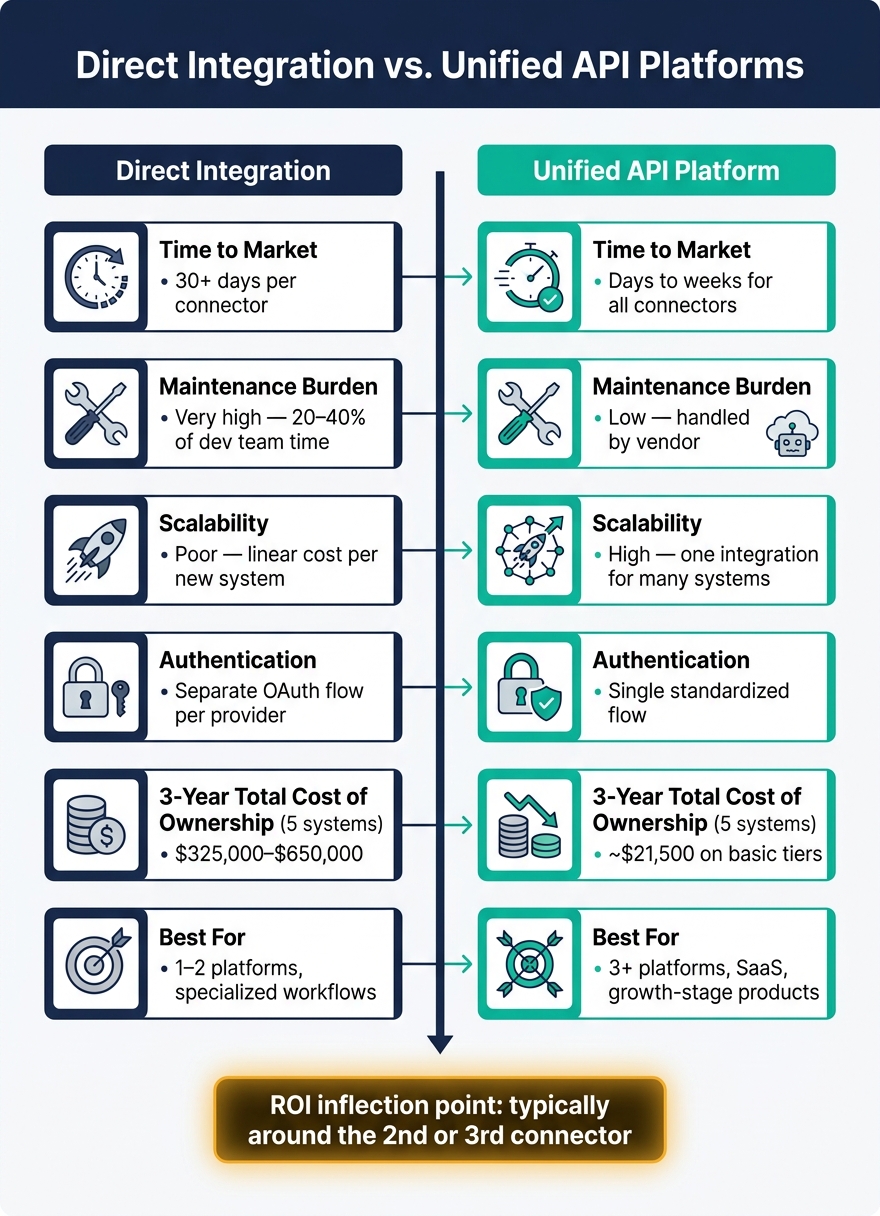
Direct Integration vs. Unified API: Cost & Complexity Compared
Choosing the right integration approach is key for achieving seamless, real-time financial reporting across platforms. Whether you go with direct integration or a unified API depends largely on how many accounting systems you need to support.
Direct integration connects your product directly to a single platform, like QuickBooks or Xero. This approach works best when your tool is designed for just one or two systems and has highly specific workflows. For instance, a tool catering exclusively to U.S. small businesses using QuickBooks Online - which dominates around 80% of the market in this segment [7] - might not require the added complexity of a unified API. Direct integration provides full control over APIs, which can be crucial for meeting strict regulatory or platform-specific requirements.
However, building a direct integration isn’t cheap or quick. It typically takes over 30 person-days and costs between $20,000 and $40,000. On top of that, maintenance can consume 20–40% of your engineering team’s time [3][14].
If you need to support multiple systems, though, unified API platforms offer a more efficient alternative.
Unified API platforms are ideal for businesses supporting three or more accounting systems. Instead of juggling separate OAuth flows, managing rate limits (like Xero’s 60 requests per minute versus QuickBooks’ 500), and mapping different schemas (e.g., "CustInvc" in NetSuite versus "Invoice" in Xero), you integrate once. The platform then handles these complexities for you [3][1].
"The accounting software landscape is brutally fragmented... Building and maintaining separate integrations for each creates massive technical debt." - Truto Blog [3]
The cost savings are significant, too. Maintaining five in-house integrations can run $325,000–$650,000 over three years, while a basic unified API tier covering the same systems costs roughly $21,500 [14]. As a growth marketer at Apideck noted, "The ROI inflection point is typically around the second or third connector" [14].
When considering a unified API platform, ensure it offers a "passthrough" mode. This feature lets you access provider-specific endpoints when the standardized schema doesn’t meet your needs [14][3].
| Factor | Direct Integration | Unified API Platform |
|---|---|---|
| Time to Market | Slow (30+ days per connector) [14] | Fast (days to weeks for all) [14] |
| Maintenance Burden | Very high (20–40% of dev time) [3][14] | Low (handled by vendor) [14] |
| Scalability | Poor (linear cost per new system) [14] | High (one integration for many) [14] |
| Data Model | Complete provider-specific features [14] | Normalized, standardized schema [3] |
| Authentication | Separate OAuth per provider [3] | Single standardized flow [3][14] |
| 3-Year TCO (5 systems) | $325,000–$650,000 [14] | ~$21,500 on basic tiers [14] |
| Best For | 1–2 platforms, specialized workflows [14] | 3+ platforms, SaaS, growth-stage products [14] |

Phoenix Strategy Group uses accounting APIs to streamline financial data, turning fragmented inputs into a single, dependable source. For growth-stage companies managing multiple financial tools, data often becomes disconnected. To solve this, Phoenix Strategy Group creates API-driven workflows that integrate data from platforms like QuickBooks, Xero, and NetSuite into one cohesive layer. This eliminates the need for manual reconciliations and lays the groundwork for real-time, dynamic dashboards.
Accurate financial data is essential for Phoenix Strategy Group’s bookkeeping and FP&A (Financial Planning and Analysis) tasks. Accounting APIs ensure this accuracy by standardizing data flow between various systems. They resolve field inconsistencies, providing a unified view that supports financial models with reliable data sources [9].
With this unified layer, tasks like cash flow forecasting and accrual accounting become seamless. Instead of exporting reports manually from each platform, the team automates the process using event-driven webhooks. These webhooks pull journal entries, bank transactions, and expense records in real time, saving time and reducing errors [4][6].
The firm’s "Monday Morning Metrics" reporting is powered by this live data integration. APIs automatically pull profit and loss statements, balance sheets, and cash flow data, which are then used to generate critical financial reports. This real-time access feeds directly into financial models, ensuring up-to-date insights [2][8].
By automating tasks like authentication, rate limits, and schema normalization, Phoenix Strategy Group can focus on transforming raw data into actionable KPIs and forecasts. These automated processes enable the team to deliver faster and more accurate results for their clients.
For clients, the benefits are clear: quicker financial closes, more precise forecasts, and investor-ready reports. API-driven workflows also support bidirectional syncing, which automates reconciliation and invoice matching, further simplifying financial management [2][8].
This approach is especially valuable for companies gearing up for fundraising or an exit. Clean, real-time financials reduce the challenges of due diligence and give leadership a clear view of unit economics and cash positions at any moment. This enables better financial decision-making and reporting - not just at month-end, but continuously across platforms.
Accounting APIs have become a cornerstone for growth-stage companies looking to streamline their financial operations. By integrating platforms like QuickBooks, Xero, and NetSuite through a unified layer, businesses can eliminate tedious manual data entry, minimize errors, and gain a real-time view of their financial health - all of which are crucial for making informed decisions.
These APIs bring automation, precision, and scalability to the table. Automated workflows take mundane reconciliation tasks off the finance team's plate, allowing them to focus on strategic priorities. Real-time data synchronization ensures that dashboards and reports reflect up-to-the-minute numbers rather than outdated exports. Additionally, unified API platforms simplify the process of connecting multiple systems, saving engineering teams the 30%–40% of development time typically spent on building and maintaining individual integrations [3].
Security also gets a boost. With features like OAuth 2.0, role-based access controls, and stateless architectures, financial data stays protected while compliance burdens are reduced [10]. This integration approach not only resolves longstanding data silos but also speeds up financial decision-making. For growth-stage companies, choosing the right API integration is a strategic move that can shape their future.
Before selecting an API tool, it’s important to clearly define your workflow needs. For example, read-only access for reporting is vastly different from bidirectional write capabilities for automating ledger entries or invoice matching. Depending on whether your team relies on AI-driven tools or live dashboards, you may need to prioritize real-time pass-through systems over sync-based architectures to prevent data discrepancies [10].
For U.S.-based companies serving small businesses, integrating with QuickBooks is a must, given its dominant ~85% market share in that segment [1]. As your company grows and adopts multi-entity structures, platforms like Sage Intacct or NetSuite may become more relevant. If you’re looking to connect multiple platforms at once, using a unified API provider like Apideck or Rutter can save both time and money - each direct integration can cost between $3,000 and $25,000, depending on complexity [3].
"The accounting API you choose should align with your customer base and technical requirements. For platforms serving multiple market segments, a unified approach eliminates the complexity." - Kateryna Poryvay, Growth Marketer, Apideck [7]
Getting your accounting infrastructure right doesn’t just speed up the closing process - it provides the financial clarity needed to secure funding, manage cash flow, and make confident decisions as your business scales.
In 2026, deciding between a unified accounting API and direct integrations comes down to your business's size and growth plans. A unified API offers one centralized interface to link with various platforms, making it easier to manage and scale as your operations expand. On the other hand, direct integrations can suit smaller businesses but often demand more work to maintain and adjust as needs grow. For companies dealing with multiple platforms, a unified API tends to be the more practical and scalable choice.
Accounting APIs are a game-changer when it comes to keeping financial data consistent and error-free. They allow different applications to exchange critical information - such as invoices, transactions, and reports - automatically, cutting down on manual entry and reducing the risk of mistakes.
When choosing an API, look for features like real-time updates to ensure your data is always current, webhooks for instant notifications about changes, and robust security protocols like OAuth 2.0 to protect sensitive information.
Additionally, regular synchronization and standardized data formats play a big role in maintaining accuracy and integrity across all your systems. These practices ensure that no matter how many platforms you're working with, your financial data stays reliable and up-to-date.
When choosing APIs, prioritize those that offer real-time data synchronization features, like webhooks or continuous updates. These ensure smooth and efficient integration. Also, take a close look at the API's rate limits to make sure they can handle your syncing requirements without causing delays or running into compliance problems.