Published on
May 10, 2026

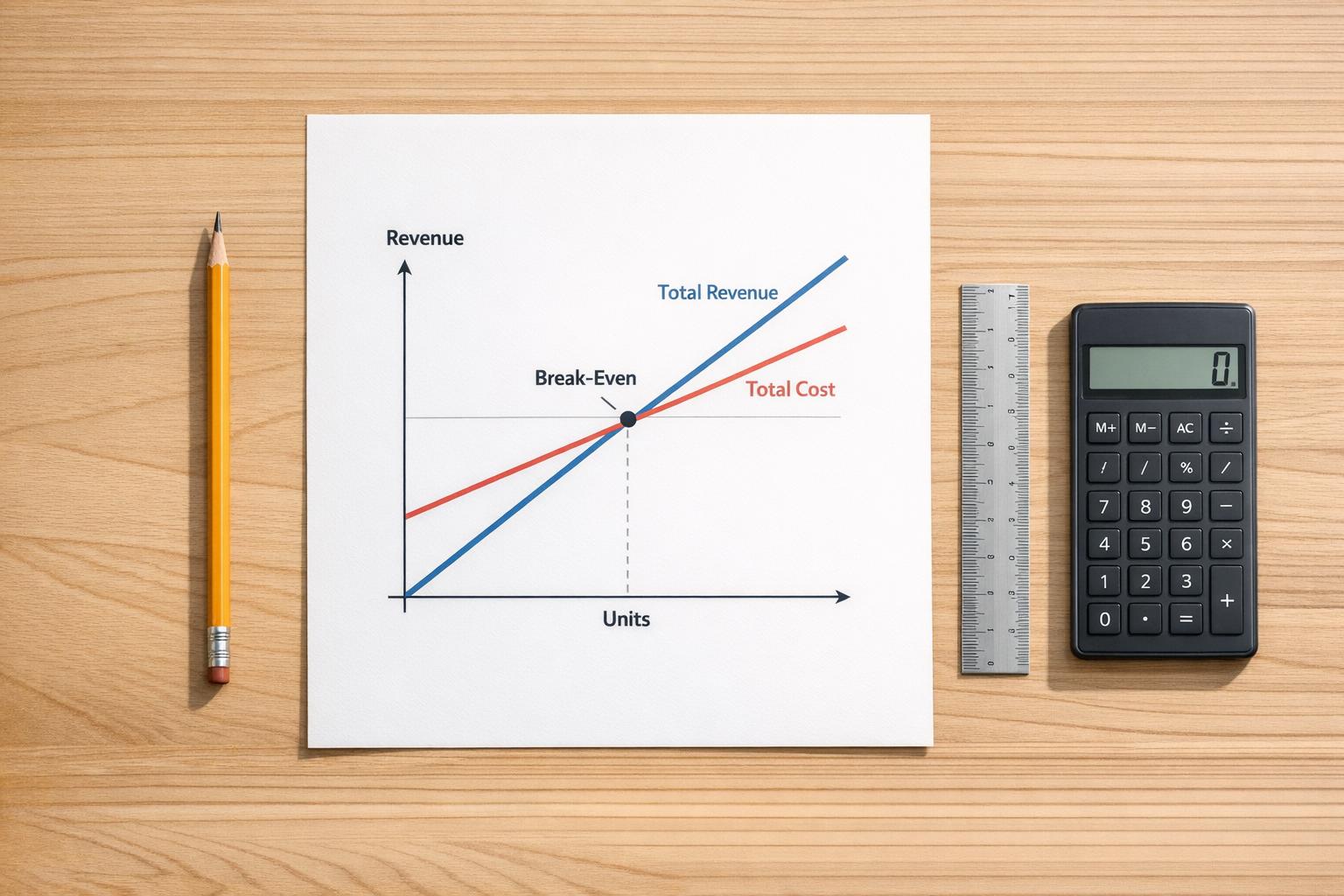
A break-even calculator helps you figure out the moment your business stops losing money and starts moving toward profit. By comparing fixed costs, selling price per unit, and variable cost per unit, you can quickly see how many sales are needed to cover your expenses. That makes this tool useful for product pricing, forecasting, and day-to-day planning.
This tool calculates your contribution margin per unit first, then uses that figure to estimate your break-even point in units and the revenue required to reach it. If your margin is too low—or negative—you’ll get a clear message instead of a misleading result. That matters, because unrealistic assumptions can throw off budgets and sales goals.
Whether you run a small business, launch products, or manage a side hustle, knowing your numbers helps you make smarter decisions. A reliable break-even analysis can show whether your current pricing works, how much room you have to absorb costs, and what revenue target makes sense. It’s a simple way to turn basic cost inputs into practical insight you can actually use.
Your break-even point is the point where total sales exactly cover total costs. You’re not losing money, but you’re not making a profit yet either. Once you sell beyond that point, each additional sale starts contributing to profit, assuming your costs stay the same.
That happens when your selling price per unit is equal to or lower than your variable cost per unit. In that case, your contribution margin is zero or negative, which means each sale is not generating enough money to help cover fixed costs. To reach break-even, you’d usually need to raise your price, lower your variable costs, or reduce fixed expenses.
Because in most real-world situations, you can’t sell a fraction of a unit. If the calculation says you need 127.2 units to break even, you’d need to sell 128 whole units to actually cover your costs. Rounding up gives you a practical target you can use for planning.