Published on
December 11, 2025

Rising energy costs are squeezing cash flows for U.S. businesses, especially those in growth stages or energy-intensive sectors like manufacturing. Here's what you need to know and do to protect your bottom line:
Bottom Line: Treat energy costs as a financial risk. By combining smarter planning with targeted efficiency improvements, you can safeguard cash flow, maintain profitability, and support growth even in volatile energy markets.
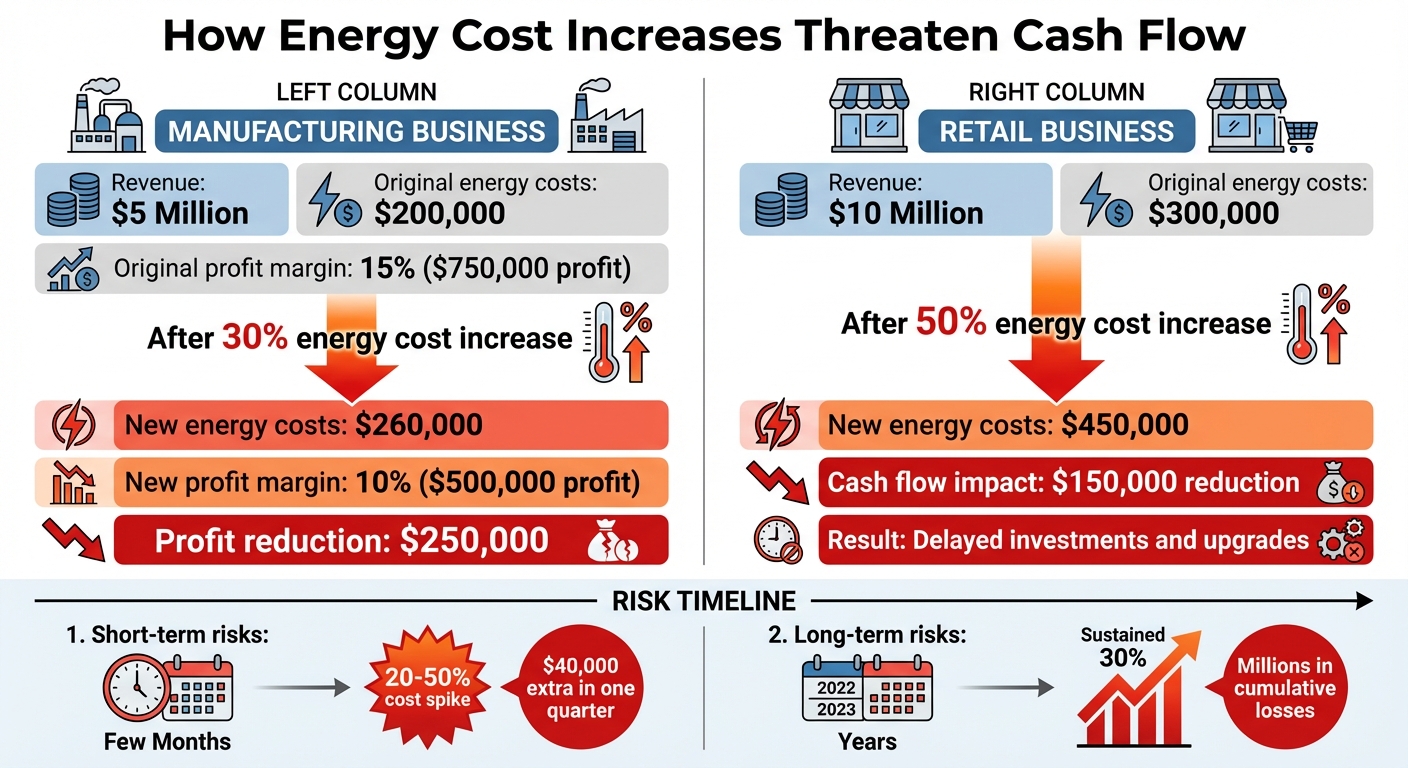
Energy Cost Impact on Business Cash Flow: Manufacturing vs Retail Examples
When energy prices surge, they can significantly increase operating expenses, cutting into margins and leaving less cash for essential needs. Take a manufacturing business with $5 million in revenue and a 15% margin - this translates to $750,000 in profit. If energy expenses climb from $200,000 to $260,000 (a 30% jump), margins shrink to 10%, reducing profit to $500,000 [1][2].
Retailers face similar struggles. A company earning $10 million annually might see energy costs spike by 50%, jumping from $300,000 to $450,000. That $150,000 increase can severely impact free cash flow, delaying necessary investments or upgrades [2].
These scenarios highlight how energy price volatility can create both short-term disruptions and long-term financial strain.
Short-term energy price spikes, often driven by seasonal demand or extreme weather, can push costs up by 20% to 50% over a few months. For some businesses, this might mean an extra $40,000 in expenses within just one quarter.
On the other hand, long-term price increases, caused by factors like policy shifts or supply shortages, can lead to sustained 30% cost hikes. These ongoing expenses don’t just strain annual budgets - they also force businesses to rethink multi-year strategies. Without careful planning, the cumulative impact of these increases can result in millions in cash flow losses over time.
For businesses, managing these challenges goes beyond plugging immediate budget holes - it’s about staying resilient in the face of prolonged cost pressures.
Growing a business often means a sharp rise in energy consumption. Expanding operations can triple or even quintuple energy use. Imagine a company scaling up, with utility bills jumping from $100,000 to $400,000. If their quarterly cash flow was $2 million, this sudden increase could turn it into a $500,000 deficit. And while expanded capacity might eventually lead to higher revenue, that growth often lags behind rising energy costs.
This mismatch between immediate energy demands and delayed revenue is especially challenging for energy-heavy industries like manufacturing. It underscores the importance of proactive planning to navigate these financial pressures [3].
After recognizing how rising energy costs can strain your cash flow, the next step is to dig into your historical expense data to uncover areas of concern.
Start by gathering 12–24 months of utility bills and fuel invoices. Organize the data in a spreadsheet, breaking it down by monthly energy expenses (including units and rates), revenue, production output, and operating income. Be sure to account for all energy sources like electricity, natural gas, and vehicle fuel [3].
With this data in hand, calculate the percentage of revenue spent on energy each month and chart the trends. Pay attention to warning signs such as energy costs rising faster than revenue for several months, sudden spikes in bills that disrupt payment schedules, or higher bills despite steady production levels [1][3]. In most industries, energy costs should typically stay below 5–10% of revenue. If you’re exceeding this range, it’s time for a closer look.
Once you’ve identified energy cost patterns, integrate these figures into your cash flow forecasts. Instead of grouping energy expenses under general overhead, give them their own line item in your weekly or monthly cash flow projections. To start, note when your bills are usually due - like the 15th of the month - and estimate baseline energy usage for each period based on past data. Keep in mind that heating and cooling demands often lead to higher costs during summer and winter months [1][2].
From there, create “what-if” scenarios to assess how changes in energy costs might affect your cash flow. For instance, calculate the impact of a 10–30% rate increase at contract renewal, increased demand from adding a shift or opening a new location, or reduced usage from efficiency improvements. Adjust your monthly energy expenses for each scenario to see how your cash balance and borrowing needs might shift [2]. If you need help designing these scenarios, Phoenix Strategy Group offers financial planning services tailored to these challenges.
These scenarios will give you a clearer picture of how energy costs directly influence your financial health.
To fully understand how energy expenses affect your bottom line, calculate metrics that tie energy costs to revenue-generating activities. For example, divide your total energy spend by the number of units produced to find the energy cost per unit, by the number of customers served to calculate cost per customer, or by billable hours to determine cost per hour [3][4]. Monitor these metrics over time and compare them across different products, locations, or teams.
If energy costs per unit rise but your prices don’t, it can lead to shrinking profit margins. Model potential margin compression by simulating 10%, 20%, and 30% energy cost increases [1][2]. This analysis will help you pinpoint which products, contracts, or customer groups could become unprofitable if energy prices spike. Armed with this knowledge, you can make informed decisions about process improvements, equipment upgrades, or pricing adjustments to protect your profitability.
Once you've pinpointed your energy cost challenges, it's time to put financial strategies in place that protect your cash flow and give you flexibility when energy prices fluctuate.
Start by building two essential forecasts: a 13-week cash flow forecast for short-term liquidity and a 12-month forecast for long-term planning. Make sure to list energy costs as a separate line item. Track unit prices (like $/kWh or $/therm), expected usage, and seasonal peaks. Update these forecasts monthly with data from recent bills and any planned efficiency projects. This detailed approach helps you identify when large energy bills might overlap with other major expenses, such as payroll or rent, so you can adjust payment schedules or negotiate extensions if necessary.
Stress-test your forecasts by modeling potential energy price increases of 20%, 50%, and even 100%. This will help you determine when you might need to adjust payments, tap into credit, or take other measures to maintain cash flow. For each scenario, check if you can still cover critical costs - like payroll, taxes, and debt service - and figure out how soon you might need to draw on reserves or credit lines. These insights can guide decisions such as locking in fixed-rate energy contracts, speeding up efficiency upgrades, adjusting pricing strategies, or delaying non-essential spending. For expert help, Phoenix Strategy Group offers fractional CFO and FP&A services that integrate energy costs into your broader financial planning.
Once your forecasts are updated, it’s time to take a closer look at your utility contracts for potential savings.
Review your utility contracts carefully. Look at renewal dates, termination clauses, and whether switching to fixed or partially hedged rates could save you money. Seek expert advice to compare available rate schedules. For instance, time-of-use plans could reduce costs if you shift energy-intensive operations to off-peak hours. Joining group purchasing programs is another option - pooling resources with other companies can lower unit costs without requiring upfront investments.
You can also explore operational adjustments, like moving energy-heavy processes to off-peak times, participating in demand-response programs that pay you for reducing load during peak hours, or consolidating operations to lower demand charges. Evaluate the potential annual savings of these options, considering any upfront costs or risks, and prioritize the ones that will have the biggest impact on cash flow. Once you renegotiate contracts or adjust tariffs, update your energy cost baseline in your profit and loss statement and cash flow forecast. Track monthly variances to ensure your savings are translating into real financial gains.
Keep cash reserves or undrawn credit available to cover several months of essential expenses in case energy prices spike significantly. A good rule of thumb is to model a "worst-case" scenario, such as a 50–100% increase in energy costs lasting 6–12 months. Make sure your reserves or credit can absorb these extra expenses without causing you to miss critical payments or violate financial covenants.
Your revolving credit facilities should also be set up to handle temporary cash flow pressures caused by higher utility bills, deposits for fixed-rate contracts, or collateral requirements. Regularly model key financial metrics - such as interest coverage, leverage ratios, and minimum liquidity thresholds - under stress scenarios, and negotiate extra flexibility with your lenders before conditions worsen. To avoid maxing out your credit lines, maintain some undrawn capacity and keep your bank informed about your energy cost management strategies. Advisory services like Phoenix Strategy Group can help you quantify funding needs, optimize your capital structure, and prepare lender presentations that highlight your risk management efforts.
Once cash flow forecasts are aligned and contracts renegotiated, operational improvements provide an immediate way to curb energy expenses. These changes not only reduce energy bills but also help safeguard cash flow through strategic adjustments and smarter practices.
Start with changes that cost little to nothing. Adjusting thermostats to 78°F in summer and 68°F in winter can reduce HVAC energy use by 1–3% per degree. Establish strict schedules to power down nonessential equipment after business hours, and ensure computers and task lighting are switched off when not in use. Regular HVAC maintenance - like cleaning filters, sealing leaks, and lubricating motors - keeps systems running efficiently. Installing occupancy sensors in low-traffic areas can cut lighting energy use by 20–80%, often paying for themselves in one to two years. Many U.S. utilities offer free or subsidized energy audits, making it easier to measure the impact of these simple adjustments [6].
Once these low-cost measures are in place, consider investing in targeted upgrades for deeper savings.
When capital investments are an option, prioritize upgrades with quick payback periods. For example, LED lighting retrofits can slash lighting energy use by 50–75% compared to older fixtures, often recouping costs within one to two years in commercial settings [5]. Upgrading to high-efficiency HVAC systems, such as ENERGY STAR-rated units with variable-speed drives, typically pays off within three to seven years. In energy-intensive operations, modernizing motors, compressors, and production equipment can significantly reduce energy consumption per unit produced, offering a buffer against rising energy prices. To evaluate the financial benefits, calculate the payback period using standard ROI methods. Additionally, many utilities and lenders provide rebates, on-bill financing, or performance contracts to lower upfront costs, while firms like Phoenix Strategy Group can help integrate these upgrades into broader financial strategies.
After implementing upgrades, ongoing monitoring is key to ensuring savings are realized and sustained.
Effective energy management starts with accurate measurement. Installing sub-meters on major energy loads - like HVAC, refrigeration, compressed air systems, or production lines - or by area (e.g., office versus warehouse) can reveal where energy is being used most heavily. Smart meters and data loggers, which track usage in intervals as short as 15 minutes, can identify peaks and inefficiencies. Even without sub-meters, a detailed review of utility bills - focusing on metrics like kWh, demand charges, load factors, and time-of-use rates - can uncover unusual patterns and justify targeted changes. Regularly tracking energy intensity metrics, such as kWh per square foot or per unit produced, helps differentiate real savings from normal fluctuations in production. Using simple dashboards or spreadsheets to display trends, assigning an energy or operations lead, and incorporating energy KPIs into management reviews ensures that operational changes translate into measurable improvements for cash flow and profit margins.
Rising energy costs are eating into profit margins, disrupting forecasts, and putting pressure on working capital. Many companies are now stuck with monthly billing due to recent contract renewals, making financial planning even harder [2]. In the U.S., energy-dependent industries are facing similar challenges, where once-stable overheads have become unpredictable, jeopardizing both profitability and growth. This uncertainty calls for immediate and coordinated financial and operational strategies.
The key lies in tackling the problem from both angles. On the financial side, steps like creating flexible cash flow forecasts, renegotiating contracts, and setting aside reserves for sudden cost spikes can provide much-needed liquidity. Operationally, actions such as upgrading to energy-efficient equipment, improving processes, and closely monitoring energy usage can help reduce consumption and deliver long-term savings. By combining these approaches, companies can address short-term cash flow issues while also fixing underlying inefficiencies. Testing cash flow scenarios before and after implementing these measures and prioritizing efficiency improvements early on can provide businesses with the flexibility they need [2]. In fact, this dual approach can lead to energy savings of 10–30%, all while building resilience against future cost swings [2].
To get started, assess where your vulnerabilities lie and take action. Conduct energy audits, renegotiate contracts, build financial reserves, invest in efficient equipment, and track key performance indicators. Companies like Phoenix Strategy Group can be a valuable resource, offering fractional CFO and FP&A services to help model energy risks, align financial goals with operational strategies, and turn energy management into a competitive advantage.
To manage sudden spikes in energy costs, businesses can take several practical steps to ease the financial burden. Start by diversifying energy sources - this could mean incorporating renewable options or relying on a mix of suppliers to reduce dependency on a single source. Negotiating fixed-rate contracts can provide stability by locking in predictable rates, while investing in energy-efficient equipment can significantly cut down on long-term operating expenses. Regularly monitoring energy usage is another smart move, as it helps pinpoint areas where savings can be made. For added protection, consider hedging strategies to navigate price swings more effectively.
On the financial side, having a solid plan in place is crucial to maintaining steady cash flow. Collaborating with seasoned financial advisors, like Phoenix Strategy Group, can make a big difference. They can develop customized strategies to help businesses manage energy costs and prepare for potential future price shifts.
Cutting down on energy costs doesn’t have to be expensive or complicated. Small changes, like replacing old bulbs with LED lighting, installing programmable thermostats, and keeping equipment in good working order, can lead to noticeable savings. Another smart move? Conduct an energy audit to pinpoint inefficiencies and identify areas where adjustments can make the most impact.
By taking these straightforward steps, businesses can lower energy use, keep expenses in check, and still run smoothly without sacrificing efficiency.
To manage energy costs effectively and maintain steady cash flow, businesses should make these expenses a core part of their budgeting and forecasting efforts. By leveraging data-driven insights, companies can fine-tune financial goals and adopt proactive measures - like improving energy efficiency or negotiating more favorable rates with suppliers.
Consistently reviewing energy expenses and updating forecasts helps keep financial plans precise and flexible. Connecting financial data with operational metrics can also sharpen decision-making and reduce the risks tied to unpredictable energy price changes.