Published on
January 2, 2026


Managing cash flow is a constant challenge for manufacturers. Unlike retailers, manufacturers invest in raw materials, labor, and production long before receiving customer payments. This delay creates pressure to balance supplier payments, payroll, and equipment costs. Tools like dashboards simplify this process by consolidating financial data for real-time insights. Here's a quick overview of three cash flow tracking methods:
Each method has its strengths and weaknesses, depending on your business needs. For growing manufacturers, automated tools like Klipfolio or Solver save time and improve decision-making by offering live data and advanced features.
Creating an Excel dashboard for manufacturing cash flow isn’t as simple as firing up a spreadsheet and plugging in numbers. It involves a three-tier structure: a Data Tab for raw inputs, a Calculation Tab to handle the behind-the-scenes processing, and a Dashboard Tab for visual presentation [6]. Before you even open Excel, there’s a lot of groundwork to cover - identifying your audience, selecting the right KPIs, and sketching out the layout. This planning phase is critical, but it’s also time-consuming [6].
Then comes the manual labor. Cleaning and organizing data can eat up as much as three days every month [6]. AG Capital puts it bluntly: "If you have to spend three days playing data janitor every month, manually cleaning and combining files, your dashboard will quickly become a monster you hate feeding" [6]. For manufacturers juggling metrics like Days Sales Outstanding (typically 40 to 50 days) and dealing with inventory where 20% to 30% is often dead stock [3], this process can drain time better spent on improving operational efficiency. While this setup is essential to get started, its manual nature makes it difficult to keep pace with real-time demands.
Excel dashboards come with a big limitation: they’re static. They tell you what happened, not what’s happening right now. Sure, tools like Power Query can automate parts of the data-cleaning process and offer a "Refresh All" button, but even this requires manual effort [6]. For manufacturers managing cash flow across multiple production runs, supplier payments, and customer invoices, these delays can leave you in the dark. By the time you’ve updated your spreadsheet, your cash position might already look very different.
Excel does offer flexibility, which can be a double-edged sword. You can calculate key manufacturing metrics like the Cash Conversion Cycle, Inventory Turnover, and Days Payable Outstanding. It’s also possible to build custom logic to track mismatches between material purchases and customer payments. But this flexibility comes with risks. Broken formulas, data entry mistakes, and fragmented information can lead to costly errors [6]. For smaller manufacturers - 93% of firms in the industry have fewer than 100 employees [8] - these mistakes can have an outsized impact.
One of Excel’s biggest drawbacks is its lack of native integration with ERP systems. Data has to be exported and then manually imported [6]. This process not only slows things down but also increases the chance of working with outdated information. As Paychex points out, "If you're still tracking cash flow with spreadsheets and manual processes, you know how time-consuming it can be - and how hard it is to get a clear picture of your working capital across multiple production runs, supplier payments, and customer invoices" [8].
Many manufacturers don’t fully leverage their ERP systems, missing the chance to pull real-time data on production costs and inventory levels directly into their financial reports [7]. These limitations highlight the need for more seamless and integrated tools, which will be explored in later sections.
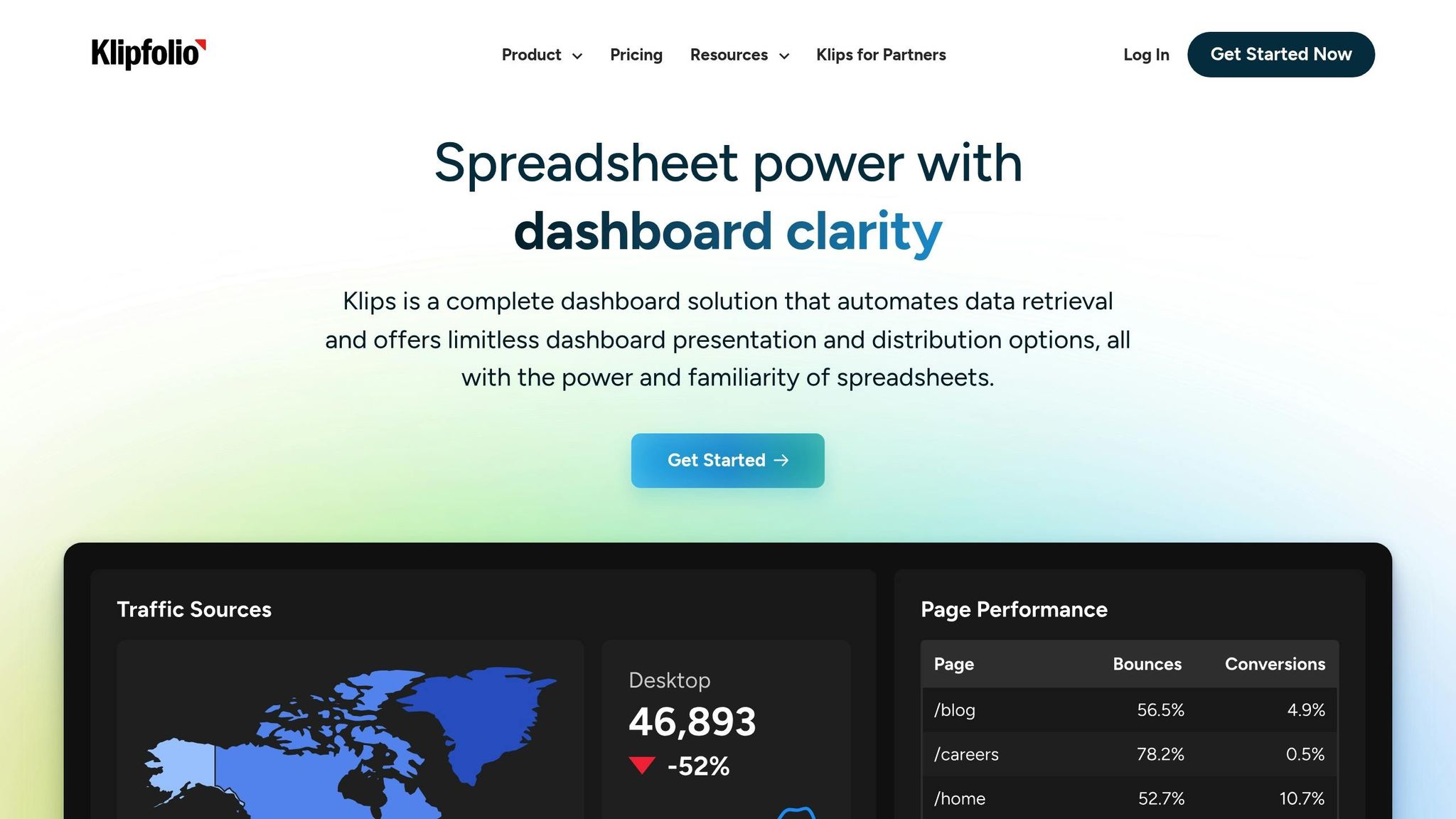
Klipfolio follows a "Connect, Build, Share" workflow, designed to be straightforward and accessible even for those without technical expertise [9]. With features like a Pre-Built Dashboard Gallery and ready-made client templates, manufacturers can quickly set up dashboards tailored to their needs [10]. Instead of starting from scratch, users can select manufacturing-specific templates and tweak them as necessary. For those seeking more advanced customization, options using CSS and JavaScript are available [9]. This approach simplifies the setup process while enabling robust, real-time cash flow insights.
Klipfolio goes beyond static solutions like Excel by offering automatic and scheduled data refreshes [10]. The platform handles an impressive 6.7TB of data daily, serving over 25,000 customers [10]. As Sebastián P., CPO at E-Planning.net, puts it:
"We upload daily data about our business and it's really helpful to get insights and monitor revenue in real-time" [10].
This real-time functionality allows manufacturers to monitor cash flow metrics on office TV dashboards or mobile apps, ensuring they can react quickly to any changes [9].
Klipfolio's manufacturing dashboards provide a comprehensive view of production facilities, powered by live data [12]. These dashboards track critical metrics like Overall Equipment Effectiveness (OEE), capacity utilization, inventory levels, and labor productivity - all of which directly affect cash flow [11][12]. For example, the Supplier Ledger Dashboard highlights opportunities for early payment discounts, while the Inventory Dashboard identifies when cash is tied up in surplus raw materials or finished goods [11]. Andrew W., Director at IT MOOTI, shares:
"I build dashboards for clients across many industries and it is by far the best tool I've come across for building KPI reports that are used daily and motivate teams" [10].
The platform also supports scenario planning, helping manufacturers map cash flow over time. This feature is particularly useful for timing significant expenses like equipment maintenance or bulk material purchases [11].
Klipfolio integrates with over 200 services, including SQL databases, REST APIs, Excel, and Google Sheets [10]. This eliminates the need for tedious manual data transfers. Manufacturers can consolidate data from ERPs, HRIS systems, and other sources into a single dashboard [9][10]. With 646 updates made in a single year, Klipfolio continues to refine and expand its integration capabilities [10]. By centralizing data from scattered spreadsheets and disconnected applications, the platform helps manufacturers spot inefficiencies and bottlenecks that might otherwise go unnoticed [12]. This seamless data integration delivers actionable insights, enabling better cash flow management.
Solver is a cloud-based Corporate Performance Management (CPM) solution designed to make life easier for manufacturing finance teams. With its "one-day deployment", it delivers around $100,000 worth of pre-built value through ready-to-use templates and reports [13]. This quick setup is a game-changer, especially for smaller manufacturers that often lack dedicated IT resources [1]. Plus, its spreadsheet-style interface feels familiar, reducing the learning curve while still offering powerful CPM tools. Compared to the lengthy and tedious manual setups often associated with Excel-based systems, Solver’s approach is a breath of fresh air.
Solver keeps things simple while delivering real-time cash flow insights, much like Excel and Klipfolio. Its cloud-connected platform ensures up-to-date visibility and integrates seamlessly with Microsoft Power BI for dynamic data visualization [19]. The centralized data warehouse pulls together information from multiple sources, making it easy to run what-if analyses and explore unlimited forecasting scenarios. This is particularly useful for tracking the cash conversion cycle - the time it takes to turn raw materials into cash from sales - allowing teams to spot and address bottlenecks before they escalate [1].
Solver caters specifically to manufacturing cash flow needs by tracking key metrics like category inventory value, monthly available versus sold trends, and net stock analysis [14][16]. Its Inventory Analysis Dashboards are especially handy for avoiding excess stock that ties up cash, by monitoring annual changes. For manufacturers with multiple plants, Solver offers benchmarking tools to compare order values and production metrics across locations [17]. On top of that, its Executive KPI Monitoring feature highlights variances between actual and budgeted revenues and Cost of Goods Sold (COGS), while also providing trends for top-performing products, customers, and suppliers [18].
Solver takes its real-time capabilities a step further by integrating directly with major ERP systems like Acumatica, Microsoft Dynamics 365 (Finance and Business Central), Sage (Intacct, X3, 100, 300, 500), SAP Business One, SAP ByDesign, and NetSuite. This connection allows it to automatically pull historical transaction data and create monthly cash flow forecast models [13][14]. Using "driver-based" forecasting, Solver generates projections for sales, payroll, and expenses based on specific operational assumptions [15]. By incorporating asset and liability accounts, it also helps manufacturers predict the timing of receivables and payables, making it easier to identify potential funding gaps [13].
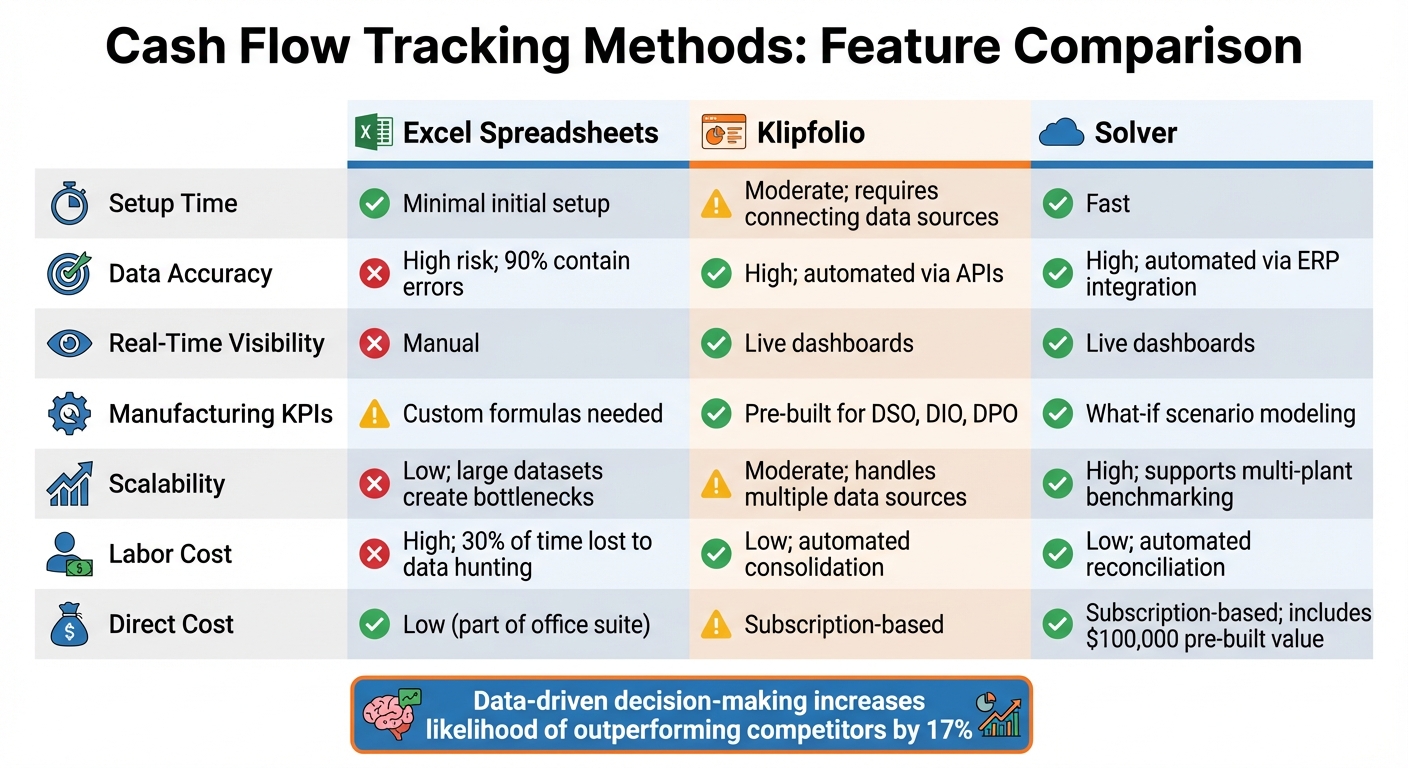
Cash Flow Tracking Tools Comparison: Excel vs Klipfolio vs Solver for Manufacturing
Let’s break down the practical trade-offs between different cash flow tracking methods, building on the detailed reviews mentioned earlier.
Excel is a go-to tool for many due to its flexibility, but it comes with significant drawbacks. Studies show that nearly 90% of spreadsheets contain errors, and employees can lose up to 30% of their workweek trying to track down and correct data issues [20]. Daniel Shorstein from James Moore Digital puts it bluntly:
"Spreadsheets aren't systems. They're stopgaps. And in 2025, they're costing mid-market companies and nonprofits more than they realize: lost time, fractured data, compliance risks and bad decisions." [20]
On the other hand, tools like Klipfolio and Solver tackle these inefficiencies through automation. While they require a higher upfront investment, automation can improve reporting efficiency by up to 90% [20]. This shift allows teams to focus on forward-looking strategies instead of reconciling outdated data - a critical advantage for manufacturing operations where tight cash flow timelines demand agility.
Here’s a side-by-side comparison of key features:
| Feature | Excel Spreadsheets | Klipfolio | Solver |
|---|---|---|---|
| Setup Time | Minimal initial setup | Moderate; requires connecting data sources | Fast |
| Data Accuracy | High risk; 90% contain errors [20] | High; automated via APIs | High; automated via ERP integration |
| Real-Time Visibility | Manual | Live dashboards | Live dashboards |
| Manufacturing KPIs | Custom formulas needed | Pre-built for DSO, DIO, DPO [5] | What-if scenario modeling |
| Scalability | Low; large datasets create bottlenecks [4] | Moderate; handles multiple data sources | High; supports multi-plant benchmarking [17] |
| Labor Cost | High; 30% of time lost to data hunting [20] | Low; automated consolidation | Low; automated reconciliation |
| Direct Cost | Low (part of office suite) | Subscription-based | Subscription-based; includes $100,000 pre-built value [13] |
The right choice depends on the size of your operation and the complexity of your data environment. For companies relying on data-driven decision-making, the odds of outperforming competitors increase by 17% [5]. As production scales, investing in automated platforms like Klipfolio or Solver becomes harder to overlook. These tools not only streamline cash flow tracking but also provide a foundation for smarter, faster decisions - something Phoenix Strategy Group leverages by combining cutting-edge technology with strategic expertise.

Phoenix Strategy Group (PSG) tackles the challenge of cash flow visibility in manufacturing by focusing on three key areas: real-time data integration, workflow automation, and proactive monitoring systems.
To provide manufacturers with up-to-date financial insights, PSG uses API synchronization to connect live financial data seamlessly. By linking bank and accounting APIs to custom dashboards, they deliver real-time cash balances and transaction data. For manufacturers managing multiple entities, PSG addresses issues like mismatched Charts of Accounts and foreign exchange complexities, making consolidated reporting automatic and far less cumbersome [21].
Their Monday Morning Metrics system helps manufacturers shift from reactive decision-making to forward-thinking strategies. This weekly tracking tool monitors critical metrics like inventory days on hand, work-in-progress aging, accounts receivable aging, and the overall cash conversion cycle [7]. As Gene Godick, Outsourced CFO, puts it:
"Cash isn't just king - it's the lifeblood that keeps production lines running, inventory stocked, and innovation possible" [7].
By updating a rolling 13-week cash flow forecast every week, manufacturers can identify potential cash flow gaps early and take action before they become serious issues [7].
PSG also enhances cash flow management through ERP integration support, streamlining the quote-to-cash process. By connecting ERP and CRM systems, they automate accounts receivable and accounts payable workflows, reducing Days Sales Outstanding and unlocking working capital [21]. This automation enables real-time variance analysis, linking financial performance directly to production-floor decisions - an essential capability for manufacturers dealing with payment delays ranging from 30 to 90 days [7].
The result is a unified system where production planning and cash forecasting work hand in hand. PSG's data engineering ensures real-time integration, so operational changes - from raw material purchases to shipments of finished goods - are immediately reflected in the cash position [21]. This alignment helps manufacturers maintain liquidity while keeping production on track.
Choosing the right cash flow tool depends on the scale and complexity of your manufacturing operations. For startups experimenting with initial models, Excel might be a practical choice. However, as operations grow, manual data entry can quickly become a bottleneck. Mid-sized manufacturers often benefit from automated, real-time tools like Klipfolio and Solver, while larger firms operating across multiple entities may require API-based platforms, despite the challenges of ERP integration [2]. Still, selecting the right tool is just one piece of the puzzle - understanding the nuances of manufacturing cash flow is equally critical.
In the U.S., most manufacturers are small-scale, yet they manage significant capital tied up in raw materials, work-in-progress, and receivables. Navigating these challenges effectively can make a huge difference. Data-driven decision-making, for example, has been shown to give organizations a 17% higher likelihood of outperforming their competitors [5]. This advantage comes from focusing on key metrics like Days Sales Outstanding (DSO), inventory turnover, and the cash conversion cycle - going beyond simply automating spreadsheets. As Samantha Cassidy, FP&A Lead at Empower Healthcare Solutions, puts it:
"It saves me so much time and having that version control allows us to stop having potentially catastrophic mistakes ever happening again" [22].
For manufacturers in the growth stage, tailored financial solutions are essential for addressing the disconnect between profitability and liquidity. Increased sales often lead to higher inventory and receivables, which can create cash flow challenges during periods of rapid growth. By leveraging integrated dashboards that link production planning with cash forecasting, companies can ensure their manufacturing commitments align with available working capital [7]. Bridging this gap is vital for achieving sustainable growth.
The transition from reactive accounting to proactive financial management is what separates manufacturers who merely survive from those poised for long-term success. Whether through advanced automation platforms or specialized advisory services like those provided by Phoenix Strategy Group (https://phoenixstrategy.group), the ultimate goal is the same: turning financial data into actionable insights that keep operations running smoothly and innovation thriving.
Klipfolio makes it easier for manufacturers to stay on top of their cash flow by offering real-time access to financial data. It connects effortlessly with spreadsheets, accounting software, and other essential tools, removing the hassle of manual reporting.
Its user-friendly visual dashboards allow CFOs to spot trends, predict cash flow, and make quick, well-informed decisions to strengthen liquidity. This efficient system helps businesses maintain control over their financial health and tackle challenges with greater assurance.
Solver takes the hassle out of cash flow management by moving away from manual Excel workflows to an automated, cloud-based solution. Instead of spending time building sheets, writing formulas, and updating data by hand, Solver integrates directly with your accounting systems and banks. It automatically reconciles transactions and stores everything in a centralized database.
With Solver, you can quickly generate unlimited what-if scenarios and forecasts - no need to rewrite or tweak formulas. Its real-time dashboards deliver clear, visual insights into your cash position, receivables, payables, and financial runway. This means faster decisions, greater accuracy, and seamless collaboration for finance teams - all without the repetitive tasks that come with spreadsheets.
Real-time data integration gives manufacturers instant access to up-to-date details about production, inventory, receivables, and payables. This allows businesses to keep a close eye on their cash position, spot timing gaps between income and expenses, and make swift decisions to keep their cash flow steady.
Having these insights on hand helps manufacturers tackle potential cash shortages before they become an issue, fine-tune payment schedules, and enhance their financial planning. In a fast-moving industry, this kind of visibility is crucial for staying flexible and responsive.