Published on
May 20, 2026


Cloud bookkeeping simplifies financial preparation for mergers and acquisitions (M&A) by organizing data, automating tasks, and providing real-time insights. Poorly managed financials can delay deals or reduce valuations. Cloud systems address key challenges like fragmented data, missing documentation, and compliance issues, ensuring businesses are ready for scrutiny during due diligence.
Key Benefits of Cloud Bookkeeping for M&A:
M&A transactions require meticulous financial preparation. The financial scrutiny involved is intense - buyers and their advisors often request over 200 specific data points [2]. If your systems can’t produce well-organized data quickly, the deal can stall or even collapse. Interestingly, the problem isn’t always about the data itself but how it’s managed.
"The most common deal delays are caused by the seller's inability to produce requested data, not by what the data shows." - Onetribe Advisory [2]
Understanding these challenges is essential because they highlight where cloud-based systems can bring efficiency and clarity to the process. Often, a fractional CFO is the one who implements these systems to ensure the business is deal-ready.
Legacy systems and scattered spreadsheets often leave financial data fragmented. For example, when a buyer requests three years of monthly management accounts with detailed customer-level revenue breakdowns, manually consolidating this information can take weeks. Even then, the results are often inconsistent.
This inconsistency can have a direct impact on valuation. Discrepancies between profit and loss (P&L) statements and actual bank deposits can skew Seller's Discretionary Earnings (SDE), which is the cornerstone of a credible valuation [3]. Buyers spotting these gaps rarely give sellers the benefit of the doubt; instead, they apply a discount. For instance, if a business with $2 million in EBITDA is selling at a 6x multiple, even a 10% discount could cost the seller $1.2 million [2].
Such data fragmentation also leads to deeper challenges in documentation and compliance.
Traditional systems often record transactions without capturing the reasoning behind them. This becomes a major issue during due diligence. Buyers need to confirm that reported earnings are both real and sustainable. That means every adjustment to EBITDA must be backed by proper documentation - like lease agreements, board meeting minutes, contracts, or invoices.
Without such documentation, adjustments are likely to be rejected. Common EBITDA add-backs, such as owner-related expenses, one-time restructuring costs, and non-recurring items, are only accepted if they’re well-documented [2]. Missing paperwork forces sellers into a reactive scramble to piece together data, which signals disorganization to buyers and can erode their confidence in the deal.
These documentation issues only get worse when compliance with GAAP standards is required.
In the world of M&A, compliance with U.S. GAAP is not optional. Buyers - particularly private equity firms and strategic acquirers - expect financial statements that adhere to consistent accounting standards, including proper revenue recognition under ASC 606. Businesses relying on manual or outdated systems often recognize revenue on a cash basis or use inconsistent methods across reporting periods, raising immediate concerns.
The issue is compounded when revenue isn’t tagged at the invoice level. Without granular tagging, it becomes difficult to separate recurring revenue from one-time sales - a distinction that directly impacts valuation multiples [3]. Attempting to reconstruct this data manually during due diligence is not only time-consuming but also prone to errors, further damaging buyer trust.
"Due diligence does not test whether your business is good - it tests whether your financial data proves it." - Onetribe Advisory [2]
Legacy financial systems often lead to fragmented data, missing documentation, and compliance gaps. Cloud bookkeeping addresses these challenges by turning disorganized processes into efficient, compliant systems.
For businesses with multiple entities, locations, or subsidiaries, consolidating financials is one of the toughest parts of preparing for a deal. Cloud platforms simplify this by centralizing all financial data, making consolidation an automated feature instead of a painstaking manual task.
Finance teams can produce consolidated reports on demand, using a standardized chart of accounts across all entities. This ensures revenue, expenses, and margins are reported consistently - exactly what buyers need to evaluate performance across periods without questioning the numbers.
"As we implement a new ERP, we use it as an opportunity to merge the businesses together from a business process standpoint and pull the entities together into the same room to talk through and enumerate their processes." - Stephen Wolff, Managing Partner & Solution Architect at Myers-Holum [1]
Cloud bookkeeping platforms also automate accounting rules for every transaction, ensuring revenue is recognized accurately and consistently. This is especially valuable for companies with subscription models, milestone-based contracts, or multi-element arrangements. Automation reduces the need for manual adjustments and clearly distinguishes recurring revenue from one-time sales - key details buyers scrutinize during due diligence.
Every transaction in a cloud system is logged with a timestamp, user ID, and edit history. Supporting documents like contracts, invoices, board minutes, and lease agreements are attached directly, eliminating the scramble to gather data later. If a buyer asks about a specific journal entry from a previous quarter, the answer is already documented in the system - not buried in email threads. This level of organization signals professional management and directly supports M&A due diligence.
"Cloud ERP systems serve as a 'strong anchor' for business integration by identifying process gaps and hidden financial issues before a transaction is finalized." - Stephen Wolff, Managing Partner & Solution Architect, Myers-Holum [1]
For M&A readiness, having access to real-time data is just as important as maintaining historical accuracy. Buyers want more than past financials; they want assurance that the business is thriving in the present. Cloud bookkeeping platforms deliver live data to KPI dashboards, giving management a continuous view of critical metrics like gross margin, customer acquisition cost, and churn. This transparency builds buyer confidence throughout the deal process.
Phoenix Strategy Group integrates these dashboards into their bookkeeping and fractional CFO services, ensuring clients have reliable, up-to-date numbers when deal discussions begin. With weekly financial snapshots - such as their "Monday Morning Metrics" - management can confidently engage in buyer conversations backed by real-time data.
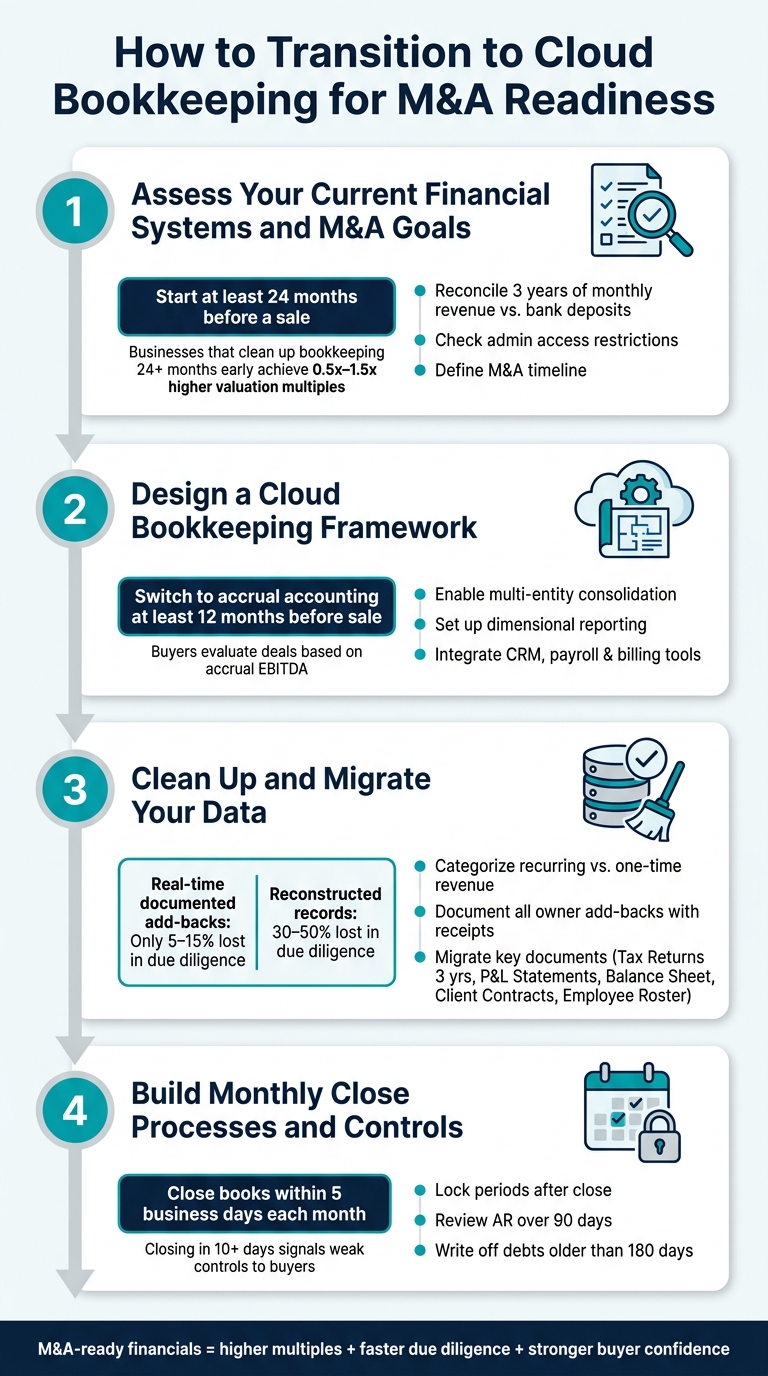
Cloud Bookkeeping for M&A Readiness: 4-Step Transition Guide
Switching to a cloud-based bookkeeping system can feel overwhelming, but with the right steps, it can be a smooth and efficient process.
Start by taking a hard look at your current financial setup. Are your records stored in a legacy desktop program, spreadsheets, or an existing cloud platform? This will give you an idea of how complex and costly the migration might be. A good first step is reconciling the last three years of monthly revenue against your bank deposits. This will help uncover any discrepancies before a potential buyer does. Also, check if administrative access to your accounting files is restricted to a single person - this could create risks during a handoff that need to be addressed before you move forward.
At the same time, think about your M&A timeline. If you're planning to sell within the next two years, you should act now. Businesses that clean up their bookkeeping at least 24 months before a sale often achieve valuation multiples that are 0.5x to 1.5x higher than those who rush to prepare [4]. This initial evaluation lays the groundwork for a successful transition to the cloud.
Once you understand your current system, it's time to design a cloud-based framework that fits your M&A goals. This isn't just about day-to-day accounting - it’s about creating a system that supports your broader objectives. Consider features like multi-entity consolidation, dimensional reporting (breaking down data by product line, location, or customer segment), and integration with tools like your CRM, payroll, and billing systems.
If you're still using cash accounting, switch to accrual accounting as soon as possible. Buyers evaluate deals based on accrual EBITDA, so making this change early - ideally at least 12 months in advance - allows time for seasonal adjustments [4].
Phoenix Strategy Group specializes in helping growth-stage companies design bookkeeping systems tailored for M&A. Their services include accrual conversion, standardizing charts of accounts, and setting up KPI tracking.
Data integrity is critical during the migration process. Start by cleaning up your records and ensuring everything is accurate. Clearly categorize your revenue streams - distinguish recurring retainer income from one-time projects and seasonal revenue. How you classify these will directly impact how buyers view your cash flow stability and your valuation.
Document all owner add-backs and discretionary expenses in advance. Each add-back should be supported by a receipt and a written explanation stored in the system. Sellers who document add-backs in real time typically lose only 5–15% of them during due diligence, compared to 30–50% for those relying on reconstructed records [4].
Finally, organize and migrate key documents into your new system to ensure they’re accessible during due diligence. Here’s a quick reference for what to include:
| Document Type | Required Detail |
|---|---|
| Tax Returns | 3 years of business returns (Schedule C or Form 1120) |
| P&L Statements | Last 3 years with monthly detail |
| Balance Sheet | Current version, including accounts receivable aging |
| Client Contracts | All active subscriptions and recurring agreements |
| Employee Roster | Tenure, title, and compensation details |
Once your system is set up, maintaining it is key. Aim to close your books within five business days each month. Taking longer than ten days could indicate weak controls.
"The standard for LMM-target businesses is a 5-business-day close. Some businesses can compress to 3 days; some take 10. Anything longer than 10 days signals weak controls." - Christoph Totter, Managing Partner, CT Acquisitions [4]
After closing a period, lock it in the system. Retroactive adjustments can raise red flags during due diligence. Keep a close eye on accounts receivable - anything over 90 days should be reviewed, and debts older than 180 days should be written off as bad debt before a buyer's Quality of Earnings team examines them [4]. These disciplined processes ensure your financials remain buyer-ready throughout the M&A process.
Once your cloud bookkeeping system is in place, its benefits extend well beyond the initial preparation stage, playing a crucial role throughout every phase of the M&A process.
A cloud platform simplifies the creation of on-demand, standardized financial reports. By using a consistent chart of accounts and reporting structure, you can avoid the hassle of reformatting data when buyers request detailed records, such as several years' worth of monthly profit and loss statements or a revenue breakdown by customer segment. This uniformity is key for tracking critical KPIs - metrics like revenue, margin, and retention remain consistent month after month. This clarity allows buyers to evaluate your business more efficiently and with greater confidence. Ultimately, this level of organization can make the due diligence process far smoother.
Financial due diligence is often where deals hit roadblocks - not necessarily because the numbers are problematic, but because sellers struggle to provide the requested information in a timely manner. A cloud-based system eliminates these delays by centralizing all transaction data, audit trails, and supporting documents. Buyers can quickly verify revenue reconciliation, review documented standard operating procedures (SOPs), and assess the platform's transferability without waiting on manual data exports. A proactive step to take early in the process is confirming that administrative access and subscriptions for your cloud platform can be transferred to the buyer without requiring a full migration. Addressing this detail upfront can save critical time during the closing phase [3].
Even after the deal closes, your cloud system continues to provide value by helping the new owners get up to speed with the business’s financials. Thanks to the system's real-time metrics and data accuracy, features like invoice-level tagging by customer segment or product line enable immediate post-merger analysis. Additionally, having 24 to 36 months of detailed, consistent management accounts gives both parties a solid baseline for resolving working capital settlement disputes [2]. Firms like Phoenix Strategy Group specialize in helping growth-stage businesses maintain this level of financial clarity, ensuring that records are transaction-ready from the first negotiation to the final stages of integration.
Cloud bookkeeping has reshaped the way businesses prepare for mergers and acquisitions (M&A), making the process smoother and more forward-thinking.
Achieving M&A readiness demands consistent financial discipline. By adopting cloud bookkeeping early, businesses can act quickly when opportunities arise - whether that’s attracting buyers, closing acquisitions, or managing post-merger integration.
Having clean and easily accessible financial records minimizes obstacles at every stage of the transaction. Centralized accounts and detailed audit trails ensure that financial preparedness becomes a natural part of running your business, rather than a rushed, last-minute effort.
"By understanding these and other challenges up front and by addressing them early, the odds of a successful M&A scenario can increase significantly." - Stephen Wolff, Managing Partner & Solution Architect, Myers-Holum [1]
Cloud bookkeeping also demonstrates operational maturity. With features like documented standard operating procedures (SOPs), transferable platform access, and real-time KPI dashboards, businesses reduce their reliance on key personnel. Companies that implement these systems often achieve higher valuation multiples as a result [3]. This level of preparedness enables smoother, more confident deal execution.
If you’re planning an M&A transaction within the next 12 to 36 months, now is the time to adopt these cloud solutions. Phoenix Strategy Group partners with growth-stage companies to build the financial foundation necessary for successful exits. From bookkeeping and fractional CFO services to comprehensive M&A advisory, implementing strong financial systems early can significantly enhance valuation and readiness for the deal.
Transitioning to a cloud-based bookkeeping system well in advance of starting the exit process can make a world of difference. It ensures your financial data stays accurate, well-organized, and ready to scale as needed. While sell-side due diligence usually kicks off 30–60 days before listing, adopting cloud systems earlier helps you maintain clean records, monitor essential metrics, and steer clear of unexpected issues when buyers start digging into the details. Phoenix Strategy Group highlights that early preparation is key to simplifying M&A processes.
When getting ready for mergers and acquisitions, it's essential to have all your key financial and operational documents stored securely in your cloud system. These documents should include income statements, balance sheets, cash flow reports, tax filings, and any public reports such as 10-Ks and 10-Qs.
Additionally, make sure to keep transaction records, audit trails, and original metadata intact to maintain data accuracy and integrity. To simplify due diligence and ensure smooth reporting, organize invoices, receipts, and contracts in a well-structured hierarchy. A clear system not only saves time but also helps present your business in the best possible light.
Cloud bookkeeping makes a Quality of Earnings (QoE) review much smoother by consolidating precise, real-time financial information in one place. These platforms handle tasks like categorizing transactions and reconciling bank accounts automatically, ensuring the records are consistent and ready for audits. This streamlined approach helps pinpoint recurring revenue, supports the justification of add-backs (like owner compensation or one-time expenses), and aids in calculating normalized EBITDA - offering clarity and minimizing mistakes during due diligence.