Published on
January 5, 2026


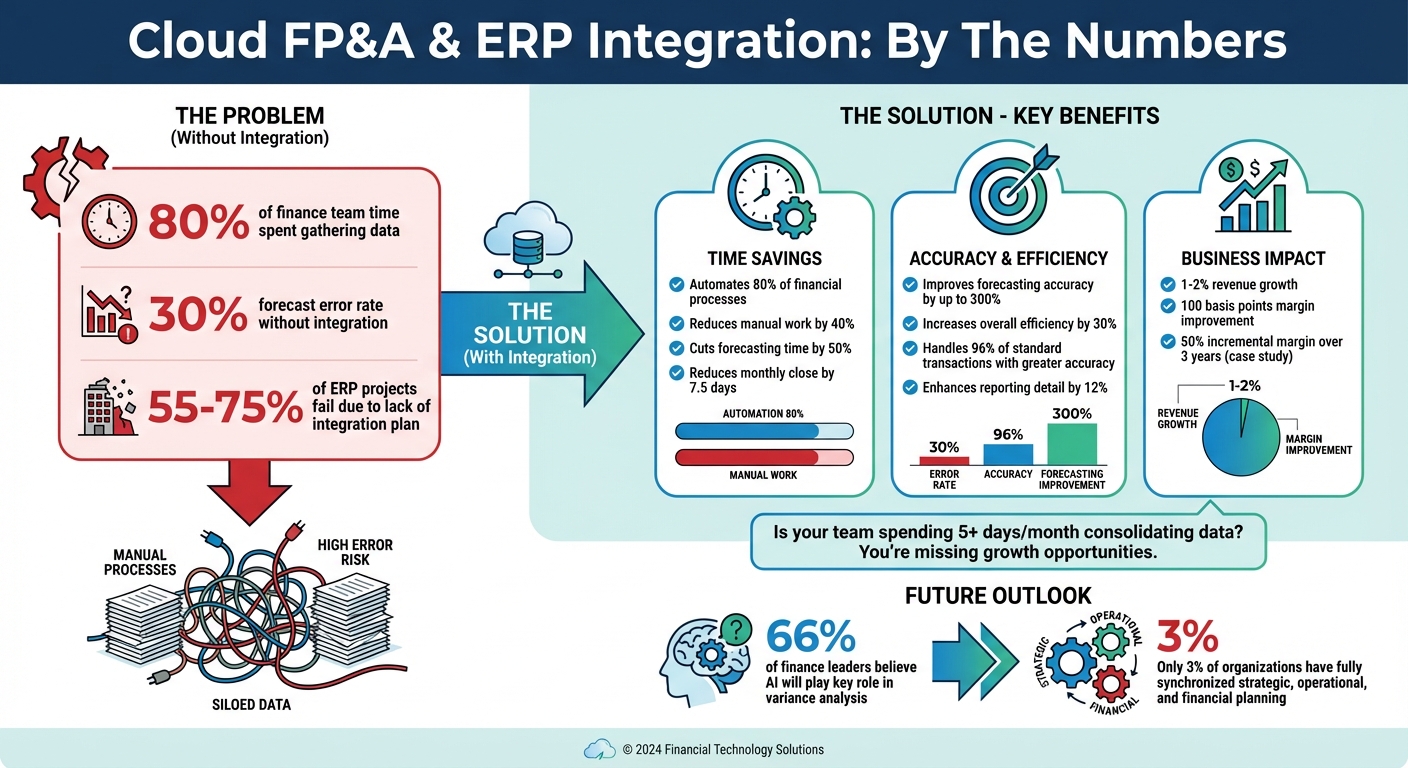
Cloud FP&A and ERP integration solves a common problem: disconnected systems that waste time and create errors. Finance teams often spend 80% of their time gathering data, delaying decisions by weeks and leading to forecast errors up to 30%. By linking these tools, businesses streamline processes, automate tasks, and improve forecasting accuracy by up to 300%.
Integrated platforms simplify compliance, enhance reporting, and allow finance teams to focus on strategy rather than repetitive tasks. This shift is critical for growth-stage companies managing complexity, such as multi-entity operations or M&A scenarios. If your team spends more than five days consolidating data each month, you’re likely missing opportunities to act faster and smarter.
Cloud FP&A and ERP Integration Benefits: Key Statistics and ROI Metrics
When ERP and FP&A systems operate independently, finance teams are often stuck manually reconciling data. This slows down analysis and creates inefficiencies. But integration changes the game. Daniel Habrunner, Senior Manager at Walldorf Consulting, describes it as:
"That's the ERP alchemy - bringing every perspective together so the organization can act faster, smarter, and with total confidence" [4].
By connecting these systems, organizations not only unify their data but also see measurable efficiency improvements.
ERP systems are great at tracking transactions and maintaining audit trails, but they often fall short when it comes to predictive analytics and scenario planning [3]. This limitation is a key reason why 55% to 75% of ERP projects fail to meet their goals - many lack a clear integration plan with FP&A [3]. However, when these systems are linked, they can automate over 80% of financial processes and handle up to 96% of standard transactions with far greater accuracy than manual methods [6].
Data silos don't just slow down reporting; they create mistrust across departments. When finance, IT, and HR rely on different versions of data, decision-making becomes fragmented. Integration solves this by establishing a single source of truth that updates automatically across the organization [8]. Len Reo, President of Attivo Group LLC, highlights this benefit:
"Without silos, information is passed around easier, making data available in real time" [5].
The advantages are immediate. For example, payroll data no longer needs to be manually shared between HR and accounting. Instead, a single data entry point updates the entire system automatically [5]. This automation extends to other processes like invoice management, cash forecasting, and intercompany journals - replacing manual spreadsheet tasks [6]. Maria Opre, Senior Analyst at EarthWeb, puts it plainly:
"Integrations directly save money by automating manual processes. This prevents duplication of efforts, eliminates errors that would require rework and reduces labor costs" [5].
By removing silos, organizations lay the groundwork for faster and more accurate financial forecasting.
With unified data and real-time updates, businesses can respond to market changes faster. In one 2022 example, integrating 12 key business factors reduced forecasting time by 50%, leading to 1–2% growth and a 100-basis-point margin improvement [2].
Consider an industrial manufacturer whose FP&A team collaborated with sales and R&D to integrate market growth and product adoption data. This allowed them to shift capital toward higher-growth platforms, achieving double-digit growth rates and a 50% incremental margin over three years [2]. These successes reflect an industry move toward "continuous planning", where forecasts update dynamically with each new transaction instead of waiting for month-end closes [7].
Finance leaders are taking notice. In fact, 66% believe that generative AI will soon play a key role in explaining forecast and budget variances [3].
When FP&A tools directly link to ERP systems, finance teams unlock advanced capabilities that streamline and enhance financial operations. These modern platforms use both standard and custom connectors to integrate ERP, CRM, HRIS, and general ledger systems seamlessly [10][13]. By eliminating the need for manual data extraction and cleaning, these tools provide a solid foundation for a range of transformative features.
Continuous, rolling forecasts are one standout feature, replacing outdated static annual budgets. As Oracle describes:
"The digital economy demands more than spreadsheets and department-oriented planning processes. Connect every part of your business on a planning platform that is fully integrated across finance, operations, and lines of business." [9]
With real-time data access, finance teams can monitor financial performance as transactions happen, enabling them to respond immediately to market changes [9][10]. AI and machine learning enhance predictive and driver-based planning by identifying patterns in historical data, connecting operational metrics to financial outcomes [9][11]. Cloud-based platforms further improve collaboration by allowing budget contributors across departments to input their data while finance teams maintain control over versions and data integrity [10]. This is especially critical for growth-stage businesses that need to adapt quickly to volatile market conditions [11]. These real-time capabilities pave the way for automated consolidation and more effective scenario analysis.
Manually consolidating data across multiple entities can be a tedious process. Integrated platforms simplify this by standardizing data formats - such as currencies, dates, and account structures - greatly reducing the time needed to close monthly books and produce reporting packages [10][11]. Automation also strengthens audit readiness by creating centralized, clean audit trails that make it easier to track transactions and user access, ensuring regulatory compliance [1][3].
Robert Gilbert, VP of Finance at a growth-stage company, highlights this efficiency:
"Cube has allowed the team to spend more time analyzing the data and less time compiling data. We have our CRM, HRIS, financial, and budget data in one place and standardized..." [12]
With a unified data foundation, direct ERP integration supports detailed "what-if" analyses [10][3]. This allows finance teams to assess the financial implications of strategic decisions - whether it’s evaluating an acquisition, timing capital investments, or testing profitability under various revenue scenarios [9]. Brad Schomber, CFO at Spoonflower, emphasizes the value:
"Our budgeting and forecasting process is more efficient and quicker with FutureView. It takes up less time of our top managers and promotes more conversations with better information from our team to make better and quicker decisions." [10]
Additionally, integrated data from systems like HRIS and CRM enables companies to model beyond just finance. For example, teams can analyze customer trends, vendor relationships, and workforce dynamics to adapt to market changes with agility. This connected planning approach ensures that scenario models are built on the most up-to-date information, reducing risks and speeding up decision-making [9][3].
When integrated budgeting meets scenario analysis, strong data governance becomes the backbone of decision-making. Accurate, real-time data ensures that every choice is informed and reliable. By linking FP&A and ERP systems, businesses establish a single source of truth - eliminating the headaches caused by mismatched spreadsheets and duplicate entries. This centralized system not only improves daily operations but also builds a solid foundation for advanced forecasting and strategic planning.
Integrated systems connect your ERP (the financial book of record) with CRM, HRIS, and other operational tools, allowing data like inventory updates, purchase approvals, and customer records to flow seamlessly [1]. With two-way integration, any updates made in sales or operations are instantly reflected in forecasts [1].
The benefits are clear. This kind of integration can increase overall business efficiency by as much as 30% while preventing costly data mismatches [1]. Modern platforms use data mapping to align fields across systems - for example, ensuring "customer ID" in your ERP matches "user ID" in your CRM [1].
McKinsey highlights that top-performing FP&A teams now rely on data lakes or warehouses to consolidate general-ledger data with non-financial information from HR, sales, and inventory systems. This creates a consistent, validated fact base for decision-making [2]. Such a setup ensures that everyone, from finance to operations, uses the same accurate data - an essential step when only 3% of organizations have fully synchronized their strategic, operational, and financial planning processes [14].
Manual compliance processes can be tedious and prone to errors. Integrated platforms solve this by automatically tracking every transaction, user access, and process change in real time [1]. Automated audit trails provide a transparent record, ensuring the business is always prepared for audits [1].
Cloud-based systems also simplify compliance by automatically updating regulations and using business rules engines to reduce errors. This can shorten the monthly close process by 7.5 days while enhancing reporting detail by 12% [17][18][15]. For growth-stage companies without dedicated compliance teams, this automation is a game-changer.
PwC emphasizes the transformative potential of these systems:
"Validation, standardization and governance can evolve from time-consuming and chaotic tasks into a powerful framework for driving business decisions" [16].
With this streamlined governance in place, businesses are well-positioned to explore use cases tailored to growth-stage companies in the next section.
Growth-stage companies encounter challenges that can be effectively tackled with integrated FP&A and ERP systems. As these businesses expand - whether through acquisitions or entering new markets - they require tools that offer real-time insights and adaptability. By merging live ERP data with advanced FP&A modeling capabilities, companies can better handle complexities and make informed decisions on the fly.
With enhanced data flow and forecasting capabilities, these integrated systems are tailored to tackle the specific operational hurdles growth-stage businesses face.
Mergers and acquisitions demand a level of speed and accuracy that manual models simply can’t match. Integrated systems make this process smoother by enabling finance teams to run unlimited what-if scenarios using live, organization-wide data. This allows them to evaluate how an acquisition might impact cash flow, revenue projections, and operational metrics [3].
A key advantage is the creation of a single source of truth, where data from the general ledger, inventory, sales, and HR is centralized. This integration helps finance leaders connect the dots between critical factors - like market growth rates or product adoption trends - and financial performance. As McKinsey highlights:
"Next-level FP&A teams are emphasizing the 'A' in FP&A - that is, taking more agency, managing data more efficiently through the use of digital tools and technologies, finding and sharing insights more quickly" [2].
During the post-merger phase, these platforms simplify financial consolidation tasks, such as handling intercompany transactions, transfer pricing, and multi-currency adjustments. This is especially important given that 55% to 75% of ERP projects fail to achieve their goals, often due to the lack of a well-defined FP&A strategy [3].
In addition to M&A, integrated systems are also crucial for companies managing operations across multiple entities.
For businesses with subsidiaries spread across various countries, currencies, and accounting standards, integrated platforms automate data flow and provide instant access to consolidated financials. A great example comes from November 2024, when Mi Hub - a global supplier of corporate clothing - cut its monthly close and consolidation process by three days after moving away from manual spreadsheets to an integrated CPM platform [19]. This shift not only sped up reporting cycles but also reduced the risk of errors from mismatched data.
For companies operating in jurisdictions with differing fiscal periods and accounting standards (like IFRS versus US GAAP), these automated systems offer finance teams detailed, real-time insights into the performance of each business unit. Role-based dashboards further enhance efficiency, giving department heads immediate access to budget versus actual performance comparisons.
At Phoenix Strategy Group (https://phoenixstrategy.group), we leverage integrated FP&A and ERP solutions to provide growth-stage companies with the real-time insights and flexibility they need to thrive.
Bringing cloud FP&A and ERP systems together transforms how growth-stage companies manage their finances. By breaking down data silos and establishing a single source of truth, these integrated platforms allow finance teams to shift focus - from wrestling with data to driving strategic growth.
With unified data and flexible insights, companies can move from simply reacting to events to making proactive decisions that create a competitive edge. Real-time access to key metrics like cash flow, budget performance, and operational data empowers leaders to pivot quickly when market conditions change or new opportunities arise. Here's a quick check: How many days does your team spend consolidating data each month? If the answer is more than five, you’re likely missing out on valuable growth opportunities. Whether it’s modeling acquisitions, managing multi-entity financials, or creating rolling forecasts, tools like automated compliance, unlimited what-if scenarios, and live dashboards are critical for scaling successfully.
At Phoenix Strategy Group (https://phoenixstrategy.group), we specialize in leveraging these integrations to provide the real-time insights businesses need to make confident decisions. Whether you're gearing up for fundraising, planning an acquisition, or overseeing multiple entities, having the right financial systems in place can mean the difference between falling behind and leading the pack.
Modern technology takes you beyond outdated budgets and fragmented data. Growth-stage companies that embrace integrated platforms set themselves up to scale faster, make smarter decisions, and lay the groundwork for sustained success.
Integrating Cloud FP&A tools with ERP systems brings all your financial data into one place, creating a real-time, unified source of truth. This eliminates manual errors, automates repetitive workflows, and ensures your data stays consistent across the board. The result? A smoother, more efficient process that saves time and reduces headaches.
With this setup, businesses can tap into AI-powered scenario modeling, which helps generate more accurate forecasts and supports smarter decision-making. In fact, studies indicate that such integration can boost forecasting accuracy by about 24%. That means organizations can rely on timely, reliable insights to guide both financial and strategic choices.
When ERP and FP&A systems operate independently, businesses often face fragmented data and limited real-time financial insights. Essential operational details, like sales orders and procurement data, get stuck in the ERP, while financial forecasts and scenario planning remain confined to the FP&A system. This disconnect forces teams to manually reconcile and transfer data - a tedious process prone to mistakes.
The lack of integration makes it harder to respond quickly to market shifts or make well-informed decisions. Manual workflows not only drive up operational costs but also slow down approvals and hurt productivity, leaving teams with less time for strategic work. For growing companies, these inefficiencies can stall scalability and disrupt the alignment of daily operations with long-term objectives. Phoenix Strategy Group tackles these challenges by integrating ERP and FP&A systems, delivering a unified, real-time financial perspective that empowers smarter and faster decision-making.
Integrating FP&A tools with an ERP system gives growth-stage companies a single, real-time view of their financial and operational data. This integration eliminates the need for manual data entry, minimizes errors, and boosts overall efficiency. By linking everyday transactions - like sales, payroll, and procurement - with strategic planning metrics, businesses can perform scenario analyses faster, generate more precise forecasts, and cut operating costs as they grow.
This integration becomes especially valuable during mergers and acquisitions. It simplifies due diligence by providing instant access to consistent historical data and reliable forward-looking forecasts. Additionally, it aids in accurate valuations, smooths out post-merger processes such as financial system reconciliation, and ensures that operations align with new strategic objectives. Phoenix Strategy Group uses these integrated platforms to guide growth-stage companies through M&A activities, ensuring financial insights remain dependable and actionable throughout the process.