Published on
January 3, 2026


When tackling clean energy projects, two collaboration models dominate: corporate partnerships and joint ventures (JVs). Each serves a different purpose depending on project scope, risk, and financial needs.
| Feature | Corporate Partnership | Joint Venture (SPV) |
|---|---|---|
| Legal Form | Contract-based | Separate legal entity |
| Liability | Shared responsibility | Limited to the SPV |
| Governance | Flexible | Formal with boards |
| Financing | Limited options | Easier to secure funding |
| Best For | Small, short-term projects | Large, long-term projects |
The right choice depends on project size, risk tolerance, and long-term goals. Corporate partnerships work for quick, low-risk collaborations, while JVs are better for high-stakes, capital-intensive ventures.
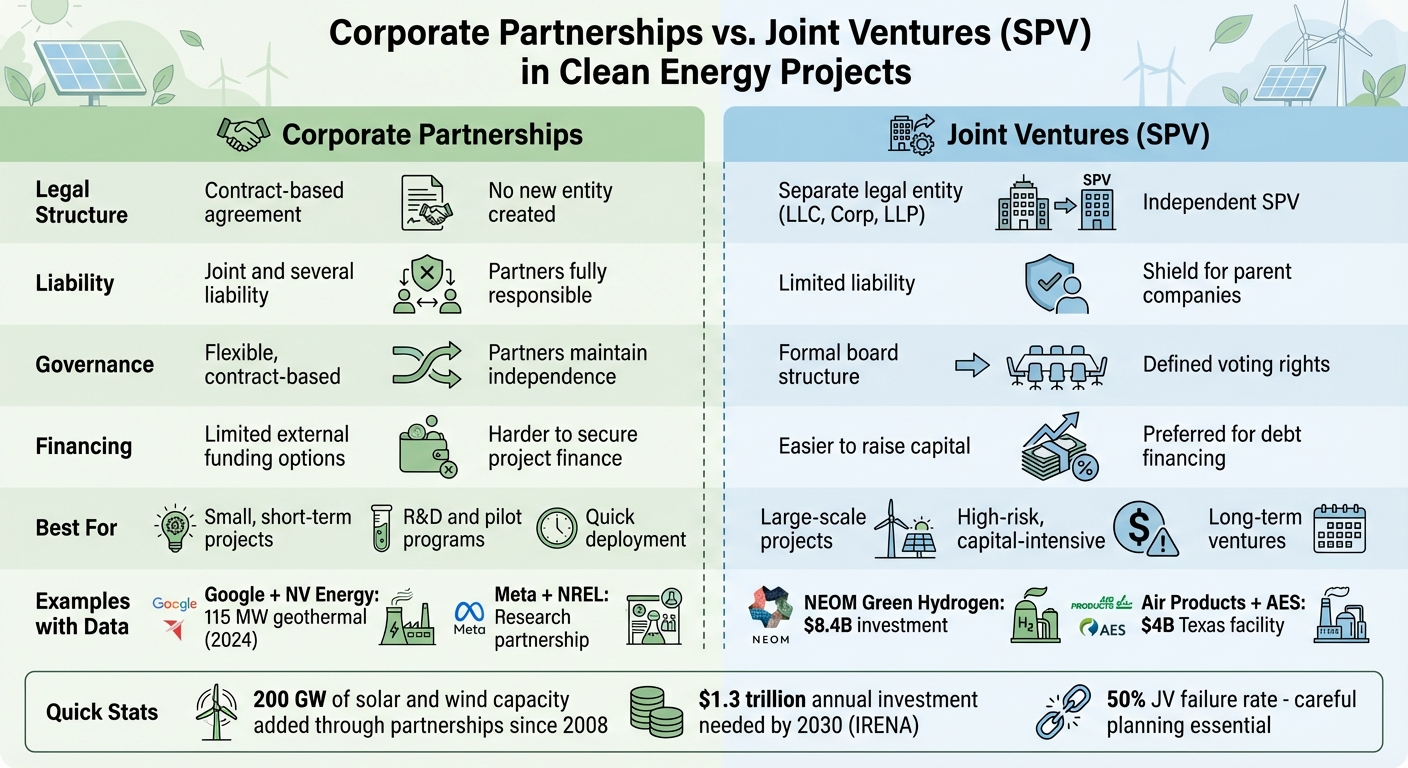
Corporate Partnerships vs Joint Ventures in Clean Energy: Key Differences
Corporate partnerships in clean energy involve collaborative agreements where companies work together through contracts, rather than creating a new legal entity. These arrangements are defined by written agreements instead of formal structures like corporations or LLCs[9].
This flexibility makes them especially appealing for clean energy initiatives. Through such partnerships, companies gain access to advanced technologies, research facilities, and expert teams - all without the administrative challenges of forming a separate entity[7][8]. As the National Laboratory of the Rockies (NLR) highlights:
NLR's technology partnership agreements allow us to better meet the needs of staff and partners as they explore ways to foster the growth and implementation of advanced energy technologies[7].
This approach has had a global impact. Since 2008, corporate clean energy buyers have helped bring nearly 200 GW of new solar and wind capacity online worldwide through various partnership models[10]. These collaborations range from straightforward technical service agreements to long-term offtake contracts, which provide price stability essential for financing clean energy projects.
Corporate partnerships are defined by their flexibility and efficiency. Unlike joint ventures, these collaborations don’t require the creation of a special purpose vehicle (SPV) or navigating complicated governance structures. Each partner remains independent, sharing resources, expertise, and risks without assuming each other’s obligations to third parties[9].
This streamlined setup makes these partnerships ideal for quick project launches and pilot programs. For example, technology partnership agreements at major research institutions can often be finalized in just 45 business days, enabling rapid deployment[7][8].
Common structures for these partnerships include:
Typically, the corporate partner provides funding and resources, gaining access to specialized facilities and expertise in return[7][8].
Real-world examples showcase the strategic use of corporate partnerships in advancing clean energy.
In June 2024, Google teamed up with NV Energy (a subsidiary of Berkshire Hathaway Energy) to introduce Nevada’s "Clean Transition Tariff." This partnership led to the development of a 115 MW geothermal project, expanding capacity for Google’s data centers. Doug Cannon, President and CEO of NV Energy, highlighted the project’s benefits:
This innovative proposal will not be paid for by NV Energy's other customers but will help ensure all our customers benefit from cleaner, greener energy resources[10].
Another example is the Meta and NREL partnership, announced in October 2024. Meta funded research led by NREL’s principal investigator Jenny Sumner to study how corporate investments influence clean energy adoption. The collaboration explored voluntary market strategies like hourly matching and how corporate buyers manage power price risks. Sumner explained:
De-risking renewable generation revenue is critical for securing financing for the construction of renewable projects[11].
Meta, which has matched 100% of its global electricity use with renewable energy since 2020, used the findings to guide regulators and corporate buyers on effective procurement strategies[11].
In December 2025, Purolator partnered with Deloitte to create a nationwide fleet decarbonization roadmap. This collaboration focused on strategic planning to help Purolator achieve net-zero emissions across its logistics operations[12]. This example highlights how companies can tap into specialized expertise without forming a new entity.
Joint ventures in clean energy are formal agreements where two or more companies join forces - pooling resources like capital, technology, land, or expertise - to develop a specific project. They share the risks, profits, and losses along the way. Unlike standard corporate partnerships that rely on contracts, joint ventures create a separate legal entity, often called a Special Purpose Vehicle (SPV), which owns the project's assets and manages the main contracts.
This setup has become crucial as the clean energy industry grows. According to the International Renewable Energy Agency (IRENA), the world will need over $1.3 trillion in annual investments by 2030 to limit global warming to 1.5°C [1]. Joint ventures help companies tackle these massive financial demands by spreading the risks and costs among multiple partners.
This model is particularly useful for high-risk, capital-heavy projects in emerging sectors. While wind and solar dominate many collaborations, newer fields like green hydrogen and carbon capture and storage (CCS) have seen an increase in joint ventures in recent years [1]. Benjie Jenkins, Director at Ankura, emphasizes the importance of these partnerships:
Partnerships – whether joint ventures or less-formal formal alliances – are not a nice-to-have but an imperative, and should be treated as a standard modus operandi in clean energy [1].
These arrangements also bring unique governance and financial benefits, as outlined below.
Joint ventures operate under formal governance structures, complete with defined voting rights and a board of directors. Each partner contributes capital and shares profits and losses based on their stake in the venture. This setup is quite different from corporate partnerships, where each party typically handles its own costs and risks.
The SPV structure offers major advantages for large-scale projects. It allows the joint venture to act independently - contracting in its own name, issuing shares, and securing project financing - while keeping liabilities separate from the parent companies' other business operations. Key decisions, such as budget approvals and contractor selections, are often subject to majority or unanimous consent through a list of "reserved matters."
A major strength of joint ventures is their ability to combine complementary expertise. For example, an oil company with offshore engineering skills might team up with a renewable technology provider, or a utility company could partner with a financial investor to leverage operational know-how and funding. This approach is especially critical for offshore wind projects, which are so expensive that they often require the combined financial power of multiple multinational utilities to succeed.
Joint ventures also help meet regulatory requirements. In countries like Japan and South Korea, offshore wind projects often require a local partner to qualify for government subsidies. These partnerships allow international companies to meet "local content" rules while gaining access to new markets.
Here are some notable examples of joint ventures that highlight how shared expertise and capital drive clean energy projects forward:
Joint ventures are likely to remain the structure of choice for large renewable energy projects and portfolios. The combination of a utility to operate and maintain the asset... and a financial investor focusing on the solid commercial return... is a tried and tested model [15].
After breaking down the details of each model, comparing corporate partnerships and joint ventures side by side reveals their distinct characteristics. When deciding which structure to use for clean energy projects, it’s essential to grasp the differences in their legal setup, handling of liabilities, and decision-making processes.
The legal structure is the most fundamental difference. Corporate partnerships are based on contractual agreements and don’t create a new legal entity. In contrast, joint ventures establish a separate legal entity - often an LLC, Corporation, or Limited Liability Partnership (LLP) - that independently owns assets and manages contracts [5][17].
Liability is another key factor. In corporate partnerships, partners face joint and several liability, meaning each party can be held accountable for the entire venture’s obligations. Joint ventures, however, provide a liability shield, where the newly created entity - not the parent companies - is responsible for debts and obligations [17]. As Jeff Cunningham, Partner at Bradley, points out:
The most successful joint ventures start with a clear business rationale, not a contract template [17].
Governance structures also vary significantly. Partnerships rely on flexible, contract-based terms, allowing each party to retain more control over their assets and employees [5]. Joint ventures, on the other hand, require formal governance frameworks, such as boards of directors and shareholder agreements, which define voting rights and decisions that need unanimous or super-majority approval [5][16].
Another difference lies in financing capabilities. Joint ventures are often preferred for project financing because the separate legal entity can own assets and offer security to lenders [5][17]. Corporate partnerships, without a distinct legal identity, face challenges in raising external funds [5][17]. This makes joint ventures particularly attractive for clean energy projects that demand significant external investment.
| Feature | Corporate Partnership (Contractual) | Joint Venture (Equity-Based/SPV) |
|---|---|---|
| Legal Form | Contractual agreement; no new entity [5] | Separate legal entity (LLC, Corp, LLP) [5][17] |
| Liability | Joint and several; parties responsible for contracts [5][17] | Limited liability; shield for parent companies [5][17] |
| Governance | Flexible; defined by contract terms [17] | Formal; Board of Directors and voting rules [5][16] |
| Financing | Harder to raise external project finance [5] | Preferred for debt/project finance [5] |
| Administrative Burden | Low; no separate filings or accounts [5] | High; entails separate filings [5][17] |
| Publicity | Private; agreement is not public [5] | Constitutional documents are public [5] |
| Duration | Project-specific or short-term [17] | Better suited for long-term strategic alliances [17] |
These differences provide a framework for determining which structure is better suited to specific clean energy projects.
Each model has its own strengths and weaknesses. Corporate partnerships stand out for their speed and flexibility. They’re quicker and less expensive to set up, involve minimal administrative work, and can be adjusted or dissolved with relative ease [5][17]. This makes them a good fit for low-liability projects, research collaborations, or situations requiring fast implementation without complex legal arrangements.
However, corporate partnerships come with risks. Partners are fully liable for obligations, which can expose their broader assets [5][17]. The absence of a separate legal entity also makes securing external financing more challenging, and ambiguities in contract terms can lead to unintended legal consequences [5][13][17].
Joint ventures, on the other hand, offer robust liability protection and structured governance. The separate legal entity limits liability to the capital invested, shielding parent companies from creditors [6][18]. This is especially important for high-risk clean energy projects involving new technologies. Joint ventures also simplify intellectual property ownership, improve access to debt financing, and ensure compliance with regulations - particularly in areas requiring local partnerships for government incentives [3][5][17].
That said, joint ventures are not without their downsides. They require extensive legal work, ongoing administrative efforts, and separate corporate filings [5][17]. Partners also give up some independence, as significant decisions must go through formal governance channels [5][6]. And with failure rates for joint ventures hovering around 50%, careful planning and strong governance are critical from the outset [17].
| Model | Pros | Cons |
|---|---|---|
| Corporate Partnership | Fast setup, lower costs, high flexibility, easy to terminate [5][17] | No liability shield, potential for unintended liability, harder to raise funds [5][17] |
| Joint Venture (SPV) | Limited liability, separate legal personality, easier to secure debt, clear IP ownership [5][3][17] | Complex/costly setup, shared control/loss of autonomy [5][6][17] |
Choosing the right collaboration model - corporate partnerships or joint ventures - depends on the project's scale, risk level, and timeline. Picking wisely can help avoid unnecessary costs and legal complications.
Corporate partnerships are ideal for small, short-term projects where speed and adaptability outweigh the need for formal governance. These arrangements are perfect for pilot programs, research collaborations, technology licensing, or joint marketing efforts. They allow companies to test ideas without requiring a significant commitment of resources or time [13].
For example, imagine a solar startup testing a new panel coating technology with a utility company. A corporate partnership makes this possible, enabling quick experimentation with emerging technologies while keeping administrative burdens low [13].
Partnerships also allow companies to share expertise without giving up control. Take a firm specializing in innovative battery storage: by partnering with a well-established energy provider, they can tap into existing distribution channels without needing to invest heavily in infrastructure [9][13].
However, when a project calls for significant investment and formalized risk-sharing, a joint venture is the better option.
Joint ventures are the preferred structure for large, capital-heavy projects that come with extended timelines and require shared risks. Examples include offshore wind farms, mining operations for critical minerals, and large-scale solar installations. These projects benefit from the pooled resources and liability protections that a separate legal entity provides [14][3].
A notable example is the $650 million joint venture formed in January 2023 between General Motors and Lithium Americas to develop the Thacker Pass lithium mine in Nevada. This venture secured GM's supply chain for electric vehicle production while distributing the significant financial and operational risks tied to mining development [9].
Marie Lucey, a Partner at Deloitte Advisory, highlights the advantages of joint ventures:
The use of joint ventures (JVs) is seen increasingly throughout the sector to develop these large-scale projects, as they allow organisations to pool resources, share risks, and leverage complementary capabilities [14].
Joint ventures are especially useful when local expertise is critical, such as entering markets with complex regulatory environments. For instance, a U.S.-based renewable energy company looking to develop offshore wind projects in Ireland (which aims for 5 GW of offshore wind by 2030 and 37 GW by 2050) could benefit from partnering with a local developer. This approach provides access to regulatory insights, established networks, and logistical know-how that would otherwise take years to build independently [14].
Additionally, the formal governance structure of a joint venture is a must for high-risk projects or those involving state-owned entities. In the clean energy sector, where technological uncertainties and shifting regulations can lead to unexpected challenges, this structure offers crucial protections [3][6].
This section dives into specific risks and strategies to manage them, expanding on earlier discussions about collaboration challenges. Both joint ventures and corporate partnerships face potential pitfalls that could derail projects without proactive management.
Intellectual property disputes are a recurring issue in clean energy projects that involve cutting-edge technologies. Questions often arise about who owns the advancements made during the project and how pre-existing intellectual property is safeguarded. In joint ventures, tensions can escalate when a partner plays dual roles, such as being both an equity owner and a technology provider. If their technology causes delays, their interests as a service provider may conflict with their responsibilities as an owner [3].
Funding disparities can create significant friction, especially in joint ventures that require substantial upfront investments. When one partner struggles to meet capital calls, the project may face delays or even risk equity dilution, which can destabilize the entire venture [3].
Governance conflicts differ depending on the model. In joint ventures, shared control can lead to deadlocks, where partners fail to agree on critical decisions like budget adjustments or market entry strategies. In corporate partnerships, the issues often stem from unclear reporting lines or a lack of oversight, which can create bottlenecks [2][4]. Strategic misalignment is another risk, particularly when a community-owned organization collaborates with a commercial developer focused primarily on financial returns [4].
Regulatory and political risks are especially pronounced in the clean energy sector, particularly when working with state-owned entities. Political interference or the need for extra-governmental approvals for arbitration or settlements can slow decision-making and inflate costs [3].
Effectively addressing these risks is essential to maintaining project integrity and ensuring long-term success.
Clear contractual agreements and deadlock resolution mechanisms are vital. One effective approach is using a "reserved matters" list to outline which decisions require unanimous approval and which can be delegated to daily management. This prevents unilateral actions and safeguards minority partners [2][13]. For intellectual property, agreements should clearly define ownership and establish protocols for handling confidential data [3]. Formal dispute resolution mechanisms, such as expert referrals or buy-sell provisions, can also help resolve deadlocks [2][3]. As Jeff Cunningham, Partner at Bradley, emphasizes:
Success requires more than good intentions - it demands careful planning, clear agreements, and robust governance from day one [17].
Financial safeguards can mitigate funding risks. For instance, step-in rights can allow a non-defaulting partner to cover another partner's funding shortfall in exchange for a greater stake in the venture [2]. Similarly, anti-dilution protections, like catch-up rights, can help partners with limited initial capital maintain their equity if funding becomes uneven [3].
When working with state-owned entities or in emerging markets, strict compliance programs with ongoing monitoring are crucial. Clear internal communication and extra time in project schedules for government approvals related to arbitration or settlements can also help mitigate delays [13][3].
The table below summarizes key risks and their impact across joint ventures and corporate partnerships:
| Risk Category | Joint Venture Specifics | Corporate Partnership Specifics |
|---|---|---|
| Governance | Deadlock in board-level decisions | Oversight bottlenecks and reporting delays |
| Financial | Default on capital calls; funding gaps | Reliance on a single partner's resources |
| Operational | Conflicts with partners acting as contractors | Strategic misalignment between entities |
| Exit | Complex equity transfers; dissolution risks | Termination of service or license agreements |
Financial advisors play a critical role in structuring clean energy deals, offering expertise that goes well beyond the typical scope of mergers and acquisitions (M&A) teams. While 90% of companies have dedicated M&A teams, only 65% have specialized joint venture teams [19]. This gap often leaves organizations struggling with challenges like valuing non-cash contributions - such as technology, intellectual property, or land - creating governance frameworks to avoid deadlocks, and securing external financing for large-scale projects.
Advisors provide detailed financial models and cash flow forecasts, which are essential for securing project financing. Take the NEOM Green Hydrogen joint venture as an example: in May 2023, the project reached financial close with a total investment of $8.4 billion, $6.1 billion of which came from external financing provided by 23 local, regional, and international banks [1]. Without the expertise of financial advisors to structure project economics and negotiate offtake agreements, securing this level of external funding would have been an uphill battle.
In addition to financial modeling, advisors assist in optimizing cross-border taxation, implementing anti-dilution protections when funding contributions are uneven, and designing clear exit strategies from the outset. As James Bamford, Senior Advisor at Ankura, aptly states:
Trying to negotiate a material JV with an inexperienced team is a recipe for a long, painful experience with no guarantee of success [20].

Financial expertise is the backbone of successful clean energy collaborations, and Phoenix Strategy Group specializes in helping growth-stage companies build strong partnerships in this space. Their fractional CFO services and financial planning and analysis (FP&A) systems provide detailed financial models and cash flow forecasts. These tools align expectations around investments, returns, and capital call mechanisms before deals are finalized.
Phoenix Strategy Group emphasizes creating flexibility in agreements from the very beginning. This includes crafting reserved matters lists tailored to specific technologies, establishing step-in rights to address funding shortfalls, and designing governance structures that prevent operational deadlocks. The firm also supports companies with M&A advisory services, ensuring that exit strategies - whether through winding down, selling stakes, or going public - are clearly defined and agreed upon in advance. This proactive approach helps avoid disputes and keeps partnerships on track for long-term success.
Deciding between a corporate partnership and a joint venture in clean energy boils down to what each model brings to the table and how well it matches your project's goals. The choice affects everything from control and financial commitment to the risks you're willing to take. Corporate partnerships are straightforward - there’s no need to set up a new legal entity, you retain full control over your assets, and the administrative load stays light. These partnerships are ideal for short-term projects or testing ideas without significant financial investment. On the other hand, joint ventures require creating a separate legal entity, which can limit liability, simplify raising funds, and provide a solid governance framework - perfect for large-scale, complex projects like offshore wind farms or green hydrogen plants.
Recent studies highlight a key challenge: 83% of business executives believe their joint ventures could deliver more value [19]. The difference often lies in aligning goals from the very beginning. As Euan Small, Senior Solicitor at Shepherd and Wedderburn, explains:
The most fundamental consideration for any joint venture is its purpose. It is critical that all parties involved are clear and aligned on the purpose of the joint venture from its inception [2].
Getting the financials right is equally important. Solid financial planning not only ensures you secure the necessary funding but also helps determine which model fits your operational needs and risk appetite. Before finalizing any agreement, it’s essential to prepare detailed cash flow forecasts, establish governance structures, and outline strategies for handling disputes. The complexity increases when you factor in cross-border taxation, regulatory approvals, and valuing non-cash contributions.
For projects involving lenders or requiring limited liability protection, an SPV (Special Purpose Vehicle) structure is often the better choice. Meanwhile, a contractual partnership works well when flexibility is key, and you plan to keep operations separate. Both approaches can lead to success in clean energy, but only if you take the time upfront to align goals, define clear governance, and map out an exit strategy.
When choosing between a corporate partnership and a joint venture for a clean energy project, there are several factors to weigh carefully. Start by looking at the strategic goals of the collaboration - what do you hope to achieve, and how does the structure support those objectives? Consider how much control each party wants to maintain, as this can significantly influence the decision.
Next, evaluate the financial commitment and risk-sharing arrangement. Does the project require creating a formal joint venture entity, or would a more flexible partnership be sufficient? Legal and liability considerations will play a big role here, so it’s worth consulting with legal experts to understand the implications.
The skills and responsibilities each partner brings to the table are another crucial element. Do they complement the project’s needs? On top of that, ensure all parties share similar values, performance benchmarks, and clear exit strategies to avoid conflicts down the road.
Lastly, don’t overlook regulatory requirements and the administrative complexities tied to each structure. These can be deciding factors in determining whether a partnership or a joint venture is the better fit. By thoroughly analyzing these aspects, you’ll be better positioned to choose the arrangement that aligns with your clean energy ambitions.
Joint ventures are often set up as a separate legal entity, like a private company or a special purpose vehicle (SPV). This setup helps limit each party's liability to the amount they've invested or any unpaid share capital. On the other hand, corporate partnerships tend to be less formal and don't have their own legal identity, which can leave partners more personally exposed to liabilities.
Choosing a joint venture allows parties to manage risks more effectively while keeping financial and legal responsibilities clearly defined. This makes it a preferred option for large-scale clean energy projects.
Financial advisors are key players in shaping clean energy joint ventures, transforming big-picture strategies into practical agreements that make financial sense. They assess how well potential partners align strategically, quantify contributions like cash, technology, or assets, and craft equity splits and governance models that match the deal's economic landscape.
These advisors also build detailed financial models to project cash flows, tax effects, and return-on-investment scenarios. This helps guide discussions around funding, debt structuring, and performance benchmarks. In the intricate clean energy sector, they ensure the right mix of equity, project-level debt, and government incentives, all while performing due diligence on regulatory risks, partner reliability, and the feasibility of the technologies involved.
Phoenix Strategy Group focuses on assisting growth-stage clean energy companies in structuring joint ventures. They provide scalable financing solutions, strong governance frameworks, and financial modeling tailored to meet the specific requirements of the U.S. market.