Published on
March 19, 2026


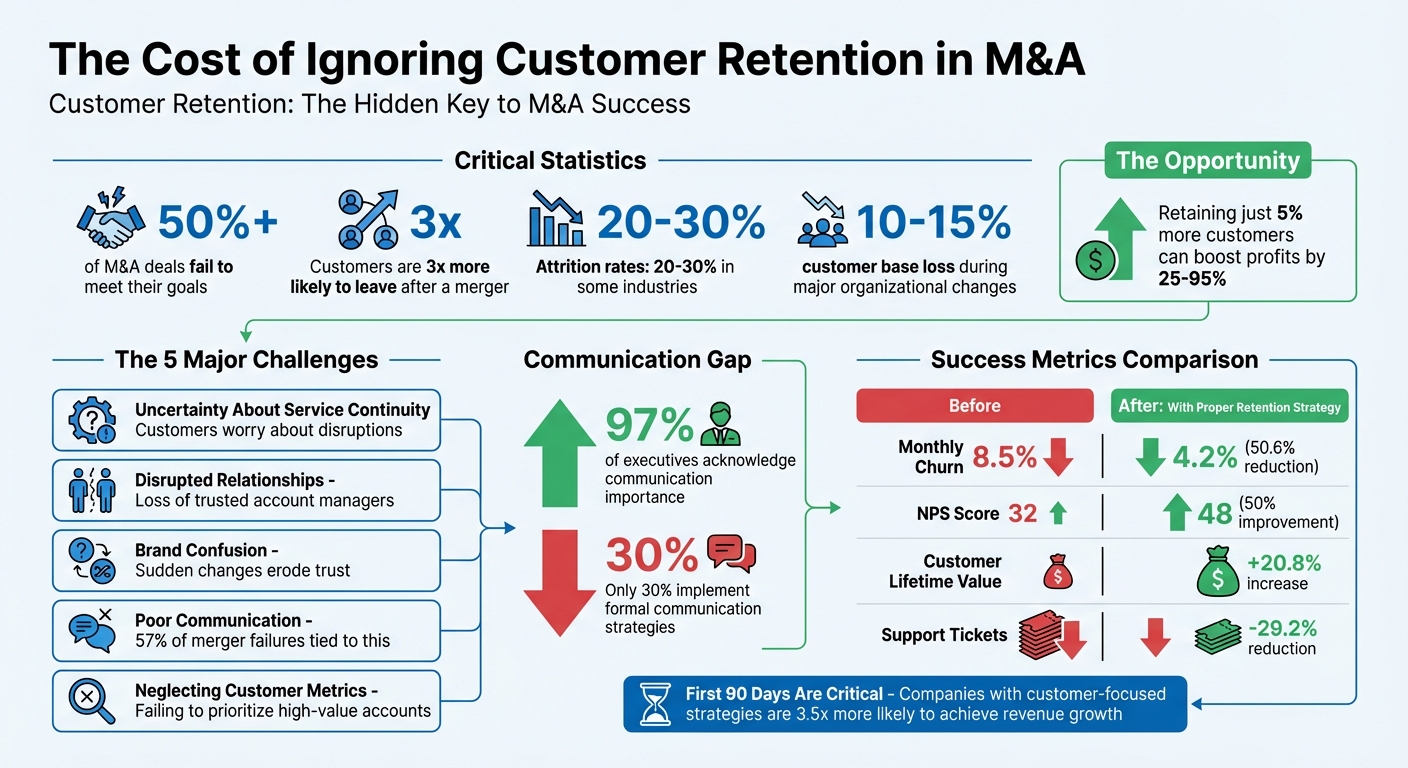
When companies merge, the focus often lands on cutting costs and streamlining operations. But here's the kicker: over half of M&A deals fail to meet their goals, and poor customer retention is a major reason why. Customers are three times more likely to leave after a merger, with attrition rates hitting 20-30% in some industries.
The good news? Retaining just 5% more customers can boost profits by 25-95%. This article breaks down the five biggest challenges to customer retention during mergers and how to solve them:
Want to avoid losing customers post-merger? Keep reading to learn actionable solutions, like proactive communication, relationship audits, and using data to track at-risk accounts.
Customer Retention Statistics in Post-M&A Integration
When companies merge, it's natural for customers to worry about disruptions. Will the service stay reliable? Will contracts change? Will support teams still be there when needed? These concerns aren't unfounded. Mergers often involve integrating IT systems, restructuring support teams, and overhauling workflows - all of which can lead to real hiccups.
Customers often fear that new ownership will bring sudden changes to the services they rely on. They might lose their trusted account managers or face unfavorable pricing adjustments. The merging of CRM systems or incompatible legacy platforms can make them feel overlooked. A stark example comes from a major US bank whose Net Promoter Score dropped from 11.5 to zero during a merger because customers felt neglected [4].
The First Union Bank case highlights how neglecting customer needs during operational changes can drive them straight to competitors. Addressing these concerns early is crucial for maintaining trust and loyalty during a merger.
The key to retaining customers during a merger is eliminating uncertainty. Customers need clear, actionable reassurances - not vague promises. Take Westpac’s acquisition of St. George Bank in Australia as an example. Their leadership aimed for zero customer defections. They assigned relationship managers to personally visit high-value clients and launched a marketing campaign highlighting tangible benefits, like access to a larger network of free ATMs. The result? A steady customer base with no defections and reduced churn [4].
Sometimes, temporary fixes are necessary when IT integration takes longer than expected. For instance, when Commerzbank and Dresdner Bank realized their system migration would be delayed by a year, they implemented a central hotline and proactive communication channels. This approach cut manual service requests by 30% and safeguarded relationships with key clients [4].
A proactive strategy combines temporary Service Level Agreements (SLAs) with real-time monitoring. Draft SLAs specifically for the transition period, focusing on quicker response times and guaranteed service uptime. Tools like Gainsight or ChurnZero can help track customer engagement and flag at-risk accounts before they churn [5]. When customers see measurable commitments - and data proving you're keeping an eye on their experience - it helps ease their concerns.
"If you don't address customer experience prior to Day 1, you're already behind." - Laura Stringer, Principal, Ninth Fourth LLC [6]
Finally, equip your frontline staff with both the tools and authority to solve problems on the spot. During transitions, customers don’t want excuses - they want solutions. Giving employees access to information across legacy systems and the power to make decisions can prevent small frustrations from turning into deal-breakers. This hands-on approach can make all the difference in keeping customers satisfied.
Mergers often shake up the personal connections that form the backbone of customer loyalty. When account managers are reassigned or relationship owners change, customers lose the familiar faces they’ve grown to trust. This isn’t just a small inconvenience. Companies can lose 10% to 15% of their customer base during major organizational changes, with disrupted relationships being a common reason [7].
The bond between customers and their relationship managers goes far beyond mere transactions. Years of trust, shared experiences, and institutional knowledge underpin these connections. A merger that disrupts these relationships without a well-thought-out transition plan risks pushing customers toward competitors. This is particularly concerning with high-value accounts, where personal connections often influence purchasing decisions and renewals.
"Sales professionals are the human face of the organization during periods of change, and their confidence, clarity, and competence directly impact customer retention rates." - William Bell, CEO and Featured Outsider, Chief Outsiders [7]
The problem worsens when top talent leaves. During integration, unclear roles or reporting structures can drive high performers to exit, often taking their customer relationships with them. This creates a double loss: the employee leaves, and the deep understanding they had of customer needs and history disappears with them. Protecting these relationships is essential to maintaining trust during such transitions.
The best approach is straightforward: retain the people customers already trust. Keeping key relationship managers and frontline staff should be a primary focus in integration planning. Even before the deal closes, conduct a "relationship audit" to pinpoint which customers have strong ties to specific account managers. Use this information to develop a retention plan for those employees [7].
When staff changes are unavoidable, personal outreach becomes critical. A great example comes from 2008, when Westpac acquired St. George Bank in Australia. The leadership team set out to achieve zero customer defections. They sent relationship managers to personally meet with wealth management clients, explaining the benefits of the merger and reassuring them about continuity. The result? No customer defections and a reduced churn rate [4].
Clear handoff protocols are another essential tool. Formalize processes for transferring account ownership, including clear guidelines about who will manage each account, how territories will be handled, and a detailed communication timeline. Sales teams should receive training in relationship preservation and change management, along with practical tools like FAQs, transition schedules, and decision-making authority to handle customer concerns immediately [7].
Give high-value accounts the attention they deserve. These clients need more than a generic email announcing changes. Schedule face-to-face meetings or video calls where new account managers can introduce themselves, explain the changes, and - most importantly - emphasize what will remain consistent. Pair any "bad news" (like a new account manager) with "good news" (such as expanded services or new offerings) to make the transition easier for customers to accept [4].
Lastly, implement a closed-loop feedback system to monitor customer loyalty in real time. Tools like the Net Promoter System (NPS) can help track shifts in sentiment. Share this feedback directly with relationship managers so they can address concerns quickly and ensure no customer is overlooked during the transition. This also helps new managers understand what matters most to the accounts they’re inheriting [4].
Mergers often lead to sudden brand changes that leave loyal customers feeling lost. In fact, over half of mergers fail financially when cultural misalignment damages customer trust [9]. Just like service interruptions or broken relationships, a shift in brand identity can weaken customer loyalty. When a company’s legacy values clash with the signals of a new brand, it creates a tough environment for retaining customers.
Customers don’t just connect with logos - they connect with the promises behind the brand. These include values, service quality, and overall experiences. Abrupt changes to these elements can destroy trust almost instantly. Many companies make the mistake of treating a brand transition as nothing more than a name change, overlooking the deeper impact such a shift has on every interaction with customers [8].
"Switching from a familiar brand to a new one is massively disrupting to customers, business partners, employees, and anyone else who has enjoyed positive experiences with a brand bound to be retired." – Prophet [8]
Timing is everything when it comes to brand strategy. Waiting until after the merger is finalized to craft clear messaging leaves customers in the dark. If internal communication isn’t aligned, the confusion only grows. Without a strong, unified brand strategy, companies risk losing customers at an alarming rate.
To tackle the confusion caused by sudden brand changes, here’s what you can do:
Start with a brand equity audit before making any public announcements. This involves assessing brand awareness, customer sentiment (using tools like Net Promoter Scores), and competitive positioning for both companies. The goal is to pinpoint which aspects of each brand resonate most with customers and identify what could be at risk during the transition [8].
Next, select a consolidation approach that aligns with your business goals and customer base. Options include:
Each approach has its pros and cons, so choose based on your audience and market position.
Create a "One Voice" document that clearly outlines your combined value proposition. Instead of vague reassurances like "nothing will change", explain how the merger benefits customers. Highlight advantages such as expanded resources, broader geographic reach, or improved technical capabilities. Always address the key question on customers’ minds: “What does this mean for me?” [7].
Take Marriott International’s 2016 acquisition of Starwood as an example. Marriott didn’t force customers to give up familiar loyalty programs. Instead, they announced that members of both Marriott Rewards and Starwood Preferred Guest would enjoy reciprocal benefits. This approach preserved customer loyalty and kept engagement high among their most dedicated customers [1].
Your sales team plays a crucial role here. As the face of your brand, they need a clear understanding of the new value proposition. Equip them with tools like FAQs, positioning guides, and decision-making authority so they can address customer concerns confidently [7].
Finally, monitor key brand metrics during the transition. Keep an eye on customer awareness, search engine performance, and social media sentiment to detect early signs of confusion or dissatisfaction. Use pulse surveys within the first 90 days to identify high-value customers who might be at risk of leaving. Address their concerns quickly - retaining just 5% more customers after a merger can boost profits by 25% to 95% [2].
For expert advice on navigating brand identity challenges during mergers, check out the insights from Phoenix Strategy Group (https://phoenixstrategy.group).
When customers are left in the dark during a merger, they often assume the worst - price increases, reduced services, or even being abandoned altogether. This information vacuum can wreak havoc on post-merger integration. In fact, 57% of merger failures are tied directly to poor communication during this critical period [10].
The statistics highlight the severity of the issue. Despite 97% of executives acknowledging the link between strong communication and business performance, only 30% of companies implement a formal communication strategy during mergers [10]. This disconnect can be costly. For instance, one major U.S. bank saw its Net Promoter Score nosedive from 11.5 to zero because customers felt ignored during their merger [4].
But the damage doesn't just come from silence - it’s also about mixed messages. If your social media posts, customer service responses, and website updates contradict each other, trust erodes quickly. Generic emails that fail to address specific customer concerns only accelerate defections. Without a clear and consistent communication plan, customer dissatisfaction can snowball, leading to substantial attrition within the first year. To address these risks, a well-thought-out communication strategy is crucial.
Start talking to your customers as soon as the merger is announced. You don’t need all the answers immediately - what matters is keeping them informed. Research shows that customers involved in transition discussions are 30% more likely to stay loyal [2]. Set up dedicated communication channels - like a hotline, email support, or a landing page - to handle merger-related questions and serve as the go-to source for accurate information [11].
Consistency is key. Develop a communication playbook to ensure your teams - whether in customer service, social media, or sales - are all sharing the same message. Westpac’s approach to mergers serves as a great example: they used personalized outreach for high-value clients and clear messaging about merger benefits to retain customers and minimize churn [10].
Tailor your outreach based on customer value. High-value accounts deserve personal attention, such as direct calls or meetings with senior leadership. For smaller accounts, broader updates work, but make sure the messaging addresses their specific concerns, like service continuity or pricing changes.
When announcing changes, try a "bundling" approach. Pair potentially negative news, like system migrations or policy updates, with positive developments, such as enhanced services or expanded resources. This helps customers see the bigger picture and accept changes more positively [4].
| Communication Pillar | Actionable Strategy | Expected Outcome |
|---|---|---|
| Transparency | Share honest updates about challenges and timelines. | Builds trust and quells rumors. |
| Continuity | Maintain stable service levels and frontline staff. | Reduces customer anxiety and defection risks. |
| Value Enhancement | Emphasize new benefits, products, or improved technology. | Shifts focus from disruptions to opportunities. |
| Feedback Loops | Use surveys and reviews to gather customer input. | Identifies at-risk customers for timely intervention. |
Within the first 90 days, implement closed-loop feedback systems. Use tools like sentiment surveys and Net Promoter Score tracking to spot unhappy customers early. Then, act on their feedback to address concerns. Companies with strong communication strategies are 3.5 times more likely to achieve revenue growth compared to their peers [10].
"70% of employees prefer to hear news about a merger directly from company leaders." – Deloitte [10]
This principle applies to customers too. Key updates, especially for high-value accounts, should come from your CEO or senior leadership. It sends a clear message: your customers are a priority at the highest levels of the organization.
By proactively addressing communication gaps and maintaining consistent, unified messaging, you can significantly reduce customer attrition. Open dialogue not only prevents churn but also demonstrates a customer-first mindset - critical for successful post-merger integration.
For expert help in crafting communication strategies that preserve customer trust during mergers, Phoenix Strategy Group (https://phoenixstrategy.group) offers advisory services tailored to navigating complex integrations effectively.
Did you know that more than 50% of mergers fail to deliver the expected shareholder value? One major reason: customer defections [4]. Yet, many companies focus solely on cost synergies and revenue projections, completely overlooking customer retention. This blind spot can have disastrous consequences.
Take the 1997 merger of First Union Bank and CoreStates Financial. Without integrating customer retention goals, the combined entity lost 20% of its customer base in just one year [4]. That’s millions in revenue gone - simply because leadership didn’t identify key customers or track early signs of defection.
The issue worsens when companies fail to distinguish between customers. Imagine treating a $50,000-per-year enterprise client the same as a $500-per-year account. High-value customers, expecting tailored service, often leave when they receive generic updates.
On average, companies lose 10% to 15% of their customers during major organizational changes [7]. Despite having access to customer data, many teams fail to set up the analytics needed to track and retain their most valuable clients. Legacy CRM systems from both merging companies often remain disconnected for months, leaving critical gaps in visibility.
To address this, companies must implement robust customer analytics right from the start. Just as you plan for cost synergies, you need to build customer retention goals into your deal model [4]. Define clear metrics: acceptable churn rates, target Net Promoter Scores (NPS), and Customer Lifetime Value (CLV) benchmarks. Tracking these from day one is non-negotiable.
Segment your customer base immediately. Use all available data to create tiers based on revenue, engagement, and strategic importance [4,10]. For instance, during the 2008 merger of Commerzbank and Dresdner Bank, leadership identified a potential disruption for high-value private banking clients. Knowing these customers would lose access to stock-trading statements during an IT migration, they proactively mailed statements. This simple action reduced service requests by 30% and significantly lowered defection risk among their most profitable clients [4].
Real-time visibility into customer health is also critical. Use CRM platforms like Salesforce or HubSpot to monitor high-value customers. Tools like Gainsight or ChurnZero can automate alerts for churn risks - whether it’s a client missing renewal discussions, submitting negative feedback, or showing declining engagement [5].
| Metric | Post-M&A Relevance | Target Benchmark |
|---|---|---|
| Monthly Churn Rate | Key indicator of integration issues | Reduce from 8.5% to 4.2% |
| Net Promoter Score (NPS) | Measures brand sentiment during transition | Improve by 50% |
| Customer Lifetime Value (CLV) | Tracks long-term value of the customer base | Increase by 20.8% |
| Revenue Retention Rate | Gauges financial stability post-merger | Improve by 9.4% |
Source for metrics: [5]
For high-value segments, assign dedicated Customer Success Managers to provide personalized support throughout the transition [5]. This ensures these critical accounts receive the attention they need to stay loyal.
Additionally, form a cross-functional customer experience team to evaluate integration decisions from the customer’s perspective [4]. Before making changes to systems, services, or branding, this team should identify potential friction points for top-tier clients and develop strategies to address them. Cutting costs at the expense of customer satisfaction will ultimately hurt your revenue.
Finally, monitor progress closely. Set KPIs within the first month and review them weekly [5]. Use tools like NPS surveys, sentiment analysis from support tickets, and direct outreach to understand customer satisfaction. Then, act on this feedback. Companies with structured retention strategies post-merger have reported a 50.6% drop in monthly churn, a 41.8% boost in feature adoption, and a 29.2% reduction in support ticket volume [5].
The takeaway? Customer analytics aren’t optional during a merger - they’re critical. Without them, you’re risking your most valuable asset: the customers who drive your revenue. For expert help in integrating customer-focused metrics into your M&A strategy, Phoenix Strategy Group (https://phoenixstrategy.group) offers advisory services to safeguard your customer base during complex transitions.
When companies go through mergers, customer retention often takes a backseat. The focus tends to land on cost savings and revenue forecasts, leaving many surprised when key customers start leaving. The fix? Bring customer metrics into the post-merger governance framework right from the start. By making customer retention a priority during integration, you can avoid these pitfalls.
The first step is setting up a cross-functional customer integration team with the authority to make decisions [3]. This team should assess every integration choice - whether it’s system migrations, policy updates, or product changes - through the lens of customer impact. Before making a move, ask: "Will this decision create challenges for high-value customers?" If risks exist, a mitigation plan should be ready to go.
"Set ambitious goals for customer retention, and adopt specific customer metrics to track performance. Put customer retention in the deal model."
– Laura Miles and Ted Rouse, Partners, Bain & Company [4]
Another critical piece is a Measure & Control framework that gives leadership access to real-time data [12]. Use tools like relationship surveys, usage analytics, and sentiment monitoring to spot potential customer issues early. With the right structure in place, you can prevent declines before they happen.
Tracking progress is just as important as setting up the tools. Establish baseline metrics before the merger is finalized and monitor changes in retention rates, churn risk, and NPS scores. For example, embedding customer metrics into governance could reduce monthly churn from 8.5% to 4.2% and improve NPS from 32 to 48 within six months [5]. The difference lies in treating customer retention as a must-have KPI, not an afterthought.
| Metric | Pre-PMI Baseline | Post-PMI Target (Year 1) | Why It Matters |
|---|---|---|---|
| Net Promoter Score (NPS) | Weighted average of both firms | Maintain or improve by 2+ points | Reflects emotional loyalty and brand health during transition |
| Customer Retention Rate | Historical average (e.g., 90%) | Greater than 85% | Gauges the immediate success of the integration plan |
| Churn Risk Profile | % of accounts flagged "at risk" | Reduce "High Risk" segment by 30% | Highlights accounts needing targeted executive outreach |
| Employee Retention (Front-line) | Combined turnover rate | Less than 15% turnover | Predicts potential service disruptions and relationship loss |
Surviving the early stages of a merger is just the beginning. To achieve sustained growth, companies need to make retention an ongoing focus, not just a one-time effort. The secret lies in weaving continuous feedback into daily operations.
A cornerstone of this strategy is real-time feedback systems. These systems capture customer sentiment as it happens and provide actionable insights to decision-makers. This allows businesses to tackle issues before they snowball into customer churn. Investing in technology that delivers this type of feedback ensures that growth remains steady and sustainable.
Another critical step is consolidating legacy CRM platforms into a single, unified system. This eliminates fragmented data and enables automated workflows that flag at-risk accounts. With this streamlined approach, businesses can act quickly to retain customers, ensuring that vital data flows effortlessly across departments.
Phoenix Strategy Group emphasizes the importance of customer retention in the post-merger phase. Their M&A advisory and FP&A services bridge the gap between customer feedback and financial strategy. By integrating churn data into long-term growth models, they ensure retention metrics are prioritized alongside revenue forecasts. This alignment helps leadership allocate resources wisely, safeguarding customer value and reinforcing retention as a key organizational goal.
Continuous optimization is equally important. By maintaining feedback loops and refining retention campaigns, companies can significantly reduce churn and enhance Customer Lifetime Value. For example, two merged SaaS companies adopted a data-driven retention strategy, cutting monthly churn from 8.5% to 4.2% - a 50.6% reduction - and increasing Customer Lifetime Value by 20.8% [5]. These results highlight the power of embedding retention into the operating model, turning initial merger gains into lasting growth.
Customer retention is more than just a checkbox in post-merger integration - it's central to achieving the full potential of any deal. Consider this: over half of executives attribute poor performance to customer attrition [2]. And here's the kicker - retaining just 5% more customers can increase profits by anywhere from 25% to 95% [2]. These numbers make it clear: keeping customers isn't just important, it's transformative.
The hurdles, while predictable, require careful handling. Customers often feel uneasy about service disruptions, brand changes, or losing the personal touch they had with account managers. Internally, an overemphasis on cutting costs can harm the customer experience, driving preventable losses. The answer? A proactive, customer-first strategy that prioritizes retention at every stage of the integration process.
"Revenue synergy isn't created by merging spreadsheets; it's created by loyal customers who choose to stay." – Msafdar [2]
The first 90 days post-merger are critical. Companies that act quickly - engaging key customers, forming dedicated retention teams, and maintaining clear communication - tend to fare better. Take Westpac, for example. Their swift, customer-centered action post-merger helped them drastically cut churn [4].
To reduce customer churn within the critical first 90 days after a merger, prioritize these key strategies:
Maintaining strong customer relationships during account manager transitions is all about clear communication and personalized attention. Assigning a dedicated account manager who understands each customer's unique needs can make a big difference. It's also crucial to communicate any changes as early as possible, being transparent about what customers can expect and addressing any concerns they might have about service or support continuity.
To further reassure customers, consider implementing loyalty initiatives, offering support across multiple channels, and actively seeking their feedback. These efforts not only build trust but also help customers feel valued and confident during post-M&A transitions.
When navigating post-merger integration, keeping a close eye on customer-related metrics is crucial. Here are some of the most important ones to monitor:
By keeping these metrics in focus, you can better ensure customer loyalty, assess service quality, and fine-tune strategies for sustainable growth.