Published on
March 13, 2026

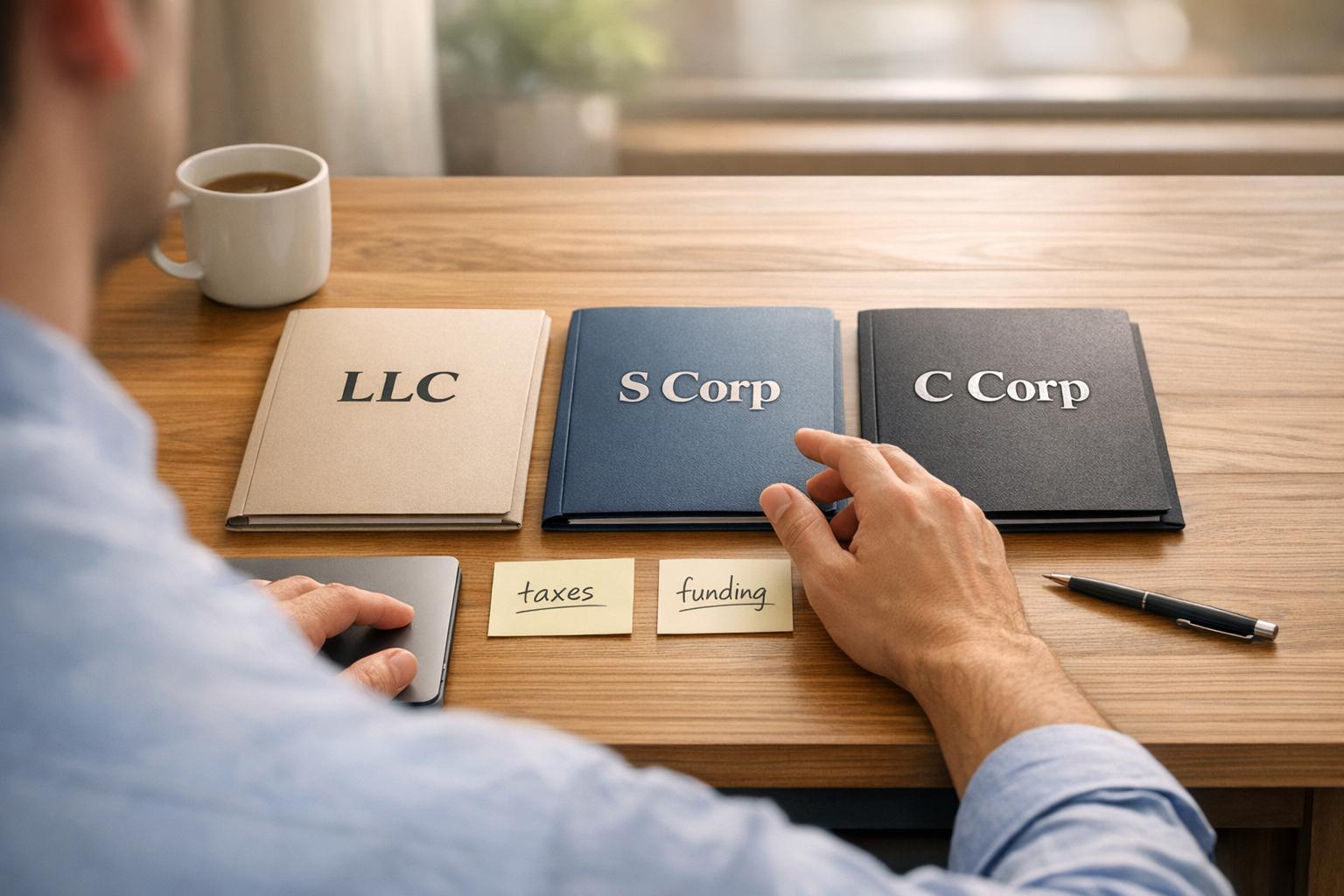
Navigating the complexities of starting and scaling a business requires strategic decisions, especially when it comes to choosing the right legal structure, managing taxes, and securing funding. In this article, we distill the key insights from a panel discussion featuring experienced intellectual property attorneys, accountants, and financial strategists. This expert-guided breakdown is designed to empower mid-market entrepreneurs managing businesses generating $500K to $10M in annual revenue with actionable strategies to achieve growth and sustainability.
Choosing the right entity is one of the most consequential decisions for any founder. Different entity types have distinct implications for taxes, legal liability, and funding opportunities. As Robert Peshi, Managing Director at CBiz, shares, "Your entity choice sets the foundation for how your business interacts with investors, the IRS, and the law."
Both Robert and financial strategist Mitch Filet emphasize that if attracting investors is a key part of your plan, starting with or transitioning to a C Corp is often essential. "Investors almost always prefer C Corps because of their clean structure, limited liability, and ability to carry forward losses", Mitch explains. Although C Corps are subject to double taxation (corporate profits taxed at 21% federally, plus individual taxation on dividends), this structure enables scalability and appeals to institutional investors.
Taxes play a pivotal role in determining the optimal entity for your business goals. Here’s a breakdown of how taxes work across entity types:
Robert advises founders to think ahead. "If you're operating at a loss, it's crucial to file your tax returns to document those losses. These losses can be carried forward and become valuable when the company becomes profitable", he states. Even if you're not generating significant revenue yet, filing tax returns ensures compliance and sets you up for future savings.
Raising capital is often a top priority for entrepreneurs, but how should you approach valuation and funding discussions?
Mitch provides actionable advice: "Look at publicly held companies in your industry to establish benchmarks. Even if they’re much larger, you can use their valuation multiples, such as price-to-sales ratios, to estimate your own worth."
For early-stage businesses:
Securing funding is just the beginning. Founders often mismanage funds by overspending on non-essential expenses. Mitch warns, "Every dollar you raise should drive growth or operational efficiency. Investors will scrutinize how you allocate their money - and failure to meet expectations can harm your credibility."
For businesses expanding their operations internationally, strategy and compliance are essential. Whether you’re a U.S.-based business entering global markets or a foreign entrepreneur launching in the United States, here’s what you need to know:
Robert explains, "Foreign entrepreneurs can establish U.S. entities, such as C Corps, to operate domestically. However, they’ll need a U.S.-based representative for banking and tax purposes." This ensures compliance with U.S. regulations and provides access to U.S. markets.
Operating globally introduces additional complexities, such as:
Success as a founder hinges on your ability to make informed decisions at every stage of the journey. Whether you're debating between an LLC or C Corp, strategizing for funding, or navigating international expansion, the key is preparation and collaboration with trusted experts. As Mitch aptly states, "Failure is inevitable in business, but what you do next determines your success."
With proper planning, professional guidance, and a commitment to best practices, you'll be well-equipped to scale your business and achieve your entrepreneurial goals.
Source: "The Founder's Financial Playbook: Accounting, Tax, Finance and Funding" - Gearhart Law, LLC, YouTube, Mar 6, 2026 - https://www.youtube.com/watch?v=MubDLs06d48