Published on
April 28, 2026


Scaling consumer goods startups requires more than just passion - it demands smart funding strategies to overcome high costs in manufacturing, marketing, and distribution. Growth capital, typically ranging from $2M to $10M+, is essential for brands that have proven their concept and are ready to expand. Here's what you need to know:
Growth capital refers to the funding that helps companies move beyond the startup phase and scale their operations. Unlike seed funding, which typically involves smaller investments (ranging from $50,000 to $1 million) to test product viability, growth capital involves much larger sums - often $2 million to $10 million or more. This funding supports efforts like expanding into new regions, launching additional product lines, and building the infrastructure needed to compete on a national level [1].
According to XRC Ventures, equity capital plays a crucial role in supporting activities that don’t immediately generate cash flow. These include brand building, team expansion, and strategic market positioning - all of which lay the groundwork for trade financing [2]. This distinction highlights why growth capital is so essential for scaling operations and achieving broader market reach.
For consumer goods startups, growth capital isn’t just helpful - it’s critical. These businesses face unique challenges, particularly when it comes to cash flow. Managing these complexities often requires specialized fractional CFO services to maintain financial health. Rising customer acquisition costs and increasingly demanding retailer expectations make having a robust funding strategy more important than ever.
The cash flow dynamics of consumer goods are particularly harsh: you’re paying for inventory before revenue comes in, marketing before customers are loyal, and distribution before processes are efficient [2]. For example, retailers often require 60 to 90 days of inventory coverage [2], while factory Minimum Order Quantities (MOQs) force brands to purchase in bulk, regardless of whether they’re ready to sell that much.
Marketing is another major expense. Early-stage brands commonly allocate 30% to 50% of their sales to marketing until they hit around $30 million to $50 million in revenue [2]. This spending is necessary to build brand awareness and establish a foothold in the market [2].
Distribution adds another layer of complexity. Major retailers like Target and Walmart now operate more like platforms than discovery engines. As XRC Ventures puts it: "Shelf space is a platform, not a promise" [2]. Simply securing shelf space isn’t enough - you need to drive customers to those shelves through digital advertising and influencer campaigns. And with online customer acquisition costs having tripled since 2019 [1], retail expansion is no longer optional; it’s a survival strategy. This type of expansion requires substantial capital to cover inventory, marketing, and logistics, all of which are vital to making retail partnerships successful.
Before pouring growth capital into your business, it's crucial to evaluate whether your model can handle scaling. This is where unit economics comes into play - it shows whether each sale pushes you closer to profitability or further into a financial hole. For consumer goods startups, this means digging deeper than just revenue figures. You need to account for every variable cost, such as shipping subsidies, packaging, customer service, and the cost of free samples or incentives [5].
It's common for early-stage brands to have negative unit economics during audience testing. The key is having a clear strategy to turn things around [2]. As XRC Ventures aptly states:
"The cost of proving you can scale is that you have to behave as if you already are" [2].
Scalability isn't something to think about only after hitting profitability. You need to show that a viable path exists to get there.
Pay close attention to your gross margin profile - it’s a game-changer. A small 5% improvement in margins can significantly boost your lifetime value (LTV) [5]. If your margins don’t allow for reinvestment of 30%–50% into marketing, inventory, and distribution, you’ll burn through capital without seeing sustainable returns. Efficiency typically kicks in when annual sales reach between $10 million and $50 million [2]. Demonstrating that your unit economics support this trajectory is essential for convincing investors.
With these fundamentals in place, it's time to dive into the financial metrics that signal readiness for scaling.
Unit economics lay the groundwork, but precise financial metrics confirm whether you're ready to scale. Growth-stage investors in consumer goods companies want proof that your business can handle expansion. One of the most critical metrics is the LTV:CAC ratio, which compares a customer’s lifetime value to the cost of acquiring them. To calculate LTV, multiply your Average Order Value (AOV) by purchase frequency, then adjust for gross margin percentage [5]. For CAC, include all related costs - marketing, creative, tools, and more [5].
Here’s a breakdown of key metrics and benchmarks:
| Metric | Struggling | Healthy (Scalable) | Elite Performance |
|---|---|---|---|
| LTV:CAC Ratio | Under 1.5:1 | 3:1 | 5:1 or Higher |
| CAC Payback Period | > 12 Months | 5–7 Months | < 3 Months |
| Gross Margin % | < 40% | 60%–75% | > 80% |
| Annual Retention | < 20% | 40%–60% | > 75% |
The payback period is just as important as the LTV:CAC ratio. Even if you hit a solid 3:1 ratio, a payback period exceeding 18 months can drain your cash reserves before you see the benefits [5]. For 2026, the ideal benchmark is a payback period of 6 months or less [5]. These metrics ensure that growth capital isn’t just fueling expansion but also driving sustainable profitability.
Rachel Springate, Founding General Partner at Muse Capital, highlights this shift in investor priorities:
"Investors are being more selective and focusing on unit economics, not just brand" [3].
Nauman Poonja from Accounovation adds:
"A company with organized statements, transparent cash flow, and well-defined projections sends one message: we know how to manage growth" [7].

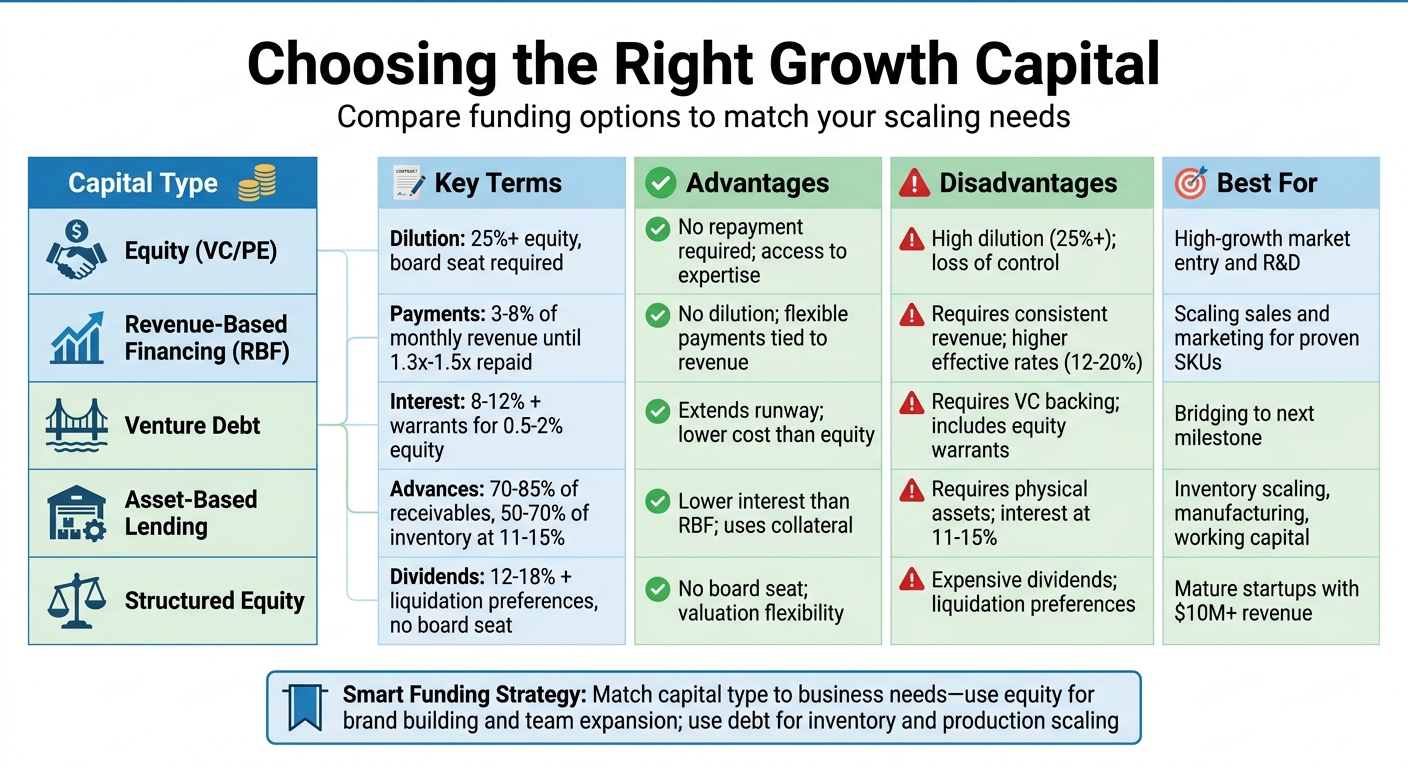
Growth Capital Options for Consumer Goods Startups: Equity vs Debt vs Blended Structures
Once your unit economics and financial metrics are solid, the next step is choosing the right type of growth capital to meet your scaling goals. Here's a breakdown of the main options:
Equity financing gives you access to funds without requiring repayment, but it comes at the cost of dilution - often 25% or more - and usually involves giving up a board seat [8].
Debt-based growth capital offers a different approach. Options like Revenue-Based Financing (RBF), venture debt, and asset-based lending allow you to maintain full ownership and avoid board changes [8]. For example:
Blended structures combine elements of equity and debt. These hybrid options, such as preferred equity or mezzanine financing, provide funding in exchange for dividends (12-18%) and liquidation preferences without requiring a board seat [8].
Take the example of Joe Marhamati, COO and Co-Founder of Sunvoy, who in 2025 used revenue-based financing from Lighter Capital to scale marketing and product development. By opting for non-dilutive capital instead of equity, Sunvoy hit key milestones while retaining full founder ownership [8].
"A $50M exit with 100% founder ownership beats a $200M exit where you own 8% after dilution" [8].
The type of capital you choose should align with your business's specific needs. Equity is ideal for activities like brand building, product development, and hiring, which don't generate immediate cash flow [1]. On the other hand, debt options like inventory financing are better suited for scaling production or fulfilling large purchase orders [1]. Many modern CPG deals now combine equity, RBF, and strategic warrants to minimize dilution while addressing both intangible and tangible growth needs [10]. By matching your funding strategy to your operational goals, you can make the most of every dollar raised.
| Capital Type | Advantages | Disadvantages | Best For |
|---|---|---|---|
| Equity (VC/PE) | No repayment required; access to expertise | High dilution (25%+); loss of control | High-growth market entry and R&D |
| Revenue-Based Financing | No dilution; payments tied to revenue (3-8%) | Requires consistent revenue; higher effective rates (12-20%) | Scaling sales and marketing for proven SKUs |
| Venture Debt | Extends runway; lower cost than equity | Requires VC backing; includes equity warrants (0.5-2%) | Bridging to next milestone |
| Asset-Based Lending | Lower interest than RBF; uses collateral | Requires physical assets; interest at 11-15% | Inventory scaling, manufacturing, working capital |
| Structured Equity | No board seat required; valuation flexibility | Expensive dividends (12-18%); liquidation preferences | Mature startups with $10M+ revenue |
Securing growth capital is just the first step. The real challenge lies in using it wisely to generate measurable returns. For consumer goods startups, it often takes $15M–$25M in total investment to hit $100M in revenue [2]. The key is to allocate funds in a way that supports operations, expands market reach, and drives revenue - without running out of cash before turning a profit.
Inventory can be a major cash drain. Production usually needs to be funded 60–90 days in advance to meet retailer expectations and minimum order quantities (MOQs) [2]. This makes it essential to use growth capital to build inventory buffers, especially for high-velocity SKUs. These top-performing products often account for 80% of revenue, so focusing on them is far more effective than spreading resources across slower-moving items [4].
Carrying inventory isn’t cheap either. Annual carrying costs typically run 20%–30% of inventory value, and healthy brands aim for turnover rates between 4× and 8× per year [4]. Beyond inventory, investing in operational infrastructure is critical. Early-stage brands may pour 30%–50% of sales into marketing [2], but as the business grows, manual processes often become bottlenecks. Automating systems like CRM and marketing tools can help maintain efficiency as the company scales [29,9].
Once operations are running smoothly, the next priority is expanding your reach to new customers.
With operations in place, the focus shifts to growing your market presence. Today, retail distribution isn’t just a late-stage goal - it’s an early validation step. Investors often expect at least one major retail partnership, such as Target, CVS, or Whole Foods, before they commit growth capital [1]. Meanwhile, relying solely on direct-to-consumer (DTC) sales has become less viable due to the tripling of online customer acquisition costs since 2019 [1].
Each sales channel has its own cash flow dynamics. DTC provides quick payments but requires significant marketing spend. Wholesale offers volume but often ties up cash for 60–90 days due to payment terms, while Amazon provides biweekly payouts [4]. A smart approach is to use equity capital for long-term investments like brand building and market entry, while reserving debt or inventory financing for short-term needs like large purchase orders [1].
To succeed in retail, start conversations with target partners 6–12 months before launch. Ensure your infrastructure can handle at least 50 retail doors, including warehousing, logistics, compliance, and inventory buffers. Tracking your Cash Conversion Cycle (CCC) will help you understand how long cash is locked up between production and payment [4].
Once inventory and market expansion are under control, it’s time to focus on high-return opportunities. For instance, Mondelez used AI-driven sales and demand planning in 2024, boosting ROI by 2% and improving forecast accuracy by 5%–10% [11]. Similarly, Clorox implemented GenAI for consumer prototyping, cutting its innovation cycle time in half [11]. These examples show how growth capital can be used to deliver measurable results.
Another smart move is concentrating resources on "power brands." In 2024, Molson Coors increased innovation-related revenue by 50% after reducing its new product launches by half to focus on high-potential opportunities [11]. Redirecting funds from underperforming SKUs to category leaders can further fuel growth.
Strategic acquisitions are another way to accelerate growth. In 2020, AB InBev’s venture arm, ZX Ventures, invested $25M in Super Coffee and secured a master distribution agreement. By 2021, Super Coffee’s valuation had surpassed $500M [9]. Acquiring competitors or complementary brands can fast-track market penetration, but it’s important to weigh the risks of overpaying or integration challenges.
| Strategy | Expected ROI | Risks | Example Use Case |
|---|---|---|---|
| Inventory Scaling | High | Overstock, cash flow strain | Funding production for a Target rollout during Q4 peak season |
| Market Expansion | Medium | Market entry challenges | Launching in a new geographic region or retail chain |
| Strategic Acquisitions | High | Overpaying, integration issues | Acquiring a competitor to gain shelf space and customer base |
| AI Implementation | Medium to High | Implementation costs, data quality | Using GenAI to reduce innovation cycle times by 50% |
| Power Brand Focus | High | Neglecting niche opportunities | Narrowing a 14-brand portfolio to 7 high-growth leaders |
Certain metrics separate startups that scale effectively from those that struggle with cash flow. For consumer goods companies, a revenue growth rate of 20%–50% year-over-year is a solid benchmark. Keeping inventory turnover between 4–6 times annually is another critical factor; falling below 4 often signals overproduction, which can tie up cash unnecessarily. For instance, one direct-to-consumer (DTC) brand cut waste by 30% and freed up $500,000 for marketing simply by optimizing this metric.
Other key targets include gross margins of 40%–60% and a customer acquisition cost (CAC) under $100–$200. Managing cash flow is equally essential - 70% of failing startups report a monthly cash burn above 15%. A beverage startup, for example, extended its financial runway from 4 to 9 months by implementing weekly cash flow projections. The ultimate aim is to achieve positive monthly free cash flow within 12 months of deploying growth capital.
Hitting these metrics often requires outside expertise to guide optimization efforts.
Phoenix Strategy Group approaches financial planning differently from traditional accounting firms. They break down silos by integrating finance and revenue teams, ensuring that tracking key metrics actively supports growth. Their fractional CFO services deliver high-level financial planning and analysis (FP&A), forecasting, and budgeting expertise without the cost of a full-time executive. Since 1998, they’ve worked with over 240 portfolio companies and helped raise more than $200 million in capital in just the past year.
Their "Victory Plan" uses historical data to create forecasts and actionable targets, refined through weekly tracking and monthly reviews. For consumer brands, they focus on unit economics, ensuring the business model supports scalability before significant capital is deployed. One beauty brand, for example, redirected $2 million from underperforming ad campaigns to higher-ROI retail channels, driving a 40% increase in revenue. As David Darmstandler, Co-CEO of DataPath, shared:
"As our fractional CFO, they accomplished more in six months than our last two full-time CFOs combined" [6].
This hands-on financial oversight not only supports growth but also sets the stage for successful exits and long-term expansion.
Scaling a business means creating a structure that can thrive independently of its founder. Phoenix Strategy Group specializes in helping startups build systems that maximize scalability and exit potential. With experience in over 100 M&As and more than five IPOs, they understand what buyers prioritize. Their method involves developing self-sustaining operations, cleaning up financial and operational data, and implementing due diligence systems early. This transforms businesses into "self-running" entities, significantly boosting valuation.
Their M&A services include valuation modeling - often targeting EBITDA multiples of 8–12x for consumer goods - cap table cleanup, and buyer outreach. One portfolio company saw its valuation triple before exit, thanks to their preparation. Lauren Nagel, CEO of SpokenLayer, remarked:
"PSG and David Metzler structured an extraordinary M&A deal during a very chaotic period in our business, and I couldn't be more pleased with our partnership" [6].
For startups eyeing future funding rounds or acquisitions, Phoenix Strategy Group’s integrated financial models and advisory services provide a clear path to growth and successful exits.
Scaling a consumer goods startup with growth capital isn’t just about securing funding - it’s about using it wisely to maintain healthy unit economics. The most successful founders match the type of funding to their specific needs: equity for long-term investments like brand building or team expansion, and non-dilutive financing for short-term needs such as funding inventory for confirmed orders. This approach helps preserve ownership, which is critical since founders often risk falling below 40% equity before hitting major revenue milestones [1]. As Rachel Vasquez aptly states:
"Investors fund businesses, not brands. Your aesthetic matters less than your P&L" [1].
To stand out, founders must focus on financing strategies that protect equity while meeting the performance metrics investors care about. For instance, a 50% gross margin is the baseline, but hitting 60% or higher is what truly captures attention. Beauty and personal care brands often achieve 70%–80% gross margins, making them more attractive to investors compared to food and beverage brands, which often struggle to exceed 40%. Similarly, wholesale reorder rates above 70% and strong revenue per SKU are far more compelling indicators of success than social media metrics [1].
Expert financial guidance plays a pivotal role in scaling efficiently and avoiding capital mismanagement. Phoenix Strategy Group offers fractional CFO services designed to help startups fine-tune unit economics, craft investor-ready forecasts, and prepare for growth. As David Darmstandler, Co-CEO of DataPath, shared:
"As our fractional CFO, they accomplished more in six months than our last two full-time CFOs combined" [6].
When growth capital is deployed strategically alongside disciplined execution and expert advice, startups can scale sustainably. For many consumer goods brands, reaching $100 million in revenue often requires $15 million–$25 million in total invested capital [2]. Founders who move quickly, stack capital intelligently, and build investor relationships 6–12 months ahead of formal raises are better positioned for success [1]. With the right financial partner and a clear strategy, consumer goods startups can grow while preserving the ownership and margins that drive long-term value.
When deciding how to raise funds, your choice between equity, debt, or a blended approach should align with your business objectives.
Each option has its pros and cons, so it’s all about finding the right fit for your strategy.
Investors pay close attention to specific metrics when assessing a startup's potential for growth and longevity. Revenue growth stands out as a key indicator - steady increases, whether year-over-year or month-over-month, suggest the business is successfully expanding its market presence.
Beyond revenue, unit economics play a vital role. Metrics like Customer Acquisition Cost (CAC) and Lifetime Value (LTV) reveal how efficiently a company attracts and retains customers. Additionally, factors such as gross margins, customer retention rates, and the burn rate help investors evaluate the startup's financial health and its ability to sustain growth over time.
The inventory required for a retail rollout hinges on three key factors: demand forecast, lead times, and cash flow. A straightforward approach is to calculate inventory by multiplying your weekly sales forecast by the lead time (in weeks). For instance, if your weekly sales forecast is 10,000 units and your lead time is 4 weeks, you’d plan for 40,000 units in inventory. Keep in mind, it’s important to regularly update your inventory levels based on real demand to prevent overstocking or running out of stock.