Published on
February 27, 2026


FP&A automation simplifies financial planning, budgeting, and forecasting by integrating systems through APIs. Instead of manually consolidating data from ERPs, CRMs, or billing platforms, APIs sync information in real time, ensuring accuracy and efficiency. This approach is especially helpful for growth-stage businesses managing complex cash flows and scaling operations with the help of a fractional CFO.
By combining APIs with AI tools, businesses can further enhance forecasting and anomaly detection, driving smarter decisions while saving time and resources.
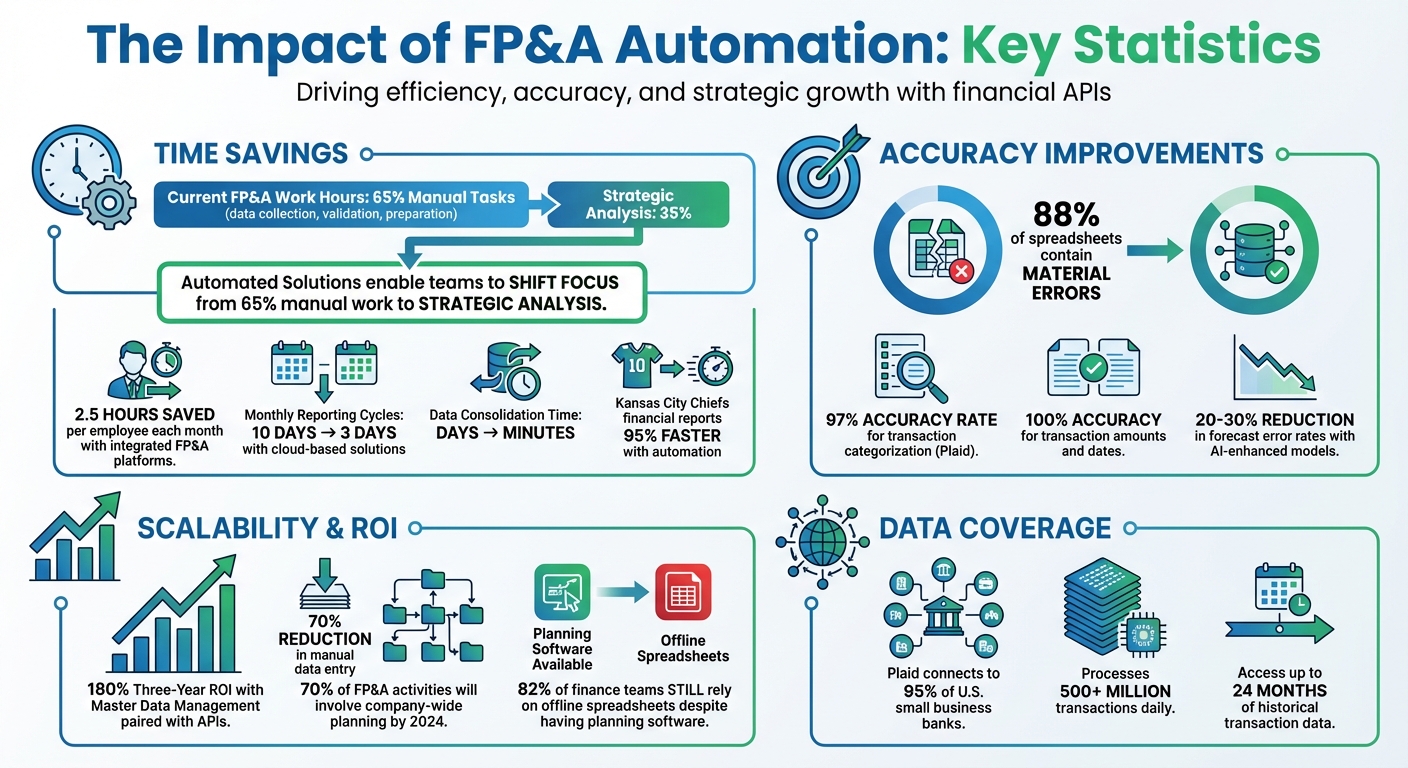
FP&A Automation Benefits: Time Savings, Accuracy, and ROI Statistics
To streamline FP&A workflows, growth-stage companies often rely on a set of financial APIs. These tools integrate various systems into a unified data engine, making automation possible. Here’s a breakdown of the five essential API categories for automating FP&A processes.
Banking APIs, such as Plaid, enable businesses to sync balances and transactions from bank accounts in real time, providing immediate cash flow visibility. Plaid connects to 95% of U.S. banks that cater to small businesses and processes over 500 million transactions daily [5]. These APIs can also access up to 24 months of historical transaction data, which is invaluable for building accurate financial models based on trends [6].
What makes these APIs even more powerful is their automatic data enrichment capability, which categorizes transactions with a 97% accuracy rate for merchant names and 100% for amounts and dates [6]. This eliminates the need for time-consuming manual categorization, allowing businesses to track cash flow instantly rather than retrospectively.
"We chose Plaid because we love the data quality and how much thought they put into elevating the user experience." - Mani Fazeli, Senior Vice President of Product [5]
For businesses, especially those with subscription-based models, revenue APIs like Stripe are game-changers. They automate accrual accounting by generating monthly revenue summaries and waterfalls segmented by product, customer, or invoice. These summaries feed directly into financial models, streamlining revenue forecasting and simplifying month-end closing tasks [7].
Accounting APIs from platforms like QuickBooks serve as the backbone for financial data management. Acting as the system of record, these APIs ensure that invoices, bills, journal entries, and reports are updated continuously. This guarantees that FP&A models always reflect the latest ledger activity [8]. Since accounting systems are the final authority for financial records, other systems like payments and CRM should feed data into them - not the other way around [8].
CRM APIs, such as Salesforce, play a key role in revenue forecasting by integrating sales pipeline data. These APIs pull real-time information on opportunities, close dates, and deal values, providing the "commercial intent" layer that complements the "cash reality" delivered by banking APIs [8]. Together, they enable finance teams to create more accurate, forward-looking models based on real-time sales activity.
HR APIs from platforms like Workday are essential for labor cost projections, particularly as personnel expenses often represent the largest cost category for growth-stage companies. These APIs provide automated access to employee records, compensation details, and payroll data, ensuring accurate expense forecasting and budget alignment [8]. They also integrate with accounting systems at the expense level, offering a complete view of operational costs.
Financial APIs can save significant time and improve efficiency, directly impacting a company’s bottom line. On average, FP&A teams dedicate around 65% of their work hours to manual tasks like collecting, validating, and preparing data [9]. By automating these processes through APIs, teams can shift their focus to strategic analysis and decision-making. For example, integrated FP&A platforms save approximately 2.5 hours per employee each month [12], and cloud-based solutions can shorten monthly reporting cycles from 10 days to just 3 [9].
Accuracy also sees a major boost when APIs replace manual workflows. Research shows that nearly 88% of spreadsheets used for budgeting and forecasting contain material errors [9], which can be especially risky for growing companies. API-driven automation reduces these risks by pulling data directly from source systems. Companies using AI-enhanced predictive models have seen forecast error rates drop by 20% to 30% [9]. A real-world example of this is the Kansas City Chiefs, who adopted Vena's agile FP&A technology in 2022 and achieved financial reports 95% faster than their previous manual methods [4].
Scalability is another key advantage. API-based systems can handle increasing data volumes and complexity without requiring a proportional increase in staff. Pairing APIs with Master Data Management (MDM) can deliver a three-year ROI of 180% by cutting reconciliation time [9]. Despite these benefits, companies must navigate several technical and organizational hurdles to unlock the full potential of API-driven automation.
While the benefits are clear, implementing API-driven FP&A solutions comes with challenges that can limit their effectiveness if not managed properly.
One major hurdle is the complexity of technical integration. Handling real-time versus batch processing, managing API rate limits, and ensuring compatibility between legacy and modern systems demand specialized skills [10][11]. Unfortunately, finance teams often lack technical expertise in areas like Python or SQL, and IT departments may prioritize system stability over integration flexibility [10][11]. To address this, companies should consider investing in training programs, with budgets ranging from $8,000 to $12,000 per analyst for skills like data visualization, SQL, and AI literacy [11].
Data fragmentation and inconsistent definitions can also lead to inaccurate models and flawed analysis. To mitigate this, companies should centralize their data in a warehouse or lake, integrating sources like ERP, CRM, and HRIS systems before feeding data into FP&A tools [9]. Implementing MDM helps standardize definitions for key entities like customers, products, and cost centers, while automated validation checks can flag inaccuracies at the source [9][10].
| Data Quality Challenge | Impact on FP&A | Mitigation Strategy |
|---|---|---|
| Inaccurate Data | Leads to flawed variance analysis and reporting | Use automated validation checks at the source |
| Inconsistent Data | Hinders performance comparisons across units | Implement Master Data Management (MDM) |
| Incomplete Data | Causes model failures or biased estimates | Enforce mandatory fields in source systems |
Organizational resistance is another common obstacle. Despite having planning software, around 82% of finance teams still rely on offline spreadsheets for core processes, which increases version control risks [4]. A phased implementation strategy can help overcome this resistance. For instance, starting with automation in a single high-impact area, like rolling cash forecasts, can demonstrate value and build confidence before scaling to more complex processes [11].
Let’s break down how to implement FP&A automation using financial APIs, step by step. This guide builds on the benefits and challenges discussed earlier.
The first step is to figure out where time is being wasted. Did you know that FP&A professionals spend 65% of their time on tasks that could be automated, like manual data collection and validation? That leaves only 35% for high-value work [13]. Start by mapping out your workflows to identify repetitive tasks and manual data consolidation efforts.
Make a list of every system where your financial data lives. This might include accounting software, CRMs, HRIS platforms, billing systems, and even bank accounts. Document how data moves between these systems - especially the manual transfers - and track how often errors occur. Don’t overlook formatting needs specific to the U.S., like MM/DD/YYYY dates, dollar signs ($), and comma-separated numbers (e.g., $1,250,000.00). This step lays the foundation for choosing the right APIs.
Next, pick APIs that work well with the tools you already use, so you don’t need to overhaul your entire system. Look for prebuilt connectors for your core platforms - like QuickBooks or NetSuite for accounting, Salesforce or HubSpot for CRM, and Gusto or ADP for payroll.
Before diving in fully, run a test. Pull one month’s worth of data and compare it to the original source. Set up validation checks to flag common issues, like duplicate entries or miscategorized expenses. These tests will help you avoid data mismatches that could erode trust in your automation process.
Now it’s time to set up automated data pipelines. Schedule regular data syncs to pull information from your source systems into a central location, like a data warehouse or your FP&A platform. For historical analysis, import 12 to 24 months of past data to establish trends. For critical metrics - like cash position, receivables, and pipeline revenue - set up real-time or daily updates.
Design your pipelines to handle both batch processing (for monthly closes) and continuous feeds (for rolling forecasts). Don’t forget to include error-handling mechanisms that alert your team when syncs fail or data falls outside expected ranges. This automation can cut consolidation time from days to just minutes [1].
Once your data pipelines are running smoothly, integrate API feeds directly into your FP&A models. Link these feeds to your budgeting templates, forecast models, and scenario planning tools. Let the API data populate your models while keeping your key formulas and assumptions intact. Modern platforms often include built-in permissions, making it easier for teams to collaborate without version control headaches.
Organize your models so that API-fed actuals remain separate from projections based on drivers. This makes it easy to update historical data while keeping your forward-looking assumptions flexible. For example, Phoenix Strategy Group’s Integrated Financial Model combines real-time data syncing with tailored forecasting frameworks, helping growth-stage companies make faster decisions during critical scaling periods.
Finally, keep an eye on your system’s performance. Track metrics like sync frequency, data latency, and error rates to ensure everything runs smoothly. Set up alerts for API failures, missing data, or values that seem off compared to historical patterns. During the first month, review these metrics weekly. Once things stabilize, you can shift to monthly monitoring.
Refine your validation rules as you uncover errors. If specific accounts consistently need manual fixes, dig into whether the problem lies in the source system’s categorization or the API’s mapping logic. Start with one high-priority area, and expand your automation efforts as issues get resolved.
Once you've established automated data pipelines, the next step is to elevate your FP&A processes by incorporating real-time data synchronization and AI-driven analytics. These tools help you quickly identify both opportunities and risks.
Real-time data synchronization eliminates delays between transactions and updates to your FP&A dashboards. APIs can continuously or periodically pull updates throughout the day, giving you instant insights into cash flow and pipeline revenue. Cloud-based FP&A platforms connect seamlessly with systems like accounting, CRM, payroll, and banking, ensuring data accuracy and providing detailed audit trails that show when and where each data point originated [14]. For software without built-in connectors, modern platforms offer flexible integration options, including API connections, automated imports, or even syncing through Google Sheets [14].
By 2024, an estimated 70% of FP&A activities will involve company-wide planning initiatives [14]. This level of coordination demands the immediacy and accuracy that only real-time data can provide. Leveraging this foundation, AI tools can take your forecasting and risk management to the next level.
AI transforms raw financial data into actionable insights, complementing real-time synchronization. Machine learning algorithms analyze historical trends in revenue, expenses, and cash flow to deliver forecasts with a level of precision that manual methods simply can't match. These AI-driven forecasts integrate seamlessly into FP&A models, ensuring they remain current and reliable.
AI also excels at anomaly detection, automatically identifying unusual variances in your financial data and alerting your team in real time. With natural language processing, you can even query your financial data using plain English, making complex insights more accessible [14].
Today's leading FP&A platforms incorporate AI for predictive analytics, anomaly detection, and scenario planning, empowering more informed decision-making. However, the effectiveness of these tools hinges on clean, real-time data feeds. For example, Phoenix Strategy Group uses a combination of real-time synchronization and AI-enhanced forecasting to help growth-stage companies uncover patterns and anomalies that could influence their scaling efforts.
For growth-stage companies, automating financial planning and analysis (FP&A) can transform a traditionally manual process into a powerful tool for driving growth. Automation can cut manual data entry by as much as 70%, turning tasks that previously took days into ones completed in minutes [1]. Industry experts highlight how automation helps teams shift focus from tedious data entry to meaningful strategic analysis [1].
But it’s not just about saving time. Automation enhances accuracy and scalability. Automated systems catch errors that might otherwise go unnoticed, and real-time data synchronization ensures dashboards are always up-to-date. By 2024, it’s projected that 70% of FP&A activities will involve company-wide planning, emphasizing the need for coordinated, timely data [14]. APIs play a key role here, seamlessly connecting different systems to create a unified data layer without disrupting existing workflows [1][2]. These tools empower teams to make smarter, data-driven decisions while streamlining operations.
To start reaping these benefits, companies should evaluate their current FP&A processes. Pinpoint repetitive tasks that drain your team’s time and identify data sources still relying on manual input - these are prime candidates for automation. Begin with high-impact areas, such as automating daily cash flow reports or linking your accounting system directly to FP&A models. Once you see results, you can expand automation efforts to other areas [1][3].
This transition isn’t just about efficiency - it’s about setting the foundation for sustainable growth. Phoenix Strategy Group specializes in helping growth-stage businesses navigate this shift. By combining fractional CFO expertise with advanced data engineering, they design and implement API-driven automation tailored to your specific needs. Whether you’re preparing for fundraising, scaling operations, or planning an exit, building a strong FP&A infrastructure can be a game-changer.
Start with automating financial data integration to link systems such as accounting software, CRMs, and banking platforms. This creates a seamless, real-time data flow that improves accuracy and supports scalability - critical during periods of growth or mergers and acquisitions. Once this foundation is in place, shift your attention to automating workflows like accounting, financial reporting, or cash flow management. This reduces manual work and minimizes errors, paving the way for more efficient and scalable FP&A processes.
You don’t always need to know SQL or Python to work with financial APIs for FP&A tasks. Many APIs come with intuitive interfaces that allow you to automate workflows and exchange real-time data without diving into code.
That said, if you're aiming for advanced customization or creating highly specific solutions, having some knowledge of SQL or Python can be a plus. Still, most APIs are built to simplify processes, so finance teams can use them effectively with limited technical know-how.
To ensure your API-synced FP&A data remains accurate and traceable, prioritize strong security practices. Use encryption to protect data during transfers and implement authentication methods to verify access. Regular monitoring is crucial to catch potential issues early.
Validate data at key transfer points and set up automated checks to quickly identify any discrepancies. Maintaining an audit trail is essential - log every data transaction, including timestamps and user activities, for transparency and accountability.
Don't forget to periodically review and update your API integrations and security protocols. This helps ensure they meet current standards and safeguards your data's integrity.