Published on
July 2, 2026

As a company grows, finance complexity rarely increases in a straight line. One month, your existing bookkeeper seems sufficient. A few months later, reporting is late, the chart of accounts no longer reflects reality, and basic questions about margins, cash flow, or entity-level performance become hard to answer with confidence.
That’s the point where many founders begin asking a more strategic question: Do we need a controller, a CFO, or both?
This distinction matters more than most owners realize. Hiring a fractional CFO before your financial data is reliable can produce elegant forecasts built on weak foundations. On the other hand, stopping at bookkeeping and monthly reconciliations can leave a growing business without the strategic financial guidance needed to scale well.
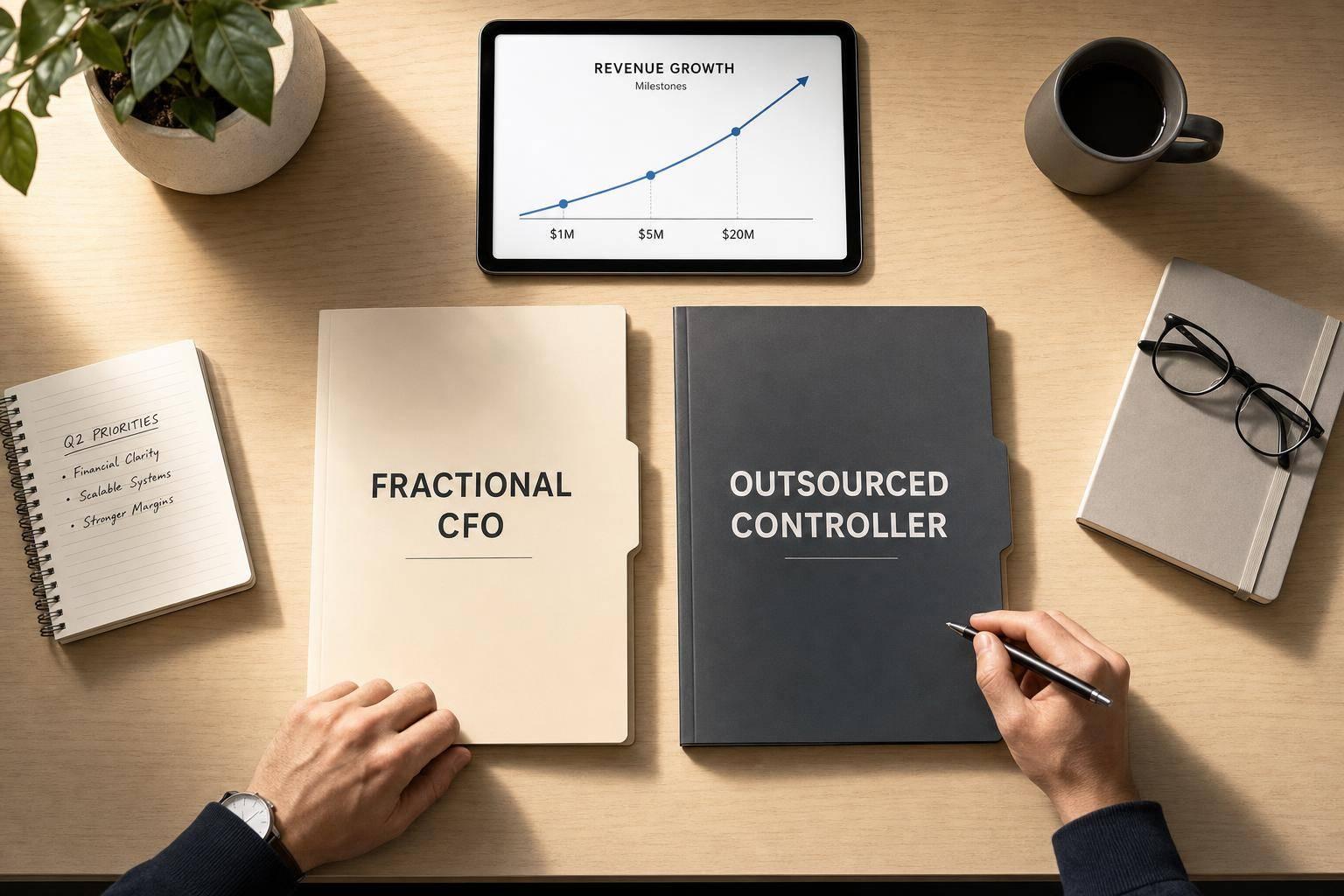
The video’s central argument is simple and important: controllers organize and validate the financial past; CFOs use that information to shape the financial future. For founders in the $500K to $10M range, understanding that sequence can prevent expensive hiring mistakes and improve decision-making at a critical stage of growth.
Early-stage businesses often operate with a lean finance stack: a founder, a bookkeeper, and accounting software. That setup can work surprisingly well for a while, especially when transactions are limited, the business model is simple, and the owner stays close to daily operations.
But growth introduces friction:
At that stage, "good enough" bookkeeping becomes a risk. The issue is not just compliance. It’s that poor financial infrastructure slows growth. Founders start spending time decoding reports instead of using them.
The video frames this as a natural progression: bookkeeper, then stronger accounting support, then controller and CFO-level capacity as the business matures. That sequence reflects how finance functions typically scale in healthy organizations.
The video describes the controller as the person responsible for turning raw financial activity into usable, GAAP-aligned financial statements. That includes the income statement, balance sheet, and the broader integrity of the accounting process.
In practical terms, a controller usually owns or oversees:
A controller ensures transactions are categorized correctly, reconciliations are complete, and reports are dependable. If a founder asks, "What was our true net income last month?" the controller should be able to answer with confidence.
Many small businesses don’t realize how costly a slow or inconsistent close can be. If every month’s books remain open deep into the following month, leadership is always operating on stale information. A controller creates the process and accountability to close books consistently.
This is one of the most valuable and underappreciated controller functions. Controls reduce the chance of:
In founder-led businesses, these issues often surface only after damage has already occurred. A controller helps create financial safeguards before problems become material.
The video mentions a common pain point: businesses trying to manage multiple operations inside one accounting environment without clean separation. That creates reporting confusion and often masks which business units are actually performing well.
A controller helps answer questions like:
The controller’s lens is primarily retrospective. As the speaker puts it, this role is focused on how the business has performed. That backward-looking orientation is not a limitation; it is the base layer of financial truth.
Without it, strategy becomes speculation.
If the controller is responsible for trustworthy historical reporting, the CFO is responsible for converting that reporting into insight, options, and direction.
The video emphasizes that the CFO takes the completed financial data and asks: What happens next?
That future-oriented work typically includes:
This is more than projecting current revenue forward. A CFO builds models that help leadership evaluate scenarios such as:
A strong CFO doesn’t just hand over a single budget. They help leadership understand how changing one variable affects the rest of the business.
Many growing companies are profitable on paper yet strained on cash. A CFO helps map timing differences between collections, payables, payroll, debt service, and growth investments.
For founders, this is often where finance becomes strategic in a very tangible way. Cash flow forecasting informs decisions like:
A CFO role extends well beyond spreadsheets. This person helps translate financial data into business choices. Examples include:
The video notes that CFO work includes one-year and three-year directional planning. That matters for founders preparing for a larger transition, whether that means scale, funding, acquisition, or operational simplification.
A controller tells you where you have been. A CFO helps determine whether your current path will get you where you want to go.
The strongest practical lesson in the video is not merely that controllers and CFOs do different jobs. It’s that the order in which you hire them often determines the value you receive.
If your accounting is broken, a CFO cannot solve the real problem. They may temporarily compensate for weak financial systems, but that usually means an expensive strategic resource is spending time rebuilding foundational reporting.
That’s a misuse of talent and budget.
A useful way to think about it:
Skipping the middle layer creates downstream distortion.
Based on the video, the first meaningful threshold for this conversation often appears around $5 million in annual revenue. That figure is not a universal rule, but it’s a reasonable signal that complexity may be outpacing basic bookkeeping.
You likely need controller-level help if any of these are true:
If monthly financials arrive weeks late, or if prior months keep changing after the fact, reporting discipline is probably insufficient.
If every P&L review turns into a debate over what is accurate, the issue is not strategy. It is accounting control.
If year-end cleanup is extensive, your monthly accounting function is not strong enough.
Segment reporting, intercompany activity, and proper entity separation require more than basic transaction entry.
If one person can receive invoices, approve payments, and execute disbursements, your financial risk is too concentrated.
Lenders, investors, and acquirers care deeply about financial cleanliness. A controller helps create that readiness.
In short, if the business cannot produce timely, accurate, decision-ready financial statements, a controller is usually the better first hire.
Once the reporting foundation is solid, CFO-level work becomes much more valuable.
A fractional CFO is often appropriate when:
If leadership is asking what the next 12 to 36 months should look like, forecasting becomes essential.
The more expensive your choices become, the more important scenario planning is.
A CFO can create a more disciplined cash forecasting cadence and help prevent growth-related liquidity surprises.
Capital raises and M&A preparation require more than clean books. They require financial storytelling, planning, and analysis.
Many companies reach a point where the owner is still making all major financial calls without enough structured support. A CFO reduces that dependency.
For companies in the upper end of the target audience range, especially those nearing or surpassing $10 million in annual revenue, the case for both a controller and CFO becomes stronger.
The video acknowledges that strong finance professionals may have some capability in both areas. That’s true, especially in smaller businesses where one person often covers multiple responsibilities.
But overlap should not obscure specialization.
A controller’s mindset tends to be:
A CFO’s mindset tends to be:
These are adjacent disciplines, not identical ones.
A founder may find a talented operator who can handle both for a period of time. But the broader lesson is that different work requires different strengths. That becomes increasingly true as transaction volume, staffing, and strategic complexity rise.
The video references controller compensation in the full-time market as a meaningful investment, noting that quality accounting talent is expensive. That cost reality is exactly why many mid-market companies explore fractional support.
For founders between $500K and $10M in revenue, the fractional model can make sense when:
That said, fractional support is not a shortcut around accountability. Whether the role is outsourced or internal, success still depends on:
Fractional talent works best when the business is serious about financial discipline, not just looking for occasional cleanup.
If you are unsure which role to hire, start with a diagnostic. Ask these questions:
If no, start with a controller.
If no, start with a controller.
If no, start with a controller.
If yes, add a CFO.
If yes, add a CFO.
If yes, you likely need both.
This framework aligns with the logic in the video while making it easier to apply in an operating business.
The video hints at several issues that are worth making explicit.
Founders sometimes want dashboards, board-ready models, and future planning before the books are stable. That usually leads to wasted time and frustration.
A reliable bookkeeper can be extremely valuable. But bookkeeping alone is not the same as controllership. At a certain size, the business needs more rigor.
A CFO can guide finance transformation, but they should not be the primary solution to broken monthly accounting.
Fraud prevention and payment controls may feel secondary until there is an incident. By then, the cost is much higher.
By the time many founders seek help, the cleanup is more expensive and the decision pressure is greater. Finance upgrades are easier when done proactively.
For the audience of scaling founders and operators, this conversation is larger than job titles. It’s really about building a finance function that matches the ambitions of the business.
If your goal is to:
Then the controller/CFO distinction becomes operationally significant.
A buyer or lender does not just evaluate top-line growth. They evaluate whether the numbers are reliable, whether the business is controlled, and whether leadership understands the financial levers that drive performance.
That’s why this is not merely an accounting conversation. It’s a value-creation conversation.
The clearest lesson from the video is that finance leadership should be built in layers. First, establish accurate reporting and internal control. Then build forecasting, planning, and strategic financial guidance on top of it.
For many growing businesses, the controller is the first critical upgrade. That role creates order, trust, and visibility. Once that foundation exists, a CFO can help management model the future, allocate capital intelligently, and make more confident growth decisions.
If your business is struggling to produce clean financials, start there. If your books are already strong and the next challenge is scaling wisely, planning cash, or preparing for a major milestone, CFO support may be the more important next move.
The key is not choosing the more impressive title. It’s choosing the role that solves your current constraint.
Source: "Fractional CFO vs Outsourced Controller: When to Hire Each Role" - The Digital Merchant, YouTube, Jun 26, 2026 - https://www.youtube.com/watch?v=KXXvc0ALgnE