Published on
March 7, 2026


Reward-based crowdfunding is a method startups use to secure funds without giving up equity or taking on debt. Backers contribute money in exchange for non-financial perks like early product access, exclusive experiences, or merchandise. This approach acts as a pre-order system, validating demand, building a customer base, and generating cash flow before product launch.
Key Takeaways:
Steps to Success:
While crowdfunding offers advantages like market validation and community building, challenges include fulfillment logistics, time commitment, and the risk of public failure. Success hinges on preparation, early momentum, and consistent engagement.

5-Step Reward-Based Crowdfunding Process for Startups
Plan your campaign to run for 6–12 weeks. Careful preparation during this time can multiply the funds you raise by two or three times[4][12]. This phase is all about laying the groundwork: identifying your audience, crafting rewards that appeal to them, and setting realistic funding goals.
Start by pinpointing your ideal backers. Think about their demographics - like age, location, and income - as well as their motivations, such as lifestyle, values, or challenges they face[5]. Take inspiration from successful campaigns in your niche. Study their reward structures and typical pledge amounts to understand what works[5]. Then, test your assumptions with pre-launch surveys or "smoke tests" to gather early feedback and fine-tune your product[5][6].
Your product should solve a clear, measurable problem. For instance, if you're creating an ergonomic keyboard, you could position it as a way to save users about $500 annually in physical therapy costs[5]. Early testing is crucial. Take Piper, for example - they secured 10,000 email signups and 1,900 paid reservations before their launch. Similarly, Botany invested $5,000 in pre-launch ads and generated 8,700 leads[3].
Keep your reward tiers simple - offer no more than five options to suit different budgets[7]. The most popular pledge amount on Kickstarter is $25[7][9]. A typical reward structure might look like this:
Early bird discounts during the first 48 hours can create urgency and drive momentum.
"I knew that an alternative on the market would typically be sold at around $20-30, and I wanted to place myself higher than that."
- Cody Lewis, Founder, PocketChange Designs[8]
When pricing your tiers, account for all costs, including manufacturing, shipping, platform fees (5%), and payment processing fees (3–5%)[1]. Add a 10–15% buffer to cover unexpected expenses[1][10][11]. Avoid offering too many variations (like sizes or colors), as this can complicate manufacturing and increase costs[8].
To calculate your funding goal, add up costs like BOM×MOQ, manufacturing, shipping, packaging, and platform fees. Exclude sunk costs like prototyping or video production[10][11].
"Ask for exactly what you need. Don't ask for more or less than what it will cost to manufacture, sell, and ship your project in the quantity you plan on producing."
Most campaigns succeed with a duration of 30 to 45 days[11][12]. This timeframe balances urgency with audience reach. Break your goal into daily targets - for example, raising $50,000 over 40 days means aiming for about $1,250 per day[12].
Success often hinges on a strong start. Campaigns that hit 30% of their funding goal within the first 48 hours have an 85% success rate[5]. Building a pre-launch email list is key. Lists with 5,000 or more subscribers convert at 38% on Day 1, compared to just 8% for cold launches[2]. Aim for at least 500 qualified email signups before going live[4]. Peak Design is a great example - they built an email list of 180,000 subscribers over nine months, raising $3.2 million on Day 1 and $12 million overall[2]. This approach not only validates demand but also helps you build a loyal customer base before launch.
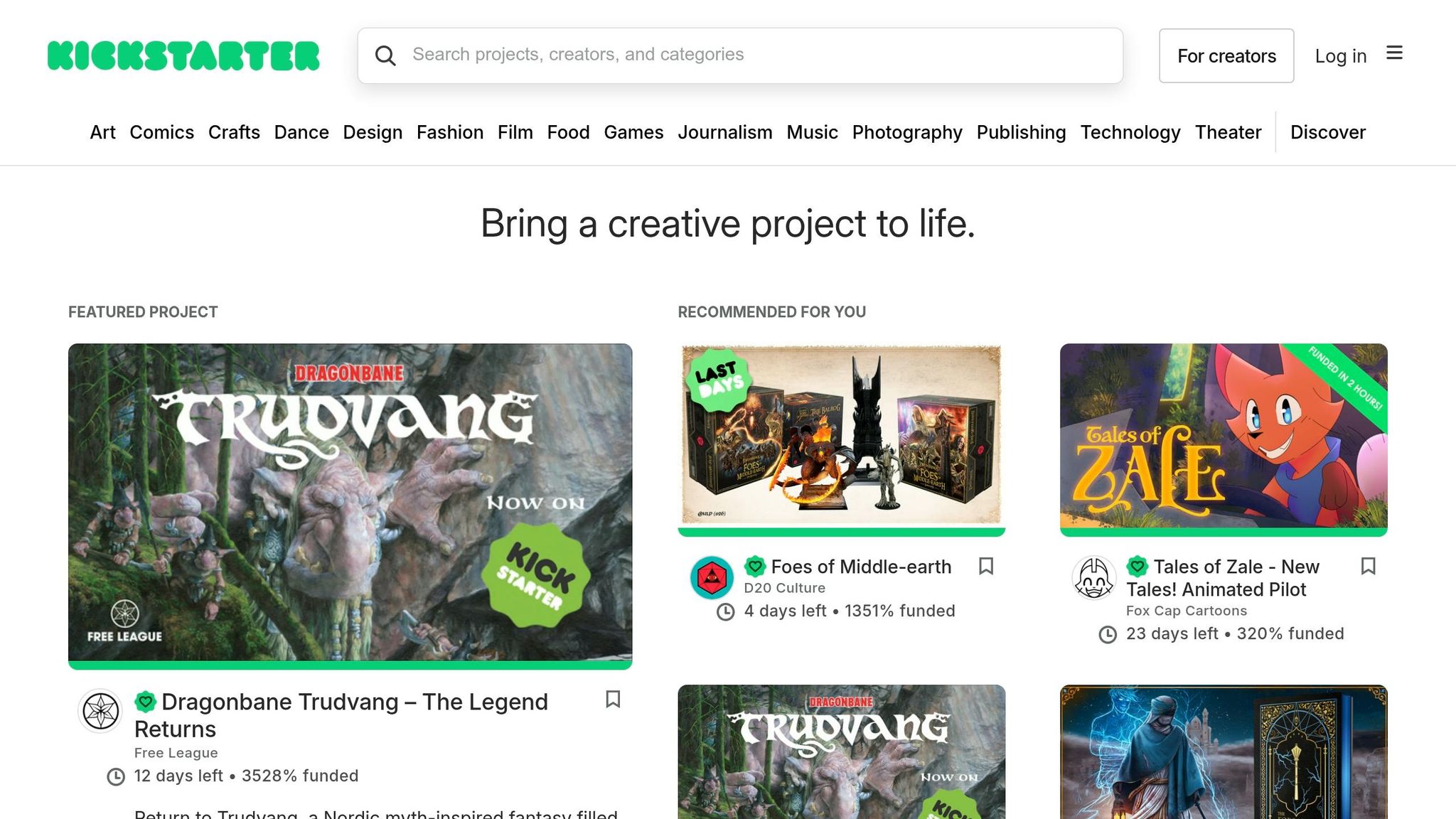
Once your campaign is ready, the next big decision is picking the right crowdfunding platform. Each platform has its own strengths, audience, and rules, so it’s important to choose wisely. For instance, Kickstarter is a go-to for creative projects and high-design hardware, with projections showing it could handle $900 million in pledges by 2025. Historically, it has processed $8.53 billion in pledges[6,32]. On the other hand, Indiegogo is often preferred by tech startups and international campaigns, with an estimated $550 million in pledges expected in 2025[15]. Success rates also differ: Kickstarter’s range sits between 37.7% and 42%, while Indiegogo’s is lower, around 13.1% to 17%[29,31]. These variations are largely due to differences in funding models and approval processes.
Understanding the costs and features of each platform is essential. Both Kickstarter and Indiegogo charge a 5% platform fee, plus payment processing fees ranging from 3% to 5%. Kickstarter adds about $0.20 per pledge, while Indiegogo’s fee is slightly higher at $0.30 per pledge. Additional charges may include international wire fees (around $25) and currency conversion costs[29,34]. For campaigns with smaller donations, Kickstarter tacks on an extra $0.05 for pledges under $10, which can add up if you expect a lot of micro-contributions[34,38].
If your campaign involves larger pledges or you want to avoid success fees, platforms like Fundable might be an option. Fundable charges a flat $179 monthly fee instead of taking a percentage of your funds[14].
Each platform also has specific rules and approval processes. Kickstarter, for instance, has a stricter vetting system that takes about 3–5 business days. Once your campaign is live, you can’t change your funding goal[16]. This makes it crucial to align your product with the platform’s audience to increase your chances of success.
"The magic happens when your product matches your platform's audience type and psychology."
- TCF Team[16]
Indiegogo, in contrast, has more flexible guidelines and offers tools like InDemand, which lets you continue fundraising even after your campaign ends[6,31]. If your project involves complex logistics or multiple add-ons, third-party tools like PledgeBox can help with fulfillment. PledgeBox charges 3%, but only on post-campaign upsells[1].
The funding model you choose can also shape your campaign’s strategy. Kickstarter uses an all-or-nothing approach, meaning you only receive funds if your campaign reaches its goal by the deadline. If the goal isn’t met, backers aren’t charged[35,36,37]. This model creates urgency and builds trust with backers, as every pledge feels critical to the campaign’s success[32,34].
Indiegogo, however, offers both all-or-nothing and flexible funding options. Flexible funding allows you to keep whatever funds you raise, even if you don’t hit your goal[29,30,35,36,37]. While this reduces financial risk for creators, it can sometimes lower backer confidence - especially if a campaign raises only a fraction of its target, such as 40%. Flexible funding might work better if you’re planning a phased launch or are confident in delivering value at any funding level.
Now that you've chosen your platform, it's time to create a campaign page that turns visitors into backers. Your page needs to answer three key questions almost instantly: What is this? Why should I care? What's in it for me? [13] The best campaigns follow a tried-and-true formula: start with a compelling hook, explain the problem and your solution, use visuals to show how your product works, share your founder story, outline reward tiers, and introduce your team. This page will serve as the foundation for your campaign promotion and backer engagement as you move forward.
Your campaign page is where storytelling meets sales. Keep your project title concise - under 60 characters - and your subtitle under 135 characters to make them easy to share. [17] Focus on how your product benefits backers rather than just listing technical specs. [13] Use engaging visuals to bring your product to life, and consider adding custom graphics as section dividers to make the page visually appealing. [17]
Take the example of Hush, a startup that raised over $1.5 million in just 30 days on Kickstarter. They became one of the top 10 most-funded Canadian campaigns by clearly showing how their product solved a specific sleep issue. [6] A 30-day campaign is often ideal - it helps maintain momentum, avoids donor fatigue, and keeps your team energized. [17]
Including a video on your campaign page is non-negotiable. Campaigns with video pitches raise four times more funding than those without, and 75% of successful Kickstarter campaigns feature a video. [19][20] Your video should grab attention within the first 3–5 seconds, showcase your passion for the project, and end with a strong call to action. [18] Keep it under two minutes, as engagement tends to drop after the first 60 seconds. [17] And don’t forget - 85% of videos on social media are watched without sound, so captions are a must. [21]
"People don't just back products; they back passionate creators with a compelling story." – PledgeBox [18]
Social proof is another powerful tool for building trust. Highlight testimonials from beta testers, media coverage, and recognizable "as seen on" logos directly on your page. These elements reduce perceived risk and make your campaign feel more credible. [6][13] Once your page and video are ready, shift your focus to pre-launch marketing to build momentum.
A strong campaign doesn’t launch in a vacuum. Pre-launch marketing is essential to prime your audience for success. Start building an email list 3–6 months before your launch date. Campaigns with pre-launch lists convert 3–5 times better than those without. [2][4] Your goal should be to hit 30% of your funding target within the first 48 hours to activate platform algorithms and generate immediate social proof. [2][22]
Strategic email sequences can help you keep potential backers engaged. Consider a pre-launch sequence that includes stages like: Mystery Teaser, Product Reveal, Social Proof, Early Bird Offer, FAQ/Objections, Final VIP Reminder, and the "Live" announcement. [4]
You might also explore a "reservation funnel", where leads pay a small deposit (e.g., $1–$5) to lock in a VIP discount. This approach dramatically increases conversion rates - leads who opt in this way are 30 times more likely to back your campaign than those who only provide an email address. [13] For instance, the Artistry campaign by Dusty used a $1 reservation funnel to offer a $7.99 mini-expansion. This strategy helped them raise $167,177 in the first 24 hours and eventually reach a total of $736,673. [13]
Your campaign page is live, and the groundwork from your pre-launch efforts is set. Now it’s time to focus on active promotion and day-to-day management. The first 48 hours are critical - they’re your chance to activate platform algorithms and establish credibility through social proof. After this initial burst, keep the momentum going with consistent promotion and active engagement. Fun fact: campaigns that post updates every five days raise three times more funds than those that don’t[23].
Social media will be your promotional powerhouse during the live campaign. Platforms like Meta (Facebook and Instagram) dominate, accounting for 90% of successful ad budgets[24]. To make the most of it, lean into short-form video content (1–2 minutes), behind-the-scenes clips, and user-generated posts. These types of content feel more personal and relatable, which helps build trust. Schedule posts strategically for peak visibility and respond to comments within 24 hours to show you’re actively engaged[24].
Teaming up with micro-influencers (those with 5,000–50,000 followers) can also give you a big boost. Their audiences tend to trust their recommendations more than those of celebrities - 92% of consumers say so[26]. Take Aaron Radcliffe, for instance, the creator of the Fyro T22 Backpack. He used a $1 reservation funnel to identify VIP backers before launch. This strategy helped him raise $232,000 in just 48 hours, eventually hitting $373,464 - over 3,700% of his goal[26].
"By the time we launched, our community members weren't just backers - they were evangelists who had a stake in seeing the T22 succeed." – Aaron Radcliffe, Creator of Fyro T22[26]
Plan to spend 2–3 hours daily managing your social media. This includes scheduling posts, responding to comments, and analyzing performance[29]. Use a mix of popular hashtags for broader reach and branded ones to build your campaign’s identity. Aim for a click-through rate (CTR) of 1% to 3% from your social posts to the campaign page[24]. And remember, people often need to see a message up to seven times before they take action[28]. Every interaction counts toward refining your strategy and driving results.
Keeping an eye on key metrics will help you understand what’s working and where to pivot. Monitor your total funds raised, number of backers, and average pledge size to gauge financial progress[30]. Also, pay attention to your visitor-to-backer conversion rate. If it’s lower than expected, your campaign page might need tweaks to make the pledge process smoother[58,59]. Hitting 50% of your goal is a big deal - once you’re there, you have a 95% chance of reaching your total target. Use this milestone to create urgency in your messaging[25].
Most campaigns hit a mid-campaign slump, but you can prepare for it. Draft updates ahead of time and plan limited-time perks (like 24–48-hour offers) to reignite interest[6,55]. Use referral tags to track where pledges are coming from, and double down on the channels that perform best[6,56]. For example, AstroBrew’s creator Joe built a pre-launch community that brought in $68,574 within 24 hours. This early success triggered Kickstarter’s discovery algorithm, adding another $35,359 in organic funding (24% of the total)[26].
Don’t forget that over half of Kickstarter traffic now comes from mobile devices, so make sure your campaign page and social media content are mobile-friendly[26]. If you’re running paid ads, set aside $500 to $2,000 for smaller campaigns to see a noticeable impact on contributions[24]. Finally, use tools like Hootsuite or Brandwatch to monitor online chatter. Address any negative feedback quickly and transparently to protect your campaign’s reputation[24].
Once your campaign wraps up, it’s time to shift gears toward fulfilling rewards and tackling post-campaign responsibilities. Kickstarter typically releases funds around 14 days after the campaign ends. However, remember that platform and payment processing fees will take about 8–10% off the total amount raised[60,61]. Also, keep in mind that 84% of Kickstarter’s most-funded projects have missed their original delivery dates, and 81% of backers from failed campaigns say they wouldn’t support the same creator again[34].
"The hardest part of crowdfunding isn't raising money - it's actually delivering on your promises." – Steve Rajeckas, Content Marketing Manager, Red Stag Fulfillment[32]
Start by using a dedicated pledge management tool like BackerKit or PledgeBox to streamline backer information collection and updates. While Kickstarter’s native surveys allow backers to submit their address only once, these tools enable ongoing updates until a predetermined "lockdown" date. They also offer upsell opportunities, which can generate additional revenue[63,64].
When setting up your fulfillment plan, build in extra time and stock to handle unexpected delays or errors. For instance, add a 25–30% buffer to manufacturing timelines and freight estimates to account for potential issues like customs delays or bad weather[60,61]. Ordering at least 20% more stock than you think you’ll need is another smart move to cover defective items, lost shipments, or late pledges[31]. Ministry of Supply learned this lesson firsthand: after raising 14 times their $30,000 goal, they faced significant logistical hurdles but maintained backer loyalty through transparent communication about their supply chain challenges[35].
"A timeline without a buffer is not a plan; it's a prayer." – PledgeBox[33]
Ensure backer addresses are collected close to the shipping date to prevent outdated information from causing delivery issues[60,61]. Weigh the final product, including packaging, to calculate accurate shipping costs before committing to rates[61,62]. Identifying the correct Harmonized System (HS) codes early can help avoid customs delays, and opting for Delivered Duty Paid (DDP) terms ensures taxes are paid upfront, sparing backers from surprise fees[61,63]. Always use tracked shipping to handle "lost package" claims effectively and maintain transparency[32].
Before shipping, conduct thorough quality checks. Avoid shipping directly from the factory to the fulfillment center without inspecting samples for defects[33]. DIY fulfillment typically costs $7–$15 per order, but address errors can inflate costs by 20–30% due to reshipments[61,63]. To minimize customer service inquiries, use software that automatically sends branded email notifications with tracking details once shipping labels are created[33].
Keep backers in the loop with regular updates. Posting weekly or monthly progress reports, even when there’s no major news, helps avoid the perception that the project has "gone dark"[68,69]. Since only 65% of Kickstarter projects ship on time, delays are common, often due to manufacturing or logistics issues[36]. When delivering bad news, use the "bad news sandwich" approach - frame delays between two positive updates to soften the blow[36]. ReVault used this technique to maintain backer support during production delays[36].
"Backers were actually fine with the delay because they were informed. Backers felt just as successful as the crowdfunders because they had made it all possible." – Joseph Hogue, Crowdfunding Expert, Crowd101[35]
Once your communication strategy is in place, you can turn your attention to allocating funds for future growth, which may involve fractional CFO services to manage complex scaling.
After fulfilling rewards, focus on using any remaining funds to support your business’s growth. Start by calculating the total landed cost, which includes manufacturing, freight, customs clearance, duties, and taxes[32]. Keep a contingency reserve for unexpected expenses, especially if shipping to the EU, where surpassing a €10,000 cumulative distance selling threshold requires VAT registration in relevant member states[32].
Your top priority is to deliver rewards to backers. Once that’s covered, allocate leftover funds toward scaling operations, hiring, or testing the market. For digital rewards, avoid public file-sharing links like Dropbox or Google Drive. Instead, use platforms like Gumroad or SendOwl, which offer secure, expiring download links with watermarking[32]. Neglecting reward fulfillment can have serious consequences, as seen in the Asylum Playing Cards campaign, where failure to provide updates or rewards led to a lawsuit by the State of Washington[35].
After understanding how a reward-based crowdfunding campaign works, it’s essential to weigh its advantages and challenges.
This funding model allows startups to raise money while keeping full ownership of their company. Unlike equity or debt financing, it transforms supporters into early customers, creating a unique relationship between businesses and backers[1].
With the global crowdfunding market expected to surpass $25 billion by the end of 2025[38], the potential is huge. But the road isn’t without its hurdles. Statistics show that only about 22% of campaigns reach their funding targets[39], and even successful projects typically raise between $7,000 and $25,000[38][39]. Additionally, platform and processing fees - usually around 8–10% - can cut into the funds available for growth[38].
One standout benefit is the immediate market validation a successful campaign can provide. Take Pebble Technology, for instance. In May 2012, they raised over $10 million from nearly 69,000 backers, proving there was strong demand for their smartwatches. This success ultimately led to their acquisition by Fitbit in 2016[37][38]. Similarly, Oculus VR’s 2012 campaign raised over $2.4 million, showcasing the potential of virtual reality and setting the stage for a $2 billion acquisition by Facebook in 2014[37][38].
However, running a crowdfunding campaign can feel like taking on a second job. It requires constant updates, marketing, and engagement, which can pull focus away from product development[40]. Failure to meet funding goals can damage a startup's reputation with investors[40]. Another significant risk is exposing intellectual property. Sharing innovative ideas publicly might attract competitors before legal protections are in place[39].
Here’s a quick summary of the key points:
| Pros | Cons |
|---|---|
| Maintain 100% ownership | High risk of public failure (78% of campaigns fall short) |
| Immediate product validation | Complex and costly fulfillment logistics |
| Generate cash flow via pre-sales | Time-intensive, requiring constant updates and engagement |
| Build a community of loyal early adopters | Risk of intellectual property theft or idea copying |
| No credit checks or collateral needed | Platform and processing fees (around 8–10%) |
Succeeding in reward-based crowdfunding requires thorough preparation, smart timing, and ongoing engagement. Start by building a solid pre-launch list to generate early momentum. For example, a pre-launch waitlist of 500 qualified leads, paired with a $1 reservation deposit, can significantly improve conversion rates[27]. Timing your launch strategically, ideally on a Tuesday between 7:00 AM and 10:00 AM EST, can also boost visibility. Campaigns that hit 30% of their funding goal within the first 48 hours are far more likely to succeed[1].
"The difference between campaigns that barely fund and those that exceed 500% isn't luck. It's execution." - Fundpop[4]
A strong start is essential, but maintaining momentum throughout the campaign is just as important. Combat the mid-campaign slowdown by posting 2–3 updates per week and rolling out stretch goals in increments of 25–50%. This approach keeps backers engaged and encourages additional contributions as the campaign nears its end[4]. After the campaign wraps up, clear communication about manufacturing and shipping timelines can turn one-time backers into long-term supporters.
When setting your funding goal, account for all costs, including manufacturing, shipping, platform fees, payment processing, and a 10–15% contingency buffer[1]. Using pledge management tools can simplify fulfillment tasks, such as updating addresses and handling tax calculations[1]. Most importantly, remember that your campaign is just the beginning[38]. The community you build and the market validation you receive can become invaluable assets for future endeavors.
With thoughtful planning and consistent engagement, reward-based crowdfunding can do more than just fund your project - it can help you build a loyal community and lay the groundwork for long-term growth.
To figure out if your product is a good match for reward-based crowdfunding, think about whether it provides tangible items or unique experiences that would attract a broad audience. Products that already show market interest, have clear demand, and come with a compelling story tend to succeed. Your campaign should include well-defined reward tiers, highlight enthusiasm for the product, and outline a reliable plan for delivering those rewards. If your product addresses a gap in the market and sparks curiosity, it could be a great candidate for this type of crowdfunding.
To set yourself up for success, aim to grow your email list to between 2,000 and 5,000 contacts before your launch. Campaigns with lists in this range typically bring in $50,000 to $120,000 on Day 1 and see a success rate of 67%. Expanding your list to over 5,000 contacts can lead to even higher conversions and funding.
It's a good idea to start building your email list 3–6 months ahead of your launch. This gives you enough time to build excitement and establish trust with your audience.
Planning ahead is key to keeping your shipping process smooth and avoiding any last-minute hiccups. Start by estimating the size, weight, and production time of your rewards before launching your campaign. This helps you understand what you're working with and prevents unexpected costs or delays down the line.
Make sure to gather all the necessary details from your backers early on. This includes their addresses, preferences, and quantities - the more accurate your data, the easier it will be to fulfill orders without errors.
It's also smart to coordinate with your fulfillment partners as soon as possible. Discuss timelines, logistics, and any potential challenges upfront. Don’t forget to factor shipping costs into your campaign budget; failing to account for these can lead to financial headaches later.
In short, the recipe for a smooth delivery process boils down to thorough planning, clear communication, and detailed data collection. These steps will help ensure rewards reach your backers on time and without unnecessary complications.