Published on
April 22, 2026

Managing cash flow across multiple properties can be overwhelming, but centralizing your data and standardizing processes can simplify the task. Here's a quick breakdown:
Without proper tracking, investors risk liquidity issues, missed growth opportunities, and wasted resources on underperforming assets. By following these steps and leveraging tools like AI-based forecasting, you can improve visibility, reduce risks, and boost returns.
Bringing all your financial data into one place is key to avoiding blind spots caused by scattered spreadsheets, multiple bank accounts, and separate property management systems. This centralized approach sets the stage for better tracking and smarter decision-making.
Pick a platform that matches the size and complexity of your property portfolio:
Using automation tools within these platforms can save time and reduce errors. Instead of spending 70% of their time gathering data, asset managers can focus more on analyzing performance [4]. Real estate professionals who adopt real-time analytics often see up to a 15% boost in net operating income compared to those who stick with manual processes [4].
Even the most advanced platform won’t help if your data isn’t accurate. Start by standardizing data fields across all properties. Use consistent naming conventions, align analysis periods, and map every property and unit to specific income and expense accounts in your general ledger. This prevents funds from being lost in vague or generic categories [5][6].
To catch mistakes early, implement strict validation rules [5]. For high-value entries, assign roles with multi-person approval processes [6]. Automate recurring entries, such as rent payments, late fees, and vendor bills, to cut down on manual errors [6]. For example, in 2024, HitechDigital helped a US-based real estate company manage over 9,000 property records daily by using dedicated teams and rigorous validation protocols to maintain accuracy across their vast dataset [5].
Centralizing and maintaining accurate data doesn’t just simplify cash flow tracking - it also improves your ability to generate reliable reports and make accurate forecasts.

Manual vs Automated Cash Flow Reconciliation Comparison for Multi-Property Portfolios
After centralizing your data, the next step is to ensure that all properties follow the same financial framework. Without consistent categories, you'll waste time remapping data manually and risk compromising accuracy. By standardizing categories, you can simplify reconciliation and gain faster, more dependable insights.
A standardized chart of accounts (COA) is essential for tracking cash flow across your portfolio. Use a consistent numbering system, such as:
For commercial portfolios, consider a five-digit hierarchy with flexible increments to allow for future growth [7][9].
If you're managing more than 5–10 properties, avoid creating separate sub-accounts for each property. Instead, use class or department coding to tag transactions with property identifiers. This keeps your COA organized and scalable [9].
It's important to separate operating expenses from capital improvements. This distinction ensures accurate calculations of Net Operating Income (NOI) and property valuations [9]. For intercompany accounts, such as management fees or cost allocations, name them based on the counterparty (e.g., "Intercompany Payable – Management Co") rather than using vague labels. This approach speeds up monthly reconciliation and avoids confusion [9].
"Consistency in categorizing will help your property owners identify trends, areas of success, and where to improve." - Taylor Brugna, Partner, The Real Estate CPA [7]
Before implementing your COA, pre-map all income and expense types to avoid discrepancies later. Assign one person to oversee and maintain the COA to prevent duplicate or inconsistent categories from being added [7][9]. A well-structured COA lays the groundwork for automated reconciliation, reducing errors and saving time.
Manually reconciling accounts for a portfolio with 10 or more properties can take weeks, and the process is prone to errors from manual remapping [8]. Automated systems, on the other hand, can handle this in hours while enforcing consistent mapping rules to eliminate mistakes [7][8].
| Feature | Manual (Spreadsheets) | Automated (Property Management Software) |
|---|---|---|
| Time Requirement | Weeks for a 10+ property portfolio [8] | Hours instead of days [8] |
| Error Risk | High; manual remapping often leads to material misstatements [8] | Low; standardized mapping and system rules minimize errors [7] |
| Intercompany Flows | Hard to track; prone to double-counting or unresolved balances [8] | Automatically eliminated at consolidation for accurate reporting [8] |
| Data Integrity | Often questioned due to lack of an audit trail [8] | Clear audit trail from property-level to consolidated results [8] |
Automated reconciliation also simplifies handling intercompany transactions like management fees, loans, and cost allocations. By eliminating these during consolidation, you avoid double-counting and ensure your group-level cash flow statement is both accurate and audit-ready [8].
Once you’ve standardized your data and set up reconciliation processes, the next step is to bring everything together in one place. A centralized dashboard gives you a clear overview by pulling data from systems like Yardi, AppFolio, and maintenance platforms using API connections. This eliminates the need for juggling multiple reports and provides real-time financial insights to help you spot issues early and manage finances more effectively [11].
Certain metrics are essential for understanding liquidity and risk. Start with Net Operating Income (NOI), which shows income after operating expenses but before debt and taxes. This serves as a benchmark for profitability [10][12]. Another critical metric is the Debt Service Coverage Ratio (DSCR), which measures whether you’re generating enough cash to cover mortgage payments. Most lenders expect a DSCR of 1.20–1.25 for refinancing and covenant compliance by 2026 [10].
Beyond profitability, track Cash Flow After Debt Service to see what’s left for reserves or distributions [10]. Keep an eye on economic occupancy, which reflects the actual rent collected compared to potential gross rent. This metric accounts for factors like concessions and delinquency, unlike physical occupancy rates, which can overlook issues like rent discounts or collection problems [12][10].
"In 2026, occupancy can mask margin pressure and hidden vulnerabilities." - Chithrakala Babu, Marketing Manager, QX Global Group [10]
Operational efficiency metrics are equally important. Use the Operating Expense Ratio (OER) to compare operating costs against gross income. The Maintenance-to-Revenue Ratio can highlight properties with aging systems that might soon need significant investments [10][12]. Additionally, monitor accounts receivable aging to track how much rent remains uncollected within 30, 60, and 90 days. This can help you anticipate risks to cash flow [10].
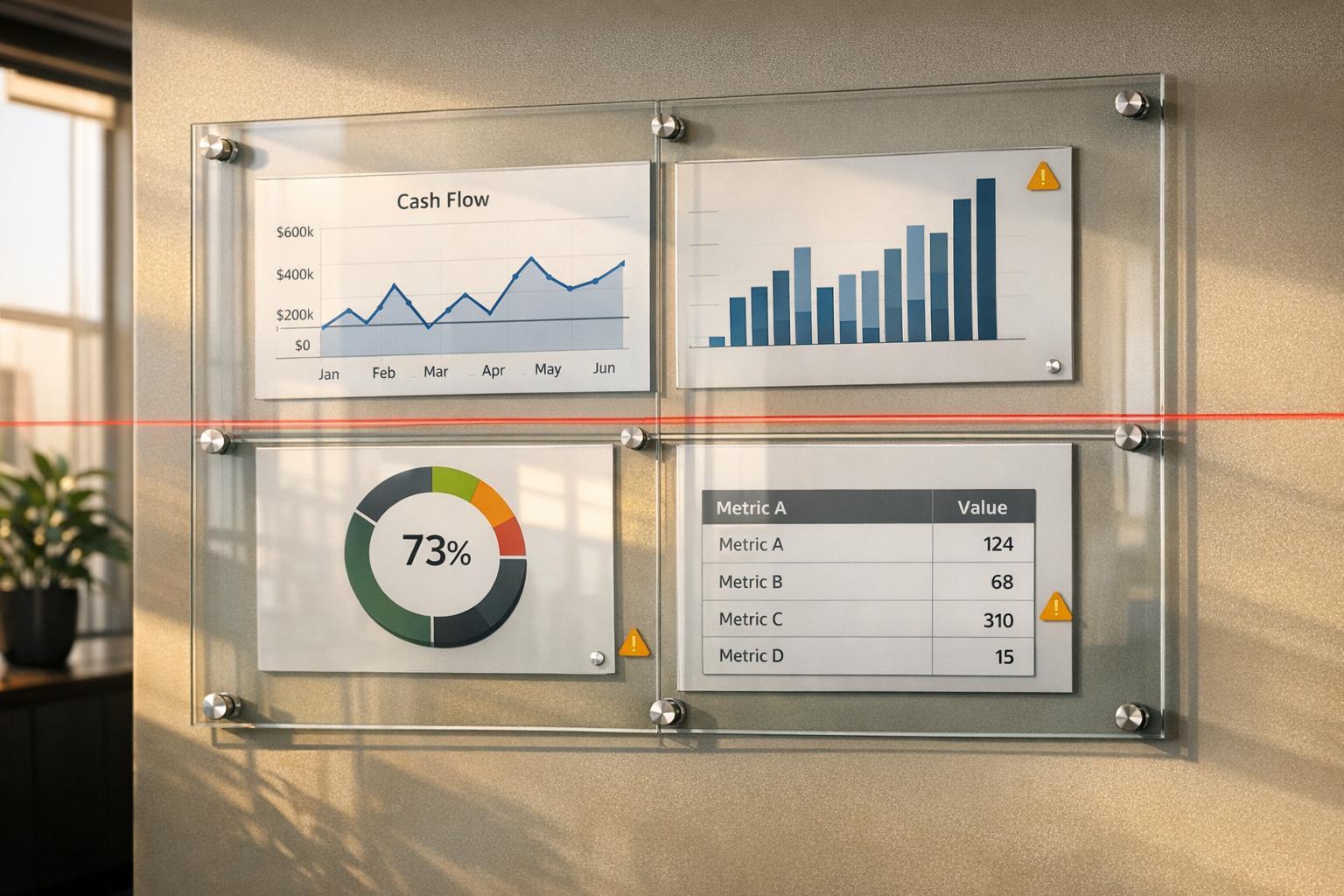
Visual tools make it easier to interpret key metrics and detect problems early. Color coding - like red for underperformance and green for meeting targets - provides instant clarity [11]. Use bar charts to compare inflows and outflows across properties, and line charts to track trends in occupancy or NOI stability over time [5]. For a deeper dive, Sankey diagrams can illustrate how gross rental income flows through expenses to net cash flow [5].
Automating data feeds is another game-changer. It reduces manual errors and provides real-time updates, helping you quickly notice unexpected spikes in maintenance costs or dips in leasing activity [11]. Tailor dashboard views to specific roles: property managers might focus on rent collection and maintenance requests, while owners may prioritize high-level metrics like ROI and Cap Rate [11].
"The most valuable finance teams are not just scorekeepers; they're early warning systems." - Chithrakala Babu, Marketing Manager, QX Global Group [10]
With your dashboard in place, you’re ready to move on to real-time monitoring and alerts, ensuring you can act quickly when cash flow events arise.
A dashboard gives you a snapshot of where things stand, but real-time monitoring keeps you in the loop the moment something goes off track. By linking your business checking accounts to a centralized platform - like Google Sheets via SheetLink or institutional systems such as Dynamo - you can automatically sync transaction data. This provides instant visibility into every dollar moving through your portfolio [1][13]. Real-time insights like these pave the way for immediate alerts and predictive analytics.
Start by creating automated tagging rules to categorize transactions by property name and expense type, such as mortgage payments, repairs, utilities, or taxes. This eliminates the need for manual data entry and helps you track cash flow streams effortlessly [1]. Set up alerts to catch deviations, like overspending or when profitability metrics such as the 1% rule or Gross Rent Multiplier (GRM) drop below acceptable levels.
For example, Marcus used SheetLink to sync contractor payments. When labor costs exceeded the budget by 5%, an alert notified him, enabling him to make adjustments quickly [1]. This swift action helped protect his project’s profitability.
Keep an eye on key metrics like the 1% rule and GRM to ensure your rent-to-value ratios remain healthy [14].
"We used to have wait 2 months...now it's a day...and I can send out an email that night."
- Frank Vitiello, Investments Operations Director, Boston University Investment Office [13]
Real-time alerts are just the beginning. Advanced analytics take cash flow management to the next level. AI-powered tools can predict future cash flow trends and flag liquidity risks before they become problems [1][13]. By integrating AI models like Claude AI, you can extract insights from raw transaction data, uncovering patterns that might go unnoticed during manual reviews [1][13]. Additionally, these platforms track upcoming liquidity events, such as notice dates and redemption amounts, to ensure you're prepared [13].
AI tools also allow for "what-if" modeling, which helps you simulate how potential investments or market shifts could affect your cash position. This is particularly useful for building a temporary reserve when forecasts signal leaner periods ahead [13][2].
Take Jennifer, for instance. She manages five single-family rentals across Ohio, Kentucky, Tennessee, Georgia, and North Carolina. Using real-time syncing, she discovered her Tennessee property was underperforming due to renter-related management issues [1]. This insight allowed her to reposition the asset strategically and consider a 1031 exchange for a better-performing property [1].
When alerts warn of rising operating costs or potential vacancies months in advance, you can act strategically. Options might include delaying non-essential upgrades, negotiating better service rates, or setting aside a cash reserve to cover future gaps [2][3]. Additionally, tagging expenses as either "Repair" (immediately deductible) or "Capital Improvement" (depreciated over time) during monitoring simplifies tax reporting and ensures you're ready for year-end filings [1].
Once you’ve set up real-time monitoring and alerts, it’s time to focus on consistent reviews to fine-tune your portfolio for the long haul. Interestingly, only 13% of real estate firms currently utilize real-time analytics, while asset management teams spend a staggering 70% of their time manually gathering data instead of analyzing it strategically [4]. By implementing a structured review process, you can leave behind reactive problem-solving and move toward proactive portfolio management. These reviews also pave the way for better forecasting and contingency planning.
Set up a review schedule based on your portfolio's activity level - weekly for dynamic portfolios and monthly for more stable ones. Use these sessions to compare actual performance against your budget through variance analysis. The consolidated dashboards and data systems you’ve already established will make this process smoother. For instance, if a property consistently exceeds its $800 monthly maintenance budget by 50% (hitting $1,200), it’s a clear sign of a deeper issue, like outdated HVAC systems or recurring tenant-related repairs.
To make your comparisons meaningful, standardize data formats across your systems, whether you’re working with Yardi, Excel sheets, or PDF rent rolls. Don’t forget to factor in seasonal variations and one-off capital expenses. Keep an eye on occupancy trends to spot revenue gaps early, and monitor your maintenance-to-revenue ratio. If reactive maintenance costs are eating into your budget due to aging infrastructure, it might be time to consider a strategic upgrade [13, 23].
While regular reviews are critical, advanced forecasting tools can elevate your strategy. Traditional spreadsheets fall short when markets shift rapidly. Instead, switch to integrated financial models powered by machine learning. These tools combine historical data with real-time insights, offering more accurate forecasting [4]. Companies that automate their data consolidation workflows have already seen up to a 15% boost in net operating income [4].
Take, for example, Phoenix Strategy Group’s Integrated Financial Model. This tool links your portfolio data to broader market trends, enabling detailed scenario planning. You can evaluate variables like rising interest rates, shifting vacancy rates, or even construction slowdowns. By mid-2025, multifamily construction starts were projected to drop 74% compared to their 2021 peak [15].
"Multifamily has better depth and predictability of capital than any other sector. And in that sense, it is unambiguously safer." - Peter Linneman, Principal, Linneman Associates [15]
Use forecasting tools for "what-if" scenarios. How would a 10% rise in vacancies impact your cash flow? What if property taxes increase by 8% next year? These models allow you to explore various outcomes and prepare accordingly. Integrate these tools with your existing monitoring systems to refine your decisions over time. Additionally, keep tabs on intercompany loans and shared-service allocations continuously to catch mismatches early, avoiding last-minute surprises during audits or month-end reviews [4].
Expanding your portfolio requires more than just adding properties - it demands a strategic approach to cash flow management and scalable systems. As your holdings grow, handling finances becomes more intricate, and what worked for a few properties may no longer suffice. To ensure smooth growth and financial stability, you’ll need to adopt practices that adapt to your evolving business needs while safeguarding against unexpected challenges.
Set aside reserves for each property or create a centralized pool for your entire portfolio. A good starting point is approximately $300 per unit each month, though this amount should be adjusted based on the age and condition of your properties. These funds act as a safety net, covering surprise expenses like emergency repairs, sudden maintenance needs, or utility spikes that could otherwise eat into your rental income.
Reserves also help manage costs related to tenant turnover and vacancies [12]. When your portfolio spans multiple LLCs or bank accounts, having a centralized reserve can prevent liquidity issues. For instance, if one property faces a shortfall, a shared reserve can bridge the gap without disrupting operations elsewhere [4].
Monitor economic occupancy, not just physical occupancy. This means accounting for rent lost due to concessions, late payments, or delayed lease-ups. It provides a clearer view of your actual cash inflows [12]. Reserves can also fund preventative maintenance and long-term projects. For example, replacing an aging HVAC system proactively is often cheaper than dealing with an emergency breakdown, and it helps stabilize your operating costs over time [12].
During the Great Financial Crisis, multifamily loan delinquency rates stayed below 0.5% and never exceeded 1%, highlighting how well-managed portfolios with solid reserves can withstand economic stress [15]. By maintaining these buffers, you can better navigate uncertainties while focusing on growth.
If managing financial spreadsheets is taking up too much of your time, consider outsourcing to fractional CFO services. These experts can refine your strategy by leveraging your data and forecasting tools. Phoenix Strategy Group’s fractional CFO services, for instance, specialize in developing advanced KPIs like NOI, cash-on-cash returns, and DSCR, going beyond basic profit-and-loss analysis [4].
Fractional CFOs also assist with liquidity planning and funding strategies, aligning them with your capital expenditure needs and market trends. Their Integrated Financial Model connects your portfolio data with broader market dynamics, enabling scenario planning for challenges like rising interest rates or fluctuating vacancy rates. This real-time approach reduces manual data collection, freeing you up to focus on strategic decisions.
Additionally, professional oversight ensures your chart of accounts is standardized across properties, intercompany loans are reconciled automatically, and your true cash position is always clear. With this level of financial clarity, you can confidently scale your portfolio without losing control of your operations.
Bringing your data together in one place and creating a standardized system can make tracking cash flow across multiple properties much easier. A unified platform doesn’t just organize your financials - it helps you make smarter decisions. By standardizing expense categories and automating reconciliations, you can cut down on errors and ensure consistency throughout your portfolio. Adding real-time alerts can also help you spot cash shortfalls early, potentially avoiding revenue losses of 10–20%.
The numbers speak for themselves: poor cash flow management is the reason 82% of real estate businesses fail within five years. On the other hand, adopting centralized systems can improve liquidity by 25–40%, according to industry data. For example, one investor managing 10 properties used AppFolio to centralize their data, standardize expense categories, and implement AI-driven alerts. The result? An 18% improvement in cash flow and $150,000 in annual savings. These results highlight how a systematic approach can turn financial management into measurable returns.
As your portfolio grows, expert guidance becomes even more critical. This is where fractional CFO services can make a big difference. They provide high-level financial expertise without the cost of a full-time hire and can integrate AI tools for accurate, short-term forecasting. Phoenix Strategy Group specializes in bookkeeping, FP&A, and data engineering for multi-property portfolios. They can help you create advanced KPIs and scenario plans that align with market trends, ensuring your business scales strategically.
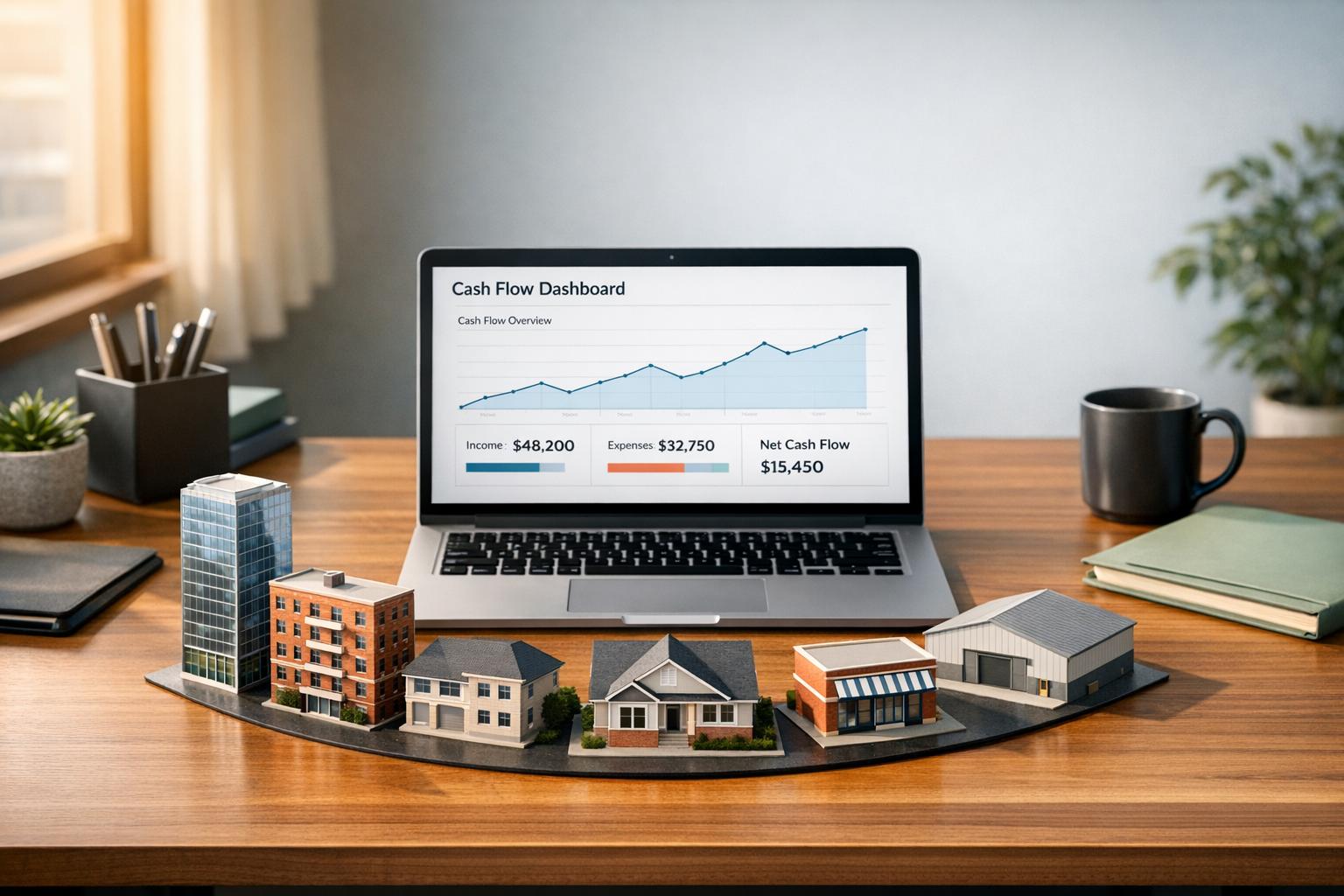
The easiest way to keep an eye on cash flow across multiple properties is by centralizing all your financial data into a single dashboard. This dashboard should integrate tools like QuickBooks and property management software to streamline the process. By setting up real-time updates through APIs, you can display essential metrics, such as income, expenses, and net cash flow, all in one place.
Automating these updates and incorporating visual alerts can make a big difference. It allows you to quickly spot potential issues or opportunities without the need for tedious manual tracking. This approach not only saves time but also helps you manage your property portfolio more efficiently.
Keep an eye on rental income, occupancy rates, maintenance costs, and property bank account balances every week. This helps you stay on top of revenue, handle any urgent expenses right away, and make sure there's enough liquidity to cover needs.
Take a deeper dive into your portfolio's performance each month. Analyze total cash flow, ROI, cap rates, cash-on-cash returns, key expense categories, and Net Operating Income (NOI). This regular review gives you a solid understanding of your portfolio’s financial health and helps guide smarter, long-term decisions.
To predict cash flow during unexpected shifts like sudden vacancies or repair costs, it's smart to use a flexible financial model that updates in real time. Pull in live data from your property management and accounting systems to keep your numbers current. Build out scenarios for the best case, worst case, and a middle-ground base case. By regularly updating these models, you'll stay prepared, even when surprises pop up, and can adjust to changes with ease.