Published on
March 7, 2026

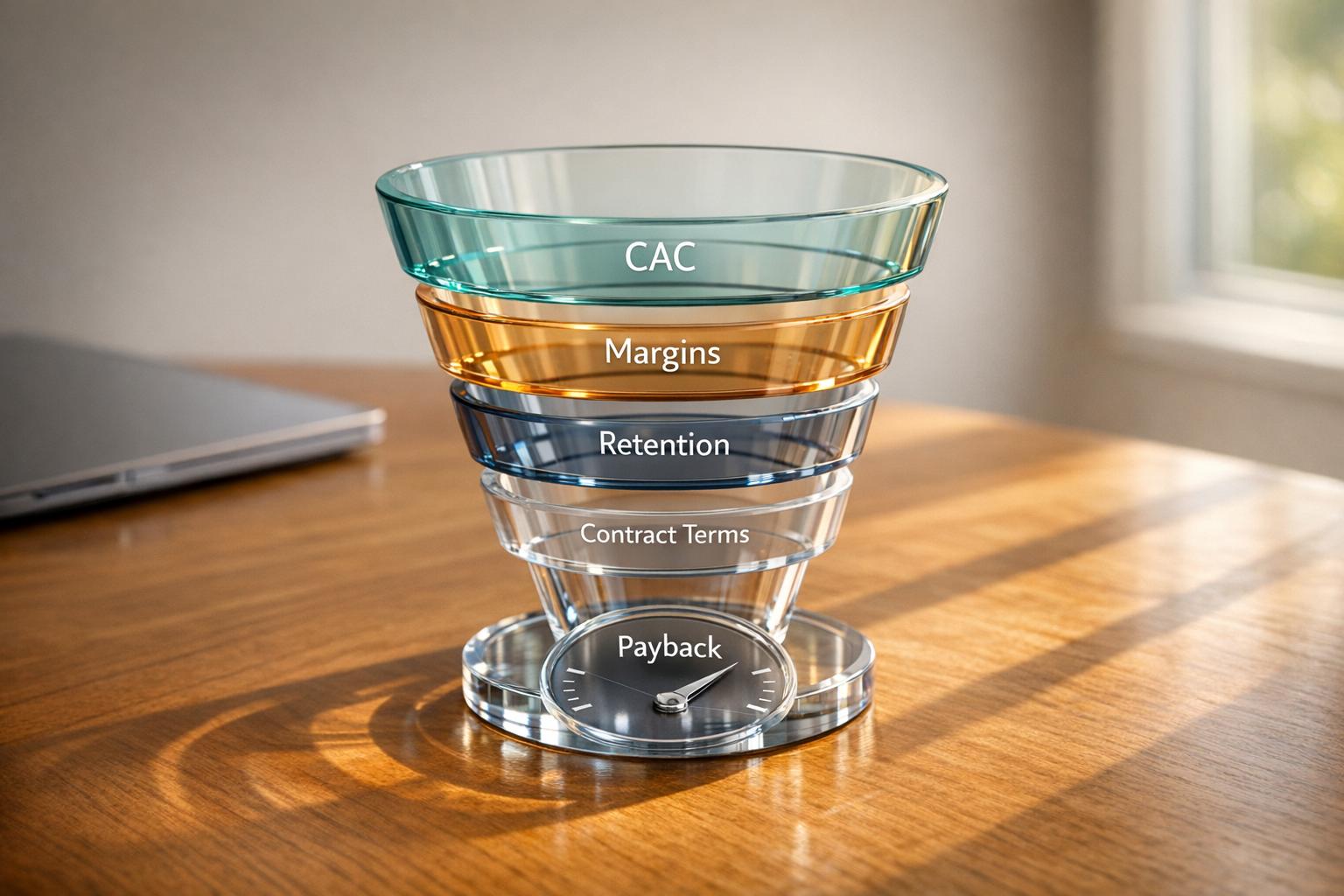
Want to recover customer acquisition costs faster? For growth-stage companies, improving the payback period is essential to maintaining healthy cash flow and fueling sustainable growth. A shorter payback period allows you to reinvest earnings more effectively, reducing reliance on external funding and minimizing financial risk.
Key strategies to improve payback period:
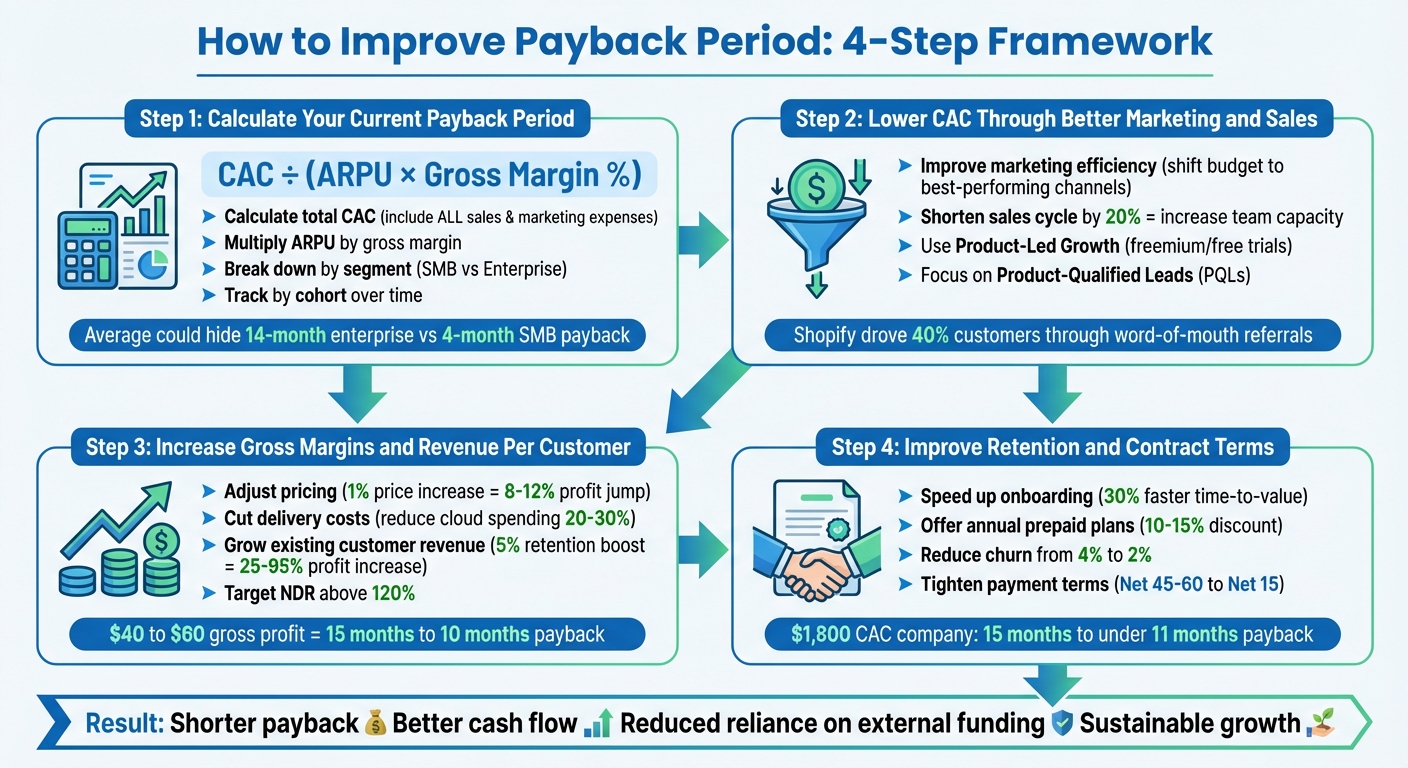
4-Step Framework to Improve CAC Payback Period for Growth-Stage SaaS Companies
To improve your payback period, you first need to understand where you currently stand. Skipping this step or relying on rough guesses can lead to poor decisions about how to allocate your resources.
The formula for calculating the CAC payback period is:
CAC ÷ (ARPU × Gross Margin %)[2][3]
Start by calculating your total CAC (Customer Acquisition Cost). This should include all sales and marketing expenses - salaries, commissions, software tools, advertising, and even overhead costs[4][3]. Leaving anything out will give you an inaccurate payback period, which could lead to overspending[3][6].
Next, multiply your ARPU (Average Revenue Per User) by your gross margin. This step ensures you account for true profitability by factoring in COGS (Cost of Goods Sold), such as hosting, infrastructure, and support[4][3].
For businesses with long sales cycles, timing matters. There’s often a gap between when you spend on CAC and when customers start generating revenue. Adjust your calculations to align CAC with when revenue actually begins[3].
Once you’ve run the numbers, break down your payback period by segments to uncover inefficiencies hiding behind the average.
A blended average payback period can be misleading. For example, your overall payback might be nine months, but this average could hide a 14-month payback for enterprise customers and a much faster four-month payback for SMBs[2]. As Girsky points out, payback period isn’t just a box to check - it’s a critical operational metric that should guide decisions[2].
To dig deeper, segment your payback period by customer type (like SMB, mid-market, or enterprise), acquisition channel (organic, paid search, sales-led), and product tier. This approach helps pinpoint areas where cash might be slipping away[2][5].
You can also track payback by cohort - the month or quarter customers were acquired. This helps you see if your efficiency is improving over time. For instance, Shopify managed to cut its blended CAC by driving about 40% of its customers through word-of-mouth referrals, demonstrating the power of organic acquisition channels to shorten payback periods[5].
Once you’ve broken down the numbers, it’s time to identify what’s causing long payback periods. High CAC is a common issue. Compare your sales and marketing spend to the number of new customers from each channel to spot inefficiencies. Low gross margins can also be a problem, as they reduce how much revenue you’re recouping each month. Review your COGS - things like hosting and support costs - to ensure they’re aligned with ARPU[5].
Another factor could be delayed onboarding, which pushes back when customers start generating revenue. Measuring your "time-to-value" (the time from contract signing to when the customer is fully onboarded) can help you spot these delays. High early churn is another red flag. If customers leave before you recover their CAC, you’re losing money outright. Even minor early churn can hurt your margins and slow growth.
Tracking your payback period month by month can act as an early warning system for cash flow issues. If your payback period starts to stretch, it could mean your cash position will weaken over the next 6–12 months. This gives you a chance to act before a potential cash crunch hits[2].
Once you’ve nailed down your current payback period, the next logical step is to lower your Customer Acquisition Cost (CAC). By doing so, you can shorten the time it takes to recover those expenses. This involves pinpointing areas in your marketing and sales processes where costs can be trimmed without sacrificing effectiveness.
Start by shifting your budget toward channels that deliver the best return. Analyze CAC by channel - whether it’s paid search, organic traffic, referrals, or content marketing - and double down on campaigns that bring in customers who are ready to purchase, not just browse. Even small improvements in your conversion rates can make a big difference. For example, increasing your landing page conversion rate from 2% to 3% can significantly reduce your overall CAC. Tactics like testing your messaging, simplifying forms, and eliminating unnecessary steps in the funnel can help achieve this.
Shortening your sales cycle by even 20% can dramatically increase your team’s capacity without needing to hire additional staff [7]. Focus on qualifying leads more effectively using smart forms or SDR checklists. Build relationships with multiple stakeholders early on, combine discovery calls with demos to save time, and address potential legal or security concerns upfront with pre-prepared documents.
"Every day a deal lingers in your pipeline costs money - not just in delayed revenue, but in sales rep time, opportunity cost, and the risk of losing the deal entirely." – Orbit AI [7]
In addition to marketing improvements, streamlining your sales process can speed up revenue recovery. Tools like ROI calculators and automated follow-ups can keep deals moving and reduce the likelihood of losing prospects to delays.
A product-led growth (PLG) strategy can be a game-changer for reducing CAC while accelerating acquisition and conversion. By offering freemium plans or free trials, you let potential customers experience the value of your product firsthand - without requiring a heavy sales push. Focus on Product-Qualified Leads (PQLs), which are users who have already hit key milestones in your product. These leads typically convert at much higher rates.
"A PQL is a user or account that has already experienced the product's value firsthand and has demonstrated a high level of engagement or reached specific usage milestones, signaling a strong likelihood to convert." – The Sales Arc [8]
To make the most of PLG, streamline your onboarding process so users quickly reach their "Aha! Moment." Use in-product prompts like tooltips, walkthroughs, and contextual notifications to guide them. This self-serve approach allows users to explore, sign up, and upgrade on their own, freeing up your sales team to concentrate on high-value accounts and expansion opportunities.
Once you've lowered your CAC, the next step is to boost your gross margins. This not only speeds up cash recovery but also strengthens your overall financial health. The key areas to focus on are pricing strategies, reducing delivery costs, and driving additional revenue from your existing customers. For example, increasing gross profit per customer from $40 to $60 can shorten your payback period from 15 months to just 10. Start by refining your pricing, then work on cutting delivery costs to maximize revenue per customer.
Pricing is one of the most powerful levers you have for improving unit economics. Even a small 1% price increase can lead to an 8–12% jump in operating profit. Begin by reviewing your pricing against competitors and assessing what your customers are willing to pay. Create tiered pricing plans that offer more than just extra features - focus on delivering value that power users will gladly pay 20–50% more for.
You could also consider shifting to value-based pricing, where your charges are tied to metrics that grow with your customers' success. Metrics like active users, transactions, or revenue under management work well here. Offering discounts for annual prepayments (typically 10–20%) can help bring in cash faster, even if it doesn't immediately affect accounting payback.
Experiment with pricing regularly. Use A/B testing or cohort analyses, and make it a point to revisit your pricing strategies at least once a year. Avoid the trap of "set and forget" pricing, as underpricing is a common issue that eats into margins.
To improve gross margins, you need to lower the cost of serving each customer. For SaaS businesses, cloud infrastructure often accounts for 20–40% of COGS. Adopting disciplined FinOps practices can help you cut cloud spending by 20–30%. Focus on optimizing compute and storage, taking advantage of reserved instances, eliminating idle resources, and keeping a close eye on usage hotspots.
Automation can also be a game-changer. Create self-serve onboarding tools like setup guides, in-app walkthroughs, and knowledge bases. These can reduce onboarding and support hours per customer by 30–50% while speeding up time-to-value. Use chatbots and tiered support systems to ensure only complex issues reach higher-cost human agents. Standardize implementations with reusable playbooks, templates, and integrations to cut down on the need for professional services.
Keep a close eye on key metrics like gross margin by product, support hours per $1,000 of ARR, and COGS per customer. This will help you ensure that cost-cutting measures don't inadvertently lead to higher churn or more support tickets.
Acquiring new customers is expensive - 5 to 25 times more costly than retaining existing ones. And even a 5% boost in retention can increase profits by 25–95%, according to Bain & Company. Expansion revenue, such as upselling, cross-selling, and feature add-ons, has almost no CAC and directly improves net dollar retention (NDR). Top-performing SaaS companies often achieve NDR rates above 120%, with many aiming for 110–130% or higher.
Start by designing a clear upsell ladder that outlines when and how customers are a good fit for higher tiers or add-ons. Use in-app prompts or outreach when customers hit certain usage or feature thresholds. Develop cross-sell bundles that address related needs - like analytics, security, or integrations - to increase ARPA and make your product stickier. Additionally, launch paid feature add-ons for premium services such as advanced analytics, priority support, or compliance modules that appeal to higher-value customers.
To make this work, implement a customer success strategy that includes quarterly business reviews, health scores, and clear expansion targets. Incentivize your customer success team with goals tied to net retention or expansion revenue. Regularly track NDR by cohort, industry, and product to identify where you're seeing the strongest growth and where there's room to improve. Use data to guide your efforts: look for patterns like usage spikes, new team onboarding, or added integrations, and use these as triggers for timely upsell offers.
For deeper insights, Phoenix Strategy Group can assist with creating detailed cohort and payback models, analyzing pricing and packaging options, and quantifying how changes in ARPA, margins, and NRR affect your cash flow and valuation.
Once you've worked on boosting margins and revenue, it's time to zero in on retention and contract terms. These adjustments play a big role in speeding up cash recovery. By improving retention, you can spread your customer acquisition cost (CAC) across more months of gross profit. At the same time, better contract terms can speed up revenue recognition - both of which directly reduce your payback period.
Take this example: A B2B SaaS company with a $1,800 CAC and $120 monthly gross profit faces a 15-month payback period with monthly billing and a 4% churn rate. But by cutting churn to 2%, shifting 60% of customers to annual prepaid plans, and increasing expansion revenue, the company could slash its payback period to under 11 months [9][10].
Onboarding is a critical piece of the puzzle, especially when you're trying to lower CAC and improve margins. The first 90 days are crucial for customer retention since many SaaS businesses see their highest churn during this period. Why? Because customers haven't yet experienced the full value of the product. A structured onboarding process can help customers realize value up to 30% faster, reducing early churn and shortening payback [10].
To reduce churn, focus on quick activation. For B2B customers, this might include a kickoff call with clear success metrics, an implementation checklist, tailored training sessions, and in-app guided tours. Keep an eye on metrics like time-to-first-value and onboarding completion rates to identify at-risk accounts early. Interestingly, cohorts that hit key value milestones within 14 days often achieve payback 3–4 months faster than those taking over 45 days [1][10][11].
Switching to annual billing with upfront payment can significantly improve cash flow. This approach pulls 12 months' revenue into the first month, reduces collection risks, and often leads to better retention compared to month-to-month contracts [9][14]. Many SaaS companies sweeten the deal by offering a 10–15% discount for annual prepaid plans, which can still deliver around 90% of a year’s revenue upfront - cutting payback by several months compared to monthly billing.
You might also consider offering tiered billing options. For example, provide standard monthly billing, annual prepaid plans with modest discounts, and multi-year contracts with deeper discounts for customers who are a great fit for your product. Adding extra perks, like onboarding support or premium customer service, can make annual plans even more appealing. Multi-year agreements with upfront or annual payments not only stabilize retention but also make payback more predictable, especially for enterprise SaaS businesses with longer implementation cycles [1][9].
Additionally, tightening payment terms - like moving from Net 45–60 to Net 15 - and automating collections can help reduce days sales outstanding (DSO). These changes further accelerate cash collection and shorten the payback period.
To ensure your retention and contract tweaks are working, consistent tracking is key. Use dashboards to monitor metrics like CAC, gross margin, churn, and contract mix to keep tabs on payback efficiency. Cohort analysis can also help you see how changes in onboarding or contract terms impact early churn, average revenue per user (ARPU), and time to CAC payback. Reviewing these metrics monthly or quarterly can directly guide decisions on marketing budgets, sales strategies, and customer success resources.
For example, Phoenix Strategy Group can assist in creating FP&A and data models that calculate CAC payback across cohorts, channels, segments, and contract types. Their fractional CFO and FP&A services can also establish a routine of monthly or quarterly reviews focused on payback efficiency. This ensures management stays on track, continually refining strategies for a shorter and more predictable payback period [1][9][14].
Improving your payback period requires a well-rounded approach that touches every part of your business. Start by accurately measuring your current performance, breaking down payback by customer segment and channel. This helps you identify where you're gaining traction and where you're falling short. From there, focus on reducing your customer acquisition cost (CAC) by eliminating inefficient marketing spend, refining your sales processes, and adopting product-led growth strategies that allow customers to onboard themselves. Additionally, aim to boost gross margins and revenue per customer by adjusting pricing strategies, cutting delivery costs, and driving expansion revenue from your existing customer base. Finally, enhance retention and contract terms by speeding up onboarding processes, encouraging annual subscription contracts, and tracking progress consistently.
However, keep in mind that cutting CAC alone won’t yield much benefit if churn remains high. Without extending customer lifetime value, payback improvements will be limited [10]. The most successful growth-stage companies treat payback optimization as a team effort that involves product, sales, marketing, and customer success teams working together with shared goals [11]. Aligning these four areas creates a strong foundation for success. When this alignment is achieved, you not only extend your financial runway with every new customer but also reduce reliance on external funding, building a scalable business that doesn’t constantly depend on raising capital [1][15]. These steps together establish a more resilient financial structure.
Once you’ve implemented these strategies, expert financial guidance can drive lasting improvements. Many growth-stage companies struggle to optimize payback without the right financial systems in place. Financial advisors and fractional CFOs can help by creating accurate unit economics models, setting up real-time dashboards to track CAC and payback by segment, and running scenario planning to understand how changes - like adjustments in pricing, churn, or sales efficiency - impact your cash flow [1][11].
For example, Phoenix Strategy Group specializes in helping growth-stage companies build these integrated financial systems. Their fractional CFO and FP&A services provide real-time insights into CAC payback, runway, and funding needs. With experience supporting over 240 portfolio companies, they’ve helped clients raise more than $200 million in the past year and facilitated over 100 M&A transactions [12][13]. Gaining this level of financial clarity is essential for sustainable growth, ensuring your business is prepared to scale effectively [1][12][13].
The payback period isn’t just another KPI - it’s a critical measure of your business’s financial health. By consistently measuring and improving it, segment by segment, you can drive meaningful progress. With the right systems and expert guidance, you’ll not only shorten your payback period but also solidify your business’s ability to grow sustainably and thrive.
A good CAC (Customer Acquisition Cost) payback period for a growth-stage SaaS company is generally considered to be under 12 months. Hitting this target often signals efficient customer acquisition efforts and quicker returns on investment - both of which are key factors in driving steady growth.
To handle a delayed payback period, it’s essential to account for the time lag between spending on customer acquisition costs (CAC) and when revenue actually starts coming in. One way to do this is by using dynamic cash flow forecasting to model those delayed revenue streams. Regularly updating your financial models with actual performance data is equally important.
It’s also a good idea to align your CAC calculations with the timing of revenue realization. This ensures you’re capturing the real payback period, giving you a clearer picture. Taking these steps allows you to make better decisions when it comes to managing marketing budgets, pricing strategies, and cash flow during times of delayed revenue.
Reducing Days Inventory Outstanding (DIO) and securing better payment terms with suppliers are two effective strategies to speed up payback periods without slowing down growth. By optimizing these areas, businesses can improve cash flow, creating opportunities to reinvest funds more efficiently.