Published on
March 19, 2026


When selling your business or merging with another, your intellectual property (IP) can make or break the deal. Buyers want to know two things: Do you own your IP, and is it free of risks like disputes or infringement? Here's how to prepare your IP for due diligence:
Taking these steps early can help you avoid delays, build buyer trust, and secure a better valuation. The goal is simple: show buyers that your IP is well-managed, legally sound, and valuable to the business.
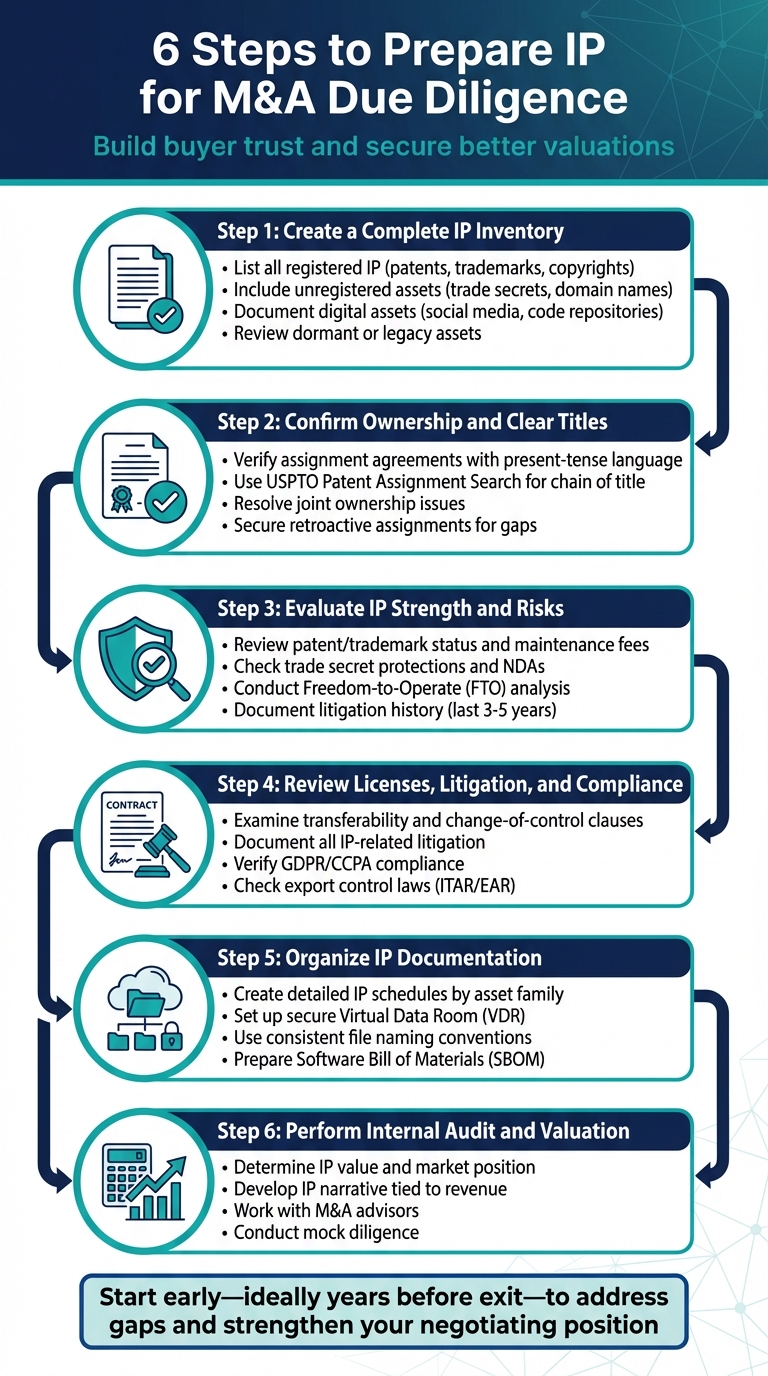
6 Steps to Prepare IP for M&A Due Diligence
The first step in M&A due diligence is building a thorough inventory of your company's intellectual property (IP) assets. This inventory acts as the backbone of the entire diligence process. As PatentPC wisely puts it, "You can't protect what you haven't identified" [7]. Buyers need a comprehensive view - not just the standout patents and trademarks, but also the less obvious assets that keep your operations running smoothly.
Start by cataloging every IP asset, including both registered ones like patents, trademarks, and copyrights, as well as pending filings. Don’t stop there - unregistered assets such as common law trademarks, informal copyrights, and trade secrets also need to be included.
Think beyond the usual legal filings. Digital and social assets are critical too. This includes domain names, social media handles, app store accounts, e-commerce pages, and even code repositories. Don’t forget to document any open-source components with restrictive licenses. Additionally, dormant or legacy assets - such as unused prototypes, archived code, or expired patents - should be reviewed. These could reveal potential historical or legal complications.
To uncover "hidden" IP, conduct interviews with department heads. They can often point out proprietary algorithms, custom dashboards, or unique data models that might not be formally recorded.
Once you’ve compiled a comprehensive list, the next step is to gather the documentation that establishes legal ownership.
After identifying your IP assets, collect all the documents that prove legal ownership. This includes registration certificates, filing receipts, maintenance records, and assignment agreements. Establishing a clear chain of title is key. For instance, if a founder developed a brand before the company was formed, or if a contractor created a vital algorithm without a written transfer agreement, ownership could become murky.
Review employment and contractor agreements to ensure they include clear, present-tense IP assignment clauses. If there are any gaps, secure formal transfers to resolve them. Also, confirm that patents and trademarks are registered under the company’s legal name rather than an individual’s or a legacy entity’s name.
Organize these documents in a secure, centralized folder with clear naming conventions like “[Asset Name] – [Type] – [Date Signed].” Make sure to include fully executed copies of licensing, joint venture, and settlement agreements, along with any amendments. For trade secrets, document access controls and verify that non-disclosure agreements are in place to maintain their legal protection. Finally, keep a close eye on renewal deadlines and maintenance fees to avoid any lapses in rights during the diligence process.
Once you've completed your IP inventory, the next move is to verify and document legal ownership. This step involves more than just having paperwork on file - it requires tracing the legal chain of title all the way from the original creator to your company. As PatentPC puts it, "Ownership is the foundation. If that's shaky, everything else - enforcement, licensing, investment - starts to wobble too" [8].
Securing clear titles starts with having detailed assignment agreements. IP rights initially belong to individual creators and don’t automatically transfer to the company [9]. To avoid disputes, ensure you have written, immediate assignment agreements that explicitly transfer these rights.
Make sure these agreements use present-tense language like "hereby assigns" instead of future commitments such as "will assign" [10]. Double-check all employment and contractor agreements for this precise wording. If you find gaps, track down the original creators and secure retroactive assignments before you begin due diligence [2]. This step ties back to the inventory you compiled in Step 1, ensuring everything aligns.
Independent contractors and freelancers deserve special attention. Their work often involves critical digital assets like domain names, social media accounts, and code repositories. These assets must be explicitly assigned to the company in writing [4].
To further verify ownership, use the USPTO Patent Assignment Search database to generate an "Abstract of Title" for your patents. This document outlines all recorded transfers, conveyances, and security interests (such as liens), confirming a clear chain of title. Be sure to check for mortgages or instances where IP was used as collateral. Under 35 U.S.C. § 261, patent interests could be void against a later purchaser if not recorded with the USPTO within three months of the transfer [9].
Joint ownership can complicate mergers and acquisitions. Without clear agreements, joint owners may have the right to use or license the IP without needing the other party's consent, which can lower the asset's value for buyers [8].
Pay close attention to claims from universities, incubators, or past collaborators involved in joint development or funding agreements. This is especially important for early-stage IP created before your company formally incorporated [4] [8]. Use your "Abstract of Title" to pinpoint any recorded third-party rights [9].
If you encounter unresolved ownership disputes that can’t be addressed before the deal closes, work with M&A advisors to manage these issues. Options include using contractual mechanisms like indemnities, price reductions, or holdbacks. For example, you might set aside a portion of the purchase price - typically for 12 to 24 months - to cover potential losses [2]. As PatentPC explains, "Buyers care more about transparency than perfection. They're not looking for a flawless business. They're looking for one they can trust" [2]. Use disclosure schedules to document and explain IP risks upfront. This approach builds trust with buyers and shields you from future claims of misrepresentation [2].
When necessary, consult experienced M&A advisors to help resolve complex ownership challenges.
After establishing a clear chain of ownership, the next step is to assess how strong and secure your intellectual property (IP) portfolio truly is. This involves determining the enforceability and value of your IP assets. As PatentPC aptly puts it, "IP is not just paperwork. It's power. And diligence is how you make sure you're actually buying it" [4]. Here, the goal is to ensure your IP is not only owned but also well-protected and free of potential risks. This means confirming the legal status of patents and trademarks, safeguarding trade secrets, and addressing any infringement concerns that could derail a deal.
Start by verifying the status of each patent - whether it’s granted, pending, or expired - and confirm that all maintenance fees and annuities are up to date. Missing a renewal deadline could jeopardize your rights, so it’s crucial to track these details carefully.
Next, examine the geographic coverage and scope of your patents. Are they filed in multiple jurisdictions or limited to specific markets? Do they protect the core functionality of your product, or do they only cover less critical design aspects? Patents tied to a product’s key features typically carry more weight than those focusing on minor elements. For trademarks, make sure your registrations match how your business currently uses names, logos, and other branding in marketing and packaging. Additionally, check for any active oppositions or past challenges in trademark registries that could indicate unresolved legal issues or market confusion.
Once you’ve confirmed the status of your patents and trademarks, turn your attention to safeguarding trade secrets.
Trade secrets - such as proprietary algorithms, customer lists, or unique formulas - play a significant role in maintaining a company’s competitive edge. Unlike patents, their value hinges on confidentiality. As PatentPC warns, "If trade secrets have been poorly guarded, they may no longer be legally protected. And once they're out, they're gone forever" [4].
To protect these assets, ensure that all employees, vendors, and contractors with access to sensitive information have signed non-disclosure agreements (NDAs) [4][5]. Limit access to proprietary data strictly to those who need it, and review your internal policies for managing confidential information. Confirm that contributors have signed written agreements transferring any trade secret rights to the company. Additionally, use automated tools to scan for potential issues where proprietary code may have been combined with restrictive open-source licenses (such as GPL or AGPL). These licenses could inadvertently force you to disclose your trade secrets publicly [2].
Finally, evaluate whether your operations might infringe on someone else’s IP rights. Conduct a Freedom-to-Operate (FTO) analysis by searching patent databases and examining competitor portfolios for potential overlaps. This is particularly important in industries like biotech and software, where innovation moves quickly [11].
Review your history of litigation and disputes, including any ongoing, past (from the last three to five years), or even threatened lawsuits. Don’t forget to factor in cease-and-desist letters you may have received [2]. As PatentPC explains, "An unresolved IP dispute doesn't just create legal risk. It creates doubt" [2]. If you uncover significant infringement risks, collaborate with your engineering teams to adjust product features or negotiate licenses with third-party patent holders to avoid future conflicts [11]. Lastly, use disclosure schedules to document any known IP risks early in the process. This transparency helps protect you from future claims of misrepresentation [2].
After verifying the ownership and strength of your intellectual property (IP), the next step is to ensure that all contracts, litigation records, and compliance obligations align with buyer expectations. This process is essential for maintaining the value of your IP and ensuring it can be smoothly transferred to a new owner. Buyers often scrutinize these areas because they directly affect the usability and future potential of the IP. Special attention should be given to licensing agreements, as they can significantly influence the outcome of a deal if they impose restrictions on the buyer's ability to use or expand the technology.
Take a close look at all licensing agreements, focusing on transferability and change-of-control clauses. These provisions can sometimes terminate a license upon acquisition, which could leave the buyer without access to critical IP. As PatentPC highlights, losing access to essential IP can have severe consequences [4]. If you encounter non-transferable licenses, consider renegotiating the terms or obtaining written consent from the licensor before completing the transaction.
Also, carefully review any exclusivity terms. Outbound exclusive licenses can restrict the buyer’s ability to operate in certain markets, while inbound licenses should offer adequate competitive advantages to justify their cost. Gadgets Gigabytes and Goodwill advises against exclusive licenses unless they involve major partnerships that function like joint ventures [10]. Additionally, ensure that your company retains ownership of background IP, as well as any improvements made during the agreement period - this is especially important in software development agreements [10]. If your assets include software, confirm that any open-source components do not impose obligations that could require public disclosure of proprietary code [2] [3].
Finally, document any litigation history tied to these agreements.
Compile a record of all IP-related litigation from the last three to five years. This should include active lawsuits, cease-and-desist letters, and warnings from competitors [2] [10]. Beyond formal disputes, identify any unresolved claims, such as those from former employees or freelancers who didn’t sign IP assignment agreements [2]. Buyers often require part of the purchase price to be held in escrow - typically for 12 to 24 months - to cover potential liabilities from IP disputes or undisclosed risks [2]. Being upfront about these issues through disclosure schedules can help you maintain credibility and control the narrative, rather than letting buyers uncover problems on their own.
After addressing licensing and litigation risks, turn your attention to regulatory compliance.
Ensure that your IP assets comply with all relevant regulations. If your company handles customer data, conduct a thorough audit of databases, algorithms, and tracking technologies to ensure compliance with GDPR (General Data Protection Regulation) and CCPA (California Consumer Privacy Act) [12]. For businesses in highly regulated sectors like healthcare, finance, or energy, check whether specific IP assets are tied to licensing requirements or geographic restrictions [3]. Additionally, determine whether your technology is subject to export control laws such as ITAR (International Traffic in Arms Regulations) or EAR (Export Administration Regulations), which could limit cross-border transfers [4]. Including any known regulatory gaps in your disclosure schedule demonstrates transparency and helps reduce the risk of post-closing liabilities [2].
After addressing compliance and litigation risks, the next step is to organize your intellectual property (IP) documentation in a way that makes it easy for potential buyers to evaluate. A well-prepared virtual data room (VDR) is essential for this process. It allows buyers to quickly verify ownership, assess the value of your IP, and identify any potential risks. The goal here is to present your IP portfolio clearly and efficiently.
Prepare detailed schedules that summarize your IP assets while showcasing their business relevance. For example, group related patents into families and include key details such as jurisdiction, status, filing and expiration dates, and a brief explanation of how each asset contributes to the business [15][4]. This approach not only highlights the value of your IP but also reinforces its importance as discussed earlier.
If possible, connect your IP assets to specific products or your development roadmap. This helps buyers see how the IP supports revenue generation. Be sure to clearly distinguish between assets owned by your company and those acquired through exclusive or non-exclusive licenses [15]. Also, include any digital assets registered under your company’s name [4]. For tech companies, maintaining a Software Bill of Materials (SBOM) is critical. This document lists all open-source components and their licenses, demonstrating compliance with licensing requirements [14].
Once your schedules are complete, ensure they are easily accessible in a secure data room.
A virtual data room (VDR) with strict access controls is a must. Organize the VDR into folders that align with the due diligence checklist, making it easier for reviewers to locate documents [13]. Use a consistent naming convention for all files (e.g., "[Asset Name] – [Document Type] – [Date Signed]") [7]. Sensitive materials should be restricted to authorized personnel only [7][4].
Leverage VDR monitoring tools to track who views documents and ensure security [7]. For sensitive information, such as customer lists or trade secrets, redact details as needed to comply with privacy laws until later stages of the deal [13]. Create a dedicated "Chain of Title" folder that consolidates signed employee and contractor IP assignment agreements. This proves the company’s legal ownership of the code or designs being sold [7][14]. Additionally, before sharing legal opinions or Freedom-to-Operate (FTO) searches, establish a Common Interest Agreement to protect attorney-client privilege [15].
"IP is not just paperwork. It's power. And diligence is how you make sure you're actually buying it." - PatentPC [4]
Once your IP documentation is in order and potential risks have been addressed, it's time to conduct an internal audit and valuation. This step ensures you're fully prepared for due diligence by identifying and resolving issues before potential buyers spot them. It also gives you a clear understanding of your IP's worth, strengthening your position during negotiations. The aim? To approach due diligence with confidence, knowing exactly what you own and how it contributes to your business.
Start by cataloging every IP asset - this includes code, designs, branding, processes, and internal tools, even if they’re not formally registered [7][4]. Review employment and contractor agreements to confirm clear IP ownership; if gaps exist, secure retroactive transfers to resolve them [7][4].
Assess your trade secret protocols to ensure safeguards are up to date [7][4]. For tech companies, confirm that your freedom-to-operate (FTO) results are still valid [4]. Additionally, audit any open-source components to ensure their licenses don’t require you to disclose proprietary code [4]. Clean, organized records - like up-to-date filings, global trademark protections, and well-documented ownership - signal professionalism and can directly boost your valuation [3].
Beyond documentation, focus on how your IP drives revenue and creates barriers for competitors [6][3]. Develop an IP narrative that explains how specific assets support your core products and future growth potential. A simple list of patents won’t cut it - buyers want to see how your IP aligns strategically with the business, especially if it opens new markets or prevents competitors from gaining ground [3].
M&A advisors bring a level of legal and technical expertise that most internal teams lack [1]. They can identify missing IP assignments, expired filings, or issues with open-source compliance that might affect your valuation [3][14].
Take, for example, Phoenix Strategy Group, which specializes in preparing growth-stage companies for exits. They perform in-depth IP audits, highlight strengths and gaps, and craft compelling narratives showing how your IP ties directly to future revenue and competitive advantages. Addressing these gaps proactively - months or even years ahead of going to market - can significantly strengthen your negotiating position and support higher valuations [3][14].
"Intellectual property is a way that companies place a drawbridge around the value that they have created." - DealRoom [1]
Getting your intellectual property (IP) ready for M&A due diligence can boost buyer confidence and help you secure a higher valuation. Well-organized IP records show that your company operates efficiently and is prepared for growth. On the flip side, messy or incomplete portfolios can lead buyers to apply a risk discount, potentially lowering your deal value [3]. By ensuring a clear chain of title and showcasing strong IP protections, you not only strengthen your negotiating position but also avoid last-minute issues that could derail the deal [3][4].
The six steps mentioned earlier provide a roadmap for a smooth and controlled due diligence process. The key is to start early - ideally, years before planning an exit. This gives you time to address any gaps and run mock diligence with outside counsel to uncover vulnerabilities before buyers do [16]. Centralizing your documentation also sends a message of professionalism and readiness [16]. These efforts ultimately lead to a more seamless transaction.
For companies navigating this process, Phoenix Strategy Group offers invaluable support. They work with growth-stage businesses to organize financial and IP records while crafting a strong growth narrative. By identifying weaknesses and quantifying the revenue tied to your IP, they help position your company for a successful and profitable exit.
Preparing your intellectual property (IP) assets well in advance - ideally 6 to 12 months before the anticipated deal closure - is a smart move. This timeframe gives you the opportunity to identify all relevant assets, verify ownership, and ensure that essential documentation, such as registrations and licensing agreements, is current and well-organized. Starting early also provides enough time to resolve any unexpected issues, ensuring your IP rights are clearly documented and enforceable when the deal is finalized.
Common problems with intellectual property (IP) that can slow down deals or lower their value include unclear ownership, missing or incomplete assignment documents, and unresolved disputes over IP rights. These issues introduce legal risks and uncertainty for potential buyers, which can impact both the timeline and the valuation of the deal.
When preparing for an IP due diligence process, certain documents are essential to ensure a thorough evaluation. These include:
These documents play a crucial role in verifying ownership and assessing potential risks, particularly during mergers and acquisitions.