Published on
January 5, 2026


Securing Series A funding is a milestone for startups transitioning from validating their product to scaling their business. Here's the bottom line: investors want proof of traction, strong financial metrics, and readiness to scale.
Key Takeaways:
Timing is everything. Start preparing early, focus on key metrics, and build relationships with investors to secure the funding needed to grow.
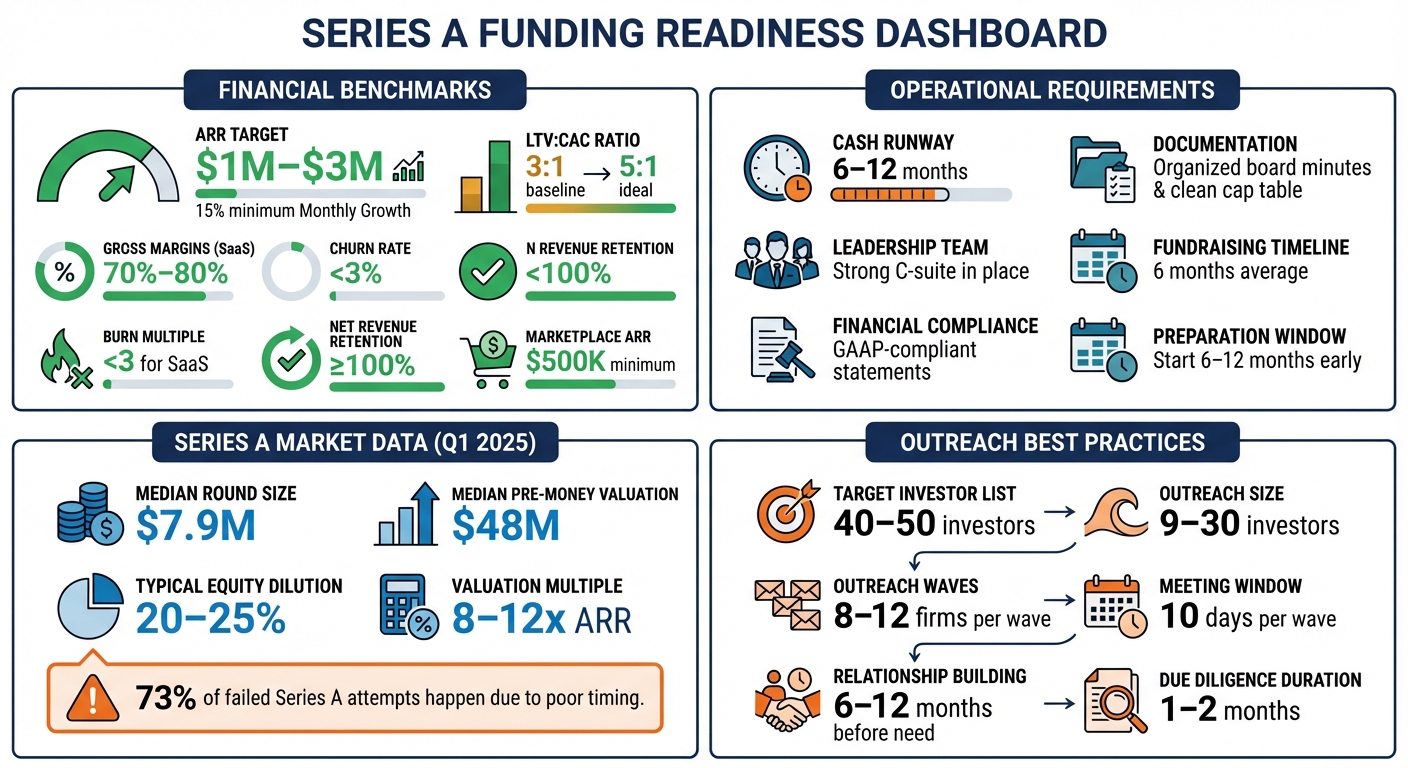
Series A Funding Readiness: Key Financial Metrics and Benchmarks
Before reaching out to investors, it's crucial to determine if your business is truly ready. Series A investors are no longer taking a chance on potential - they're looking for companies that have demonstrated real traction and operational strength. Timing and preparation are everything at this stage.
Your financial performance is the ultimate proof that your business model works. Most Series A investors expect Annual Recurring Revenue (ARR) between $1 million and $3 million as a sign of market validation [7][8]. On top of that, they want to see consistent monthly growth of at least 15% over six months [7].
Unit economics play a major role as well. A solid Lifetime Value to Customer Acquisition Cost (LTV/CAC) ratio of at least 3:1 is often the baseline, but hitting 5:1 can really set you apart [7]. For SaaS companies, aiming for 70%–80% gross margins and keeping churn under 3% are key targets. Marketplace businesses, on the other hand, should aim for at least $500,000 in ARR and double their growth rates [7][8].
Another critical metric is the "Burn Multiple", which measures efficiency by dividing total burn by net new ARR. For SaaS businesses, this should ideally be under 3 [8]. Additionally, your Net Revenue Retention (NRR) should be at least 100%, showing that your current customers are not only sticking around but also increasing their spending with you [7].
Take the example of DataFlow. They hit $1.8 million in ARR with 15% monthly growth but chose to delay their Series A by six months. This extra time allowed them to improve their Net Promoter Score from 28 to 52 and reduce churn from 8% to 3%. The result? Their valuation ended up 2.3 times higher than initially projected [7].
"Series A financial readiness means demonstrating scalable revenue growth with proven unit economics. Investors need confidence that additional capital will accelerate growth, not just extend survival." - ICanPitch [7]
But financial metrics are only part of the equation. Operational readiness is equally important.
Strong numbers won't matter if your company isn’t ready to scale. Investors want to see that you've built the operational foundation to grow effectively. This includes having a well-rounded leadership team where key responsibilities have been handed off from the founders - often by bringing in executives like a CTO or VP of Sales [7].
Your back-office operations should also be in order. This means maintaining GAAP-compliant financial statements, keeping organized board minutes, and ensuring your cap table is clean and straightforward [7][8]. As Jim Stewart, COO at True Ventures, explains:
"As you think about raising later stages of funding, Series A and beyond, the investors that are going to be interested in leading those deals require more information and more data, in a slightly more formal way." [3]
Cash runway is another critical piece. Starting your Series A preparations with 6–12 months of cash runway puts you in a much stronger negotiating position. Anything less than six months can leave you scrambling, which weakens your leverage [7][9]. Since the entire fundraising process typically takes about six months from start to finish, planning ahead is essential [3][10].
CloudMetrics provides a great example here. With $2.8 million in ARR and 12 months of runway, they were able to close an $18 million round at a $72 million valuation in just four months. Their success was largely due to having a complete due diligence package ready to go [7].
Timing is everything. About 73% of failed Series A attempts happen because companies either try to raise funds too early - before they've built enough traction - or too late, when cash is running dangerously low [7]. Building relationships with investors 6–12 months before you actually need the funding gives you the flexibility to strike at the right moment, rather than being forced into a deal by financial pressure [9].
For personalized guidance on assessing your readiness and fine-tuning your financial operations, experienced advisors like Phoenix Strategy Group can be an invaluable resource.
Once you've established strong operational and financial metrics, the next step is to validate your growth potential with a detailed financial model. For Series A investors, rough estimates won't cut it - they expect precise, well-supported projections that showcase scalable profitability. Your model should bridge your current performance with your future potential.
A comprehensive financial model must include the Income Statement, Balance Sheet, and Cash Flow Statement [11]. These statements should be fully integrated, reflecting changes cohesively to show not just revenue growth but also how that growth impacts your cash flow, working capital, and overall financial health [23,24].
Start with bottom-up forecasting for the first 12–24 months, then shift to top-down analysis for years three to five to establish realistic assumptions [20,22,23]. For the short term, focus on key revenue drivers like customer acquisition rates, average contract values, and expansion revenue from existing customers, modeled with monthly detail [20,23].
Your revenue model should center on 4 to 5 key performance indicators (KPIs) that drive growth [13]. Common metrics for startups include Customer Acquisition Cost (CAC), Lifetime Value (LTV), churn rate, and average selling price. Base these projections on historical data and document every assumption to avoid overestimating growth or creating unrealistic "hockey-stick" curves.
Personnel costs often account for 60% to 70% of expenses in service businesses and 15% to 30% for product companies [12]. Model headcount expenses line-by-line, showing when new hires will join and how their roles contribute to revenue. As Vanessa Kruze, CPA and Founder of Kruze Consulting, notes:
"Investors tend to really focus on your gross margin. Everyone wants to invest in companies that have a higher gross margin because high gross margins allow you to spend more money on operating expenses" [13].
Prepare at least three scenarios: a base case, an optimistic case, and a downside case. These scenarios demonstrate your readiness for different outcomes [22,23]. The base case should be realistic, the optimistic case can reflect additional capital, and the downside scenario should account for challenges. For SaaS and e-commerce businesses, working capital modeling is especially important because cash collection timing often differs from revenue recognition [22,24]. Be sure to model Accounts Receivable and Accounts Payable to show when cash will actually flow into your account.
To ensure your financial models meet investor expectations, consider collaborating with experienced advisors like Phoenix Strategy Group. Their expertise can help integrate your models with real-time financial tracking systems, keeping your projections grounded and aligned with actual performance.
Investors demand real-time financial data that is updated frequently, allowing you to quickly spot discrepancies between actual performance and projections. Start by organizing a centralized data room using platforms like Box or Dropbox [3]. As Jim Stewart, Chief Operating Officer at True Ventures, explains:
"We see Box and Dropbox as perfectly adequate to meet most of the needs for a data room" [3].
Your data room should include up-to-date financial statements, tax returns for the past three years, board meeting minutes, and your detailed financial model - all neatly organized for investor review. Implement monthly Budget vs. Actual (BVA) analysis to track where you're over or under budget [13]. Regular BVA reviews can help you identify and address issues early, such as a higher-than-expected CAC or delays in hiring, ensuring your fundraising process stays on course - typically a six-month effort [3].
Keep a close eye on your burn rate and cash runway by calculating your monthly run rate (summing costs like salaries, overhead, legal fees, and software subscriptions) and dividing your remaining cash by that figure [15,19]. Update this calculation weekly to avoid surprises.
Hiring a fractional CFO can also be a smart move to ensure your financial tracking meets investor standards [3,19]. Accurate, real-time financials not only boost investor confidence but also streamline the due diligence process during your Series A round.
Transform your solid financial models into a pitch deck that demonstrates scalable growth and product-market fit. At the Series A stage, investors aren't just looking for potential - they're seeking proof. They want to see that investing in your company will yield predictable returns. This is where your financial models and operational preparedness come together to tell a compelling story.
Your pitch deck should follow what’s known as the "Fundraising Vertebrae" - a concise narrative of 10 to 15 bullet points, each backed by concrete data. Janelle Tam, Series A Program Manager at Y Combinator, puts it this way:
"The deck should make clear that the obstacle to your growth is actually money (not incompetence, poor product quality, a lack of product-market fit, etc.)" [14].
Every slide should reinforce that your business is already working and that additional funding will fuel proven growth.
A strong Series A deck typically includes 10–20 slides, covering key areas like traction, problem, solution, product, market opportunity, competition, value proposition, go-to-market strategy, business model, and the team [4][14]. Start with a traction teaser slide that grabs attention by showcasing top-level growth stats. Highlight 2–3 headline metrics that underscore your core argument [14].
The heart of your deck should focus on:
Your traction slide should go beyond a single revenue figure. Instead, present detailed data on revenue, growth trends, and unit economics. Investors prefer seeing 4 to 6 months of consistent growth trends over isolated snapshots [14].
When discussing market opportunity, use a bottoms-up approach - calculate potential customers and the value your product delivers, rather than relying on vague top-down reports [14][5]. Other essential slides include:
These components build on the financial and operational groundwork you’ve already laid, presenting a cohesive case for investment.
Take the example of Arik Keller, Founder and CEO of Mable, who secured an $8.5 million Series A round in 2020. Keller focused on two milestones: proving product-market fit in a challenging B2B eCommerce space and demonstrating an economical customer acquisition strategy for 15,000 independent grocery stores. Key metrics, such as active customers, retention rates, and specific customer cohorts, played a pivotal role in convincing investors [5].
Your financial and growth plans should clearly illustrate how Series A funding will drive measurable outcomes. Include a three-year forecast, burn rate, and quarterly P&L for the past, current, and upcoming year [4][3][5]. Highlight key financial metrics like revenue, COGS, and operating expenses to outline your path to profitability. For context, the median Series A round in Q1 2025 was $7.9 million, with a median pre-money valuation of $48 million [2]. While valuation multiples of 8 to 12 times ARR are common, actual numbers will depend on your growth rate and market dynamics.
Your funding ask slide should clearly state the amount you’re raising and the milestones you aim to achieve within the next 18 to 24 months [14][2]. Break down how the capital will be allocated - whether for hiring, market expansion, or scaling your sales efforts - and tie each dollar to specific, measurable outcomes.
Avoid using screenshots of internal dashboards; instead, recreate charts from raw data to ensure clarity [15]. As Jim Stewart, COO at True Ventures, explains:
"As you think about raising later stages of funding, Series A and beyond, the investors that are going to be interested in leading those deals require more information and more data, in a slightly more formal way" [3].
Partnering with experts like Phoenix Strategy Group can help you craft investor-ready presentations that seamlessly integrate your financial projections into a persuasive pitch narrative.
Once your pitch deck is polished, the next step is to find and connect with investors who align with your business goals. Think of fundraising like a business-to-business sales process: research potential investors, qualify leads, and manage your outreach methodically. Start by creating a target list of 40–50 investors, then divide them into smaller waves of 8–12 firms. Use the first wave as a trial run to refine your pitch, saving your top-priority investors for later rounds [9].
Focus on specific partners within firms who have experience in your industry or category. Tools like Crunchbase can help you confirm whether a firm is actively investing and has recently raised a fund. Alexandra Wilkis Wilson, Co-founder of Gilt and Glamsquad, emphasizes the importance of early relationship building:
"Think about the investors you want before you need them... for a lot of investors, they do want to track you and your company's growth."
To build these relationships effectively, start connecting with investors 6–12 months before you actually need funding [9].
The best introductions often come through warm connections, such as other founders in a firm's portfolio, co-investors of your current backers, or peer CEOs. Avoid cold emails whenever possible. When reaching out, share a teaser deck of 3–5 slides or a brief email that includes your company description, key metrics, vision, and specific funding request. Aim to schedule meetings within each outreach wave over a 10-day period. This creates a sense of urgency and fosters a competitive environment [9].
Once you have a strategic plan in place, focus on identifying investors whose interests align with your market and growth strategy.
To refine your outreach, dig deeper into each investor's fit by reviewing their portfolio and recent activity. Look beyond fund size and check for investments in companies related to your sector. Firms with complementary portfolio companies are more likely to understand your market while avoiding conflicts of interest. Be cautious of firms invested in direct competitors, and steer clear of corporate venture capital (CVC) at the Series A stage, as potential risks to future acquisition opportunities may outweigh the benefits [16].
Take the time to conduct reverse due diligence by speaking with founders from the investor's portfolio. This includes those whose companies didn’t succeed. These conversations can provide insight into how the investor supports founders during tough times. Since Series A investors often join your board for several years, alignment on vision and personal dynamics are just as important as valuation. David Goldberg, General Partner at Alpaca VC, highlights this:
"In the same way that an investor prioritizes founder-market fit, a founder needs to prioritize investor-founder fit, meaning 'who' you are pitching is equally if not more important than what or how you are pitching" [6].
After thoroughly researching investors, make sure your financials are as polished as your pitch. Collaborate with experienced advisors, such as a fractional CFO or financial consultant, at least 2–3 months before you begin pitching. This ensures your financial models are solid and your outreach strategy is well-prepared [3]. Jim Stewart, Chief Operating Officer at True Ventures, explains:
"As you think about raising later stages of funding, Series A and beyond, the investors that are going to be interested in leading those deals require more information and more data, in a slightly more formal way" [3].
Services like Phoenix Strategy Group can help refine your financial projections, organize data rooms, and develop targeted outreach strategies. They go beyond basic bookkeeping to create detailed forecasts and unit economics analyses that institutional investors expect. Arrive at investor meetings confident that your financials can withstand scrutiny. Set up a well-organized data room early, using platforms like Box or Dropbox, to include essential documents such as your pitch deck, historical records, board minutes, tax returns, and three-year forecasts [3].
Once you've delivered your pitch and captured investor interest, the next step is often the most critical: due diligence. This is where investors dig deep into your business, verifying documents and scrutinizing every detail. The goal? To ensure everything checks out before the deal is finalized. As Andreessen Horowitz aptly states:
"I assume you run your company like you run your data room" [17].
Investors will request a comprehensive set of documents, so your data room needs to be airtight. Expect to provide 12–24 months of financial statements - this includes income statements, balance sheets, and cash flow statements - along with tax returns and projections for the next 12–18 months [11]. Corporate documents are equally essential: your Certificate of Incorporation, bylaws, board meeting minutes, and organizational chart should all be ready to go. Your capitalization table must clearly outline ownership stakes for founders, employees (including option pools), and prior investors, with details on every SAFE, convertible note, and term sheet [11].
Make sure every employee and contractor has signed a Proprietary Information and Inventions Agreement (PIIA); missing agreements can jeopardize the deal [17]. Other key documents include patent and trademark filings, major customer and vendor contracts, employment agreements, and your equity incentive plan.
Consistency is non-negotiable. Your ARR figures should align across your pitch deck, financial model, and accounting records. As they say, "Consistency equals credibility" [17]. Also, be prompt - aim to respond to investor requests within 24 hours and keep your data room well-organized with an indexed structure [17].
Once the documents pass inspection, the focus shifts to hammering out the terms.
When term sheets start coming in, look beyond the numbers. Pay close attention to valuation, board representation, investor involvement, and long-term alignment. Board seats, in particular, are a big deal - investors may hold them for a decade or more [9]. Negotiating terms that align with market standards can save both sides from lengthy legal disputes [9].
To minimize dilution, try to secure multiple term sheets at the same time, aiming for the typical 20–25% equity range for Series A rounds [1]. Timing matters here: start fundraising after hitting significant milestones to boost your valuation [6].
The closing phase itself usually takes about 1–2 months. This involves finalizing crucial documents like the Stock Purchase Agreement, Investors' Rights Agreement, and Right of First Refusal [9].
Working with advisors, such as Phoenix Strategy Group, during negotiations can help you safeguard your equity while ensuring you secure enough runway to achieve your goals.
Securing Series A funding requires meeting specific financial and operational milestones before approaching investors. To be ready, you’ll need to show strong revenue figures, scalable growth potential, and solid unit economics. Having a well-organized data room with key documents - like financial statements, tax returns, and legal paperwork - can streamline due diligence and highlight your operational preparedness [3].
Once your operations and pitch deck are in order, timing becomes a crucial factor. Start the fundraising process early - ideally 6 to 12 months before you actually need the funds. This allows time to polish your pitch, connect with 40–50 potential investors, and refine your strategy based on feedback [9]. As Jim Stewart from True Ventures explains:
"As you get ready to think about selling your story to a new lead investor, you'll need more forecasted data and more strategic thinking around your financial model and how your business is going to progress and grow" [3].
Expert advisors can play a key role in bridging the gap between solid financial planning and successful investor discussions. Services like those provided by Phoenix Strategy Group can help refine your financial models, develop accurate forecasts, and guide you through investor negotiations and due diligence.
Finally, leadership focus is critical. CEOs should dedicate their energy to fundraising efforts, leaving daily operations in the hands of their team [9]. With careful preparation, clear metrics, and strategic guidance, you’ll be in a strong position to secure the capital you need while minimizing dilution and maintaining control over your company’s future.
When gearing up for Series A funding, it's crucial to highlight financial metrics that showcase your company's growth trajectory and overall financial health. Investors tend to zero in on monthly recurring revenue (MRR) and annual recurring revenue (ARR), along with their respective growth rates, as these figures paint a clear picture of your revenue consistency and expansion.
Another key focus is the balance between customer acquisition cost (CAC) and customer lifetime value (LTV), which helps investors gauge your profitability and efficiency in acquiring and retaining customers. Metrics like net dollar retention (NDR) or churn rate are also pivotal, as they reveal how well you're retaining customers and driving additional revenue from your existing base.
Beyond these, investors will take a close look at your gross margin, burn rate, and cash runway. These numbers indicate how effectively you're managing resources and whether your business is positioned for sustainable growth and scalability.
To secure Series A funding, startups need to prove they're ready to scale efficiently. This begins with establishing a strong financial foundation. Keep your bookkeeping accurate and up to date, develop detailed financial forecasts covering the next three years, and monitor essential metrics like monthly recurring revenue (MRR), customer acquisition cost (CAC), lifetime value (LTV), and churn. These numbers give potential investors a clear snapshot of your company’s growth trajectory and financial stability.
Another key step is to formalize your team and processes. Define roles, reporting structures, and hiring plans to ensure your leadership team is prepared for rapid expansion. Scalable systems for finance, product development, and data management are crucial to avoid operational bottlenecks as your business grows. Investors want to see a well-organized team and efficient processes that can handle the demands of scaling.
Lastly, consider bringing in expert advisory support to address any gaps. Fractional CFOs or data engineering specialists can help fine-tune your financial models and ensure your metrics are accurate and reliable. Firms like Phoenix Strategy Group offer services designed to streamline operations, craft a compelling financial narrative, and position startups for a successful Series A round. By combining operational readiness with clear proof of product-market fit, you can instill confidence in investors and secure the funding needed to take your business to the next level.
To craft a standout Series A pitch deck, make sure to include these essential components:
For added impact, include an appendix with extra materials like detailed financials or customer testimonials. Keep the design clean, the content concise, and tailor your presentation to resonate with your audience. A visually engaging deck that communicates your vision effectively can leave a lasting impression on investors.