Published on
December 9, 2025


Selling an e-commerce business requires targeting the right buyer, not just any buyer. Different buyer types - like competitors, aggregators, or financial investors - evaluate businesses using unique criteria. To maximize your sale price and speed up the process, you need to identify your ideal buyer early and tailor your approach to their priorities.
Here’s what matters most:
Key steps include:
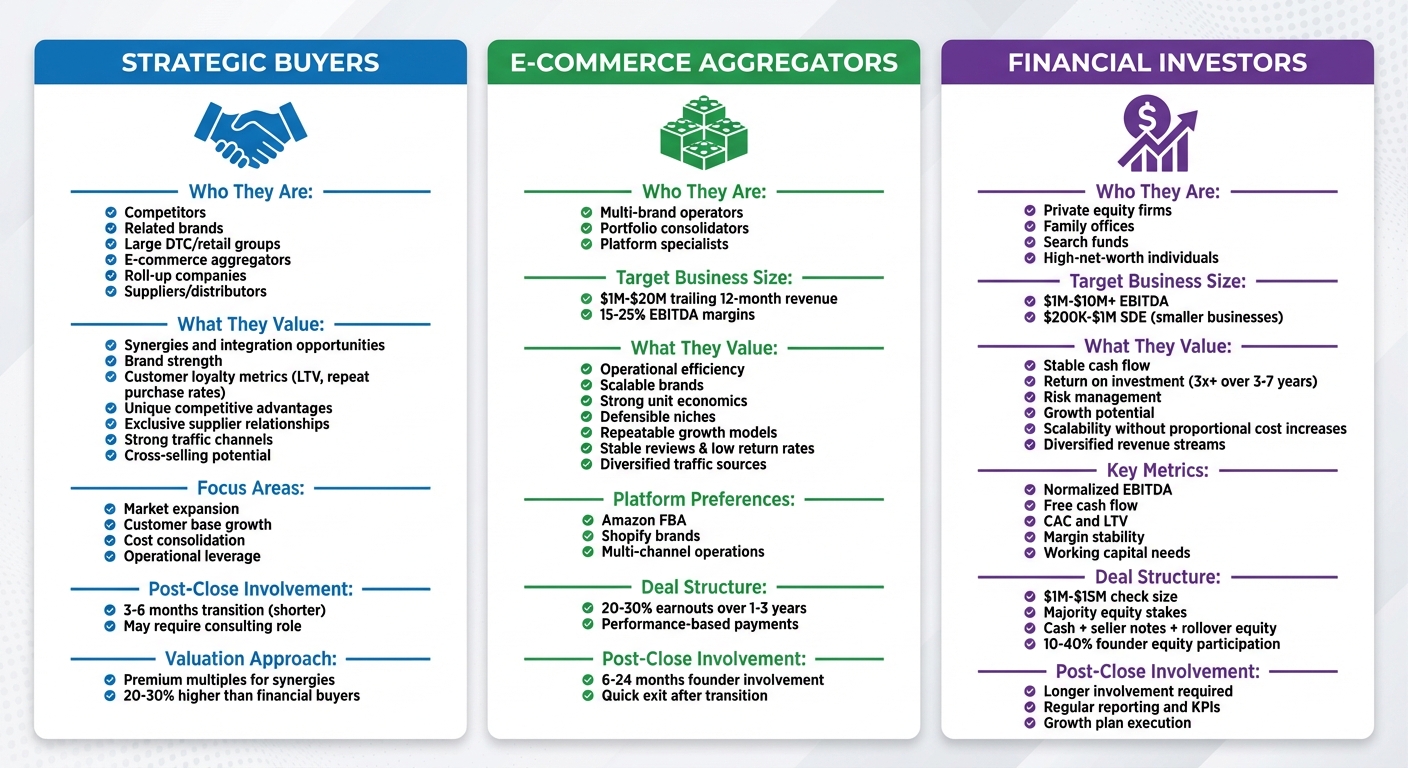
Three Types of E-commerce Buyers: Strategic vs Aggregator vs Financial Investor Comparison
When you're gearing up to sell your e-commerce business, it's crucial to understand the two main types of buyers: strategic buyers and financial buyers. Each group evaluates opportunities differently, values distinct metrics, and approaches deals in unique ways. Knowing these differences early on can help you tailor your preparation, from organizing financials to framing your pitch. Let’s break down what each type is looking for.
Strategic buyers can include competitors, related brands, large direct-to-consumer (DTC) or retail groups, e-commerce aggregators, roll-up companies, and even suppliers or distributors. Their goal is to acquire assets that align with and enhance their existing operations. For instance, a competitor might buy your business to eliminate competition, expand their customer base, or streamline operations. Meanwhile, an aggregator managing a portfolio of beauty brands might see your skincare line as a natural fit alongside their hair care and cosmetics offerings.
What sets strategic buyers apart is their focus on synergies - the added value they can realize by integrating your business into theirs. This could involve cutting costs by consolidating ad spending, software tools, or staff. They might also capitalize on your customer base by cross-selling products from their other brands. If your business has strong traffic channels, like a high-performing email list or solid organic search rankings, they can leverage those to boost sales across their portfolio.
Strategic buyers often place a premium on brand strength, customer loyalty metrics such as lifetime value (LTV) and repeat purchase rates, and unique competitive advantages. These could include exclusive supplier relationships, stellar product reviews, or top rankings on platforms like Amazon. Essentially, they’re willing to pay more for businesses that offer long-term growth opportunities and operational leverage.
Financial buyers, on the other hand, approach acquisitions purely as investments. This group includes private equity firms, family offices, search funds, and high-net-worth individuals. Unlike strategic buyers, they’re not looking for synergies but instead focus on cash flow, return on investment, and risk management. Their valuations are typically based on metrics like normalized EBITDA, free cash flow, and growth potential.
For U.S.-based e-commerce businesses, financial buyers often target companies generating $1 million to $10 million or more in EBITDA. Smaller online businesses with seller’s discretionary earnings (SDE) between $200,000 and $1 million may attract individual buyers or smaller funds, often financed through SBA-backed loans.
Financial buyers are meticulous about risk assessment. They’ll analyze whether your revenue streams are diversified or overly reliant on a single channel, product, or supplier. They’ll dig deep into metrics like customer acquisition costs, lifetime value, and margin stability. A key focus is on scalability - businesses that can grow without a proportional rise in operating costs are especially appealing. They’ll also examine working capital needs and capital expenditures to ensure the business can generate predictable, stable cash flow with minimal risk.
To prepare for this level of scrutiny, many sellers turn to firms like Phoenix Strategy Group. They specialize in helping growth-stage e-commerce businesses create investor-grade financial reports, FP&A models, and clean data rooms that provide the transparency financial buyers expect.
Once you’ve identified the different types of buyers, the next step is gathering the essential details that reveal whether a buyer is the right fit. Creating a detailed profile for each potential buyer helps you understand their acquisition priorities and how your business aligns with their goals.
Geography plays a bigger role in acquisitions than many sellers realize. Buyers often have specific geographic preferences - some focus solely on U.S.-based businesses, others on North America (the U.S. and Canada), and a smaller group targets global operations. These preferences stem from logistical, compliance, and currency considerations. For example, U.S.-focused buyers tend to favor businesses with revenue in U.S. dollars, domestic fulfillment structures (like U.S.-based third-party logistics providers), and American suppliers. This setup simplifies integration and reduces risks. In fact, brands operating entirely within the U.S. often command a premium because cross-border operations can bring challenges like tax complications and compliance hurdles.
When profiling buyers, note where they currently operate and where they aim to expand. For instance, a competitor already selling in the U.S. and Canada might see your business as a gateway to international markets if you have strong global online visibility or support multi-currency payment systems. On the other hand, if your supply chain relies on overseas suppliers with long lead times and your customer base spans multiple regions, you’ll need buyers with global logistics expertise rather than those focused on domestic operations.
Transaction size is typically one of the first filters buyers use. Private equity firms and aggregators often require a minimum EBITDA, usually above $1 million, with enterprise values ranging from 3× to 6× EBITDA. Target buyers whose financial criteria match the scale of your business.
Equally important are buyer preferences for specific business models. Some buyers specialize in direct-to-consumer (DTC) Shopify brands with owned traffic, while others focus on Amazon FBA businesses or hybrid models that combine multiple sales channels. Understanding your revenue breakdown is key. For example, if 70% of your revenue comes from Amazon FBA, you’ll likely attract aggregators skilled in marketplace consolidation. If 80% of your revenue is through owned traffic on your Shopify store, strategic buyers with a focus on DTC brands may find your business more appealing. Buyers typically stick to their area of expertise, as their teams and systems are optimized for specific models.
Your traffic sources and marketing channels are critical factors that influence valuation. Buyers prefer businesses with diversified, repeatable customer acquisition strategies. Channels like organic search and email marketing are especially attractive because they tend to have lower costs and higher customer lifetime value. Institutional buyers often require 12–24 months of consistent advertising data to confirm trends. Additionally, many buyers limit the portion of revenue derived from paid advertising since over-reliance on a single channel can signal risk.
Analyze your traffic sources to understand the revenue contribution of each channel - organic search, paid advertising (Google Ads, Facebook, TikTok), email/SMS campaigns, social media, affiliate programs, or marketplace channels. For example, a business generating 50% of its traffic organically, 30% from email, and 20% from paid ads will typically be more attractive than one relying on 80% paid advertising. A diversified model suggests sustainable growth, while heavy dependence on a single channel raises concerns about rising acquisition costs if market conditions shift.
Product categories are another major consideration. Buyers often have clear preferences or exclusions. Popular categories include beauty, health and wellness, pet products, and home goods. Conversely, categories with high regulatory risks (like certain supplements), safety concerns (such as weapons), or extreme seasonality (e.g., holiday-specific toys) are often avoided. Many buyers also steer clear of brands reliant on "hero SKUs", where a single product accounts for most of the revenue, as this increases concentration risk. Document your category’s market size, growth potential, competition, and whether your products have steady, year-round demand or are trend-dependent.
Deal structures vary widely among buyers and significantly impact valuations and payout timelines. Most e-commerce acquisitions are structured as asset sales rather than stock sales. Buyers generally prefer asset purchases because they can acquire inventory, customer lists, and intellectual property without taking on existing liabilities. Financial buyers and aggregators often include earnout provisions, where 20% to 30% of the purchase price is paid over one to three years, tied to performance metrics like customer acquisition costs, lifetime value, or repeat purchase rates.
Post-close involvement is another critical factor. Aggregators usually aim for a quick seller exit after a brief transition period. In contrast, private equity-backed roll-ups or strategic buyers might require the founder to stay involved for 6 to 36 months, often as part of earnout agreements. If your role is central to product selection, customer relationships, or marketing strategy, buyers may lower their valuation or require a longer transition period (typically 3 to 12 months, sometimes with a consulting fee). However, businesses with well-documented processes and an established management team are more likely to secure higher valuations and shorter transition periods. Firms like Phoenix Strategy Group help sellers prepare by creating clean financial reports, detailed FP&A models, and operational documentation, showing buyers that the business can thrive without the founder.
To get your e-commerce business ready for a successful exit, it's crucial to turn your data into detailed buyer personas - profiles that represent the ideal acquirers for your business. These personas help you focus your preparation efforts and tailor your approach to meet the needs of potential buyers. Start by analyzing past buyer interactions to identify patterns. Look at which conversations led to offers and which didn’t, noting reasons like valuation disagreements, mismatched business sizes, or concerns over owner dependency. This historical data forms the foundation for realistic, actionable personas.
Keep your focus narrow by developing three key personas. For each, include details like the buyer’s company profile (size, revenue, location), typical deal size, preferred business models, investment goals, deal structure preferences, due diligence priorities, and post-close involvement expectations. These specifics will help you create targeted outreach strategies, prepare relevant materials for your data room, and anticipate negotiation points.
The three most common buyers in e-commerce exits are strategic competitors, e-commerce aggregators, and financial investors. Each has distinct motivations and risk factors:
For a practical approach, create a one-page document for each persona. Use descriptive names like "Strategic Competitor Sarah" or "Roll-up Ryan" to make them relatable. Include a summary of who they are, what they want, their must-haves, deal-breakers, and typical decision-making timelines. This framework ensures your team can align business preparation with each persona’s priorities, whether that means emphasizing operational synergies for competitors, clean processes for aggregators, or financial metrics for investors.
Regularly revisit and refine your personas. Test them with external advisors, such as M&A consultants or brokers, who can validate your assumptions based on current market trends. Think of these personas as evolving tools that adapt to shifts in buyer behavior, market conditions, and capital availability. Surveys show that businesses using high-quality buyer personas see better leads and improved alignment, with persona-based strategies boosting conversions by an average of 73% [1][2].
Strategic competitors are larger brands in your industry or related categories. They aim to grow market share, enter new regions, or acquire complementary products and customer bases. Typically, these buyers generate $20 million to $200 million in annual revenue and have established direct-to-consumer and retail channels, along with the infrastructure to quickly integrate your brand. They seek synergies through shared supply chains, cross-selling opportunities, and cost savings, and they expect detailed operational data to ensure a smooth integration.
When building this persona, identify criteria for strategic fit, such as overlapping customer demographics, average order value, price points, and brand positioning. List potential competitors (five to 20) with details like revenue, product categories, and known acquisitions. Highlight how your brand fills specific gaps, such as serving a new demographic or offering a complementary product line. Strategic buyers often pay higher multiples if they see clear synergies.
These buyers usually prefer shorter transition periods (three to six months) but may require your involvement to integrate operations and maintain relationships with key partners. They might also ask you to stay on as a consultant to ensure a smooth handoff for functions like customer service or marketing. To appeal to this persona, emphasize overlapping customer bases, potential lifetime value growth from cross-selling, and supply chain efficiencies. Showcase metrics like repeat purchase rates and Net Promoter Scores to highlight customer loyalty and brand equity. Ensure your financial and operational data meet their expectations.
E-commerce aggregators are multi-brand operators that acquire small- to mid-sized e-commerce businesses, centralizing operations like marketing, supply chain, and customer service to drive efficiency. These buyers are selective, targeting brands with strong unit economics, defensible niches, and repeatable growth models. Typically, they focus on businesses with $1 million to $20 million in trailing 12-month revenue and EBITDA margins of 15% to 25%.
Aggregators often specialize in Amazon FBA or Shopify brands with stable reviews, low return rates, and diversified traffic sources (organic search, paid ads, email, SMS). They value operational leverage, such as reducing costs through bulk purchasing or streamlining fulfillment. When profiling this persona, note their platform focus (Amazon, Shopify, or multi-channel) and category expertise (e.g., beauty, home goods, or health). Many aggregators now prioritize narrower niches to reduce integration risks.
Deals with aggregators often include earn-outs tied to performance metrics over one to three years. Founders are usually expected to stay involved for six to 24 months to stabilize operations and meet earn-out goals. To attract aggregators, prepare detailed financials, including revenue, EBITDA, and growth rates over the past 12 to 36 months. Provide channel breakdowns, SKU-level performance data, repeat purchase rates, and comprehensive SOPs for fulfillment, customer service, and advertising. Align your data with their expectations to strengthen your appeal.
Financial investors - such as small private equity funds, family offices, or high-net-worth individuals - focus on return on investment and business scalability. They typically manage $20 million to $200 million in assets and write checks ranging from $1 million to $15 million for majority equity stakes. Their goal is to achieve a 3× or higher return on invested capital over three to seven years. Unlike strategic buyers or aggregators, financial investors are less interested in operational synergies and more focused on cash flow stability and growth opportunities.
This persona should reflect their risk tolerance regarding customer concentration, supplier dependency, and platform reliance. Financial investors often use complex deal structures, combining cash, seller notes, and rollover equity to align incentives. They may require the founder or management team to stay involved in executing the growth plan, often with equity participation of 10% to 40%. Post-close, they expect regular reporting, clear KPIs, and a defined value-creation roadmap.
To appeal to financial investors, highlight key metrics like customer acquisition cost, lifetime value, and payback period. Emphasize cash flow stability and growth potential, and showcase defensible advantages like brand strength, community engagement, or subscription revenue. Ensure your financial and operational data align with their priorities to make your business an attractive investment.
Understanding your target buyer personas is just the beginning. The next step is aligning your business operations, finances, and assets to meet their expectations. This preparation phase, which often takes 12–24 months, can significantly boost your valuation. The aim is to shift your business from being overly dependent on you, the founder, to becoming a scalable, professionally managed asset that buyers can seamlessly integrate or operate independently. Since different buyer types - strategic competitors, aggregators, and financial investors - evaluate businesses through different lenses, your preparation must address their specific priorities. Here’s how you can tailor your financial and operational profile to appeal to all buyer types.
Clean and accurate financial records are non-negotiable. Many e-commerce deals fall apart due to incomplete or inconsistent financial documentation. To avoid this, adopt GAAP-aligned, accrual-basis bookkeeping at least 12–24 months before your planned exit. Prepare detailed monthly profit and loss statements, balance sheets, and cash flow statements that showcase a clear three-year financial history. Include normalized EBITDA calculations and a comprehensive add-back schedule (e.g., owner salaries above market rate, one-time legal fees, personal expenses).
Buyers place significant emphasis on unit economics and operational efficiency. Track key metrics like customer lifetime value (LTV), customer acquisition cost (CAC), LTV/CAC ratio (a healthy benchmark is typically above 3:1 over 12–24 months), gross margin trends, and cash flow stability. For Amazon-centric businesses, provide data on ACOS, TACOS, Buy Box percentages, review metrics, and SKU-level contributions. For direct-to-consumer brands, include blended and channel-specific CAC, creative performance metrics, and funnel data such as click-through rates, conversion rates, and average order value. Segment performance by channel (e.g., Amazon, Shopify, wholesale), product category, and geography to help buyers identify synergies within their portfolio.
Financial sponsors and aggregators often filter deals based on a few key metrics before diving into detailed due diligence. These metrics include trailing twelve-month EBITDA, growth rate, margin profile, and channel risk. Healthy benchmarks include gross margins of 60%+ for categories like beauty, apparel, and supplements, paid media CAC payback within 6–12 months, and 40–60%+ of revenue from repeat customers for mature brands. Clearly presenting these metrics can build buyer confidence and streamline negotiations. Firms like Phoenix Strategy Group specialize in helping growth-stage e-commerce businesses refine their financial reporting and prepare for mergers and acquisitions, making them particularly appealing to institutional buyers.
Once you’ve established strong financial reporting, the next step is to ensure your operational assets are well-documented and transferable.
Your intellectual property and operational assets are critical to a successful exit. Start by registering trademarks for your brand name and logos with the U.S. Patent and Trademark Office. Ensure all intellectual property - like proprietary product designs, domain names, customer databases, supplier relationships, and custom software - is owned by the business entity, not by individuals. Conduct an IP audit and document exclusive supplier agreements, manufacturing partnerships, or distribution rights that give your business a competitive edge. These assets are especially valuable to strategic buyers, as they reduce post-acquisition integration costs.
Supplier contracts should be well-documented with clearly defined pricing, order quantities, terms, and assignability. Minimize reliance on single suppliers whenever possible, as buyers increasingly value diversified supply chains and stable third-party logistics (3PL) relationships. Recent disruptions in global supply chains have made redundancy and geographic diversification even more important. Formalize agreements with key partners like 3PL providers, agencies, and software vendors, ensuring these contracts can be transferred to a new owner or renewed under similar terms.
Organize your first-party data - including email lists, SMS subscribers, and loyalty program members - with proper consent records and segmentation. Buyers are more likely to pay a premium for businesses with diversified traffic sources and robust email/SMS lists, as these assets offer immediate revenue potential. Brands heavily reliant on a single ad platform or marketplace are viewed as riskier investments.
Owner dependency is a major red flag for buyers, as it creates risks around business continuity and valuation. Some aggregators even require that a business can operate with minimal founder involvement within 30–60 days of acquisition. To achieve this, standardize and document all core processes through standard operating procedures (SOPs) and centralize knowledge using tools like Asana, Trello, Slack, or Notion. Cover key areas like inventory management, advertising campaigns, customer service, and product launches.
Building a light management team is another critical step. Hire roles like an operations manager, marketing manager, or customer support lead, ensuring that at least one person besides you can handle each essential function. For brands where the founder plays a significant role in the brand story, focus on creating brand assets that are not tied to you personally. This could include community engagement initiatives, user-generated content, or educational resources that allow for a smooth transition away from the founder.
Establish clear reporting structures and decision-making hierarchies to ensure the business runs smoothly during the transition period. Document customer relationships and ensure they are tied to the business itself, not to personal connections. A self-sustaining business not only commands a higher valuation but also attracts a broader range of buyers who feel confident in their ability to take over and operate the company effectively.
Profiling potential buyers before selling your e-commerce business is one of the smartest moves you can make. By understanding who’s willing to pay the best price - and what matters most to them - you can adjust your financials, data room, and overall strategy to align with their priorities. Strategic competitors, aggregators, and financial investors each have unique ways of evaluating businesses, so tailoring your reporting, KPIs, and operational details to match your most likely buyer type can lead to smoother due diligence, fewer renegotiations, and higher valuations. In fact, research shows that strategic acquirers often pay 20–30% higher multiples than financial buyers when synergies are evident, making the right buyer match critical.
To get started, map out realistic buyer categories for your niche and revenue level. Then, identify what each type typically looks for - such as deal size thresholds, preferred sales channels, margin expectations, or their level of involvement after the sale. Create simple one-page buyer personas that outline their priorities, potential red flags, and common questions. Use these profiles to audit your financials and operations, spotting gaps like missing SKU-level profitability or undocumented workflows. Address these weaknesses 6–24 months before you plan to sell. Keep in mind, this isn’t a one-and-done task; update your buyer personas as your business grows, adds new channels, or receives feedback from real buyer interactions.
The results can be game-changing. For example, a DTC skincare brand with $3 million in annual revenue identified strategic beauty companies and Amazon-native aggregators as its top buyer profiles. By tailoring its data room to emphasize Amazon performance and paid-social metrics for aggregators, while showcasing its U.S. customer base and brand equity for strategics, the founder received multiple letters of intent, minimized diligence renegotiations, and secured a higher multiple with a faster closing process than a generic approach would have achieved.
Phoenix Strategy Group (PSG) specializes in helping growth-stage e-commerce companies turn buyer profiling into actionable strategies. Their fractional CFO and FP&A services prepare exit-ready financials in USD, covering normalized EBITDA, add-backs, unit economics, and channel-specific performance metrics - all tailored to what different buyer types expect. PSG’s data engineering team consolidates and cleans data from Shopify, Amazon, ad platforms, and 3PLs, ensuring KPIs are presented in the formats preferred by strategic, aggregator, or financial buyers. They also map the buyer landscape, refine personas, and conduct targeted outreach to U.S. and international buyers, while structuring deals based on what each buyer type typically values.
"PSG and David Metzler structured an extraordinary M&A deal during a very chaotic period in our business, and I couldn't be more pleased with our partnership." – Lauren Nagel, CEO, SpokenLayer
Whether your exit is a year or several years away, starting the buyer profiling process now helps you focus on the right KPIs, make informed capital and marketing decisions, and reduce owner dependency. These steps set your business up for a smoother, more profitable transition when the time comes.
Strategic buyers are companies aiming to expand their market reach, streamline operations, or gain an edge over competitors by incorporating your e-commerce business into their current setup. Their focus tends to be on long-term growth and creating synergies that enhance their overall operations.
In contrast, financial buyers - such as investment firms or individual investors - are more concerned with return on investment (ROI). They zero in on metrics like cash flow, profitability, and the potential to sell the business later for a profit. Their strategy often revolves around shorter-term gains or financial restructuring.
Recognizing these distinctions allows you to refine your buyer profiles and position your business to attract the right type of buyer for your desired exit strategy.
Preparing your e-commerce business for the right buyer means focusing on making your operations efficient, keeping your financial records accurate, and presenting your business strategically.
Start with your operations. Ensure every process - whether it's inventory management or customer support - is running smoothly and documented clearly. Buyers want to see a business that's easy to take over without unnecessary complications.
Next, get your financial house in order. This includes organizing your financial statements, tax records, and any other documents that show how your business is performing. Buyers appreciate transparency and want to see clear evidence of profitability and growth potential.
Lastly, think about how you position your business. Highlight what sets it apart and tailor your pitch to what matters most to potential buyers. Whether they're looking for scalability, market share, or strong profit margins, aligning your presentation with their priorities can make all the difference. A well-prepared business doesn’t just attract attention - it commands a better price.
When buyers assess whether an e-commerce business is ready to scale, they tend to zero in on a few critical factors. They look at how strong and reliable the operational systems are, whether the business shows consistent revenue growth, and how stable the customer base is over time. Additionally, they’ll examine the resilience of the supply chain, the ability of the technology infrastructure to grow with demand, and whether the business can handle more volume without losing efficiency.
Focusing on these aspects in your buyer profile can highlight your business’s potential and make it stand out to prospective buyers.