Published on
March 10, 2026


When raising funds for your startup, understanding regulatory filings is essential to avoid legal issues. Whether you're pursuing a seed round or a series round, compliance with federal securities laws and state-specific Blue Sky laws is non-negotiable. Here's what you need to know:
Failing to meet deadlines or filing incorrectly can lead to penalties and jeopardize your exemption status. Stay organized, plan for compliance costs with fractional CFO services, and maintain accurate records to ensure smooth fundraising.

Seed vs Series Round Regulatory Filing Requirements Comparison
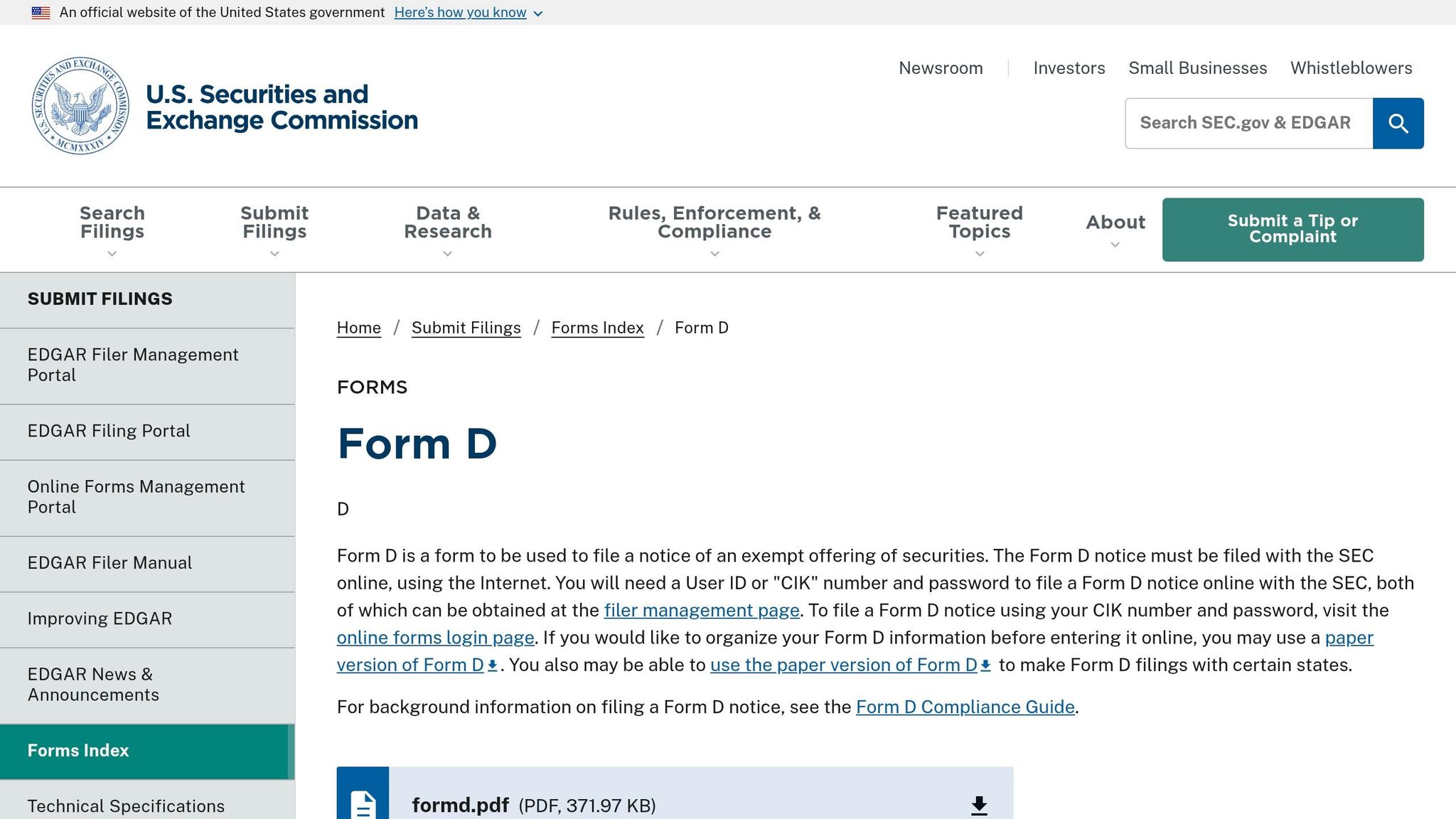
Once you close your first seed round, you have 15 calendar days from the first sale to file Form D with the SEC [1]. For clarity, a "sale" happens when an investor commits to invest by signing the investment agreement - not when the funds are actually transferred [4]. If the 15th day falls on a weekend or federal holiday, the deadline extends to the next business day [4].
To get started, set up an EDGAR account and obtain a Central Index Key (CIK) by filing Form ID [1]. Since this process can take several days, it’s best to begin early. The good news? The SEC doesn’t charge any fees for opening an EDGAR account or filing Form D [1]. Once submitted, Form D becomes publicly accessible through the SEC’s EDGAR database. It includes details like your company name, executive officers, the offering size, and the Regulation D exemption you’re relying on [1].
"Form D is not an application for exemption approval - it is a notification that the issuer is relying on one of the exemptions under Regulation D." - Blue Sky Comply [4]

Most seed rounds use one of three Regulation D exemptions:
Filing Form D with the SEC is just one part of the process. You’ll also need to handle "Blue Sky" filings for each state where your investors reside. While Rules 506(b) and 506(c) preempt full state registration, you’re still required to submit notice filings in these states [5]. This typically involves providing a copy of your federal Form D, a Consent to Service of Process (Form U-2), and paying state-specific fees - usually within 15 days of your first sale to an investor in that state [9].
Here’s an example of how state fees vary:
It’s crucial to track each investor’s home address because state jurisdiction depends on where the investor lives - not where your company is headquartered [11].
If your seed round stays open for more than 12 months, you’ll need to file an amended Form D annually [1]. Amendments are also required if there are material changes, such as an increase in the offering size or new executive officers [1]. While Regulation D offerings don’t require ongoing SEC financial reporting, keeping detailed investor records is essential in case of future audits [1].
This breakdown of seed round filings lays the groundwork for understanding the additional complexities of Series round filings.
Series rounds build upon the groundwork of seed rounds but bring added layers of complexity due to larger capital amounts and the involvement of investors across multiple states.
Form D must be filed within 15 calendar days of receiving the first investor commitment (marked by the subscription signature). In December 2024, the SEC penalized two private companies and a registered investment adviser for failing to meet this deadline. These offerings, which ranged from tens of millions to $250 million, resulted in fines of $60,000, $175,000, and $195,000, respectively [12]. For rounds with multiple closings, the 15-day countdown begins with the first investor commitment.
Private Series rounds often rely on Rule 506(b) or Rule 506(c) exemptions, as they allow for unlimited capital raises - essential for larger funding rounds.
In addition to federal exemptions, Series rounds require strict adherence to state-level compliance.
Since Series rounds often involve investors from various states, issuers must navigate increased Blue Sky filing requirements. Notice filings are due within 15 days of the first sale in each investor’s state of residence, with fees varying by jurisdiction. For example:
For Series rounds involving investors from 15–25 states, filing fees can range from $5,000 to $10,000. Engaging a professional filing service may add another $5,000 to $15,000 to your costs [10][11]. Many startups manage these complexities by hiring a fractional CFO to oversee compliance and financial strategy. Notably, Delaware and Colorado do not require notice filings for Rule 506 offerings.
"The SEC governs the 'sky,' but the states control the 'ground.' To raise capital confidently - and avoid problems later - make sure both levels are covered."
These state-specific requirements highlight the increased complexity of Series rounds, which also extends to post-offering obligations.
If a Series round remains open for more than 12 months, issuers must file an annual amendment to Form D [1]. Certain states, such as California, also require annual renewals for Blue Sky filings under these circumstances [10]. While the SEC does not charge fees for Form D submissions or amendments, issuers are required to maintain thorough records of investor accreditation for at least five years [1][13].
When it comes to choosing between seed rounds and series rounds, there are clear trade-offs to consider. For instance, seed rounds offer a lot of flexibility. Did you know that 90% of pre-seed rounds on Carta use SAFEs? These agreements let investors join at different times without having to lock in a valuation right away [3]. Plus, the compliance process is straightforward - standardized documents and lower legal fees make things easier. However, one downside is that fundraising details are made public through the SEC's EDGAR database. This can be a double-edged sword: it might attract attention from potential investors, but it also puts your activities on competitors’ radar [14][16].
On the other hand, series rounds come with more complexity but also provide a clearer structure for investor relationships. You'll need to amend your Certificate of Incorporation, authorize new share classes, and negotiate detailed investor rights. This adds to legal costs, but it also establishes clear rules, like liquidation preferences and board representation. These features can improve governance and create accountability, which might benefit your company in the long run [15].
Here's a quick comparison:
| Feature | Seed Round (SAFE/Note) | Series Round (Priced Equity) |
|---|---|---|
| Filing Flexibility | High; allows rolling closes and deferred valuation [15] | Low; requires fixed valuation and formal equity issuance [15] |
| Compliance Complexity | Minimal; uses standardized documents [15] | High; involves amending bylaws and board restructuring [15] |
| Legal Costs | Lower; simpler negotiations and faster closings [15] | Higher; includes due diligence and custom term sheets [15] |
| Investor Rights | Limited; no board seats until conversion [15] | Comprehensive; includes voting rights and protective provisions [15][3] |
| Publicity Impact | Public via EDGAR; validates traction but alerts competitors [14] | Public via EDGAR; often draws competitor scrutiny [14][2] |
The choice between these options often depends on your growth stage and financing goals. Public disclosure is a key factor here. Transparency can attract further investment and validate your business, but it also exposes your fundraising activity to competitors. As Michał Kowalewski from Capbase explains:
"Many companies delay or avoid filing the Form D all together, because they don't want the publicity" [14].
However, skipping the filing comes with risks. If you don’t file, you could lose eligibility for future Reg D exemptions - a consequence that most startups can't afford [16].
Another aspect to weigh is cost. While the SEC doesn’t charge for Form D filings, state-level fees can range from $300 to $1,000 per jurisdiction [2]. For Series rounds involving multiple states, these fees can add up quickly, especially on top of the higher legal costs tied to priced equity negotiations. Balancing these factors is key to picking the right filing approach for your company's financial strategy.
Understanding the regulatory differences between seed and series rounds is crucial for gaining investor trust. Seed rounds typically involve flexible tools like SAFEs and convertible notes, requiring minimal documentation. On the other hand, series rounds demand formal amendments and detailed investor protections. Both require timely Form D filings and state notices, making preparation essential for staying compliant.
Emily Wu, Partner at Lumia, highlights the importance of timing:
"Form D... is something that needs to be filed within 15 days of receiving investment. And so a lot of times this is very great for founders because they don't need to pay attorneys for anything until they actually get the money" [2].
Maintaining a clean cap table and strong bookkeeping practices is equally important. Investors today are more selective, expecting startups to show solid financial foundations and well-organized records before committing capital [15]. Neglecting legal or financial infrastructure can jeopardize even the most promising fundraising efforts.
Taking a proactive approach not only ensures regulatory compliance but also strengthens financial management strategies. For those seeking expert support, Phoenix Strategy Group provides fractional CFO services, bookkeeping, and fundraising assistance tailored to growth-stage companies. Their expertise in cap table management, financial reporting, and compliance preparation helps startups meet investor expectations. Whether you're navigating your first SAFE or preparing for a priced Series A, experienced advisors can simplify the process and minimize costly errors.
The term “first sale” refers to the moment when the initial investor becomes fully and irreversibly committed to their investment. This event triggers the requirement to file Form D with the SEC.
If all investors qualify as accredited, Blue Sky filings are generally not necessary under Regulation D. That said, certain states might still require notice filings or offer specific exemptions. The key here is that compliance hinges on the individual laws of the states where the securities are being sold. It's essential to carefully review these state-specific requirements to ensure everything is handled correctly.
If your funding round stays open for more than 12 months, you might face extra regulatory requirements. For instance, audited financial statements could be necessary if the total amount raised crosses specific thresholds. Additionally, compliance with SEC rules such as Regulation Crowdfunding may come into play, as these rules include strict reporting timelines and financial statement obligations based on how much funding you've secured.