Published on
January 6, 2026


Navigating global mergers is tougher than ever, with over 130 jurisdictions enforcing merger control rules. Companies face rising costs, delays, and conflicting decisions due to overlapping regulations in key markets like the US, EU, and UK. Mid-market businesses, in particular, struggle with these challenges, as regulatory scrutiny increases - even for deals below traditional thresholds.
Key points:
To manage these challenges, companies must plan early, coordinate filings across jurisdictions, and design remedies that satisfy multiple regulators. Working with experienced advisors can help streamline this process and avoid costly missteps.
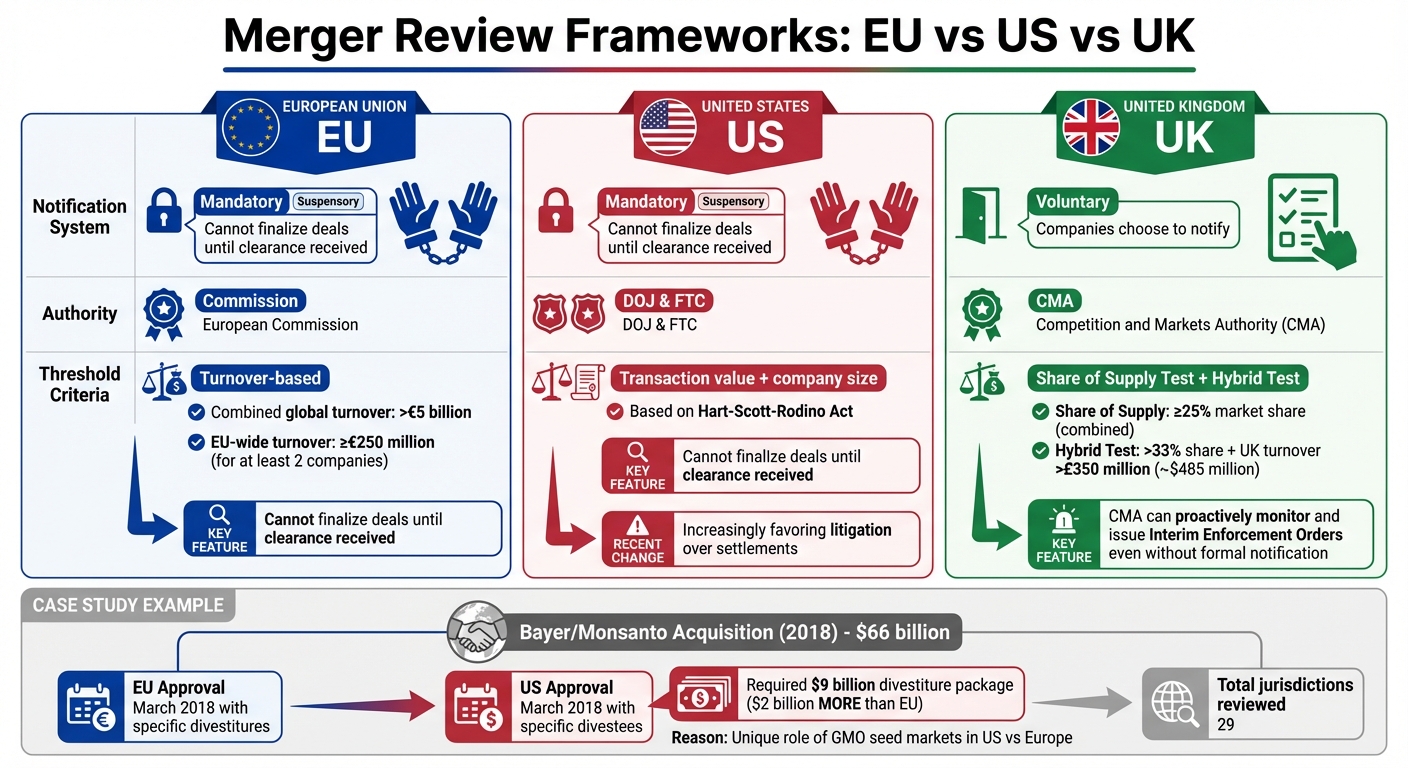
EU, US, and UK Merger Review Framework Comparison
The frameworks used by the EU, US, and UK for merger reviews differ significantly, creating hurdles for cross-border transactions. In both the EU and US, companies are required to notify regulators and cannot finalize deals until they receive clearance [4]. The UK, however, operates under a voluntary system. Its Competition and Markets Authority (CMA) actively monitors deals that aren’t formally notified and can issue Interim Enforcement Orders to halt integration efforts [5].
Each jurisdiction also uses different criteria to establish authority over a transaction. The EU relies on turnover-based thresholds, requiring a combined global turnover of more than €5 billion and EU-wide turnover of at least €250 million for at least two involved companies [4]. In the US, the Hart-Scott-Rodino Act focuses on transaction value and company size [6]. Meanwhile, the UK uses a "Share of Supply" test, flagging deals where the parties collectively hold at least a 25% market share. This is supplemented by a "Hybrid Test", aimed at identifying acquisitions that could be predatory - such as when one party has over a 33% share and generates UK turnover exceeding £350 million (roughly $485 million) [5].
A prime example of these differences is Bayer's $66 billion acquisition of Monsanto in 2018. The European Commission approved the deal in March 2018, requiring divestitures in specific seed and herbicide markets. However, the US Department of Justice mandated a broader divestiture package worth $9 billion - about $2 billion more than the EU’s requirements. This discrepancy stemmed from the unique role of genetically modified seed markets in the US, which are absent in Europe [1]. Beyond these established jurisdictions, emerging markets are also reshaping merger control dynamics.
Emerging markets are increasingly introducing their own merger control rules, adding more complexity to global transactions. The Bayer/Monsanto deal, for instance, underwent scrutiny in 29 jurisdictions, including Brazil's Administrative Council of Economic Defence [1]. Similarly, Thermo Fisher Scientific’s $13.2 billion acquisition of Life Technologies in 2013 required reviews in nine jurisdictions, such as China, Russia, Australia, and New Zealand [1].
Countries like India and Singapore are now implementing specific regulations for AI governance and data protection, directly influencing how tech-driven mergers are assessed [8]. Many regulatory bodies are lowering thresholds or adjusting requirements to capture more global transactions, making the filing process increasingly intricate [7].
Different antitrust philosophies among regulators add another layer of complexity. While the US and EU often prioritize concerns about "innovation harm", the UK’s CMA tends to focus on issues like vertical integration and conglomerate effects [1][6]. These differing priorities can lead to conflicting demands for remedies, complicating deal negotiations.
The Microsoft/Activision Blizzard merger in 2023–2024 is a clear example. The European Commission approved the deal with a 10-year behavioral remedy, allowing free cloud gaming licenses. In contrast, the UK CMA initially blocked the transaction, citing concerns over cloud gaming. Microsoft eventually gained UK approval by restructuring the deal and selling global cloud streaming rights (excluding the European Economic Area) to Ubisoft [1][6].
Another instance is the Zimmer Holdings/Biomet merger. Both the Federal Trade Commission and European Commission flagged overlaps in orthopedic implants. However, their differing views on geographic markets led to separate consent agreements, requiring distinct buyers for assets in the US and EU [1]. These examples underscore how varying regulatory interpretations can complicate mergers.
"The effects of the transaction in Europe . . . may differ from its effects in the United States." – US Department of Justice [1]
The impact of these regulatory challenges is significant. In 2024, the number of transactions abandoned due to antitrust concerns rose by 50% compared to previous years [7]. Additionally, the European Commission’s record €432 million (approximately $475 million) fine on Illumina for closing its GRAIL acquisition without approval highlights the steep costs of misjudging regulatory overlaps [1].
Regulatory reviews often add 3–6 months to deal timelines, but for more complex or disputed transactions, the pre-close period can stretch to as long as two years [9]. With over 130 jurisdictions worldwide enforcing active merger-control rules - each with its own notification requirements and review processes - the risk of delays has grown significantly [3].
A good example of this is the UK's Competition and Markets Authority (CMA), which can independently initiate investigations and demand filings from companies. This can happen even during the review periods of other jurisdictions, throwing off carefully planned timelines [1]. Such unpredictability often forces businesses into standstill periods, delaying integration efforts and the realization of synergies. In the U.S., the DOJ and FTC are increasingly leaning toward litigation instead of settlements, which means deals that might have previously been resolved through consent orders now face months of additional delays [9].
"The CMA can also open investigations on its own volition and request filings from the parties, sometimes well into the timing of reviews by other jurisdictions. This mid-stream intervention can cause major disruptions." - John D Harkrider and Michael O'Mara, Partners, Axinn Veltrop & Harkrider LLP [1]
On top of traditional antitrust reviews, deals now face extra scrutiny through mechanisms like Foreign Direct Investment (FDI) screening and the EU's Foreign Subsidies Regulation (FSR). These processes demand extensive and often time-consuming information requests [3]. Between 2022 and 2023, global regulators challenged at least $361 billion worth of announced deals [9]. The resulting delays only add to the difficulties of managing cross-border transactions.
Managing regulatory requirements across multiple jurisdictions comes with steep legal and advisory costs. Companies must hire local legal experts to navigate the unique demands of each region, which can quickly drive up expenses [1][3]. For instance, the revised U.S. Hart-Scott-Rodino (HSR) filing form and the EU's Foreign Subsidies Regulation have added significant disclosure and document production requirements, making the preparation process even more labor-intensive [3][2].
Prolonged pre-close periods also create operational challenges. Target companies must allocate resources to integration planning while simultaneously preparing for the possibility of deal failure [9]. This dual focus often leads to employee attrition, forcing companies to spend heavily on financial incentives and retention strategies to keep key talent onboard through the uncertainty [9].
The stakes for non-compliance are high. In jurisdictions like India and Spain, failing to meet FDI notification requirements can result in penalties as severe as the transaction's total value [3]. In the UK, individuals responsible for notification failures under FDI rules could even face up to five years in prison [3].
These rising costs, coupled with conflicting regulatory demands, make navigating mergers increasingly complex.
Antitrust regulators now factor in broader considerations like industrial policy and national security, which often leads to inconsistent requirements across jurisdictions [2]. For example, one regulator might accept behavioral remedies such as investment commitments, while another demands structural divestitures, creating remedy packages that are impossible to reconcile [2][1].
The collapse of the Adobe/Figma merger in December 2023 highlights this issue. The $20 billion deal fell apart after the companies couldn't address concerns raised by both the UK CMA and the European Commission over the acquisition of a potential competitor [9]. Similarly, in January 2024, Amazon abandoned its $1.7 billion acquisition of iRobot after the European Commission signaled plans to block the deal, resulting in a $94 million termination fee [3].
When one foreign regulator launches an investigation, it can effectively stall the entire process, even neutralizing the ability to litigate against a U.S. regulator. Deals cannot close until every jurisdiction is satisfied, leaving companies in operational limbo. This uncertainty forces target management to juggle integration planning with the possibility of deal abandonment, often leading to business decline and further talent loss during the prolonged waiting period [9].
"The effects of the transaction in Europe... may differ from its effects in the United States." - U.S. Department of Justice [1]
These challenges underline the importance of coordinated filing strategies and expert guidance for companies navigating complex regulatory landscapes.
Managing global merger reviews effectively starts with a centralized approach. Appointing a global coordinating counsel, supported by local experts, ensures a unified strategy while tapping into regional insights about specific regulatory processes and enforcement trends.
For instance, using cooperation waivers can simplify reviews by allowing regulators to communicate directly. This tactic enables agreement on a single remedies package, streamlining the process. A notable example is Dell Technologies’ $67 billion acquisition of EMC Corporation in 2016. Dell conducted three months of pre-filing consultations with the U.S. FTC, avoiding a "Second Request" and speeding up approvals across multiple jurisdictions [1].
"Timely, predictable, and efficient clearance requires significant upfront analysis and preparation to define an effective clearance strategy; selecting and tightly cooperating with a team of local specialist antitrust counsel; and effectively engaging with and facilitating cooperation among global regulators."
– John D Harkrider, Partner, Axinn Veltrop & Harkrider LLP [1]
Another strategic approach is sequencing reviews, such as the "U.S. last" method. During Ball Corporation’s acquisition of Rexam PLC (2015–2016), clearances were first secured in Brazil and the EU before addressing the U.S. review. This sequence allowed the company to negotiate a more favorable remedies package with the DOJ before the deal’s deadline [1]. Such thoughtful coordination helps reduce delays and uncertainties, creating smoother regulatory pathways.
Planning remedies early - before signing the merger agreement - can be a game changer. By analyzing potential remedies upfront, companies can shape negotiations around closing conditions and deadlines. This also gives them time to test divestiture packages in the market before regulatory demands arise. The goal? Craft a single remedy package that works across multiple jurisdictions, minimizing disruptions and preserving asset value [1].
Confidentiality waivers are now standard practice for aligning remedies, helping regulators collaborate and reduce conflicting demands. However, varying market conditions might still require tailored solutions depending on local regulations and licensing frameworks.
"Engaging early in planning a remedy package (even as a 'plan B') can save time, minimise business disruptions, market-test the suitability and sale value of potential remedy packages... and even line up suitable divestiture buyers."
– Michael O'Mara, Partner, Axinn Veltrop & Harkrider LLP [1]
The risks of getting remedy design wrong can be costly. Take Bayer’s 2018 acquisition of Monsanto, which spanned 29 jurisdictions. The U.S. DOJ required a divestiture package worth $9 billion - $2 billion more than the European Commission’s demands [1]. This underscores the importance of proactive planning and streamlined remedy design to avoid unnecessary financial and operational burdens.
Specialized advisory services play a critical role in navigating complex, multi-jurisdictional reviews. These experts handle risk analysis, coordinate filings across borders, and ensure consistent communication with regulators [1]. They also help businesses meet new procedural demands, like those introduced by the updated U.S. Hart-Scott-Rodino filing forms, which now require more extensive disclosures and document production [2].
Advisors can strategically sequence filings to build regulatory momentum or keep litigation options open. They also manage inter-agency communication through confidentiality waivers and oversee concurrent sales processes, ensuring maximum divestiture value. This expertise is especially beneficial for mid-market companies, as the U.S., EU, and UK accounted for 29% of global merger clearances and 36% of remedy-involved clearances in 2023 [1].
Phoenix Strategy Group provides tailored M&A support, offering services like financial modeling, cash flow forecasting, and regulatory documentation preparation. Their integrated approach helps companies address regulatory overlaps, evaluate deal economics under various remedy scenarios, and maintain financial stability during lengthy reviews.
Working with experienced advisors is crucial to meeting diverse regulatory requirements and avoiding costly compliance missteps. Their expertise ties together the strategies needed to navigate regulatory overlaps, ensuring a comprehensive and effective approach to complex mergers.
Global mergers are becoming increasingly complicated due to overlapping regulations, making early strategic planning more critical than ever. One essential step is conducting an antitrust risk analysis before signing any agreements. This helps define closing conditions, set deadlines, and outline remedy obligations [1]. For context, preparing a U.S. HSR filing now requires an average of 105 hours - a significant jump of 68 hours from earlier requirements [10]. These longer timelines should be built into your planning process.
Centralized coordination is key. By working closely with internal and local experts, companies can stay aligned with global enforcement trends. Confidentiality waivers can also be a powerful tool to streamline communication between regulatory bodies. Additionally, strategic filing sequences - starting with major jurisdictions like the U.S., EU, and UK - can create momentum for approvals in smaller regions [1]. This kind of coordination is essential for executing deals effectively, even in the face of regulatory hurdles.
The stakes are high. With a 50% increase in abandoned transactions and daily penalties for HSR non-compliance reaching as much as $53,088 [7][12], mid-market leaders need to focus on coordinated strategies. Opportunities are there for those who plan well, such as the 24% growth in U.S. transaction values projected for the second half of 2025 [11]. Companies that master regulatory coordination can position themselves to take full advantage of this renewed deal activity.

Phoenix Strategy Group specializes in helping businesses tackle the regulatory challenges of global mergers. Their services include financial modeling, cash flow forecasting, and the preparation of regulatory documentation - essential tools for managing the complex, multi-jurisdictional reviews that often stretch over several months. With their expertise, navigating these challenges becomes more manageable, ensuring smoother deal execution.
Conflicting regulations can turn global mergers into a maze of complexity and expense. Different countries often enforce their own antitrust laws, foreign investment policies, or sector-specific rules, which can lead to outcomes that don’t align. One regulator might green-light a deal, while another could impose strict conditions, require divestitures, or even block the transaction outright. This lack of coordination can drag out negotiations, force companies to rethink their strategies, or, in the worst-case scenario, cause the entire merger to collapse. The result? Shareholder value takes a hit, and the anticipated benefits of the deal are left hanging.
These regulatory clashes also come with hefty price tags. Legal fees pile up, timelines stretch on, and uncertainty looms over what the final deal will even look like. Even when a merger gets the green light, companies aren’t necessarily in the clear. If a deal approved in one region is later challenged in another, it can lead to expensive adjustments or even the need to unwind parts of the transaction.
To tackle these hurdles, companies need to take a proactive approach. This means diving into the regulatory landscape early, engaging with authorities ahead of time, and building deal structures that can adapt to changing requirements. Working with seasoned advisors like Phoenix Strategy Group can make a big difference. They can help streamline the process, reduce risks, and protect the value of the deal, making the journey a little less daunting.
Regulatory overlaps in global mergers happen when companies must navigate filing and approval processes across multiple jurisdictions. These overlapping requirements can create challenges like timing conflicts, repetitive paperwork, and even risks such as gun-jumping - when businesses begin integrating prematurely before receiving regulatory approval. To avoid these pitfalls, a proactive and carefully coordinated approach is essential.
Here are some key strategies to stay on track:
Collaborating with experienced advisors like Phoenix Strategy Group can make a significant difference. They can help design a customized roadmap, manage the filing process, and simplify the complexities of global regulatory requirements, ensuring a smoother merger process.
Emerging markets are becoming increasingly influential in the world of merger regulations, driven by their rapid economic growth and stronger antitrust and foreign-investment policies. Areas like Southeast Asia, Latin America, and Africa are stepping up their oversight by tightening review processes, expanding filing requirements, and collaborating more closely with key regulatory players such as the United States and the European Union. For companies pursuing cross-border deals, this means navigating additional layers of scrutiny to secure approvals in these regions.
With emerging markets accounting for a growing portion of global deal activity, their more assertive regulatory approaches can lead to higher compliance costs, longer approval timelines, and, in some cases, blocked transactions that might have been cleared in more established markets. To manage these challenges, companies often turn to expert advisors like Phoenix Strategy Group. Their guidance helps streamline the filing process, minimize risks, and ensure transactions move forward as smoothly as possible.