Published on
March 19, 2026


Cross-industry collaborations drive innovation but come with complex risks. Regulatory conflicts, operational misalignments, and differing work cultures can hinder progress. To manage these challenges, five specialized risk models provide solutions:
Each model addresses specific challenges, and combining them can provide a balanced approach to managing risks in partnerships. Below, we’ll dive into how these models work and where they’re most effective.
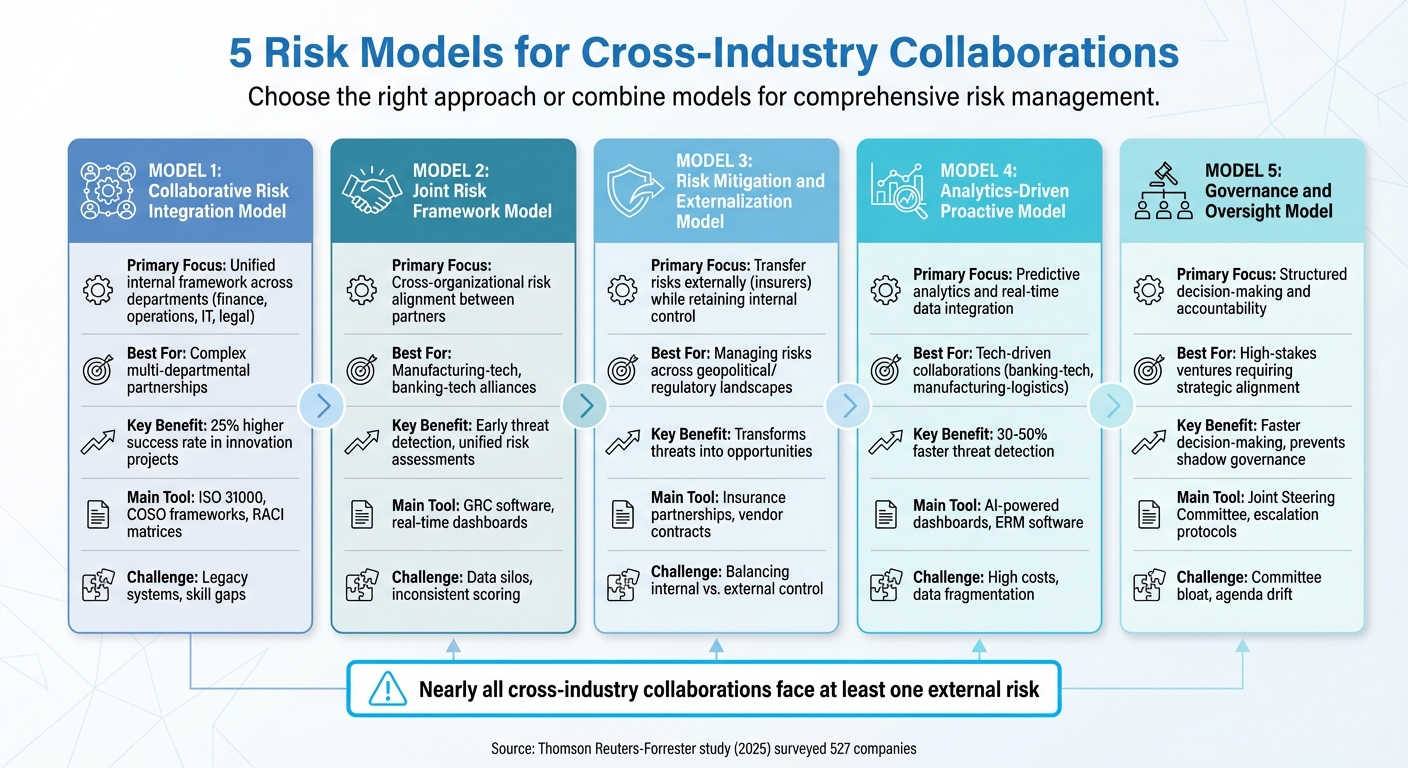
Comparison of 5 Risk Management Models for Cross-Industry Collaborations
The Collaborative Risk Integration Model brings together teams from finance, operations, IT, and legal under a unified risk framework. By doing so, it eliminates departmental silos and ensures risks are identified, assessed, and managed consistently across the organization. This model often uses established frameworks like ISO 31000 or COSO to guide its processes.
At its core, this model prioritizes teamwork and shared accountability. Teams participate in workshops to align risk scoring methods and clarify roles using tools like RACI matrices. The goal? To create a single, reliable source of risk intelligence. Shared dashboards and real-time threat monitoring further support this effort, ensuring transparency and efficiency.
This model works especially well for partnerships dealing with complex risks that cut across multiple business areas. A great example is the Siemens-IBM collaboration on smart grid solutions. By combining Siemens' energy expertise with IBM's data analytics capabilities, they were able to jointly assess risks and plan for scenarios involving both technology and regulatory challenges [3].
Organizations using this approach have seen a 25% higher success rate in innovation projects. According to a Thomson Reuters–Forrester study conducted in October 2025, which surveyed 527 companies in North America and Europe, connected workflows help reduce unplanned risks and improve coordination across departments [3][4]. For instance, the Siemens-IBM partnership achieved 30% faster project completion times and greater satisfaction among stakeholders. Other benefits include cost savings through shared risk management and improved resilience against issues like supply chain disruptions and cyberattacks [3][4].
Adopting this model isn't without its hurdles. Legacy systems and skill gaps across departments can slow down integration efforts. Poor data quality might erode trust in shared assessments, and cultural differences between teams can lead to friction. For example, the Toyota-Tesla partnership faced operational challenges due to differing work styles and decision-making processes. Addressing these issues often requires strong governance, executive support, and investments in technology platforms that allow real-time data sharing across the organization [3][4][5]. These challenges highlight the importance of robust planning when implementing such an integrated approach, paving the way for exploring other risk management frameworks later in the article.
The Joint Risk Framework Model offers a collaborative approach where partners from different industries join forces to identify, evaluate, and address shared risks. Instead of focusing solely on internal teams, this model emphasizes cross-organizational consistency. By using standards like ISO 31000 or COSO, it ensures that all parties speak the same "risk language" and work cohesively.
This model brings together diverse teams - finance, operations, IT, legal, and compliance - through structured workshops. These sessions use tools like RACI matrices and real-time dashboards to create unified risk assessments. By sharing insights across departments, the framework ensures accountability and fosters a comprehensive understanding of risks. This approach is particularly valuable in situations where risks span across industries.
This model is ideal for partnerships like manufacturing-tech or banking-tech alliances, where combining expertise enhances risk management. For instance:
By integrating expertise from various fields, this model helps uncover risks that might otherwise go unnoticed. Tools like integrated governance, risk, and compliance (GRC) software enable faster responses with real-time tracking and cross-team alerts for financial and compliance risks. For example, banks using this framework have been able to detect cybersecurity threats early, boosting their resilience. Additionally, composite reporting provides executives with a unified view of risks, rather than fragmented snapshots from individual departments. Shared dashboards further improve decision-making by offering real-time insights that incorporate multiple perspectives.
While the benefits are clear, the model isn't without its hurdles. Data silos and outdated systems can make integration difficult, especially when technologies are incompatible. A lack of executive support can undermine efforts to build a collaborative culture. Inconsistent risk scoring methods may lead to friction during assessments. Coordination challenges - such as resolving conflicts or making joint decisions - can increase initial setup costs. Overcoming these obstacles requires ongoing commitment and effort.
Building on the idea of collaborative frameworks, this model zeroes in on managing risk by leveraging external partnerships.
The Risk Mitigation and Externalization Model relies on the insurance market to transfer certain risks to external parties while keeping direct control over others. The key is identifying which risks can be delegated and which need to stay under internal management.
This model brings together expertise from multiple fields - technical, scientific, financial, and strategic - to evaluate overlapping risks. The goal is to transform potential threats into opportunities. It offers practical insights tailored for C-suite executives and boards dealing with complex challenges in varied geopolitical and regulatory landscapes [6]. Additionally, it fosters partnerships across industries by striking a balance between internal oversight and market-driven risk management solutions.
This approach focuses on predicting and preventing risks by using advanced analytics and integrating real-time data. It allows organizations to spot potential threats - whether in supply chains, cybersecurity, or regulatory issues - before they become problems. By combining data streams and applying predictive tools, teams can anticipate disruptions and act early, especially in complex, cross-industry collaborations.
One of the standout features of this model is its ability to eliminate data silos that often hinder effective risk management. By bringing together data from fractional CFO services, IT, operations, and compliance, it creates a unified view of interconnected risks. Tools like Thomson Reuters ONESOURCE+ and Databricks help streamline data workflows with AI-powered analytics, delivering real-time insights into potential threats. Integrated Governance, Risk, and Compliance (GRC) dashboards and regular updates ensure that organizations can adjust their risk strategies as conditions change.
This model is particularly effective for tech-driven collaborations, such as partnerships between banks and technology firms or between manufacturers and logistics providers, where constant monitoring is crucial. For instance, banks have successfully used Enterprise Risk Management (ERM) software with AI analytics to centralize risk data across departments. This setup has enabled real-time alerts and faster threat detection, significantly cutting down response times.
The benefits are clear. A Forrester study from 2025, which surveyed 527 directors, reported that integrated technology systems can improve threat detection speeds by 30–50%. These systems also enhance visibility and reduce the costs of risk management, empowering teams to make quicker, more informed decisions [4].
Adopting this model isn’t without its challenges. Data fragmentation, high upfront costs, and a lack of expertise in analytics can slow implementation. Legacy systems and inconsistent data quality add to the complexity, making strong leadership and a cultural commitment to open data sharing essential for success.
This model sets up structured decision-making processes for cross-industry partnerships. Instead of relying on organic collaboration, it defines who makes decisions, how disputes are escalated, and who is accountable. The aim? To avoid chaos that hinders progress or allows one partner to dominate the flow of data.
At its core, this model creates a "strategic cockpit" to identify and address operational issues early on [8]. It establishes a Joint Steering Committee (JSC) with a formal charter, supported by operating committees and working groups to handle daily tasks. Decision-making responsibilities are clearly outlined using enhanced RACI models, which include "Veto" and "Escalation" rights. Escalation paths are time-limited - such as 5 days for working groups and 15 days for the JSC - to prevent delays on contentious matters [8].
"Governance and operating discipline determine whether the partnership's bold strategy converts into quarterly results and day‑to‑day collaboration." – Umbrex [8]
This model is ideal for high-stakes ventures where parent companies need strategic alignment, but the partnership itself requires agility. It’s particularly effective in situations where multiple organizations bring diverse cultures, risk approaches, or operational systems to the table. Companies that automate KPI reporting by integrating directly with tools like CRM and ERP systems benefit from a "single source of truth", which eliminates both data hoarding and human error [8].
Clear governance accelerates progress by focusing resources on shared objectives, rather than bogging teams down in bureaucracy [8]. It prevents "shadow governance", where accountability gets lost, and provides pre-established pathways for resolving disputes, helping to maintain strong relationships even during conflicts. Organizations often report faster decision-making when authority is clearly assigned, allowing the right people to act without unnecessary delays. This model also complements other risk management approaches, ensuring smoother collaboration in complex partnerships.
Potential pitfalls include "committee bloat", where too many members slow down decision-making, "agenda drift", which shifts focus to trivial details instead of strategic goals, and information imbalances, where one partner controls key data [8].
Each risk model brings its own strengths, tailored to factors like collaboration complexity, industry demands, and an organization’s approach to risk. While each addresses specific challenges, combining them can create a more well-rounded strategy.
The Collaborative Risk Integration Model takes a unified approach by creating a framework that spans across finance, operations, IT, and legal teams. This model focuses on cross-functional risk assessments, tackling both traditional and emerging risks in a cohesive way [5].
The Joint Risk Framework Model works particularly well in multinational collaborations, such as cybersecurity initiatives or supply chain partnerships. It emphasizes unified risk scoring to guide decision-making, making it ideal for industries where alignment across borders is crucial [5].
The Risk Mitigation and Externalization Model is designed to reduce silos and cut costs by implementing integrated controls and clear RACI (Responsible, Accountable, Consulted, Informed) accountability. However, if industry priorities are not aligned or technology isn’t fully integrated, data fragmentation can become a challenge [5].
For partnerships that rely on predictive insights, the Analytics-Driven Proactive Model employs AI-powered tools and real-time dashboards, such as ONESOURCE+. This model provides early warnings for interconnected financial and compliance risks, helping organizations stay ahead of potential issues [4].
Finally, the Governance and Oversight Model ensures accountability through structured decision-making. Its success, however, depends on fostering a collaborative culture to address resistance and adapt to evolving risks [7].
Studies show that nearly all cross-industry collaborations face at least one external risk [7]. To navigate these challenges, many organizations use a mix of models. For instance, analytics tools can deliver early alerts, governance ensures accountability, and integration frameworks improve visibility. Deloitte experts suggest embedding governance early in public-private partnerships [2], while Thomson Reuters highlights the value of analytics platforms for managing digital risks [4].
Choosing the right combination depends on your priorities - whether it’s speed (analytics), cost efficiency (mitigation), comprehensive visibility (integration), or structured oversight (governance). The most effective collaborations often layer these approaches to meet their specific needs.
Collaborative frameworks are critical for navigating the complexities of modern partnerships. Cross-industry collaborations come with intertwined risks - spanning finance, operations, compliance, and technology. The five models discussed here each offer unique benefits. For example:
These approaches do more than just define responsibilities - they deliver measurable outcomes. Misaligned models, on the other hand, can lead to silos and greater risk exposure. Consider this: a Forrester study commissioned by Thomson Reuters in October 2025, which surveyed 527 director-level professionals across North America and Europe, revealed that integrated technology stacks significantly enhance risk management across functions [4]. In practice, this has translated to faster issue resolution and improved project delivery. For instance, collaborations between banking and tech sectors have successfully combined ERM software with oversight models to streamline data and eliminate redundancies. Similarly, healthcare organizations have used governance frameworks alongside proactive models, such as vendor tabletop exercises, to mitigate the impact of incidents [1][9].
The key to success lies in tailoring these models to your partnership's specific needs. Whether you're in tech-finance or supply chain management, tools like shared GRC dashboards, focused workshops, and clear RACI matrices can help adapt these frameworks effectively [4]. For particularly intricate collaborations, such as those requiring advanced financial planning or complex data engineering, advisory firms like Phoenix Strategy Group provide the expertise needed to scale these frameworks.
At its core, fostering a culture of collaboration - anchored by solid governance and integrated technology - lays the groundwork for resilient partnerships. As global regulations and digital landscapes evolve, maintaining continuous improvement loops and feedback systems will ensure your models stay agile and prepared for emerging risks [2].
To select the right risk model, start by pinpointing the specific risks and key risk indicators (KRIs) tied to your collaboration. Make sure the model aligns with your partnership's governance structure and level of complexity, as this helps clarify decision-making roles and responsibilities. Consider a range of risks - operational, financial, legal, and strategic - and keep a close eye on KRIs to track any changes. Regularly review and adjust the model to keep it effective as circumstances evolve.
When dealing with complex risks that span multiple areas - like operational, financial, regulatory, and strategic challenges - it's smart to use a combination of risk models. This approach is particularly useful in cross-industry partnerships where risks are interconnected and require careful consideration. By leveraging multiple models, you can achieve a deeper analysis and make more informed decisions.
To move quickly, implement real-time data synchronization and set up clear governance frameworks. Assign specific roles, define responsibilities, and clarify decision-making authority. Support these with measurable metrics and key risk indicators (KRIs). This approach promotes transparency, accountability, and smooth collaboration.