Published on
March 21, 2026

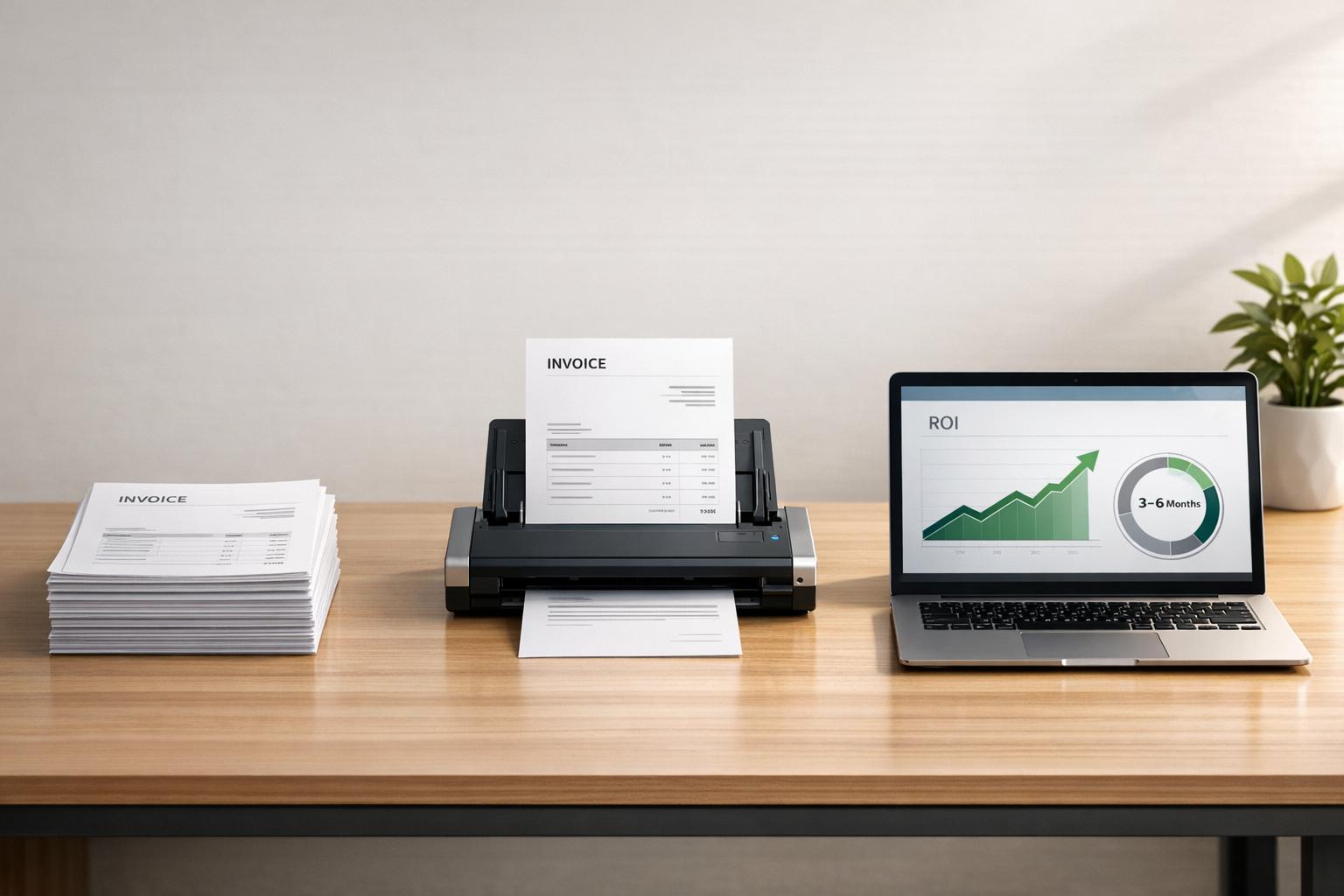
Manual invoice processing is expensive, slow, and error-prone - but AI-powered solutions can cut costs by 83%, reduce errors by 91%, and process invoices up to 85% faster. For growth-stage companies managing over 500 invoices monthly, this shift can save thousands annually and improve cash flow management.
Key takeaways:
If your company is stuck in manual workflows, it’s time to consider AI as a way to save money, reduce errors, and manage growth efficiently. Many organizations also leverage fractional CFO services to oversee these digital transformations and optimize long-term financial strategy.
Handling invoices manually comes with a hefty price tag that often goes unnoticed. On average, processing a single invoice costs between $12.00 and $40.00 [5][6]. When you factor in overhead, correcting errors, and missed opportunities, the total cost can climb to $56 to $103 per invoice [3].
But labor costs are just the tip of the iceberg. Manual processes also lead to additional financial losses:
These inefficiencies hurt cash flow and reduce the return on investment for companies, especially those in growth stages.
Manual workflows aren’t just expensive - they’re time-consuming. Each invoice takes 15 to 20 minutes to process, including data entry, verification, and routing [7]. The full cycle, from receipt to payment, can stretch to 14.6 to 20.8 days [8][9]. If an invoice has errors or exceptions, it adds another 10 to 30 minutes per case [3].
Accuracy is another major pain point. Manual data entry has an error rate of 5% to 15% [7]. Fixing a single mistake can cost between $25 and $50 in labor and research [3]. These mistakes not only delay payments but also eat into valuable time. Finance professionals often spend 30% of their time on repetitive invoice tasks instead of focusing on strategic work, reducing the overall efficiency and ROI of the finance team.
Scaling manual invoice processes is nearly impossible without adding more staff. A single accounts payable clerk can manage only 2,000 to 3,000 invoices per month [1]. As invoice volumes grow, companies are forced to hire additional employees, creating a linear growth model that becomes unsustainable over time. Even as of 2026, 60% to 64% of finance teams were still heavily reliant on manual tasks [8].
This challenge was evident in the case of Roamler, a data insights company. Before adopting automation, they relied on a 15-person outsourced team just to handle manual data extraction. As their business grew, so did their staffing needs - an approach that was neither efficient nor scalable [7].
These limitations highlight the pressing need for automation, which is explored further in the next section on AI-Powered Invoice Processing.
Handling invoices manually is often slow, costly, and error-prone. AI-powered solutions tackle these challenges head-on, offering faster, more accurate, and cost-effective alternatives.
Switching to AI-powered invoice processing slashes costs significantly. With manual methods, the average cost per invoice ranges from $15 to $40. Automation, on the other hand, brings that down to just $2–$5 - an impressive 83% reduction [6]. For a business processing 1,000 invoices a month, this translates to annual savings of $13,000 to $35,000. Most companies see a return on investment within 3 to 6 months, and for those processing higher volumes, the payback period is just 3 to 8 months. First-year ROI often lands between 200% and 600%, thanks to reduced labor costs, fewer mistakes, and the added bonus of capturing early payment discounts [4].
AI transforms the speed and accuracy of invoice processing. Tasks that used to take 15–20 minutes are now completed in just 30–60 seconds using tools like OCR, machine learning, and automated ledger coding [4][6]. While manual systems typically have error rates of 5–8%, AI-driven platforms reduce that to under 1%. Many systems achieve 99% accuracy when capturing invoice header data and deliver up to 85% "no-touch" processing, meaning most invoices require no human involvement at all [7].
AI eliminates the need to scale staff as invoice volumes grow. Traditionally, an accounts payable clerk could handle 2,000–3,000 invoices monthly. With AI, that same clerk can manage significantly more without additional resources [1]. Cloud-based platforms can handle anywhere from 100 to over 10,000 invoices monthly without driving up staffing or infrastructure costs [4][11]. For instance, one company replaced a 15-person team with AI, cutting costs by over $300,000 annually and improving accuracy [7]. Similarly, Liance Legal adopted AI to process contracts 60% faster, saving $120,000 annually and allowing legal teams to spend 50% more time on strategic work [7]. This shift lets growing businesses focus resources on initiatives that generate higher returns.
AI speeds up approval cycles to just 1–2 days, giving businesses better control over payment schedules. This efficiency boosts early payment discount capture rates from 20–30% to 65–80%, tripling the savings potential (typically around 2% of invoice value) [6][7]. Additionally, AI provides real-time insights into payment obligations and uses predictive analytics to forecast cash needs 30–90 days in advance, improving working capital by 15–25% [4]. By preventing duplicate payments with 99.9% accuracy, companies can avoid around $12,000 in annual losses. Fewer late payments also mean avoiding penalties, which usually range from $45 to $150 per occurrence [4]. These improvements directly enhance ROI by reducing waste and freeing up cash for other priorities.
These advancements set the stage for exploring integrated financial services in the next section.

Phoenix Strategy Group takes AI-powered invoice processing to the next level by embedding it into a broader suite of financial services tailored for growth-stage companies. Instead of treating automation as a standalone tool, the firm integrates AI into areas like bookkeeping, fractional CFO services, and FP&A workflows. The result? A seamless financial management experience that simplifies operations and supports strategic goals.
By leveraging AI, Phoenix Strategy Group slashes invoice processing costs by about 83% [6]. What used to cost $15–$40 per invoice now drops to just $2–$5. These savings go straight to the bottom line, giving companies the financial flexibility to focus on key priorities like expansion, fundraising, or mergers and acquisitions. This approach aligns perfectly with the firm's mission to deliver comprehensive financial services that drive tangible results.
With AI, invoices are processed in under 60 seconds - five times faster than traditional manual methods [6][2]. This automation frees up around 40% of staff time that would otherwise go toward repetitive data entry, allowing teams to focus on higher-value tasks like financial analysis and managing vendor relationships [6]. Tools like the Weekly Accounting System and Monday Morning Metrics offer clients real-time insights and faster month-end closes, making daily operations smoother and more efficient.
Phoenix Strategy Group's AI-powered system automates over 85% of invoices, handling even complex documents with minimal human involvement [2]. This scalability ensures companies can manage growing invoice volumes without adding staff or increasing costs. By taking care of time-consuming processes, the system allows businesses to channel their energy into revenue growth, strategic planning, and fundraising efforts, setting the stage for long-term success.
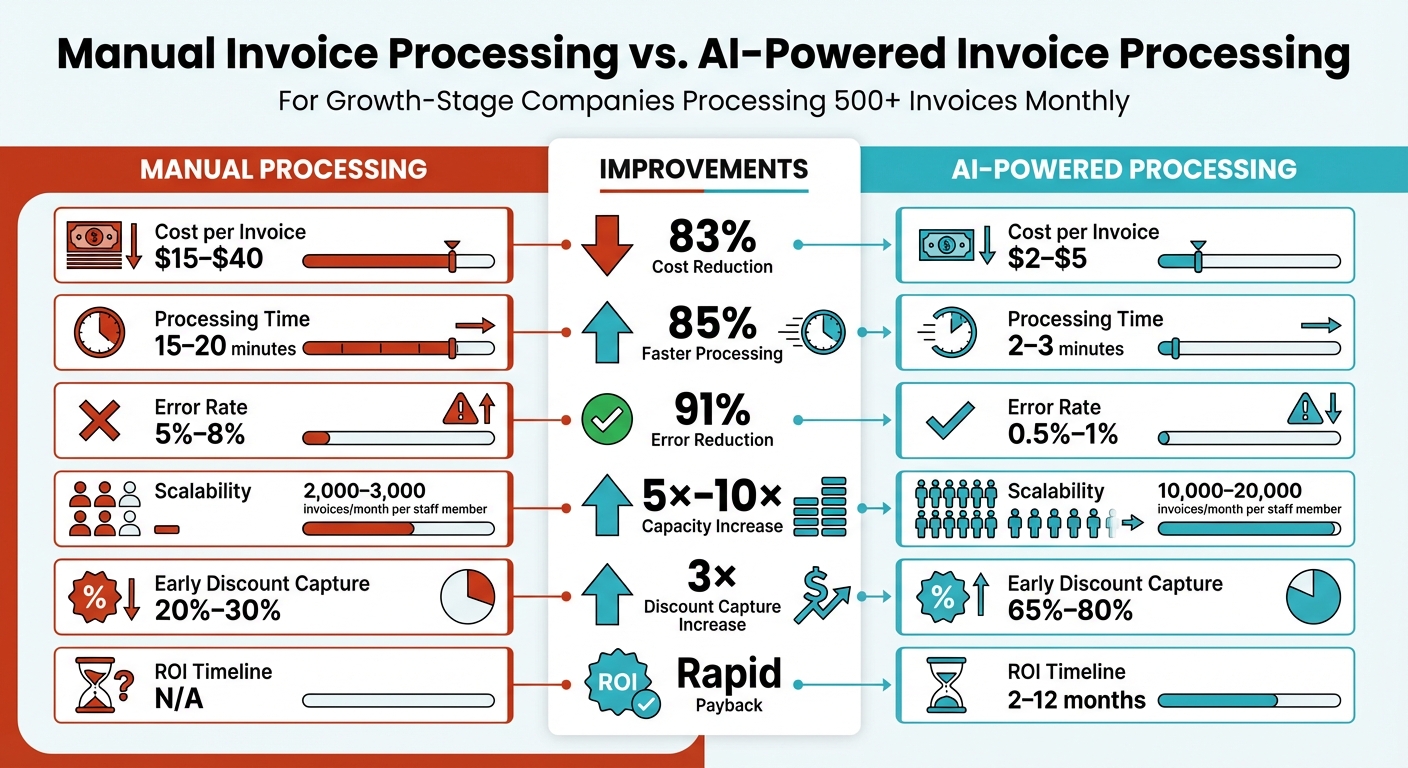
Manual vs AI Invoice Processing: Cost, Speed, and Accuracy Comparison
When deciding on an invoice processing method, it's important to weigh the trade-offs between manual and automated systems, especially regarding ROI.
Manual processing offers full control and requires no upfront investment in technology. However, it’s slow, costly, and prone to human error. Each invoice can cost between $15 and $40 to process and take 15–20 minutes. Over time, this creates scalability issues. On top of that, error rates of 5%–8% and missed early payment discounts can add up to hidden costs exceeding $30,000 annually [12].
On the other hand, AI-powered systems are designed to cut costs and improve efficiency. They reduce the cost per invoice to just $2–$5 and slash processing times to 2–3 minutes, with error rates dropping below 1% [12]. That said, adopting AI comes with upfront expenses ranging from $500 to $8,000 per month and potential challenges integrating with existing ERP systems. In fact, 28% of companies report technical issues, while 29% cite budget constraints as barriers [1][8].
Phoenix Strategy Group takes a unique approach by embedding AI within a comprehensive financial service model. This hybrid system delivers an 83% reduction in costs, speeds up processing, and increases invoice capacity by 5×–10× [12]. By seamlessly integrating AI into bookkeeping, fractional CFO services, and FP&A workflows, companies can achieve transformative improvements in efficiency and ROI.
| Metric | Manual Process | AI-Powered Automation | Improvement |
|---|---|---|---|
| Cost per Invoice | $15–$40 [12] | $2–$5 [12] | 83% Reduction |
| Processing Time | 15–20 minutes [12] | 2–3 minutes [12] | 85% Faster |
| Error Rate | 5%–8% [12] | 0.5%–1% [12] | 91% Reduction |
| Scalability (Invoices/Staff) | 2,000–3,000/mo [1] | 10,000–20,000/mo [1] | 5×–10× Capacity |
| ROI Timeline | N/A | 2–12 months [12][1] | Rapid Payback |
| Early Discount Capture | 20%–30% [12] | 65%–80% [12] | 3× Increase |
These numbers clearly show how AI adoption can lead to faster payback and substantial ROI improvements.
That said, manual processing struggles to scale without proportional cost increases, which delays ROI. AI systems, while efficient, require clean data and strong organizational support to work effectively. Change management can also be a hurdle - 64% of AP professionals attribute workplace stress to manual processes, and transitioning to new workflows may face resistance [1][8].
For companies processing over 500 invoices per month, the ROI timeline can be shortened significantly. Mid-sized businesses often see payback within 3–6 months, with first-year returns ranging from 400% to 500%. Smaller organizations, however, might experience slightly longer payback periods and lower returns [1].
For growth-stage companies handling more than 500 invoices each month, AI-powered invoice processing offers tangible benefits: lower costs, faster turnaround times, and a 91% reduction in errors compared to manual processes. Businesses generating $500K to $10M in revenue often recover their investment in just 3–6 months, with first-year returns ranging from 3× to 5×.
The choice to adopt AI often depends on factors like invoice volume, complexity, and the company’s growth plans. If your team spends over 16 hours a week processing invoices, you’re likely facing missed early-payment discounts, late fees, and inefficient use of resources. As invoice volume grows, manual methods can quickly become a bottleneck, highlighting the need for automation.
By implementing AI, companies can shift their focus from repetitive tasks to more strategic initiatives. This enables teams to better manage cash flow, negotiate with vendors, and support overall business growth. As Parker Gawne, Founder at Syntora, puts it:
"The return is driven by reducing manual data entry and error-checking from hours to minutes per client" [2].
Before diving into AI adoption, take stock of your current processes. Track how many hours are spent, the error rates, and the costs associated with handling exceptions. Start by applying AI to your highest-volume invoices to achieve a quick return on investment, and then gradually expand to handle more complex formats - often within 3–6 months.
For businesses looking to scale without adding more back-office staff, AI-powered invoice processing provides a clear path to efficiency and growth. Phoenix Strategy Group is one example of how AI-integrated financial services can deliver these gains, all while maintaining the oversight needed for long-term success.
To figure out the return on investment (ROI) for AI-powered invoice processing, you need to weigh the savings and efficiency improvements against your upfront costs. Here's how you can break it down:
By following these steps, you can get a solid understanding of how AI invoice processing can impact your bottom line.
AI-powered invoice automation proves to be a smart investment when dealing with hundreds of invoices each month. The benefits become even clearer at higher volumes - around 500 or more - where the cost savings and efficiency gains are hard to ignore. This scalability makes it a perfect fit for growing companies looking to make the most of their resources while simplifying their processes.
To make the move to AI-powered invoice processing, you'll need a few key pieces of data: invoice images or PDFs, vendor details, and transaction records. It's also crucial to integrate with accounting systems like QuickBooks Online or PostgreSQL. These integrations enable automated processes such as data extraction, validation, and reconciliation, streamlining your workflow and reducing manual effort.