Published on
April 2, 2026


Accurate cash flow forecasting is critical for SaaS businesses, where recurring revenue can still result in unpredictable cash flow. Here's a quick guide to improving your forecasting accuracy:
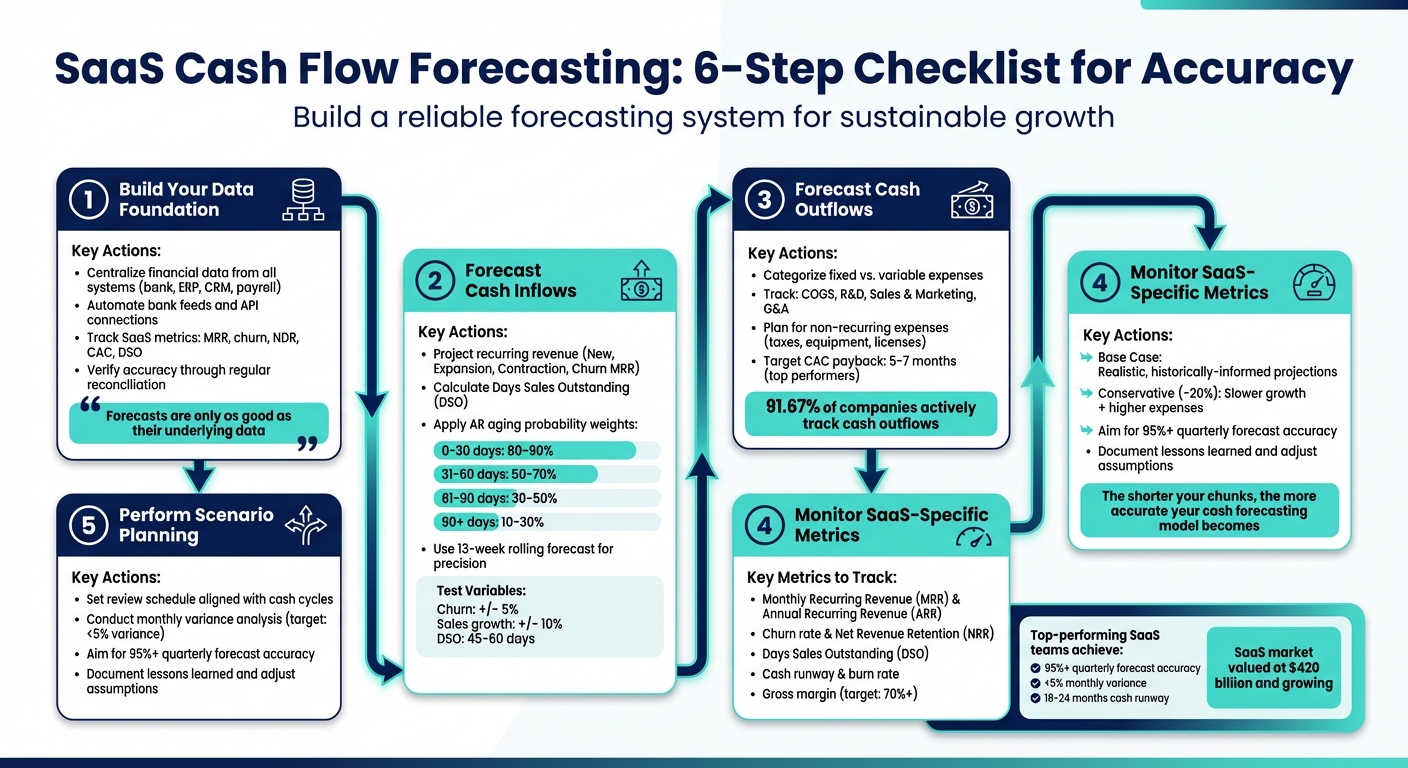
6-Step SaaS Cash Flow Forecasting Framework
The reliability of your forecast depends entirely on the quality of your data. As Nigel Sapp from Numeric puts it:
"Forecasts are only as good as their underlying data" [5].
Before estimating future cash flow, you need a clear and accurate picture of your current financial position. This requires a structured process to centralize, gather, and validate your data.
Start by identifying all the systems that interact with your cash flow. This includes bank accounts, ERP systems or general ledgers, accounts receivable and payable aging reports, payroll platforms like Gusto, tax schedules, and loan documents [5][7]. Use APIs to connect these systems, eliminating the need for manual CSV exports, and consolidate all cash data into a single, real-time dashboard [5][6][7].
Automating bank feeds ensures that your opening cash balance is always up to date [5]. Similarly, linking your payment processor (e.g., Stripe) and CRM (e.g., HubSpot) to your accounting software creates a seamless flow of data [6]. The ultimate goal is to have a single source of truth - a dashboard that provides a real-time, accurate view of your cash position for all stakeholders [5].
Once your financial data is centralized, the next step is to integrate metrics specific to SaaS businesses for a comprehensive understanding of your cash flow dynamics.
In addition to standard financial figures, SaaS companies need to track metrics that influence cash flow, such as subscription revenue, churn rates, renewal rates, customer acquisition cost (CAC), upsells, and pipeline data [5]. Automating the tracking of these metrics within your centralized platform allows for real-time updates. For instance, any changes in churn or renewals will automatically adjust your cash projections, reducing the need for manual intervention.
| Data Source Category | Specific SaaS Data Points to Centralize |
|---|---|
| Banking | Reconciled cash balances, interest income |
| Revenue/Sales | Subscription revenue, new bookings, upsells, pipeline data |
| Operations | Churn rates, renewal rates, Customer Acquisition Cost (CAC) |
| Outflows | Payroll, benefits, vendor AP, tax obligations, loan repayments |
| Metrics | Burn rate, cash runway, Days Sales Outstanding (DSO) |
Even minor errors can have a significant impact on your forecasts. GoCardless highlights this risk:
"something as simple as a formatting error could impact your results when you're running reports" [6].
To avoid this, perform regular bank reconciliations - daily or weekly - use automated three-way matching, and conduct variance analyses to quickly spot and address discrepancies [5][6][7]. These steps are crucial to maintaining a trustworthy and accurate source of financial data for your SaaS cash flow forecasting.
At Phoenix Strategy Group, we stress the importance of building a solid data foundation. By focusing on centralization, automation, and consistent verification, you can ensure that your forecasts are grounded in your true financial position.
Once you've established a solid data foundation, it's time to focus on predicting when cash will actually land in your bank account. Unlike revenue recognition, which tracks when revenue is earned, cash flow forecasting is all about pinpointing actual bank transfers. As Nigel Sapp from Numeric puts it:
"A sale can improve P&L even if payment is not received for weeks or months... Cash flow forecasting, by contrast, only reflects cash that is expected to move into or out of the organization's bank accounts" [5].
This step involves translating recurring revenue data into precise projections of cash inflows.
Start by modeling your subscription revenue based on customer cohorts. Tracking your Net Dollar Retention (NDR) is key here - it provides a reliable baseline for estimating additional cash from current customers, which is essential for forecasting expansion revenue. For new bookings, prepare multiple scenarios: on-plan, above-plan, and below-plan. These scenarios help you account for varying growth paths [2] [13].
By nailing down your recurring revenue projections, you’re laying the groundwork for accurate cash collection estimates. But projecting revenue is just the first step - understanding when that cash will actually arrive is equally important.
The gap between when a customer commits to a purchase and when you collect payment can greatly affect your liquidity. To estimate this, rely on Days Sales Outstanding (DSO) to calculate your average collection period [5]. Keep in mind that as invoices age, the likelihood of collection drops. Use probability weightings for your accounts receivable (AR) aging buckets, such as:
For greater accuracy, use weekly time buckets within a 13-week forecast. This approach captures mid-month cash flow fluctuations that might otherwise go unnoticed. Julio Martínez, Co-Founder & CEO of Abacum, explains:
"A business might appear solvent on a monthly basis while facing mid-month liquidity challenges. The 13-week model captures these crucial timing differences" [11].
Your billing structure plays a major role in cash timing. Annual contracts paid upfront deliver immediate liquidity, which can be reinvested in areas like customer acquisition. On the other hand, monthly billing spreads out cash inflows, making it more accessible for smaller customers [13]. To ensure your forecast aligns with reality, map out each contract type - whether annual, monthly, or prorated - and factor in their specific cash receipt schedules [8].
Now that you've built a solid foundation of data, the next step is to predict when cash will actually hit your bank account. Unlike revenue recognition, which tracks when revenue is earned, cash flow forecasting zeroes in on the timing of actual bank transfers. As Nigel Sapp from Numeric explains:
"Positive P&L does not guarantee [liquidity], and cash flow forecasting is the only way to assess whether the organization can meet its obligations when they come due." [5]
This process involves turning your recurring revenue data into precise cash inflow projections - a critical element of effective SaaS financial planning.
Start by modeling your subscription revenue, focusing on four key movements: New, Expansion, Contraction, and Churn MRR. These metrics help you track monthly changes in revenue [1][3]. To better manage these variations, maintain separate pipelines for renewals, expansions, and new business, as each follows its own unique patterns [3]. Keep an eye on your Net Revenue Retention (NRR) - a figure above 100% signals growth driven by your existing customers [1].
It’s also smart to prepare multiple scenarios for new bookings: on-plan, above-plan, and below-plan. This way, you’re ready to adapt to fluctuations in performance [2].
Once you’ve mapped out your revenue flows, shift your attention to the actual timing of cash inflows.
Payment delays can have a big impact on liquidity, making it important to account for collection timelines. Use Days Sales Outstanding (DSO) to calculate the average time it takes to collect payments [5]. The longer an invoice remains unpaid, the less likely it is to be collected. You can apply these probability weightings to your accounts receivable (AR) aging buckets:
To better capture cash flow fluctuations, use weekly time buckets within a 13-week forecast. This approach highlights mid-month liquidity challenges that might not show up in monthly projections. Julio Martínez, Co-Founder & CEO of Abacum, points out:
"A business might appear solvent on a monthly basis while facing mid-month liquidity challenges. The 13-week model captures these crucial timing differences." [11]
Finally, refine your cash forecasting by accounting for the dynamics of new bookings and upsells. Pay close attention to billing structures: annual contracts deliver immediate cash, while monthly billing spreads inflows over time [8]. Separate contracted sales from potential deals to apply the appropriate risk weightings. Additionally, map out each contract type and automate mid-cycle adjustments to keep your forecasts up-to-date [8].
To effectively forecast cash outflows, it's essential to get organized. A recent study found that 91.67% of companies, including SaaS firms, actively track their cash outflows, underscoring how critical this step is for accurate forecasting [10].
Start by grouping your expenses into clear categories. Here’s a breakdown:
A key part of this process is differentiating between fixed costs (like rent or base salaries) and variable costs (such as commissions or transaction fees). This distinction helps you capture expense fluctuations more accurately [10].
Carl Panepinto of Storm Internet highlights the importance of this approach:
"The best way to ensure an accurate cash flow forecast through SaaS is to organize expenses to shape up into a fixed budget. This will allow you to deal with both fixed and variable costs within the company." [10]
Don’t forget about non-recurring expenses. Items like asset purchases, tax payments, or loan interest can sneak up on you and cause cash flow surprises. Since personnel costs often make up the largest chunk of expenses, align your forecasts with your hiring plan and product roadmap.
Susan Gagnon from Costumes Heaven offers this practical advice:
"SaaS businesses are complex, and it is easy to forget an expense or two. But even this can prove to be the difference between having an accurate or inaccurate forecast." [10]
Start by sorting your expenses into fixed and variable categories. This sets the groundwork for a more precise cash outflow forecast. Fixed costs are those that stay the same no matter how much your business grows, like rent or salaries. On the other hand, variable costs change depending on your business activity.
Key expense categories to monitor include:
For variable costs, pay close attention to sales and marketing expenses, as these directly impact your Customer Acquisition Costs (CAC). For SaaS companies, a target CAC payback period is typically 12 months or less, though top performers aim for 5 to 7 months [13].
Infrastructure costs are another area to watch. Expenses like cloud hosting and software licenses can grow unpredictably as your user base expands. Keep these expenses separate to better understand how they fluctuate with customer growth.
Once you've categorized your ongoing expenses, shift your focus to one-time costs that could disrupt your forecast.
Occasional, one-time expenses can throw off even the best cash flow forecasts. Examples include tax payments, loan repayments, equipment purchases (like laptops for new hires), and annual software license renewals [2][10][13].
To estimate these accurately, review your historical financial records and past cash flow statements. If you're planning for growth, don’t forget to include onboarding costs - things like hardware and software licenses for new employees are often overlooked [2]. Using a 13-week rolling forecast can give you a detailed, week-by-week view of your cash flow, helping you anticipate these larger, infrequent payments before they cause issues [12][13].
For even more precise forecasting, collaborate with your teams to refine these estimates.
To create a reliable cash flow forecast, you need accurate details about expenses, and this requires input from across your organization. Your finance team can’t do it all alone. Department heads are often aware of upcoming costs - like marketing campaigns, software upgrades, or hardware purchases - that might not be reflected in your current data.
Assign specific expense categories to department leaders and use automated tools to track variances and maintain accountability [4]. Patrick Campbell, CSO at Paddle, sums it up well:
"Doing anything inconsistently will give you inconsistent results. Cash flow forecasting is no exception" [9].
Regularly conduct Budget vs. Actual analyses to ensure everyone stays on track and to spot any discrepancies [4].
Once you've centralized your data and refined your forecasting, it's time to focus on SaaS-specific metrics. These numbers aren't just about keeping track - they transform cash flow forecasting into a precise and actionable tool by addressing the unique challenges of SaaS businesses.
Start with Monthly Recurring Revenue (MRR) and Annual Recurring Revenue (ARR). These are the backbone of your cash inflows. But here's the catch: you can’t just look at the top-line numbers. It's essential to distinguish between deferred revenue and earned revenue to avoid recognizing cash before it's actually earned [14][15]. Shifting your attention from pure revenue to customer behaviors can offer deeper insights.
Next, pay close attention to churn rate and Net Revenue Retention (NRR). These metrics reveal whether your customer base is increasing or losing value over time. Using cohort analysis to evaluate these metrics helps you predict future cash flows with greater accuracy [15]. Kish Patel, Founder of Consult EFC, explains it well:
"SaaS investors are not just buying your product. They are buying your unit economics, your retention, and your growth efficiency" [15].
Days Sales Outstanding (DSO) and Accounts Receivable aging also play a huge role. These metrics determine how quickly cash makes its way into your account. By reconciling your AR ledger weekly, you can reduce delays caused by overdue invoices [14].
Finally, cash runway and burn rate are essential for understanding how much time you have before needing additional funding. A rolling 13-week cash flow forecast can help you manage burn rate with precision [15]. SaaS investors typically expect gross margins of at least 70% [15], so keeping a close eye on your gross margin ensures you're maintaining healthy unit economics.
Mastering these metrics prepares you for the detailed scenario planning that comes next.
Churn and renewal rates are critical for keeping your recurring revenue steady. If churn is high, it can create unpredictable cash flow gaps, while strong renewal rates provide a stable foundation for your financial projections [2][10]. One key metric to watch is Net Dollar Retention (NDR), which reflects how well you're growing revenue from existing customers through upsells and expansions. This approach is often more cost-effective than constantly chasing new customers [2][13]. To stay ahead, set up triggers for identifying at-risk accounts - like reduced usage or delayed payments - so you can take quick action to stabilize cash flow [13].
Tracking operational metrics like Days Sales Outstanding (DSO) is just as important as forecasting revenue. DSO measures how long it takes, on average, to collect payments on invoices [15]. To stay on top of this, reconcile your Accounts Receivable ledger by the second day of the month-end close to account for outstanding invoices [14]. Weekly mini-reconciliations can help you identify payment discrepancies within 72 hours [14]. A high DSO often signals inefficient collection processes, which could hurt your credibility with investors during due diligence [15]. To address this, establish a system for following up on overdue payments and leverage accounting software with automated bank feeds to minimize manual errors [14]. Once you’ve streamlined collections, you can focus on understanding how long your cash reserves will last.
With predictable inflows and efficient collections in place, the next step is calculating your cash runway - the time your current cash reserves can support operations. To do this, divide your current reserves by your monthly net burn rate [10][13]. Ideally, aim to maintain 18–24 months of runway. High-performing SaaS businesses often achieve a CAC (Customer Acquisition Cost) payback period of 5–7 months [13]. For a more detailed view, use a 13-week rolling forecast to help you respond quickly to potential cash shortages [12][13]. Additionally, encourage annual billing to boost immediate liquidity and use automated dunning systems to handle failed payments efficiently [13].
To navigate financial uncertainties, it's crucial to engage in scenario planning. This involves creating several forecasts: a realistic base case, an optimistic best-case, and a more cautious worst-case. These scenarios allow you to anticipate cash flow fluctuations and prepare for unexpected changes, such as market disruptions or economic shifts [16].
Building these scenarios starts with repeating your core forecasting process for each case. Focus on an 18-month period, identifying inflows, outflows, and net cash while factoring in working capital adjustments. Tailor each scenario based on varying growth rates and expense levels. For instance, the best-case scenario might assume higher revenue growth, while the worst-case scenario accounts for increased churn or reduced sales [16].
Historical data can help validate your scenarios. For example, if your churn rate typically averages 5%, test scenarios with a range of 3% to 8%. Similarly, incorporate seasonal trends - like a 15% spike in Q4 renewals or slower enterprise sales during summer months - into your base case. For the worst-case scenario, factor in potential delays or unexpected events, such as a sudden economic downturn or a sharp rise in churn. Adding a contingency buffer of 10–20% for expenses can further safeguard against surprises [16][18].
Regular updates are key. Revisit your scenarios monthly and conduct variance analysis to see how projections align with actual results. For example, one SaaS startup developed three scenarios: a base case with a 12-month runway, a best-case scenario with 24 months and 30% upsell growth, and a worst-case scenario with a 6-month runway and 15% churn. Their worst-case analysis revealed they would need $2 million in funding within six months. Acting early, they secured the necessary capital, and their actual performance closely matched the base case - proving the value of their preparation [16].
Using accurate data and solid revenue and expense projections, scenario planning helps you better understand how cash flow might change under different conditions.
Build three distinct scenarios: base-case, conservative (-20%), and optimistic (+20%) to project cash flow over the next 18 months. The base-case scenario should reflect realistic, historically informed projections and act as your main planning framework. The conservative scenario assumes slower sales growth paired with rising expenses, while the optimistic scenario envisions exceeding sales benchmarks alongside stable or lower costs [16].
For each scenario, go through the key forecasting steps again. Pinpoint your cash inflows and outflows while factoring in adjustments for working capital. This approach gives you a clearer picture of how cash flow shifts under different conditions and helps determine how long your cash reserves might last in varying business climates.
Once these scenarios are created, ensure that the assumptions driving them are solid.
Stress-test your main assumptions by tweaking variables like churn (+/-5%), sales growth (+/-10%), and days sales outstanding (DSO) (45-60 days). Recalculate your cash runway for each adjustment to see how these changes might affect your financial position [16][17].
For instance, if your churn rate typically averages 5%, try modeling scenarios with churn rates at 3%, 5%, and 8% to gauge the impact on cash flow. Similarly, explore what happens if monthly recurring revenue (MRR) growth slows by 15% or if customers take two extra weeks to pay. These sensitivity tests highlight which metrics need the closest attention and where you might need backup plans.
Leverage historical data to spot seasonal trends - like a 15% revenue boost in Q4 or slower sales during summer - and apply these as seasonal multipliers in your base scenario [16].
Beyond predictable patterns, prepare for unforeseen challenges. Model scenarios for economic downturns, such as a 20% spike in churn, delays in product launches affecting new bookings, or market changes that cut inflows by 15-30% over 1-3 months while raising outflows by 10% [16]. Use seasonal multipliers (e.g., +15% in Q4) alongside these downside scenarios to test how your forecast holds up against sudden disruptions.
Cash flow forecasts aren’t static - they need regular updates to stay relevant. Market changes, unexpected expenses, or shifts in customer behavior can all impact your projections. Top-performing SaaS finance teams aim for quarterly forecast accuracy above 95%, with monthly variances staying within 5% of actual results [4]. Achieving this level of precision requires consistent reviews and updates.
To keep forecasts actionable, use overlapping intervals that address both short-term and long-term needs. For instance, plan for immediate liquidity with 30-, 60-, and 90-day forecasts while also preparing 6- to 12-month projections for strategic goals [2]. Align updates with your operational cycles - if payroll runs biweekly, review forecasts biweekly too. Jim Bullis, Head of Pre-Sales & Solutions at Cube, highlights the importance of smaller intervals:
"The shorter your chunks, the more accurate your cash forecasting model becomes" [2].
Each review should include a detailed variance analysis, comparing your forecasted figures to actual bank balances and transaction records. If variances exceed 5%, dig into the specifics. For example, did a customer delay payment? Did a campaign exceed its budget? Share these discrepancies with department heads immediately so they can adjust their plans and refine future estimates [4]. This approach turns your forecast into a dynamic tool that evolves and improves over time.
A rolling calculation method is essential for maintaining continuity. Start each new forecast period using the actual closing cash balance from the previous period [2]. For example, if March ends with $450,000 in cash instead of the forecasted $500,000, use $450,000 as the starting point for April. This method prevents compounding errors and ensures your forecasts remain grounded in reality.
Documenting major variances and the lessons they reveal is equally important. Record details like a churn rate increase from 5% to 7% in Q2 or how a delayed product launch shifted $80,000 in expected bookings to the next quarter. These insights build institutional knowledge, making future forecasts more accurate and helping your team avoid repeating mistakes. As Patrick Campbell, CSO at Paddle, advises:
"Doing anything inconsistently will give you inconsistent results. Cash flow forecasting is no exception. Once you decide to do it, maintaining the data should become a regular part of your operation" [9].
After completing scenario planning, the next step is to keep your forecasts accurate by reviewing and updating them on a regular schedule.
Align your review schedule with your business's unique cash flow cycles, rather than sticking to rigid calendar dates. For instance, if you process payroll every two weeks or have monthly rent and subscription payments, plan reviews before these significant expenses hit to ensure your cash position is ready [2].
SaaS companies often find value in using a dual-interval approach. Short-term forecasts (30-, 60-, and 90-day) help manage immediate liquidity, while longer-term projections (180-, 270-, and 365-day) support strategic decision-making [2]. The secret to success here is consistency - once you’ve set a schedule, stick to it. Irregular reviews can lead to fluctuating accuracy and missed insights.
Each month, compare your forecasted figures to your actual bank balances. Leading SaaS teams aim to keep monthly variances within 5% and achieve over 95% accuracy for quarterly revenue and cash burn projections [4]. If your variances exceed 5%, use accounting software to dig into the details, identify the root causes, and share findings with relevant department leaders promptly [4].
Variance analysis can also reveal behavioral trends within your team. For example, are they "sandbagging" (deliberately underestimating to ensure targets are exceeded) or being overly optimistic? Both tendencies can skew decision-making. Revisiting key SaaS metrics during variance analysis ensures alignment with prior forecasts and helps maintain realistic expectations [2].
The insights gained here should feed into a feedback loop that drives continuous improvement.
Keep detailed records of key variances and their causes. For example, if churn rates increase by 5% to 7% or cash flow is disrupted by delays, document the reasons. These could stem from pricing changes, product challenges, or even seasonal trends. This documentation becomes a valuable resource for improving forecast accuracy over time.
Also, track which specific actions had a measurable impact on revenue. Recording seasonal trends unique to your industry can help you better predict and plan for similar fluctuations in future forecasts. These lessons learned will serve as a foundation for smarter and more informed forecasting down the road.
Accurate cash flow forecasting is at the heart of a strong SaaS financial strategy. It shapes critical decisions around hiring, pricing, and growth, ensuring your business is prepared to adapt and thrive [2][1]. By following a structured approach, you can create a reliable system that supports confident, data-driven decisions.
The SaaS market, valued at around $420 billion, continues to grow rapidly [1]. As Alex Zlotko, CEO at Forecastio, explains:
"When the revenue forecast is wrong, SaaS businesses make poor decisions about hiring, spending, and expansion. When the forecast is right, they improve sales performance, manage cash flow, and support sustainable growth" [3].
Accurate forecasting doesn’t just enhance operational decisions - it also builds trust with investors and strengthens strategic planning.
While recurring revenue provides a sense of stability, forecasting reveals how much of that revenue is available as liquid cash to cover expenses like payroll and operational costs [2][6]. Teams that prioritize disciplined forecasting can reach up to 95% accuracy, giving them the ability to proactively address challenges like increased churn or underperforming upsells before they impact financial health [3].
A dynamic forecast is key to maintaining this stability. Regularly compare actual results with projections and adjust assumptions as market conditions evolve [1]. Integrating data from billing, CRM, and accounting systems eliminates manual errors and ensures all departments - Sales, Marketing, Finance, and RevOps - are aligned on goals and growth expectations [19][6]. This single source of truth keeps your business focused and adaptable.
The companies that achieve long-term success treat forecasting as a core discipline, not an afterthought. By implementing these practices, your team can anticipate cash flow hurdles and seize new opportunities for growth. Start refining your forecasting process today to gain the clarity and control needed for sustainable success.
For personalized financial and strategic support, explore the services offered by Phoenix Strategy Group.
One of the quickest ways to sharpen your forecast accuracy is by adopting dynamic cash flow forecasting. This approach uses live data to update projections in real-time, making your forecasts more adaptable to changing conditions. It also involves scenario planning, which allows you to explore different outcomes and prepare for potential challenges. Finally, keeping a close eye on key metrics like burn rate and cash buffers ensures your forecasts stay on track and dependable as circumstances evolve.
When deciding between a 13-week and a monthly cash flow forecast, it all comes down to what your SaaS company needs. A 13-week forecast gives you a detailed, short-term snapshot - perfect for keeping a close eye on daily operations or tackling immediate cash flow challenges. On the other hand, a monthly forecast paints a bigger picture, helping you plan for the long haul and shape your strategic goals. Using both together can give you a well-rounded view, improving accuracy and adaptability in managing your cash flow.
When it comes to forecasting cash flow in a SaaS business, a few key metrics can make or break your predictions. Among the most critical are churn rates, customer retention costs, and how these factors affect both recurring and deferred revenue streams.
Why do these matter so much? Even a slight uptick in churn can have a ripple effect, impacting everything from cash flow to overall valuation and profitability. Keeping a close eye on these numbers isn’t just about staying informed - it’s about maintaining financial stability and ensuring your forecasts are as accurate as possible.