Published on
March 12, 2026


Selling a business often comes with tax challenges that can trigger audits. Key issues include missing documentation, errors in asset allocation, multi-state tax complications, and missteps in capital gains reporting. For example, mismatched Form 8594 filings between buyer and seller frequently raise red flags. Similarly, failing to address state nexus obligations after the South Dakota v. Wayfair decision can lead to unexpected liabilities. Proper planning, clear documentation, and expert guidance are essential to minimizing risks.
Key Points to Watch Out For:
How to Stay Compliant:
Selling a business is complex, but proactive steps like mock audits, digital recordkeeping, and expert advice can help reduce risks and ensure compliance.

5 Common Tax Audit Triggers When Selling a Business
Aside from the state tax issues mentioned earlier, errors in documentation and asset allocation are another major concern during audits. One key document, Form 8594, plays a central role in business sales and often catches the IRS's attention. If sellers fail to file it - or if the buyer's version doesn’t match the seller’s - it raises a red flag. Around 40% of business buyers misallocate the purchase price on this form, leading to delays and penalties [3].
Sellers frequently overlook the need for professional appraisals for tangible assets like machinery or real estate. They may also skip preparing valuation reports for Section 197 intangibles, such as trademarks or customer lists [3][5]. Without these records, the IRS can decide to reallocate asset values, often to amounts that are less advantageous.
The IRS requires a signed joint allocation schedule to confirm that both parties agree on the same asset values as outlined in the purchase agreement [4][6]. Without this document, mismatched filings are almost guaranteed. As Accountably puts it:
"Treat Form 8594 like the deal's scoreboard. If buyer and seller show different scores, you invite questions and lose time you cannot spare" [4].
Other missing documents, such as inventory counts, pricing support, and accounts receivable aging reports, can also increase exposure. These records help the IRS determine whether income should be taxed as ordinary income or capital gains [4]. Without them, defending your position becomes much harder. Penalties for incorrect or late information returns start at $60 per return if corrected within 30 days but can climb to $340 for general failures [4]. These documentation issues, combined with allocation errors, make sellers more vulnerable to IRS scrutiny.
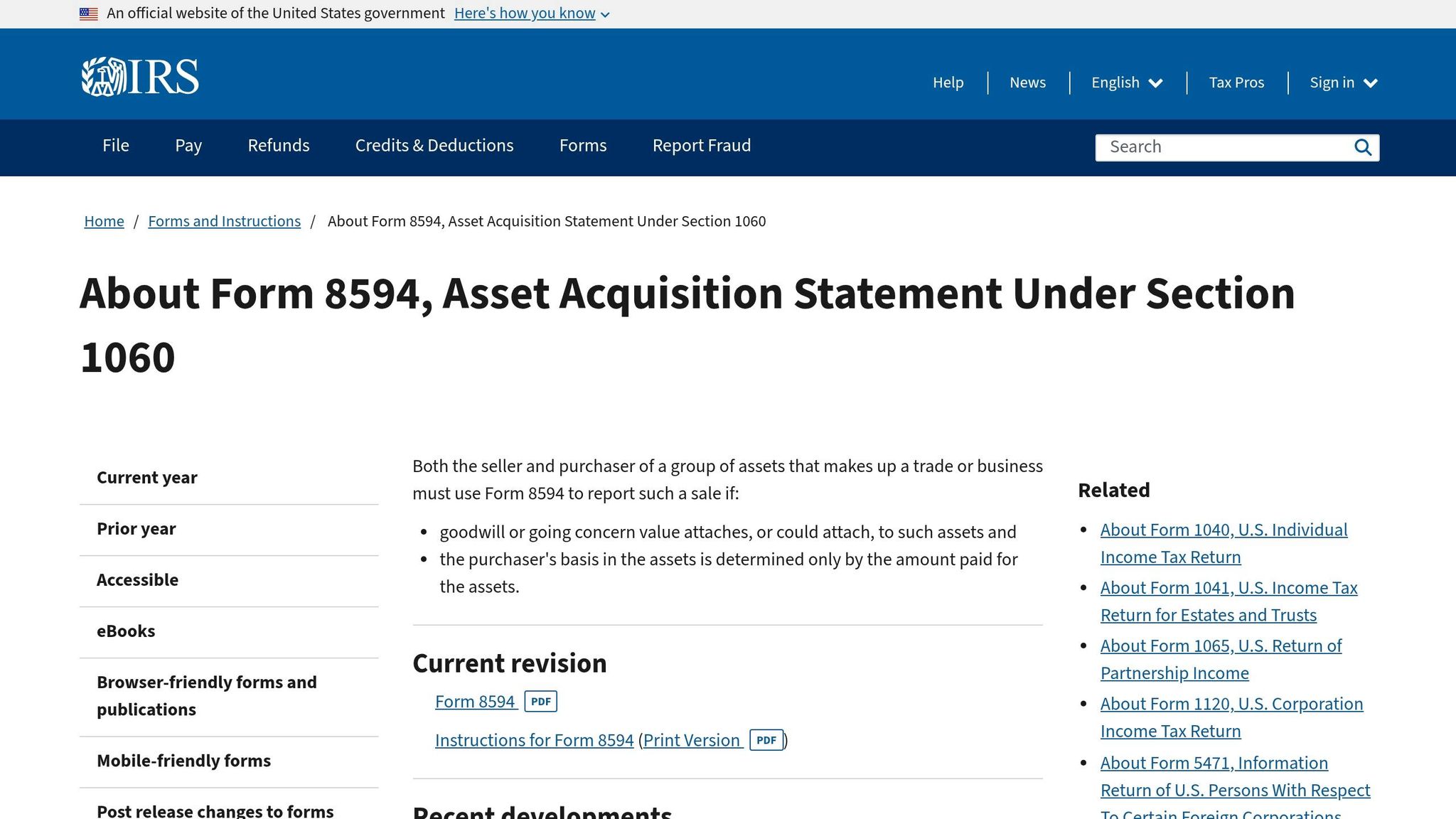
Proper asset allocation on Form 8594 must follow the residual method, assigning value across seven classes in order - from cash (Class I) to goodwill (Class VII) [3]. Sellers often prefer higher goodwill allocations to benefit from capital gains tax treatment, while buyers typically aim to allocate more value to depreciable assets, like equipment (Class V), to maximize deductions [7]. If these allocation details aren’t resolved in the letter of intent, discrepancies in filings can trigger audits [6].
To avoid problems, keep an evidence file with equipment dealer quotes, previous appraisals, and notes detailing the methodology used to determine values for goodwill and Section 197 items [4][6]. Additionally, setting calendar reminders for earn-out milestones ensures that supplemental Form 8594s are filed in the correct tax year when contingent payments are made [4]. Staying organized with these steps can help reduce the risk of errors and audits.
Sellers often run into trouble with capital gains calculations due to incomplete documentation or confusion about the rules. When selling a business, it's essential to clearly separate ordinary income from capital gains, as mistakes here can result in penalties. Things get even trickier with installment sales, especially when sellers assume the rules apply automatically without accounting for exceptions.
One frequent issue involves Section 1202 exclusions for qualified small business stock (QSBS). To qualify for QSBS, the stock must belong to a domestic C corporation with gross assets under $50 million (or $75 million after July 4, 2025) [10][11]. Additionally, the stock must be held for at least five years to claim the full 100% exclusion. This exclusion can eliminate both the 20% federal capital gains tax and the 3.8% Net Investment Income Tax [11].
However, claiming QSBS treatment can be tricky. Audit risks often arise when businesses hold too much idle cash, which violates the rule requiring 80% of assets to be used in an active trade or business [11][12]. Another pitfall? Pivoting into disqualified industries like professional services, financial services, or hospitality, which can disqualify the stock entirely [10][12]. To defend your QSBS claim during an audit, maintain thorough records, including asset values at issuance and proof of your active trade or business status [10][12].
Installment sales come with their own set of challenges. Under IRC Section 453, installment reporting happens automatically unless you opt out by the tax return deadline [8]. But not all assets qualify for installment treatment. Items like inventory, accounts receivable, and publicly traded securities are excluded, meaning they could trigger immediate tax liabilities if misclassified [8][9].
Depreciation recapture is another common oversight. IRC Sections 1245 and 1250 require that any recaptured gain be reported as ordinary income in the year of sale, regardless of when you actually receive the cash [9]. As the AccountingInsights Team explains:
"The IRS requires recognition of recaptured amounts in the sale year." [9]
Another complication arises when the stated interest rate on installment payments is too low. In such cases, the IRS applies the Applicable Federal Rate (AFR), which can reclassify parts of the principal as ordinary interest income. This can push you into a higher tax bracket [9]. For larger transactions, Section 453A imposes a non-deductible interest charge on deferred tax liabilities if installment obligations exceed $5,000,000 [8].
Lastly, sellers must file Form 6252 every year they receive a payment. This form calculates the taxable portion of each payment based on the gross profit percentage [9]. Missing this step - or miscalculating the numbers - can draw the IRS's attention and lead to penalties. These errors highlight the importance of precise reporting to avoid audits and unnecessary complications.
Non-compete payments and earn-out arrangements often come under IRS scrutiny during business sales. The IRS may try to reclassify these payments from capital gains (which are taxed at a lower rate) to ordinary income, leading to a higher tax bill. To protect your tax treatment after selling your business, it's crucial to maintain detailed records and follow specific steps.
Non-compete payments are closely examined because they can blur the line between proceeds from an asset sale and compensation for services. If your sale agreement doesn’t clearly distinguish non-compete payments from other transaction elements, the IRS might classify them as ordinary income instead of part of the capital gain from the sale.
One way to safeguard your intended tax treatment is by obtaining an independent valuation of the non-compete agreement. A qualified appraiser can determine its fair market value based on factors like industry norms, the geographic scope of the agreement, and its duration. Completing this valuation before the sale is finalized - and explicitly referencing it in the purchase agreement - can strengthen your case. Earn-out arrangements, like non-compete payments, also require thorough documentation to withstand potential IRS challenges.
Earn-out payments are typically reported as installment sales under IRS Regulation 15a.453-1(c). Under this arrangement, each payment is divided into two parts: one portion recovers your tax basis, and the other is treated as taxable gain. However, the IRS may question whether these payments are genuinely part of the sale or if they should be reclassified as royalties or rental income.
To prevent reclassification, ensure your agreement includes an IRS-compliant interest rate and specifies a fixed payment period. Without a defined period, the IRS may apply a 15-year basis recovery rule, which could accelerate the recognition of taxable gains. Properly structuring the agreement and addressing these details upfront can help you avoid unexpected tax consequences.
Selling a business that operates across multiple states comes with hidden but critical tax risks. Since the 2018 South Dakota v. Wayfair decision, states can enforce tax collection based on economic or virtual presence - even if your business lacks a physical office or warehouse there [13]. Navigating these requirements can feel overwhelming, especially when compliance obligations aren't carefully monitored in the complex U.S. tax system [13]. Let’s break down how economic nexus and state-specific tax triggers can affect your filing obligations.
Economic nexus laws have made tax compliance more complicated. These laws kick in when your business surpasses specific sales or transaction thresholds set by individual states, regardless of physical presence [13][14]. For instance, many states use benchmarks like $100,000 in sales or 200 transactions to establish nexus [13]. However, thresholds vary widely. California sets its threshold at $500,000 in retail sales, while New York and Massachusetts require both $500,000 (NY) or $100,000 (MA) in sales and 100 transactions [13]. Tennessee, on the other hand, applies only a $100,000 sales threshold [13].
The risks intensify when unresolved nexus issues are uncovered during due diligence. As Zaid Butt, Partner at Evolved, LLC, explains:
"The longer the gap between when nexus began and when it is discovered, the more cautious buyers become" [2].
Buyers often respond by asking for price reductions, escrow holdbacks, or extended indemnification periods to account for potential liabilities [2][15]. Worse still, if you have nexus but haven’t filed returns, the statute of limitations doesn’t apply - allowing states to assess back taxes, penalties, and interest indefinitely [15][1]. Beyond sales tax, economic nexus can also trigger obligations for corporate income, franchise, or business license taxes [13][14].
Closing state tax accounts for a multi-state business adds another layer of complexity. Before selling, conduct a comprehensive State and Local Tax (SALT) nexus study to identify filing obligations. This includes both physical presence - like employees or inventory - and economic activity [2][15]. Pay special attention to remote employees, as even one remote worker can create physical nexus in a new state [13][2].
If the nexus study reveals past exposure, you may want to use Voluntary Disclosure Agreements (VDAs). These agreements can limit the lookback period to 3–4 years and waive penalties [2][14]. Properly determining nexus not only prevents unexpected liabilities but also simplifies the process of filing final tax returns. Keep collecting and remitting sales tax until the state officially confirms your permit is closed; stopping prematurely could leave you responsible for unpaid taxes [16]. Some states even require you to maintain sales tax permits and continue filing for a set period after ceasing business activity - a rule known as trailing nexus [16]. Be prepared, as closing a state tax account can sometimes trigger an audit [16].
Taking disproportionate deductions after selling a business can catch the attention of the IRS. These problems often stem from misunderstandings about what qualifies as deductible in the year of the sale or from errors in calculating the stepped-up basis when buyers and sellers structure deals differently. Both scenarios can lead to audits and hefty penalties if not handled carefully.
The IRS closely examines deductions claimed in the same year a business is sold. For example, donating appreciated property might seem like a good idea, but the deduction is often limited to the property's adjusted basis and can be further restricted due to depreciation recapture [17].
Depreciation recapture is a common audit trigger. When selling equipment or real estate, the IRS requires you to recapture prior depreciation deductions as ordinary income, not capital gains. For Section 1245 property, like equipment, all depreciation must be recaptured as ordinary income up to the gain realized. For Section 1250 property, such as real estate, only depreciation exceeding straight-line depreciation is recaptured, with the remaining gain taxed at a special 25% rate [17]. Additionally, payments for non-compete agreements or consulting services are taxed as ordinary income. If these amounts appear excessive or aren't well-justified, the IRS may investigate [6].
To avoid these pitfalls, back up your valuations with solid evidence. Use dealer quotes for equipment, broker opinions for intangible assets, and maintain a well-organized evidence file. Include basis schedules and explanatory notes to support your claims [6].
Disputes over basis adjustments can further complicate tax outcomes after a sale. In stock sales, buyers often request elections like Section 338(h)(10), which allow the transaction to be treated as an asset sale for tax purposes. This benefits buyers by providing a basis step-up for future depreciation but can significantly increase the seller's tax liability. As Scott Sturgeon points out:
"A 338(h)(10) election can mean the difference between walking away from the closing table with $6 million and walking away with $4.5 million, even if the purchase price on paper never changed." [18]
Mismatched Form 8594 allocations between buyer and seller often lead to disputes. To avoid disagreements over asset reclassification, both parties should use the residual method and agree on a single allocation schedule. Attach this schedule directly to the purchase agreement to safeguard favorable basis adjustments [17][6]. Keep in mind, the election must be made jointly by the 15th day of the 9th month following the acquisition, and it's irrevocable once filed [18].
Thorough documentation is essential for stepped-up basis calculations. Use detailed worksheets to support your numbers. Without clear records, the IRS might reclassify gains as ordinary income. Both excessive deductions and basis missteps highlight the importance of meticulous post-sale documentation to avoid costly tax issues.
Taking proactive steps after a sale can shield you from IRS audits. The post-sale period often attracts scrutiny, but with thorough reviews and expert guidance, you can significantly lower your chances of being audited.
Conducting regular mock audits is a smart way to prepare for potential IRS reviews. These simulations, led by tax professionals, focus on key areas like asset allocations, capital gains calculations, and sale-related documentation. By identifying and addressing discrepancies early, you can stay ahead of potential issues. To stay on track, consider working with a CPA or tax advisor on a quarterly basis after the sale. They can help align your federal income tax returns with documents like depreciation schedules, sale agreements, and state filings. Particular attention should be given to basis step-ups and non-compete payments, as these are common areas of IRS scrutiny [20][22].
Digital record storage is another essential tool for avoiding audit risks. Using a secure, cloud-based system ensures your records are tamper-proof and well-organized. Categorize files such as asset allocations, earn-outs, installment sale agreements, and marketplace reports for easy access. The IRS recommends keeping these records for at least seven years. Additionally, ensure your digital files match your general ledgers to avoid inconsistencies. For extra precaution, download and archive payment processor reports from platforms like PayPal, as auditors often cross-check this data with taxpayer filings [19][20].
Beyond these internal measures, fractional CFO services can offer additional layers of protection for your tax compliance.
Fractional CFO services provide specialized financial oversight that can reinforce your compliance efforts. These professionals go beyond standard accounting by conducting ongoing reviews and ensuring accurate reporting of capital gains, basis step-ups, and state filings. They also synchronize bank and accounting data in real-time, which improves cash flow visibility and strengthens your financial records against potential audit challenges.
For example, Phoenix Strategy Group offers fractional CFO and M&A advisory services tailored to post-sale tax compliance. Their team helps with asset allocation reviews, earn-out documentation, and multi-state tax issues, all of which are common triggers for audits after a business sale. They also use advanced technology and data to conduct mock audits customized to your transaction. While starting this process 2–4 years before a planned sale is ideal, even post-sale engagement can help resolve compliance gaps before the IRS identifies them [20][22].
Businesses that invest in specialized tax services tend to face fewer audits. Research indicates that 60% of sales tax audits focus on high-risk industries with weaker compliance practices. Companies with strong internal controls and expert guidance can avoid common mistakes, such as undocumented exempt sales, which account for a third of out-of-state audit issues [21].
Selling a business often draws extra attention from the IRS. Common audit triggers include missing documentation, allocation mistakes, and errors related to multi-state taxes. For example, failing to provide sale documents, misreporting Form 8594 allocations, or discrepancies in installment payments can all raise red flags. Businesses involved in major transitions, like mergers or acquisitions, are especially likely to face closer scrutiny from both federal and state tax authorities [19][20][23].
The good news? Many of these risks can be avoided with the right strategies. Keeping accurate records is a must - store digital copies of sale agreements, exemption certificates, and state sales records for at least seven years. Make sure these records align perfectly with your tax filings. This attention to detail lays the groundwork for better planning.
Speaking of planning, taking proactive steps can make a big difference. Running mock audits before filing can help uncover potential issues, like overestimated deductions or errors in basis step-up calculations, before they catch the IRS’s eye. Complex situations, such as earn-out provisions, non-compete agreements, or multi-state tax obligations, often require specialized expertise to handle correctly [20].
Specialized advisory services are another way to reduce audit risks. Phoenix Strategy Group, for instance, offers fractional CFO and M&A advisory services designed to address these challenges. Their team can assist with asset allocation reviews, multi-state tax filings, and documentation for earn-outs - areas that are often targeted during audits. Using advanced tools and proprietary data, they deliver tailored compliance reviews to help strengthen your financial records against IRS scrutiny [20].
It's important to hold onto certain documents following a sale. These include final tax filings, capital gains reports, escrow agreements, earn-out agreements, and any records tied to the sale structure, such as asset or stock sale documentation. These records are crucial for staying compliant and handling any future tax or legal questions that might arise.
To steer clear of Form 8594 mismatches, it's crucial for both parties to agree on how the purchase price is divided among the transferred assets. Put this agreement in writing to ensure everyone is on the same page and to minimize the chances of triggering an audit. If disputes come up, make sure to have solid backup materials, such as valuations or appraisals, to support your position. Consulting with tax professionals can also be a smart move - discrepancies on this form can catch the IRS's attention and lead to unnecessary complications.
Yes, even after selling your business, you might still owe taxes in some states. This can happen for several reasons, such as unresolved state tax liabilities, nexus-related issues, or specific state rules around sourcing and withholding. It's important to address these factors thoroughly during the due diligence process to steer clear of any surprise tax bills.