Published on
January 2, 2026


When businesses from different industries collaborate, governance ensures decisions are made effectively, resources are allocated fairly, and accountability is maintained. Without structured governance, partnerships often fail - less than 15% succeed long-term due to weak frameworks. On the flip side, disciplined governance boosts success rates to over 80%.
Here’s what you need to know:
Governance isn’t just structure - it’s the backbone of successful partnerships, ensuring alignment, accountability, and resilience across industries.
Choosing the right governance framework shapes how decisions are made, risks are managed, and coordination is handled across industries. Three primary models - Collaborative Governance, Lead Organization-Governed Network, and Network Administrative Organization (NAO) - offer distinct approaches to authority and accountability. Let’s break them down.
This model spreads decision-making authority among all partners rather than centralizing it in a single organization. Each stakeholder plays an active role in shaping strategy, allocating resources, and addressing challenges. The focus is on shared accountability, meaning all partners are collectively responsible for the outcomes.
"Collaborative governance is the way collaborations organise themselves to achieve their goal." – Platform C [7]
This approach is ideal for addressing systemic challenges that no single organization can solve on its own. For example, the UN Partnership Platform has registered over 6,000 commitments and partnerships aimed at advancing Sustainable Development Goals [8]. However, collaboration takes time - research shows that complex partnerships spend 60%-70% of their meeting time building trust [3]. To stay on track, it’s crucial to establish clear operating principles and co-create a team charter early on [1][3]. Regular reviews, conducted at least once a year, ensure the framework adapts to changing market conditions or partner incentives [1][3].
Here, one organization takes the lead, coordinating the efforts of all other partners. This lead organization, often the one contributing the most resources, holds the decision-making authority [2]. The model allows for quicker, more efficient decisions compared to consensus-driven approaches. Clarity is maintained by defining roles, decision-making processes, and escalation protocols [2].
The lead organization’s ability to make timely decisions is key, but it must balance authority with trust to avoid alienating other partners. If too many decisions are escalated to senior leadership - known as "pass-ups" - it could indicate governance issues or hesitation at lower levels [2]. Establishing clear decision-making guidelines, including the necessary expertise, data, and urgency, can prevent bottlenecks and keep the partnership running smoothly.
This model relies on a separate, dedicated entity to manage governance and oversee daily operations. The NAO acts as a neutral platform, coordinating activities, standardizing communication, and tracking progress with defined metrics.
A real-world example is the Community Advisory Board (CAB) in Brownsville, Texas. Formed in 2001 by the University of Texas School of Public Health, the network expanded to include 210 members from business, government, and non-profits. A five-member leadership team serves as the administrative body, setting agendas and managing subcommittee actions [6].
The NAO model formalizes accountability through tools like MOUs, partnership agreements, and bylaws. The administrative team monitors performance, addresses potential issues early, and ensures all partners stay aligned with the partnership’s main objectives - even when external conditions shift [3].
"Clear governance structures, such as committees, workgroups, or facilitated discussions, provide direction while nurturing equity and inclusivity to resolve actual or perceived power imbalances that can arise during collaboration." – Intersector Toolkit [6]
This framework is particularly effective for partnerships involving numerous stakeholders or those planning to scale up. It provides the structured foundation needed for growth and expansion.
No matter the framework you choose, three key elements determine if your governance structure will succeed: clearly defined roles, efficient decision-making processes, and proactive risk management. Each of these requires thoughtful planning to prevent conflicts and ensure alignment among partners. Together, these components - roles, decision-making, and risk management - form the backbone of any governance framework.
Unclear roles can derail partnerships. When tasks go unassigned, confusion and conflict often follow. The solution? Assign specific roles and document them clearly so everyone knows who’s responsible for what.
Here’s how roles typically break down in partnerships:
For example, assigning clear roles makes accountability easier to manage across industries or sectors.
To avoid misunderstandings, tools like RACI charts can clarify who is Responsible, Accountable, Consulted, and Informed for every major task. Pair this with a Team Charter, a document co-created by stakeholders that outlines the partnership’s purpose, each member’s contributions, and specific roles. Additionally, establish Operating Principles to define expected behaviors - like “showing respect during disagreements” - which can help bridge differences between corporate cultures. Finally, formalize everything through agreements like MOUs or bylaws to lock in the accountability structure.
"Governance is an exercise in balancing trust and control on a fulcrum of risk – risk in performance and risk in relationship." – Norma Watenpaugh, CEO, PhoenixCG [1]
Once roles are defined, the next step is to streamline decision-making. Without clear processes, bottlenecks can stall progress. The goal is to create a system that involves the right people at the right time, cutting through unnecessary bureaucracy while maintaining accountability.
Decision-making roles should be assigned based on three criteria: Expertise, Information, and Timing. This ensures decisions are made by those with the right context and authority.
It’s also crucial to define escalation protocols early. Ask questions like, “How will we handle situations that require escalation?” and monitor how often decisions are unnecessarily passed up to senior levels. A high rate of these “pass-ups” can signal governance problems or a reluctance to make decisions.
Legal agreements often overlook practical day-to-day operations. To address this, create a Joint Venture (JV) Governance Framework (typically 10–15 pages) that outlines how governance will function daily. Include plans for handling recurring decisions like annual budgets or major investments. Standardized meeting formats and agendas can also help overcome cultural differences between partners.
Research shows that companies with disciplined collaboration approaches achieve success rates exceeding 80% [1]. The difference lies in having clear, well-understood processes.
Cross-industry partnerships come with unique risks - regulatory hurdles, cultural clashes, misaligned goals, and operational complexities. Effective governance doesn’t just react to problems; it anticipates and mitigates risks before they escalate.
Your governance model should reflect the partnership’s specific risk profile. For instance, a short-term marketing partnership will require different controls than a long-term research venture.
Operating Principles can also play a role in managing relationship risks. By codifying shared values and behaviors, you can prevent cultural differences from disrupting collaboration.
Dedicated Alliance Management Teams are essential for monitoring progress and identifying potential issues early. In a 2015 survey of over 1,250 executives, 68% anticipated an increase in joint ventures or large partnerships. By 2018, that number rose to 73% [3]. As partnerships become more common, systematic risk monitoring is no longer optional.
Annual strategy reviews can help partners adapt to market changes and shifting incentives. It’s also wise to include restructuring or exit plans in initial negotiations. Define what information each governance level needs and monitor its flow to avoid miscommunication.
Finally, use performance metrics - like member turnover rates, director participation, and alliance growth - to measure governance effectiveness. These indicators can serve as early warning signs, helping you make adjustments before issues escalate.
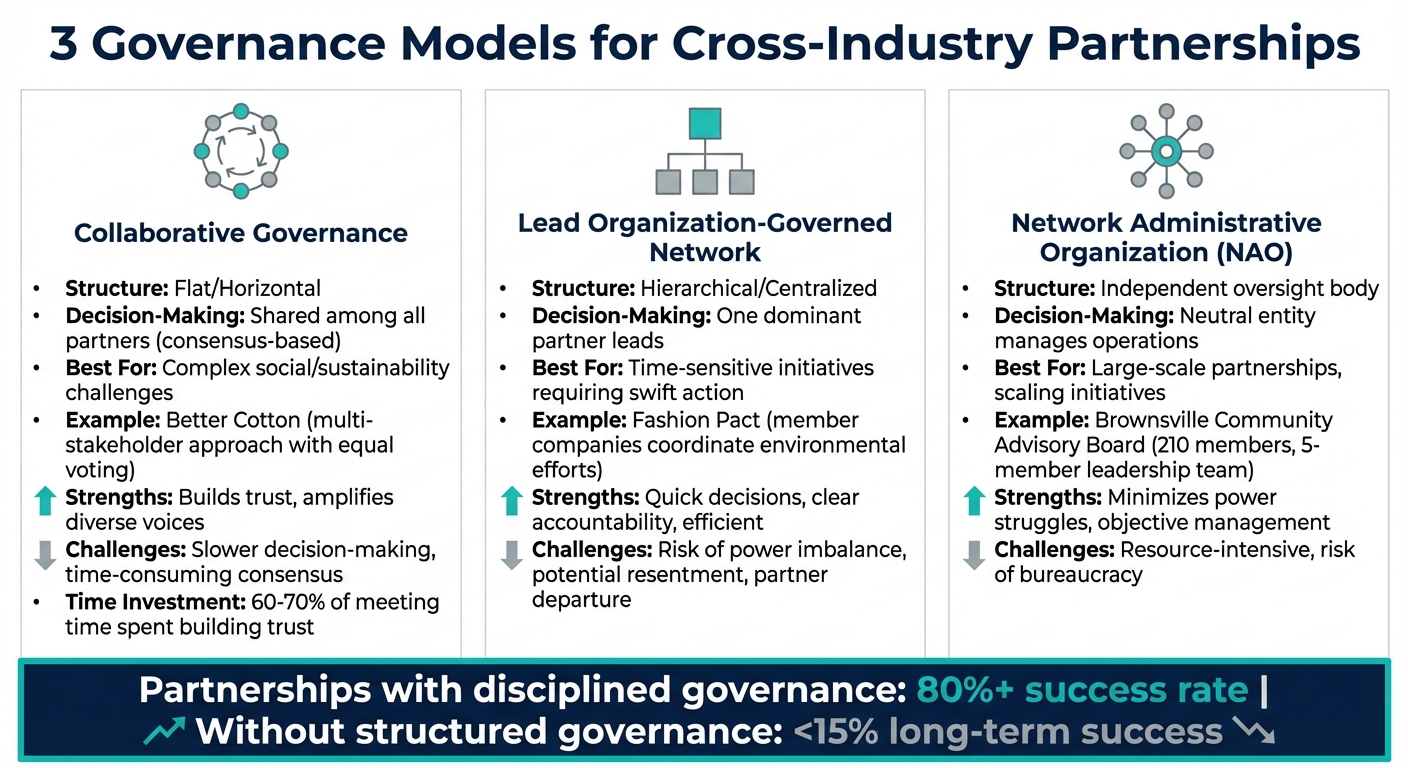
Comparison of Three Governance Models for Cross-Industry Partnerships
Selecting the right governance model means aligning it with the specific needs of your partnership. Each model approaches decision-making, hierarchy, and flexibility differently. Recognizing these trade-offs can help you steer clear of common missteps that often disrupt cross-industry collaborations. Let's break down the strengths and challenges of three widely used models.
The Collaborative Governance Model operates with a flat structure, where all partners share decision-making responsibilities. This model shines in fostering trust and amplifying diverse voices, making it particularly effective for tackling complex social or sustainability challenges. A great example is Better Cotton, which employs a multi-stakeholder approach, giving all participants equal voting power to advance sustainable development [8]. However, the need for consensus can slow down urgent decision-making, which might hinder time-sensitive initiatives.
In contrast, the Lead Organization-Governed Network centralizes authority in one dominant partner. This partner takes charge of strategy and execution, ensuring swift action and clear accountability. The Fashion Pact is a prime example, where member companies exclusively make decisions to coordinate environmental efforts across the industry [8]. While this model offers efficiency, it comes with risks. If the leading organization prioritizes its own interests over others, it can lead to resentment, legal disputes, or even the departure of key partners [4].
The Network Administrative Organization (NAO) model introduces an independent body to oversee governance and strategy. Acting as a "backbone", this structure minimizes power struggles by involving experts across different decision-making levels, ensuring more objective management [2]. However, this approach can be costly to administer and risks becoming overly bureaucratic if not adapted to the partnership's changing needs.
Ultimately, the governance model you choose has a direct impact on your partnership's ability to adapt and operate efficiently. The key lies in selecting a model that aligns with your partnership's complexity, scale, and urgency [2].
Getting diverse partners on the same page under a unified governance model starts with involving the right people in the initial discussions. Operational leaders, like business-unit executives or alliance managers, should take the lead here - not just lawyers or business development teams. Otherwise, there’s a risk of creating agreements that look good on paper but don’t work in practice [3].
Transparency is key. Discuss both the primary goals (like launching a new market strategy) and secondary motivators (such as gaining access to specific suppliers). This helps align expectations and ensures everyone agrees on what success looks like [3]. Industries often differ in their approach to hierarchy, decision-making, and speed, so ironing out these differences early can prevent headaches down the road.
One practical tool is a Team Charter or Partnering Agreement. Created collaboratively, it outlines the partnership’s purpose, the value each stakeholder brings, and the specific objectives everyone is working toward [1]. Define success metrics and KPIs at the outset to avoid confusion about whether goals are being met. Since partnerships evolve over time, schedule formal strategic reviews - at least once a year - to reassess goals, scope, and any necessary adjustments due to market changes [3].
"When our alliance managers see a conflict, I want them to protect the venture. It's my job to run interference for them with corporate."
– Savvy alliance management executive [2]
A structured approach pays off. Partnerships using a disciplined lifecycle framework report success rates exceeding 80%. Monitoring "pass-ups" (unnecessary decision escalations) can serve as an early warning sign of governance issues [1] [2].
Once shared goals are in place, the next step is setting up scalable policies to support the partnership’s growth.
A practical governance framework is essential. Aim for a concise 10–15 page document written in plain language. This framework should outline how the partnership operates, including roles, authorities, and reporting lines. Unlike rigid legal contracts, this document can be updated through Board resolutions as the partnership evolves [5].
Striking a balance between structure and adaptability is critical. Codify shared values and behaviors to bridge differences in work styles across sectors [1]. Use a layered decision-making system, where decisions are made at the appropriate level - whether by the Board, committees, or management - based on expertise, urgency, and information needs [2].
A great example of scalable governance comes from the University of Texas School of Public Health in Brownsville. In 2001, they created a Community Advisory Board (CAB) to tackle local health challenges in an area with an 80% obesity rate. As the CAB grew from 35 to 210 members spanning health, business, government, and non-profits, they implemented a subcommittee system and a five-member leadership team. This structure allowed the diverse group to act as a unified voice for health policy, despite its size and complexity.
Clearly define delegated authorities. For instance, specify which decisions the lead executive can make (like managing budget overruns or hiring) and which require Board approval [5]. Standardizing meeting formats and information flow can help reduce confusion, especially when partners come from different business cultures [3]. Keep an eye on pass-ups; if too many decisions are being escalated, it’s a sign that the governance structure might need tweaking [2].
Incorporating financial expertise into your governance framework strengthens decision-making and ensures resources are managed effectively. Financial tools like KPIs, models, and playbooks can bridge gaps between partners with varying business practices and communication styles [3].
"Governance is an exercise in balancing trust and control on a fulcrum of risk – risk in performance and risk in relationship."
– Norma Watenpaugh, CEO and Founder, PhoenixCG [1]
One smart move is identifying which partner excels in specific areas - like forecasting, budgeting, or financial reporting - and assigning those responsibilities accordingly [3]. Financial advisors can also simplify complex legal agreements, turning them into actionable governance plans that detail how the Board and committees will operate day-to-day [5].
Phoenix Strategy Group provides an example of how financial expertise can enhance governance. Their fractional CFO and FP&A systems deliver real-time data, cash flow forecasts, and KPIs, creating financial guardrails and clear delegated authorities. Studies show that joint ventures with weak governance frameworks tend to underperform over time, highlighting the importance of getting this right [5].
When it comes to evaluating the health of a partnership’s governance, it's important to look beyond just financial outcomes. Key indicators like decision-making speed and the "pass-up" rate - how often decisions are escalated to senior management instead of being handled at lower levels - offer valuable insights [2]. A high pass-up rate often points to poorly assigned decision-making responsibilities. Additionally, board engagement metrics, such as participation rates and individual director performance, can highlight how actively involved the governance body is. Of course, financial metrics like operating cash flow, return on equity, and budget variance (actual vs. target) remain crucial for determining whether the partnership is meeting its goals [9]. Together, these metrics provide a clear picture of performance and lay the groundwork for making necessary adjustments to governance structures.
Using performance data as a foundation, governance frameworks should be flexible enough to adjust to shifting circumstances [5]. A straightforward governance document - 10 to 15 pages written in plain language - can be updated through board resolutions as conditions evolve [5]. Annual reviews are essential for keeping pace with market changes and shifting partner priorities [3].
"Alliance governance that is overly rigid will stifle innovation and thwart efforts to adapt to changing conditions."
– Norma Watenpaugh, CEO and Founder, PhoenixCG [1]
To handle market or performance changes without the need for contract renegotiations, define financial evaluation formulas in advance [3]. If decision-making slows down or pass-ups increase, it might signal the need to reassign decision-making rights [2]. Partnerships with weak governance structures often see a significant drop in performance over time [5].
Planning for an exit should begin from the very start. A time-bound charter, typically lasting three to five years, helps avoid "zombie partnerships" that outlive their purpose [11]. A great example is the mHealth Alliance, which sunsetted in 2014 after achieving its initial mission of raising awareness. Its assets and leadership transitioned into HealthEnabled, a new entity in South Africa focused on scaling national digital health initiatives [11].
To ensure a smooth exit, establish a clear 12- to 24-month transition timeline and define specific trigger events, such as major legal, market, or performance changes, to guide decisions on whether to exit or restructure [10][11]. An independent evaluation conducted in the fourth year of a five-year goal can help determine whether the partnership should wind down or evolve [11].
For long-term continuity, identify an institutional home that can carry the partnership’s mission forward. Additionally, make sure all data and tools are preserved in accessible formats, ensuring that the knowledge and resources built throughout the partnership remain available for future use [11].
Effective governance is the backbone of successful cross-industry partnerships, transforming written agreements into practical, day-to-day operations. By embracing disciplined collaboration, organizations can achieve success rates exceeding 80%[1]. This approach involves treating governance as an evolving process that clearly outlines decision-making authority, resource distribution, and mechanisms for adapting to change.
The strategies outlined in this guide - from collaborative models to lead organization networks - offer a solid starting point for building partnerships that adapt, innovate, and achieve meaningful results. Strong governance creates a balance between trust and control, helping to manage risks while ensuring accountability across all partners.
Whether it's defining decision-making workflows, tracking performance metrics, or planning structured exits, a well-designed governance structure accelerates decision-making, reduces miscommunication, and fosters personal accountability[2]. The partnerships you establish today will directly influence your competitive edge in the future.
For organizations looking to enhance their governance frameworks, expert support can make a real difference. Phoenix Strategy Group (https://phoenixstrategy.group) specializes in helping growth-stage companies develop practical governance systems, create actionable documents, and align partners on operational goals. Their expertise in financial and strategic advisory ensures partnerships are built to last - from initial structuring to scaling, transformation, and even exit planning. With their guidance, you can set your partnership up for long-term success.
Disciplined and flexible governance is the key to thriving in cross-industry collaborations. By investing in effective systems, adapting to evolving conditions, and seeking expert advice, you can navigate the complexities of partnership management with confidence.
The article doesn't pinpoint three specific governance models for cross-industry partnerships. Instead, it explores a range of governance approaches, such as the contrast between formal and informal structures, the distinction between business and operational governance, and the interplay of hierarchy with inclusivity. While some resources, like the BSR blog, discuss four multi-stakeholder governance models, these aren't categorized into three distinct types.
If you have a particular source that defines three governance models, feel free to share it for a more tailored comparison. Otherwise, the emphasis is on grasping the broader principles and strategies that drive effective governance in cross-industry collaborations.
To make decision-making smoother in a collaborative governance setup, start by defining everyone's roles and responsibilities. A RACI chart can be a great tool for this - it clarifies who’s responsible, accountable, consulted, and informed for each decision. This way, there’s less confusion, and decisions are made by the right people without unnecessary back-and-forth.
Setting up clear and transparent rules is equally important. Things like voting thresholds, quorum requirements, and clear escalation paths help build trust among all partners and prevent delays caused by unclear procedures. Regular check-ins, shared dashboards, and fast-track processes for low-risk decisions can also keep things moving efficiently.
To keep the system working smoothly, focus on four key principles: transparency, equity, efficiency, and responsiveness. These ensure that everyone involved feels valued and heard while keeping the process productive and flexible.
Cross-industry partnerships can unlock incredible opportunities by leveraging the unique strengths of each party. However, they often come with their fair share of challenges. Common pitfalls include misaligned goals, poor communication, weak governance leading to unclear decision-making, and differences in operational approaches or company cultures. Financial risks, such as cost overruns, regulatory hurdles, or disputes over intellectual property, can also pose significant threats.
To navigate these challenges effectively, businesses need to put a solid plan in place. Start with a clear governance framework that outlines roles, decision-making processes, and how resources will be allocated. Performing detailed due diligence is another critical step - it ensures all parties are aligned on strategic priorities, operational methods, and even cultural values. Well-structured contracts are equally important, as they should define shared objectives, compliance requirements, and how risks will be distributed. Additionally, regular performance reviews and flexible management strategies can help partnerships adapt to shifting market conditions and stay on track.
By tackling these risks head-on, businesses can safeguard their investments and unlock the full potential of their collaborations. Phoenix Strategy Group offers expertise in building governance structures and providing strategic and financial guidance to help companies successfully manage these complexities.