Published on
June 23, 2026

For many founders, revenue growth feels like the cure for almost every operational headache. Sell more, stay busier, and the business should improve. In practice, that assumption often creates a deeper problem: growth magnifies weak financial systems.
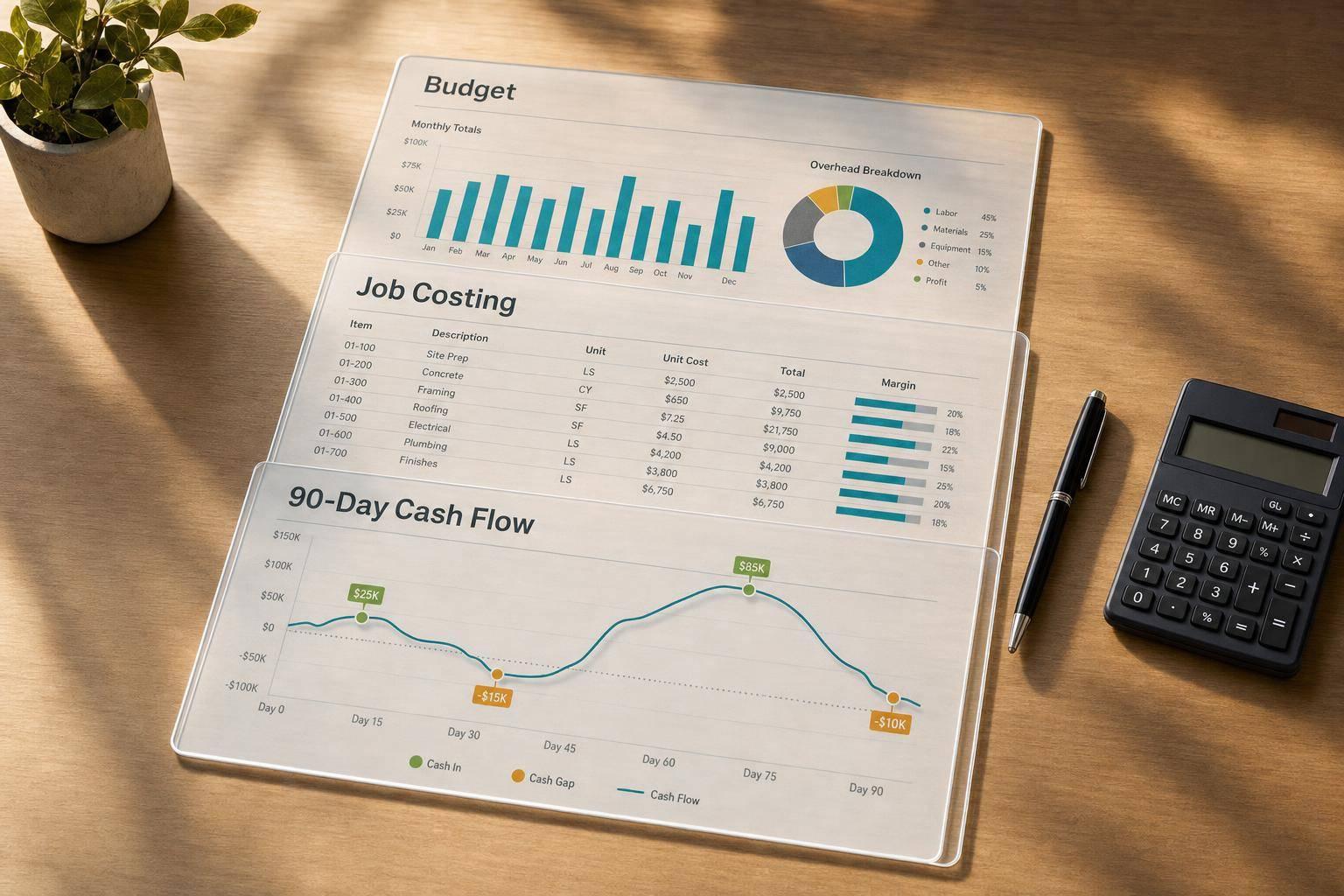
That’s the central lesson behind the video’s framework for budgeting, job costing, and cash flow planning. Although the source is aimed at contractors and trades businesses, the underlying principles apply broadly to founder-led companies in the $500K to $10M range. If your margins are inconsistent, your bank balance feels disconnected from your P&L, or you’re constantly reacting to cash pressure, the issue is rarely "not enough revenue" by itself. More often, it’s a missing operating system for money.
The video makes a blunt point worth repeating: a profitable-looking business can still be structurally fragile. That happens when owners rely on deposits to fund today’s work, delay decisions until the books force a crisis, or assume that accounting reports alone provide financial control.
This article expands on that message and organizes it into a practical operating model: a 90-day cash flow system built on three disciplines:
Together, these create something many mid-market founders want but rarely build intentionally: visibility before problems become urgent.
One of the strongest ideas in the video is that many owners over-rely on hustle. That approach can work in favorable conditions. When demand is strong and jobs are easy to sell, inefficiencies stay hidden. But when pricing tightens, costs rise, or cash collections slow, every small leak becomes visible.
That’s why the speaker frames the business as a game of percentages. You only get 100 cents on every revenue dollar. Once those cents are consumed by labor, materials, subcontractors, vehicles, software, salaries, rent, and financing costs, what remains is profit. If too many "1% losses" disappear across the company, growth may increase stress faster than it increases wealth.
For founders, this is a critical shift in mindset:
A company can grow on the first while quietly weakening on the second and third.
The video is best understood not as a single cash flow tactic, but as a stacked system.
A budget is often treated as an accounting exercise. In reality, it is a management tool. Its job is to help you decide, in advance, what kind of company you are trying to build and what economic model must support it.
The video argues that many businesses either do not budget at all or rely on chart-of-accounts structures designed for tax filing rather than decision-making. That’s a costly mistake. Founders need financial categories that answer operational questions, not just compliance questions.
A useful annual budget should show:
This matters because a budget does more than project outcomes. It forces strategic assumptions into the open.
For example:
Without those answers, a budget becomes wishful thinking in spreadsheet form.
The video’s strongest budgeting insight is the idea that every financial assumption should be paired with a management action. That is where transformation happens.
A stronger founder budget typically includes notes like:
This is important because budgeting should not be passive. It should function like a pre-commitment plan.
This is one of the most useful ideas in the source material.
Instead of creating one plan, create two:
Why this matters: most founders wait too long to cut costs because they make decisions emotionally, in the middle of uncertainty. A B budget gives you pre-decided triggers and responses.
For example:
That level of planning turns uncertainty into governance.
Annual budgets establish the target. Job costing shows whether the field reality supports it.
This is especially relevant to project-based businesses, but the principle carries over to any company where gross margin varies by deal, client segment, team, or delivery model. If you only review monthly financial statements, you are often learning about a problem long after it has already repeated itself many times.
The video emphasizes comparing estimate versus actual at the job level. That means tracking:
From there, owners can analyze performance by:
This is where the article’s broader business takeaway becomes clear: job costing is not just accounting accuracy; it is feedback for pricing, sales discipline, and operations management.
When done consistently, job costing usually reveals one or more of the following:
Some jobs keep crews busy but drag average margin below what overhead requires.
Two reps may book the same top-line volume but produce very different gross profit outcomes.
Material inflation, labor assumptions, or scope omissions can quietly erode profitability across many jobs.
One team may produce more gross profit per hour than another, even with similar pricing.
A business can have "good sales" overall but a bad combination of job types.
That final point is especially important. Many founder-led businesses do not actually have a revenue problem; they have a revenue mix problem.
The video provides rough gross and net margin benchmarks for several contracting categories. Those numbers are useful directional references, but the larger insight is more important than any single benchmark:
Gross margin expectations should reflect the economics of the work being sold.
Generally speaking:
For founders outside the trades, the lesson still holds. Compare apples to apples. A maintenance program, one-off implementation project, recurring service contract, and custom build should not all be managed under one margin expectation.
If your internal reporting blends them together, you lose the ability to price and scale intelligently.
This is the layer many companies skip because they assume accounting software will tell them what they need to know. It usually doesn’t.
The video distinguishes between profitability and cash clearly: a business can be profitable on accrual accounting and still have no cash available. That mismatch often confuses founders, especially when financial reports appear positive while the bank account says otherwise.
The reason is timing.
Cash flow depends on three moving pieces:
If outflows exceed inflows for long enough, the bank balance deteriorates regardless of theoretical profitability.
A full-year forecast is useful, but the video wisely emphasizes a more manageable window: 90 days.
That time horizon is short enough to be accurate and long enough to make meaningful adjustments. It gives founders room to act before a payroll panic, vendor issue, or line-of-credit emergency.
A solid 90-day cash flow forecast should include:
What makes this useful is not just visibility. It is optionality.
When a forecast shows a coming shortfall, leaders still have time to:
By contrast, once the shortfall arrives, choices narrow and become more expensive.
The source identifies several recurring causes of cash stress. Expanded for founder-operators, these are the four that deserve the most attention.
The video discusses "overhead efficiency", essentially how much fixed cost the business is carrying relative to revenue.
Growth-stage founders often hire in anticipation of scale, not in response to proven economics. That can be smart if timed well. It becomes dangerous when overhead gets ahead of margin.
Common examples:
None of these are inherently wrong. The question is whether they increase future operating leverage or simply add fixed burden.
A healthy way to think about new overhead is: What revenue, margin, or execution improvement must this expense unlock to justify itself?
The video’s advice here is direct: do not fund customer projects out of your own pocket unless the business model truly requires it.
That means reviewing:
In practical terms, founders should ask:
Businesses rarely go cash-negative because of one huge mistake. More often, they go cash-negative because dozens of "small timing gaps" stack up.
The video describes "shiny objects", which is a useful phrase for purchases that feel good but lack strategic rigor.
Founders often rationalize these as brand-building or growth investments:
Some of these may eventually be justified. The real test is whether the business has earned them and whether the return is measurable.
A disciplined founder distinguishes between:
That distinction matters most when cash is tight.
This is one of the most avoidable problems in most founder-led companies.
AR tends to drift because no one clearly owns it, collection conversations feel uncomfortable, and follow-up is inconsistent. The video’s remedy is simple and practical: assign responsibility, review weekly, automate reminders, and escalate deliberately.
A strong AR process includes:
Founders sometimes focus heavily on sales pipeline management while neglecting collection pipeline management. That is a mistake. Booked revenue is not usable until it becomes cash.
While the source comes from the construction and contracting world, its implications are broader.
For a founder between $500K and $10M in revenue, the business often sits in an awkward middle stage:
This is exactly where budgeting, job costing, and cash forecasting become strategic - not administrative.
In non-trades businesses, "job costing" may translate to:
The same principle applies: if you do not know which work creates margin and which work consumes it, scaling only spreads the confusion.
The video offers templates, but even without specific tools, founders can begin implementing the system with a structured 90-day rollout.
Focus on understanding current reality.
Actions:
Questions to answer:
Now move from visibility to management.
Actions:
Questions to answer:
The final step is cadence.
Actions:
Questions to answer:
One of the most useful subtexts in the video is not really about spreadsheets. It’s about energy.
When financial systems are weak, founders end up spending enormous time on avoidable emergencies:
That creates the illusion of entrepreneurial toughness, but often it is just unmanaged complexity.
Better financial systems do not remove uncertainty. They make uncertainty visible early enough to manage. That changes the founder’s role from firefighter to operator.
And for businesses aiming to scale, raise capital, or prepare for a sale, that distinction matters. Buyers, lenders, and sophisticated investors are not impressed by hustle. They are impressed by control.
The most valuable idea in the video is also the simplest: financial problems are rarely sudden; they are usually unseen until late.
A founder does not need perfect forecasting to improve outcomes. They need a better rhythm of visibility and response. Annual budgeting clarifies the model. Job costing verifies whether the work supports the model. A 90-day cash forecast shows whether the timing of money can sustain the model.
That sequence matters.
If your company is growing but still feels financially uncertain, the answer may not be "sell harder." It may be to build the financial operating system your growth now requires. In businesses at the $500K to $10M stage, that shift is often the difference between expansion that creates freedom and expansion that creates fragility.
As the speaker suggests, once you start seeing the numbers clearly, the business stops feeling random. You begin to see patterns, choices, and leverage points. And that is when finance stops being a back-office function and becomes a leadership advantage.
Source: "Stop Scrambling for Payroll: The 90-Day Cash Flow System for Contractors" - Breakthrough Academy, YouTube, Jun 3, 2026 - https://www.youtube.com/watch?v=VtwtlMqGhyo