Published on
April 20, 2026


AI-powered budgeting tools are transforming how growth-stage companies manage finances. They save time, reduce errors, and provide real-time insights by automating manual tasks like data consolidation and forecasting. These tools integrate seamlessly with systems like ERP, CRM, and HRIS, allowing finance teams to focus on strategic decisions instead of repetitive processes.
Key Benefits:
Popular Tools:
For companies scaling rapidly, choosing the right AI tool can streamline processes and improve financial decision-making. Tools like Drivetrain and Mosaic are ideal for mid-sized businesses, while Anaplan suits larger enterprises managing complex operations.
AI budgeting tools are transforming how growth-stage companies approach financial planning. Instead of relying on static, outdated annual budgets, these tools introduce rolling forecasts that adjust instantly to market changes. By connecting directly to systems like ERP, CRM, HRIS, and billing platforms through no-code connectors, they ensure data accuracy and timeliness. Finance teams can tweak variables - like sales growth, hiring plans, or customer acquisition costs - and immediately see how these changes affect cash flow and profit-and-loss statements across different scenarios.
The results speak for themselves. Many leading AI tools achieve 95% accuracy on 13-week cash projections. They even feature conversational interfaces, allowing finance teams to query real-time cash positions effortlessly [8]. With 72% of companies already leveraging AI for financial forecasting [8], this shift is timely, especially as cash flow and liquidity risks remain a top concern for businesses globally through 2028 [8]. These tools not only provide real-time insights but also pave the way for automated variance detection, ensuring smoother financial analyses down the line.
AI simplifies variance analysis by automating calculations across departments, eliminating the need for manual formulas. These tools flag variances exceeding predefined thresholds, cutting what used to take hours into mere minutes [11].
The benefits go beyond speed. AI-driven platforms can reduce forecasting errors by 50% [3] and enable Budget vs. Actual (BvA) reporting to be completed 80% faster [2]. This automation saves finance teams 15–20 hours monthly by streamlining variance calculations and creating summary views [11]. Additionally, machine learning models uncover trends and anomalies that human analysts might overlook, offering early warnings before minor variances escalate into bigger issues.
"Precanto's AI-powered insights help uncover trends and anomalies that otherwise would be missed. It's like having an expert analyst working 24/7", said Kurt Shintaffer, Former CFO at Apptio [3].
This combination of speed and accuracy allows finance teams to shift their focus from manual tasks to strategic decision-making, a crucial advantage for companies in growth phases that often benefit from fractional CFO services.
AI budgeting tools also excel in integrating with existing financial systems, making budgeting processes more efficient. With pre-built, no-code connectors, platforms seamlessly sync with tools like NetSuite, Salesforce, and Workday without requiring IT intervention [7][4]. They even offer bi-directional add-ins for Excel and Google Sheets, enabling teams to retain their familiar workflows while syncing data in real time with a central AI platform [9][4]. This is a game-changer considering that 94% of manual spreadsheets contain critical errors [10].
These integrations ensure that any updates - such as changes in general ledger entries or accounting segments - automatically flow into all reports and dashboards, maintaining real-time accuracy [13][4]. Some platforms also feature "agentic AI", which allows users to query financial data through tools like Slack or Microsoft Teams using natural language [9]. Implementation is impressively quick, with AI-native platforms often operational within days or weeks, compared to the lengthy 6–18 month cycles typical of legacy systems [4][8].
"Implementing Aleph was insanely fast. We did all of our quarter-end reporting with Aleph less than 3 weeks after signing", said Chris Brubaker, VP of Finance [4].
These seamless integrations and rapid deployment capabilities underline how AI budgeting tools are reshaping financial management, empowering companies to make faster, more informed decisions.
For growth-stage businesses, AI-powered budgeting platforms can tackle complex financial planning with features like conversational analytics and automated model generation. Here's a closer look at some standout tools:
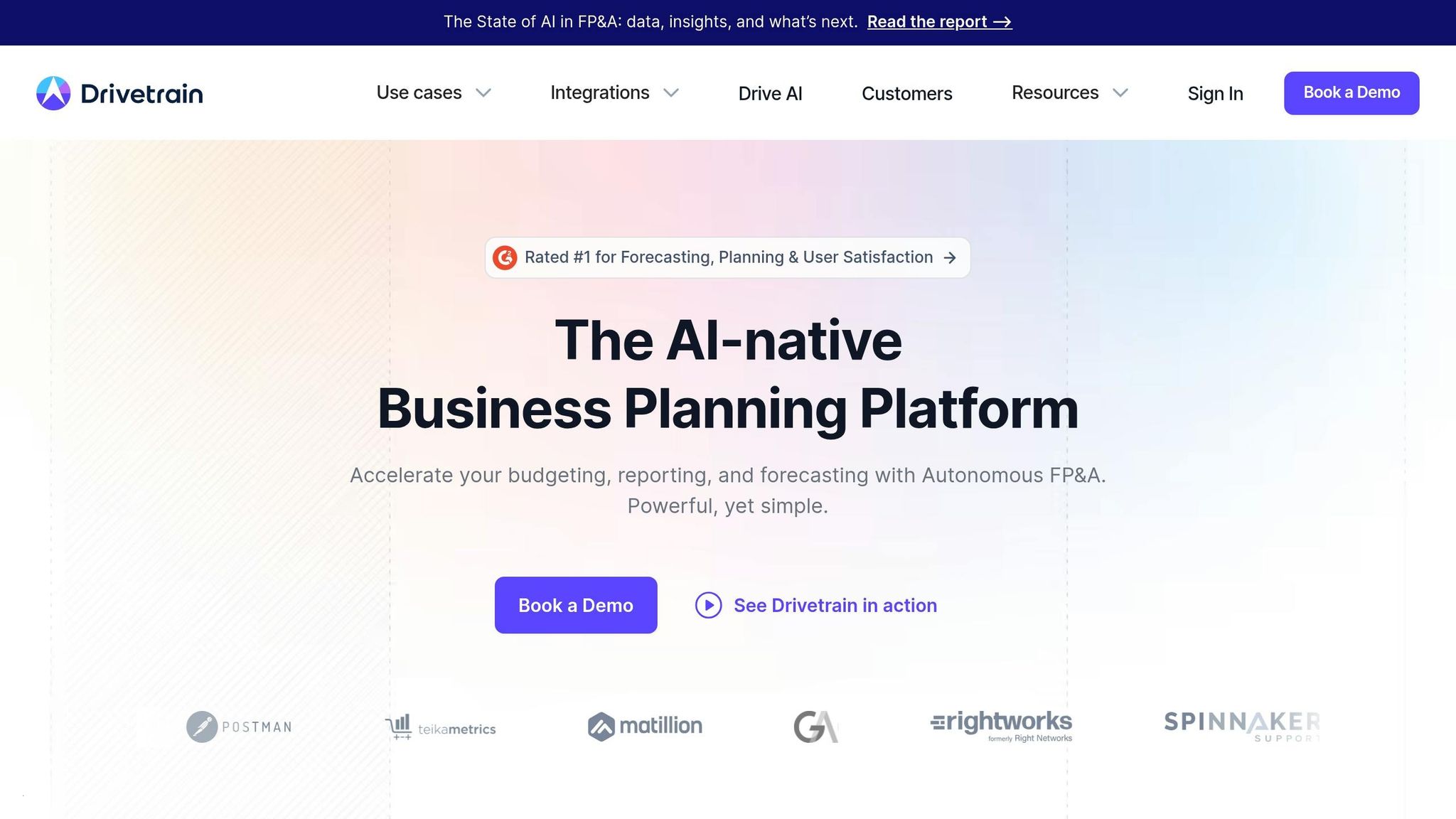
Drivetrain is tailored for fast-growing B2B companies, offering tools that simplify financial analysis. Its AI Analyst lets finance teams query datasets using plain English - no technical know-how required. For example, you can ask why marketing expenses spiked in Q1 and get quick, clear answers [7].
Another key feature is AI BvA (Budget vs. Actual), which identifies anomalies and explains variances in minutes. With over 800 pre-built connectors, Drivetrain integrates seamlessly with ERPs, CRMs, and HRIS systems [14]. Users report that complex headcount planning models take one-tenth the time compared to traditional tools [7].
"Drivetrain is automating our financial forecasting, reporting & KPI tracking. These three items have been a massive time-saver for us as they used to involve a lot of manual effort and are now updating in real time", said Andrew De Fanti, Manager, FP&A at Quantum Metric [14].
Drivetrain also earns high marks for usability, with a 4.9/5 G2 rating. Implementation is fast, typically taking 4–6 weeks, and the platform consolidates data up to three times faster than manual methods [14].
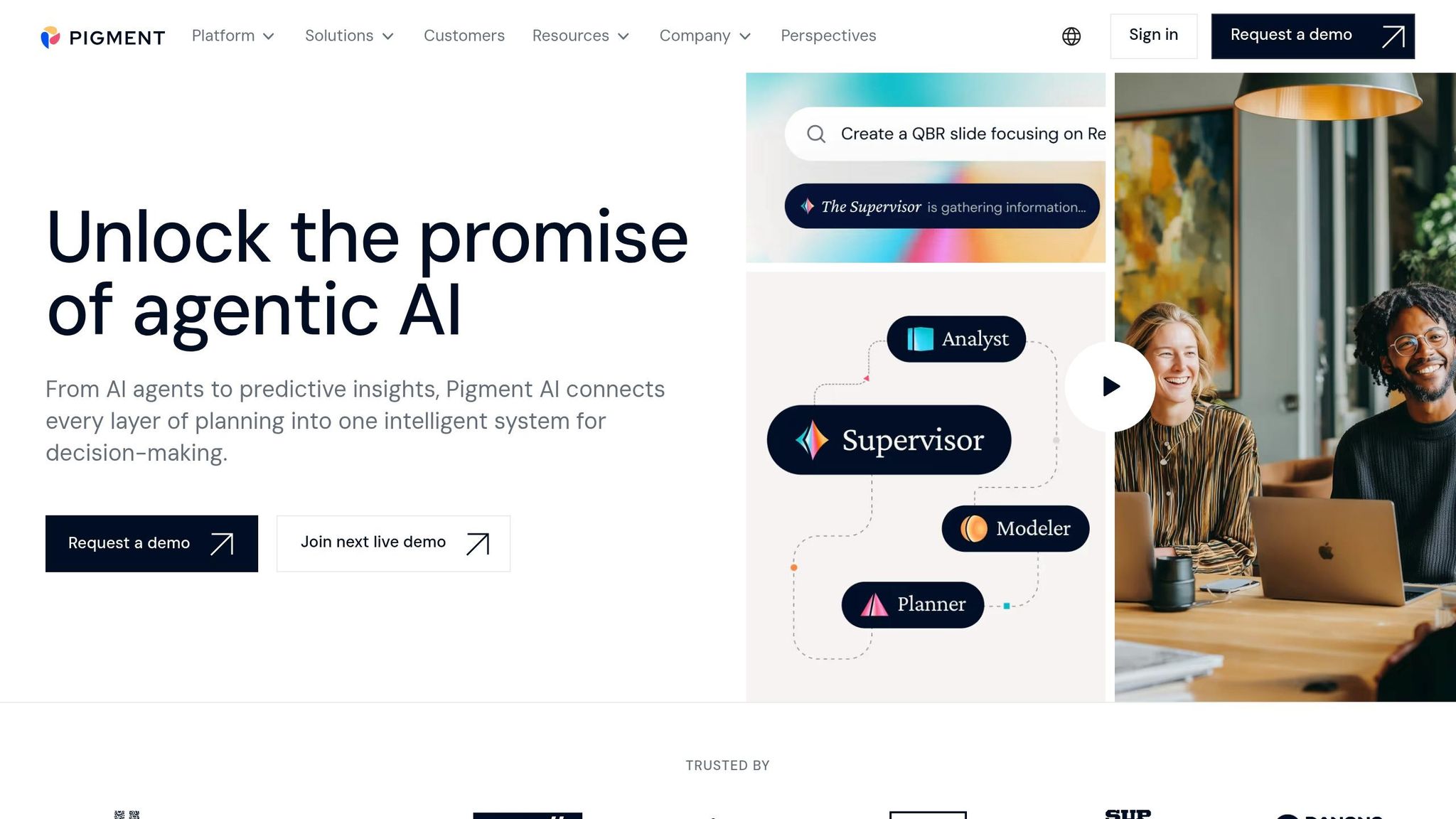
Pigment takes a unique approach with its agentic AI capabilities, deploying specialized AI agents - Planner, Modeler, and Analyst - to handle specific budgeting tasks. For instance, the Modeler Agent can write formulas, refine models, and suggest next steps, reducing planning tasks from days to just an hour [15]. Users have reported a 60% reduction in model build times, and tasks like contract indexation now take 30 minutes instead of three hours [15].
"Pigment's agentic AI capabilities make us feel like 'mini CFOs' within our departments. It's a game-changer for how we collaborate, analyze, and make decisions", said Montaek Kohli, Strategic Finance Manager [18].
While Pigment offers excellent visualization and collaboration tools, its proprietary formula syntax can make the learning curve steeper. Implementation typically takes 3–6 months [17].
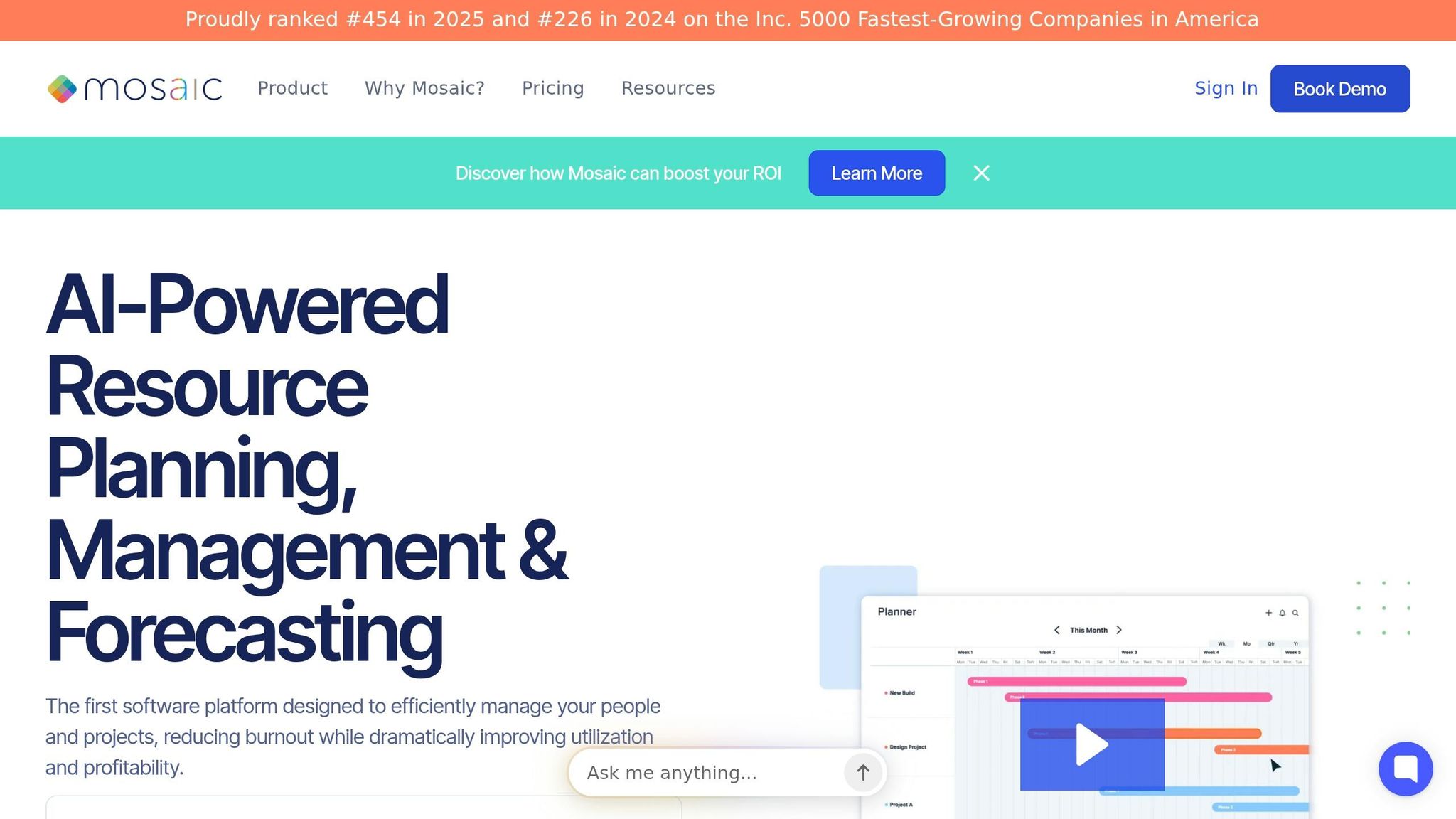
Mosaic's Arc AI simplifies performance tracking with automation and natural language queries. Its NLP interface allows users to access spending data and generate insights without complex menus or custom reports. By enabling department heads to pull their own reports through conversational queries, Mosaic lightens the load on finance teams. This makes it particularly well-suited for SMBs and mid-market companies [7].
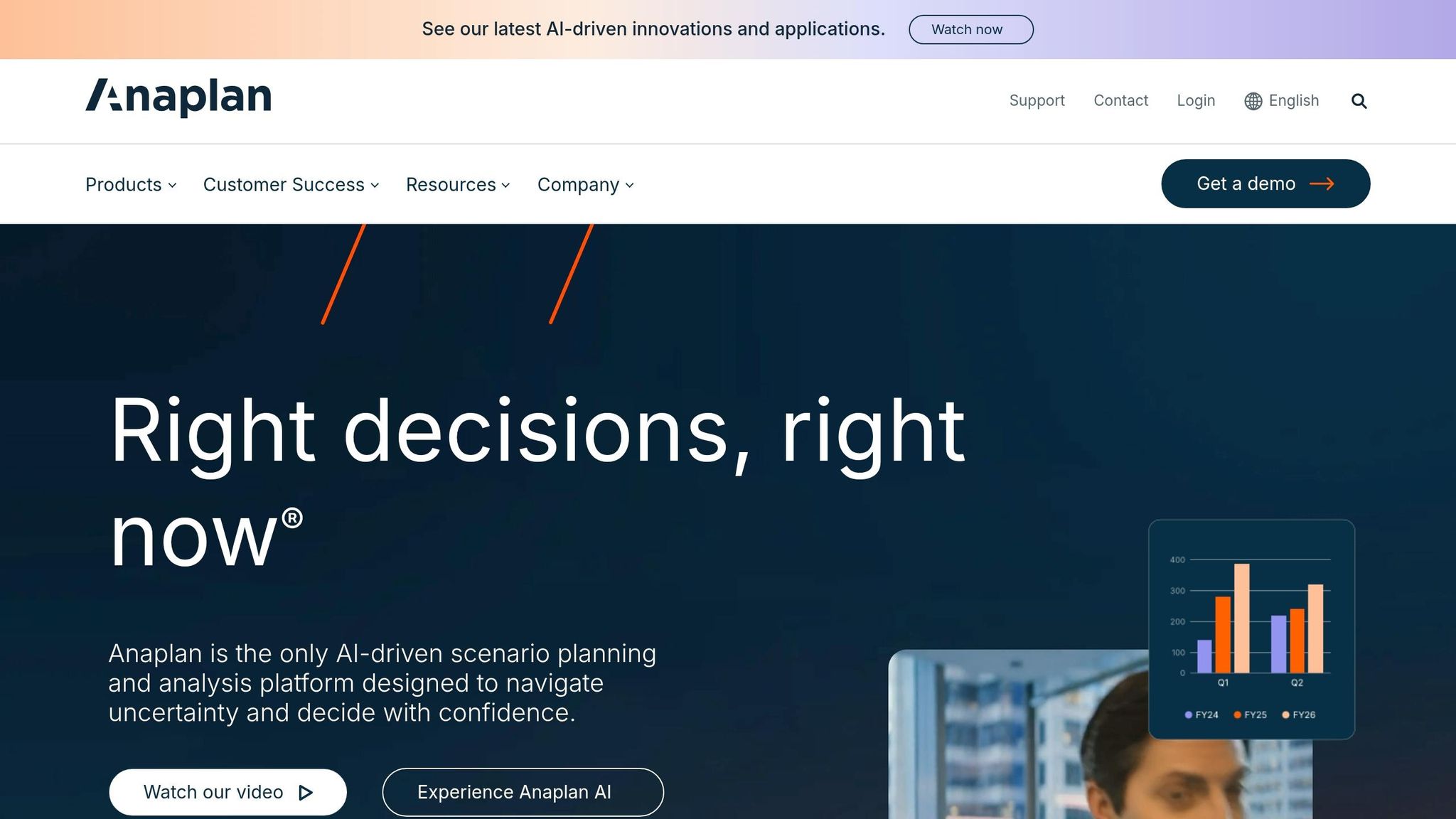
Anaplan shines in handling large-scale, complex financial planning. Its PlanIQ feature uses machine learning forecasting, while the CoPlanner AI assistant supports natural language queries. The platform's scenario optimization tools allow teams to run "what-if" analyses, modeling the impact of hiring plans, market changes, or new business ventures without rebuilding spreadsheets [16].
However, Anaplan is known for its high implementation costs and reliance on external consultants. Deployment typically takes around six months [17].
Datarails integrates AI directly into Excel, making it ideal for teams that want to enhance existing workflows. With features like Genius Chat for conversational analytics and AI-driven narrative storyboards to explain budget variances, Datarails supports continuous budgeting and automatic forecast updates. It also integrates with ERP and CRM systems. While its Excel-centric approach is appealing, its dashboards are less advanced compared to newer AI-native platforms [7].
Each of these tools aims to eliminate inefficiencies in manual budgeting, freeing up finance teams to focus on strategic decision-making. By automating tasks like data consolidation, variance analysis, and scenario planning, these platforms enable finance professionals to become key players in driving business growth [19].

AI Budgeting Tools Comparison: Features, Implementation & Best Use Cases
For companies in their growth phase, picking the right AI budgeting tool can make a big difference in improving resource allocation and forecasting precision. Below is a comparison of key features and trade-offs for two popular tools.
| Tool | Implementation Time | Integration Count | AI Capabilities | Best For | Key Limitation |
|---|---|---|---|---|---|
| Mosaic | N/A | N/A | Advanced reporting and budgeting functions | High-growth companies needing self-service budgeting | Can be expensive for smaller startups [12] |
| Anaplan | ~6 months | N/A | Advanced what-if modeling and scenario optimization | Large enterprises with complex, global operations | High setup costs and reliance on external consultants [12] |
This table highlights the tools' major features, but let’s dive deeper into their specific strengths and challenges.
Mosaic
Mosaic is tailored for high-growth companies due to its self-service budgeting capabilities and advanced reporting features. However, its cost can be a barrier for smaller startups, making it less accessible for businesses with limited budgets [12].
Anaplan
Anaplan’s strength lies in its ability to handle complex what-if modeling, making it a great fit for large enterprises with global operations. That said, its lengthy deployment process, high setup costs, and dependence on external consultants can be drawbacks for companies looking for faster or more cost-effective solutions [12].
Next, discover how Phoenix Strategy Group uses these tools to drive financial growth for companies in their scaling phase.
Phoenix Strategy Group offers a fresh approach to financial advisory for growing companies. Instead of just suggesting AI budgeting tools, the firm integrates AI directly into its services, creating financial systems that can scale alongside the business.
Their fractional CFO and FP&A teams use agentic AI to streamline routine tasks and strengthen financial oversight. By 2026, 63% of finance departments are expected to rely on AI, with agentic AI projected to influence 15% of daily decisions [20]. According to Deloitte [20], finance leaders are now prioritizing areas like process analytics, AI model management, and maintaining data integrity.
Phoenix Strategy Group employs machine learning to refine resource allocation, manage risks, and improve cash flow forecasting. Their data engineering services set up real-time monitoring systems to track AI-related expenses - an essential feature in today’s unpredictable token-based economies [20]. They also utilize 60-day build-and-test cycles to quickly validate AI applications and measure their ROI.
Beyond automation, Phoenix Strategy Group focuses on seamless financial integration across teams. Their Integrated Financial Model and Monday Morning Metrics systems unify real-time financial data across departments, creating a cohesive financial framework. This is particularly impactful as over half of finance leaders now play a key role in shaping organizational strategy [20]. By combining bookkeeping, CFO expertise, and data engineering, the firm eliminates the departmental silos that often slow decision-making in scaling businesses.
In addition to offering AI tools, Phoenix Strategy Group ensures these technologies align with broader business goals. For companies considering tools like Mosaic or Anaplan, they provide strategic guidance to tie tool selection to larger objectives - whether it’s preparing for funding, improving unit economics, or building a financial foundation for a future exit. This comprehensive approach highlights the critical role of finance in driving growth for scaling companies.
AI-powered budgeting tools have reshaped how growth-stage companies handle financial planning. These tools allow finance teams to automate tasks like data consolidation and error detection, freeing up time to focus on strategic initiatives. The results? Many companies have shortened their forecasting cycles from 6–8 weeks to just 2–4 weeks, shaved nearly five days off monthly reporting, and increased productivity by as much as 60% [1][5][6].
Relying on manual processes increases the risk of costly errors - something modern AI tools mitigate with automated variance analysis and real-time data updates.
Selecting the right tool depends on your company’s unique needs. For mid-market businesses, platforms like Drivetrain or Mosaic offer efficient and scalable solutions. Larger organizations might find the in-depth modeling capabilities of Anaplan more suited to their requirements.
Beyond software, working with experienced advisors can take your financial strategy to the next level. For instance, Phoenix Strategy Group combines AI tools with fractional CFO and FP&A services to help companies prepare for funding rounds, refine unit economics, and lay the groundwork for successful exits. Their Integrated Financial Model and Monday Morning Metrics systems ensure alignment and adaptability by creating a reliable, unified financial framework.
In today’s landscape, finance isn’t just about balancing the books - it’s a driver of growth. Whether you adopt AI budgeting tools independently or collaborate with experts to unlock their full potential, embracing these technologies can give your company a powerful edge as it scales.
To start using an AI budgeting tool effectively, begin by collecting accurate historical financial data. Next, ensure your financial systems are properly integrated with the tool. Finally, establish clear and specific budgeting goals. These steps help the AI recognize patterns, create reliable models, and provide insights that align with your financial strategy.
AI budgeting tools are designed to handle messy, ever-changing financial data with ease. Using advanced data processing and pattern recognition, these tools can take raw inputs like CSV files or bank statements and transform them into clean, organized data. They’re also great at spotting anomalies that might otherwise go unnoticed and can adjust to updates in real time.
Key features include automated data cleansing, integration with multiple data sources, and dynamic reforecasting. These capabilities ensure that budgets and forecasts stay accurate, even in the face of frequent changes - a common challenge for growth-stage companies.
A practical timeline for rolling out an AI-driven budgeting platform is approximately 90 days. This period provides enough time for smooth integration, which can lead to quicker close cycles and improved forecast accuracy - key benefits often emphasized in recent conversations about using AI in financial operations.