Published on
June 2, 2026


Subscription management APIs are the backbone of businesses with recurring revenue models like SaaS, streaming, or subscription boxes. They simplify billing, renewals, plan changes, and failed payment recovery while offering real-time insights into key metrics like Monthly Recurring Revenue (MRR) and churn rates. Instead of building complex in-house systems, these APIs streamline operations, reduce churn, and enable businesses to scale efficiently.
By integrating subscription management APIs, businesses can reduce manual work, recover up to 70% of failed payments, and streamline financial operations to focus on growth.
Subscription management APIs oversee every stage of a subscription, from free trials to cancellations, automating the business processes needed at each step. This detailed tracking ensures that the right actions are taken automatically, saving time and effort.
Here’s a breakdown of common subscription statuses:
| Status | Description |
|---|---|
active |
Payments are up to date, and the subscription is in good standing [7]. |
incomplete |
The initial payment attempt during sign-up failed [5][6]. |
past_due |
A recurring payment failed, and the system is retrying or recovering [5][7]. |
unpaid |
All payment retries failed, and access to the product is typically revoked [7]. |
paused |
The subscription remains active but isn't generating invoices [5]. |
Automated payment recovery systems play a crucial role here. For instance, they usually retry failed payments up to three times at 24-hour intervals before marking a subscription as unpaid [7]. This retry window is essential for recovering revenue without requiring manual intervention.
For businesses with more intricate subscription setups, tools like Stripe allow you to define up to 10 phases within a single subscription schedule [4]. This flexibility lets you plan transitions such as a trial period, an introductory discount, and then standard billing - all in one configuration.
These lifecycle tools provide the groundwork for the pricing and billing processes that follow.
Once subscription stages are mapped out, the API's pricing and billing mechanisms ensure revenue is calculated accurately. These APIs are built to handle a variety of pricing models, whether it’s a flat fee, usage-based charges, or a mix of both.
For example:
In usage-based setups, APIs use meters to log events in real time, such as API calls, data storage, or tokens consumed. A hybrid approach is also common, combining a flat monthly fee with metered overages. For instance, $200/month might include 100,000 tokens, with additional tokens billed at $0.001 each [8].
APIs also offer tools for handling mid-cycle changes with proration options:
always_invoice: Immediately charges or credits the difference.create_prorations: Adds adjustments to the next invoice.none: Skips any adjustments entirely [5][6].To reduce confusion, the invoice preview endpoint can show customers exactly what their updated charges will be before changes are finalized. This transparency helps minimize support requests and builds trust.
These billing features work hand-in-hand with lifecycle tracking to simplify revenue management.
Modern customers expect to handle their subscriptions independently. Subscription management APIs make this possible by enabling self-service portals where users can:
These portals are designed with security in mind, offering short-lived sessions that expire after 5 minutes of inactivity or within 1 hour of the last activity [10]. Additional features include:
To further enhance customer retention, APIs can detect when a user starts a cancellation process and automatically offer incentives like discounts or coupons to encourage them to stay [10]. Deep links, which are API-generated URLs, make it even easier for users to complete specific actions, such as updating payment details or reactivating a subscription [10][12].
These self-service and retention tools reduce friction, empowering customers while improving overall satisfaction.
To ensure your subscription management API operates smoothly and scales effectively, it's crucial to design integrations that allow each system to focus on its core responsibilities. For example, the subscription platform should handle plans and renewals, the ERP should manage accounting tasks, the gateway should process payments, and middleware should connect these systems through transformation, orchestration, and routing [13].
| Domain | System | Responsibility |
|---|---|---|
| Subscription Lifecycle | Subscription Platform | Plans, amendments, renewals, usage, invoicing [13] |
| Financial Control | ERP | AR, GL, revenue schedules, close processes [13] |
| Payments | Gateway / PSP | Authorization, settlement, refunds, chargebacks [13] |
| Integration | Middleware / API Layer | Transformation, orchestration, routing, monitoring [13] |
The subscription platform should always serve as the single source of truth. Local databases should only act as caches. If the data between them drifts, billing errors can occur, which are notoriously difficult to diagnose and fix [15][16].
Two key design principles can save you major headaches down the road. First, treat subscriptions as a state machine. This means every subscription exists in a specific state - like Active, Past Due, or Unpaid - and your application should respond accordingly. Second, use idempotency keys for all POST requests. This mirrors billing practices that prevent duplicate transactions, ensuring no duplicate charges or state changes occur during network retries, which is a common and costly mistake [14][15].
These foundational practices pave the way for efficient real-time event management, which is explored in the next section.
Webhooks are a game-changer for keeping your system updated without constant polling. Whether it's a payment failure, a subscription upgrade, or the end of a trial, the subscription platform sends a real-time event to your endpoint. How you handle these events can make or break your system.
"Relying on synchronous execution to process Stripe Webhooks in 2026 is not just a technical debt issue; it is a severe architectural flaw that mathematically guarantees revenue leakage." - Gabriel Cucos, Growth Engineer [17]
The best approach is simple: acknowledge the webhook with a 200 OK response, enqueue the payload using a message broker, and process it asynchronously. Stripe, for instance, requires a response within 3 seconds - if you miss this window, the event is marked as dropped [17]. Inline processing during high-traffic periods risks timeouts and missed events.
To ensure security and reliability, follow these practices:
These steps are vital for maintaining operational efficiency and reducing revenue leakage.
Securing API credentials is often overlooked, but it's critical. A staggering 71% of SaaS platform data breaches involve compromised API credentials [14]. To mitigate this risk, store all credentials (such as API keys, OAuth tokens, and certificates) in a centralized vault. Refresh OAuth tokens proactively - ideally 5–10 minutes before they expire - using per-account mutex locks [20]. For simpler setups involving API keys, enforce IP whitelisting and rotate keys regularly.
From a compliance perspective, U.S.-based businesses handling payments should use hosted UI components like Stripe Checkout whenever possible. This approach ensures sensitive card data never touches your servers, significantly reducing your PCI DSS scope [18]. Teams that adopted this strategy launched payment integrations 4.2x faster and experienced 3x fewer billing bugs in the first 90 days [18].
For European transactions, it's essential to flag recurring charges as merchant-initiated transactions after the initial SCA-authenticated signup. Skipping this step can lead to higher decline rates and increased involuntary churn [1][16].

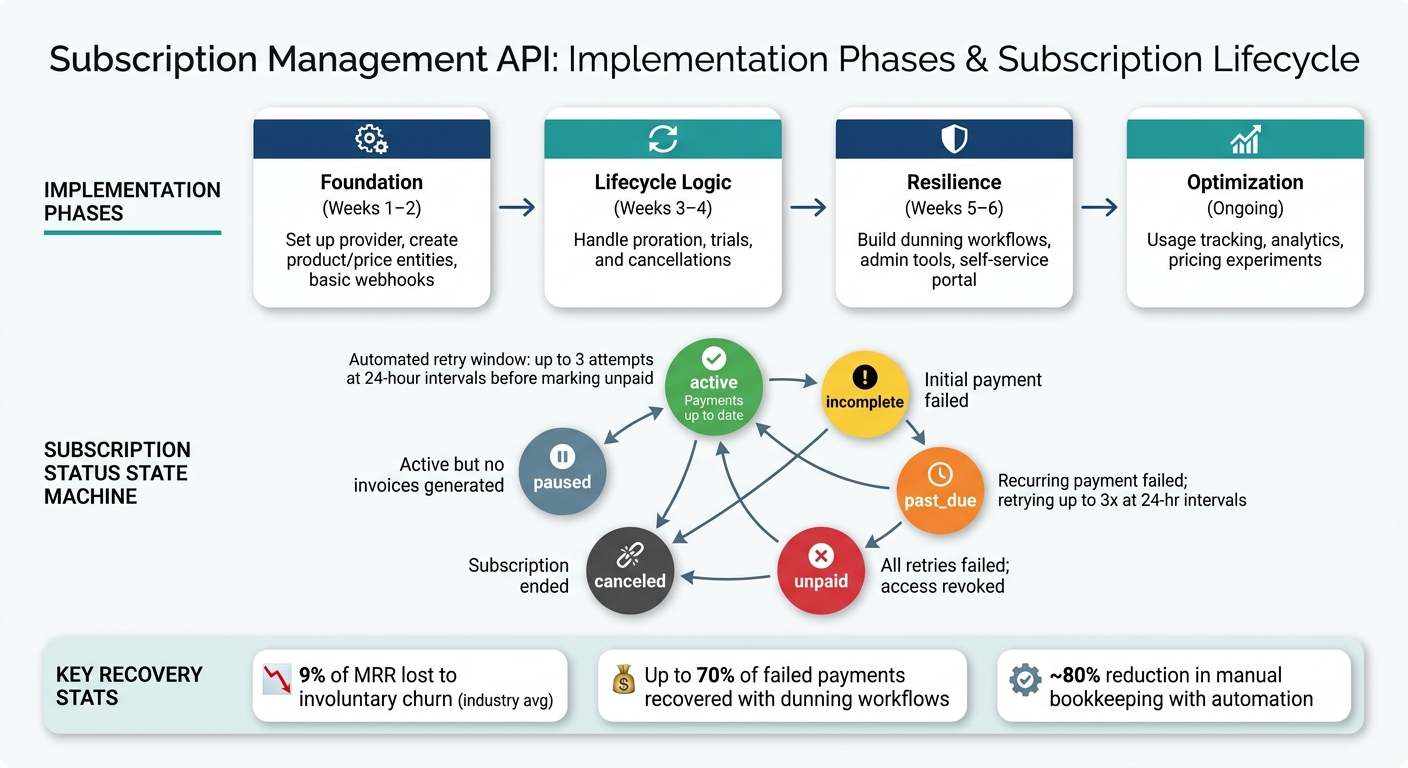
Subscription Management API Implementation Phases & Lifecycle
Getting API implementation right requires detailed planning. Start by mapping out every subscription state before writing a single line of code. Define all possible states - like trialing, active, past_due, unpaid, and canceled - and clearly outline the triggers that move subscriptions between these states. This upfront effort helps you avoid revenue leaks that can be tricky to fix later.
The implementation process typically unfolds in four phases:
| Phase | Timeline | Focus |
|---|---|---|
| Foundation | Weeks 1–2 | Setting up the provider, creating product/price entities, basic webhooks |
| Lifecycle Logic | Weeks 3–4 | Handling proration, trials, and cancellations |
| Resilience | Weeks 5–6 | Building dunning workflows, admin tools, and a self-service portal |
| Optimization | Ongoing | Adding usage tracking, analytics, and experimenting with pricing |
A key tip: Always generate a preview invoice before making mid-cycle plan changes. This reduces confusion over unexpected charges. Also, store all trial and billing timestamps in UTC - Daylight Saving Time transitions have caused billing headaches for teams that didn’t follow this practice.
Once your implementation plan is solid, shift your focus to rigorous testing and monitoring.
Testing subscription logic isn’t just about ensuring things work under perfect conditions. Use your payment provider's test card numbers to simulate various failure scenarios, such as:
This approach ensures your dunning logic is ready for real-world situations.
Failed payments are a bigger issue than many teams anticipate. They make up 20–40% of SaaS churn, and most failures - about 80–90% - are soft declines. These are temporary issues, like expired cards or insufficient funds, that can often be resolved with the right retry strategy [1][2]. A well-designed dunning workflow, with retries on days 1, 3, 5, and 7, paired with timely customer email notifications, can recover 60–70% of these payments.
Keep a close eye on subscription state transitions, especially when they move into past_due or unpaid. Monitoring these shifts helps you fine-tune retry logic. Use correlation IDs across your webhook ingestion, middleware, and ERP layers to trace transactions end-to-end without digging through disconnected logs. And remember: subscription states should always be updated based on webhook events, not client-side callbacks.
As your subscriber base expands, two common challenges arise: handling webhooks under heavy load and hitting API rate limits during renewal cycles. The solution? Use queue-based asynchronous processing for webhooks and state updates. This approach boosts both system performance and operational reliability.
Avoid polling for state updates - it wastes rate limits and can lead to race conditions. Instead, rely on webhooks for real-time updates and run automated daily reconciliation jobs to ensure your local database stays in sync with the platform's records.
For usage-based billing at scale, use append-only event logs with idempotency keys rather than direct database counters. This prevents race conditions and ensures accuracy as your system grows.
Take the Isla Hotel Reservation Platform as an example. By implementing usage-based billing for API calls and automated proration for plan upgrades, they scaled from 10 to over 200 hotel clients. This reduced front-desk support calls about billing by 68% [21]. Clean, scalable billing logic not only protects revenue but also cuts down on operational overhead, making life easier for your entire team.
Subscription APIs are not just about managing operations - they’re a goldmine for financial insights. When your subscription system runs smoothly, the data it generates can be leveraged to calculate critical financial metrics. Every subscription event feeds into this system, providing valuable information for decision-making.
From the API layer, you can extract data like price IDs, billing intervals, quantities, and lifecycle timestamps to calculate metrics such as Monthly Recurring Revenue (MRR) and Annual Recurring Revenue (ARR). You can also gain better visibility into cash flow by analyzing collection methods (automatic vs. manual), payment success rates, and identifying overdue accounts with past_due status flags.
APIs also help break down unit economics. Metrics such as Customer Acquisition Cost (CAC), Lifetime Gross Profit (LTGP), and Average Order Value (AOV) can be automatically calculated. For example, Stripe’s API offers reporting features like debit_credit_by_product and debit_credit_by_invoice to simplify these analyses [22].
For businesses in the U.S., aligning subscription billing practices with ASC 606 is crucial as they grow. ASC 606’s five-step model - identifying contracts, defining performance obligations (POBs), determining transaction prices, allocating standalone selling prices (SSP), and recognizing revenue upon fulfillment - can be directly integrated into subscription APIs.
Here’s how subscription APIs and ERP revenue engines align with the ASC 606 framework:
| ASC 606 Step | Subscription API Action | ERP Revenue Engine Action |
|---|---|---|
| 1. Identify Contract | Contract activated / "Closed-Won" | Create Revenue Arrangement |
| 2. Identify POBs | Extract line items by product category | Create Revenue Elements / POB records |
| 3. Determine Price | Extract total amount + variable considerations | Set transaction price & estimate constraints |
| 4. Allocate Price | Pass unallocated line items | Relative SSP allocation across POBs |
| 5. Recognize Revenue | Fulfillment events (delivery, usage, milestones) | Apply recognition rules (straight-line/usage) |
Manual systems struggle with mid-term contract changes like upsells, downgrades, or cancellations, as they require dynamic re-allocation of transaction prices. A smart approach is to handle SSP allocation within your ERP revenue engine, ensuring compliance even when pricing plans shift. Additionally, using idempotency keys for API-driven financial transactions - such as invoices, payments, and refunds - helps avoid duplicate entries caused by webhook retries or network issues [13][24].
For businesses managing high transaction volumes in ERPs like NetSuite, summarizing daily activities into journal entries is often more efficient than syncing every transaction individually. Processing raw transactions can delay data syncing with ERPs by up to 20 days in some cases [24].
This alignment of financial systems with subscription APIs creates a solid foundation for strategic financial planning.

To tackle these financial integration challenges, Phoenix Strategy Group (PSG) offers specialized advisory services. Acting as a fractional CFO and revenue operator, PSG uses subscription management APIs to connect sales pipeline data and customer behavior directly to cash flow and financial forecasts. This creates a unified model that decision-makers can rely on.
PSG’s expertise is especially valuable during fundraising and M&A processes. Over the past year, they’ve helped clients raise over $200 million [23] and bring over 100 M&A deals and 5+ IPOs to completion since 1998 [23]. Their approach focuses on building "buyer-grade financials" - clean, API-driven data models that can stand up to the scrutiny of investors and acquirers. When subscription data flows seamlessly into financial models, due diligence becomes far less stressful.
"As our fractional CFO, they accomplished more in six months than our last two full-time CFOs combined." - David Darmstandler, Co-CEO, DataPath [23]
PSG’s services include bookkeeping, FP&A, data engineering, and M&A advisory. Their philosophy is simple: your financial systems should work hand-in-hand with your subscription infrastructure to drive success.
Subscription management APIs are more than just tools for handling payments - they’re the engine that keeps a recurring revenue business running smoothly. They connect everything: product access, billing, financial reporting, and customer communication, all in one system. With the right setup, you can grow your revenue without needing to expand your team or add extra administrative work.
The numbers show why this matters. On average, 9% of MRR in the SaaS industry is lost to involuntary churn caused by failed payments. But with automated dunning workflows, you can recover up to 70% of those failed transactions [3]. Automation also slashes manual bookkeeping by about 80%, giving your finance team the freedom to focus on big-picture strategies instead of tedious data entry [25].
Dawid Woźniak, Technical Support Engineer at Fungies.io, highlights the importance of getting this right:
"A broken billing system will cost you customers, revenue, and sleep. Invest the time to build it right - or choose a platform that handles the complexity for you." [2]
Tracking metrics like MRR/ARR, Net Revenue Retention, LTV:CAC ratio, and churn rate becomes much easier with a well-integrated subscription API. Clean, standardized, and synchronized data across your CRM, billing platform, and ERP ensures your financial insights are reliable. This clarity enables informed decisions - whether it’s adjusting pricing, entering new markets, or preparing for fundraising.
The takeaway is simple: view your subscription infrastructure as a strategic asset, not just a technical necessity. Businesses that align their billing, product, and financial systems early tend to scale faster, report more accurately, and avoid the headaches caused by manual errors or overlooked details.
To set up a subscription management API, you’ll need a few key components in place. First, ensure you have an account with your payment provider and a well-structured product catalog. You’ll also need a system to create and manage customer profiles.
On the technical side, secure storage for payment details is critical to protect sensitive information. A server-side implementation is necessary to handle subscription requests, ensuring smooth processing of actions like sign-ups or cancellations. Additionally, a webhook handler is essential for dealing with real-time updates - like payment successes or failures - so your app can respond appropriately.
With these elements, your app can effectively manage user access, update accounts as needed, and initiate internal actions based on subscription status changes.
To prevent duplicate charges, make sure your handler is idempotent - this means that processing the same event multiple times should always produce the same outcome. Use the platform's unique event ID to track which events have already been handled.
Here’s a good approach: respond with a 200 OK right away to acknowledge receipt, and then handle the event payload asynchronously. To avoid conflicts, rely on atomic operations like an INSERT with a unique constraint to ensure that only one worker processes each event ID. Keep a record of processed event IDs for a duration that exceeds the provider's retry window to safeguard against potential reprocessing.
To align with ASC 606 requirements, your ERP system needs to process subscription events that reflect contract performance and state changes - not just invoice summaries. These events include new subscriptions, usage ratings, renewals, credits, and contract modifications like upgrades or cancellations.
The key data involved includes service period dates, line-level changes, and amendment reasons. This information is essential for accurately mapping performance obligations while ensuring auditability and preserving data integrity throughout the revenue lifecycle.