Published on
April 15, 2026


AI is revolutionizing financial risk forecasting by providing real-time insights, automating manual tasks, and improving accuracy. By 2024, 58% of finance teams had adopted AI, and predictions suggest that by 2028, 80% of CFO tasks will leverage AI. Here's what you need to know:
AI tools are helping businesses move from reactive to proactive risk management, making them indispensable for companies aiming to stay ahead in a volatile market.
The world of finance is evolving, and AI-powered platforms are transforming how teams predict and manage risks. These tools use features like automated anomaly detection and advanced scenario modeling, offering businesses the ability to adapt to shifting market conditions. Below is a breakdown of five platforms, each with its own strengths in financial forecasting.
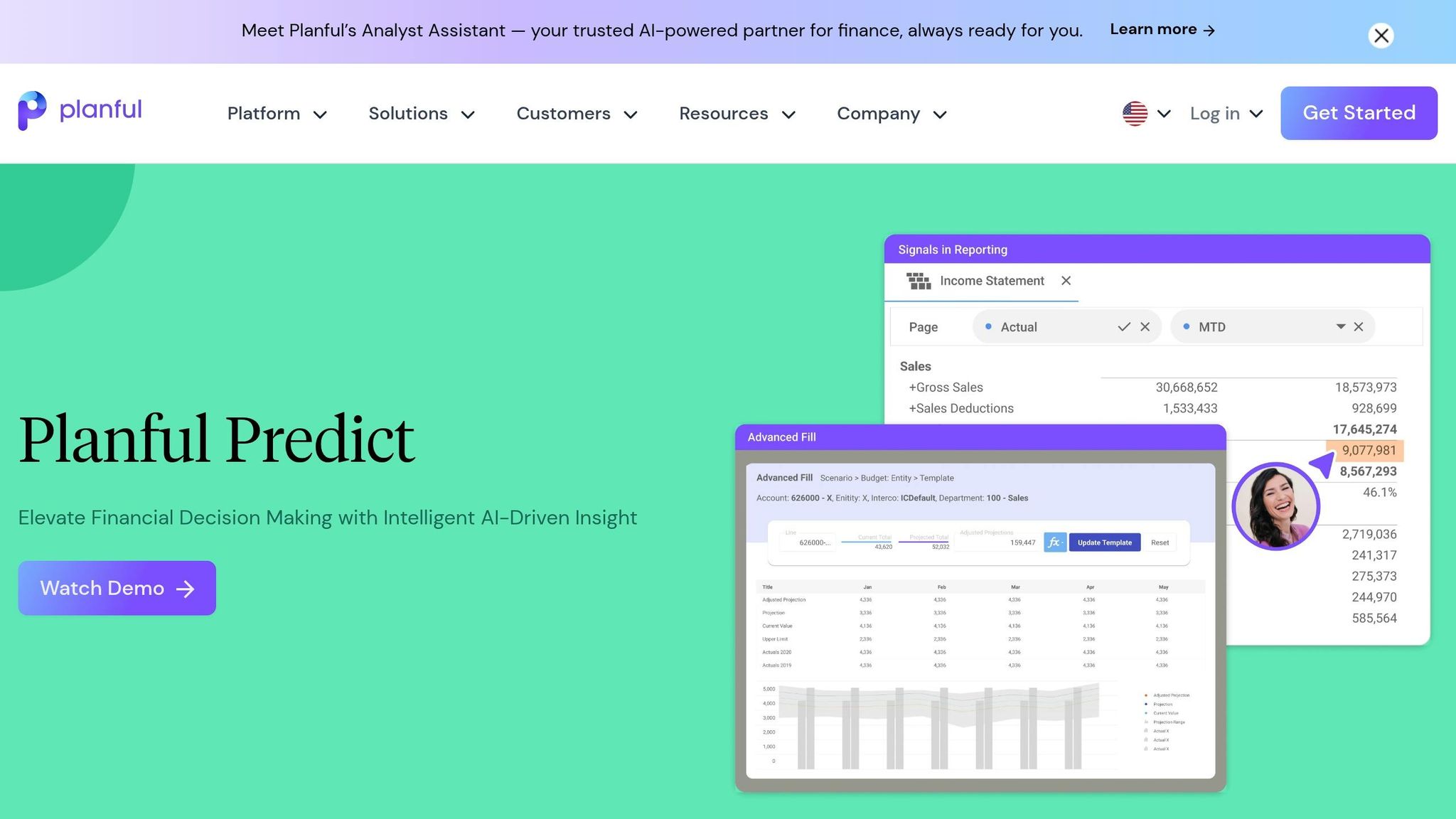
Planful Predict operates with two key engines: Predict: Signals and Predict: Projections. The Signals module acts as an early warning system, scanning for errors and anomalies automatically. Projections, on the other hand, generates AI-based forecasts by analyzing historical data, pinpointing areas of overspending or underperformance.
"We can rely on Predict to indicate to us where we need to spend our attention and where we don't." - Robby LeBourveau, Director of Finance, Manufacturing Industry
This platform shifts finance teams from tedious manual tasks to more strategic roles. It offers tiered pricing customized to ERP systems, and users have rated it 4.3/5 on both Capterra and G2. Many users appreciate its structured approach to budgeting and forecasting.
| Feature | Details |
|---|---|
| Core AI Capabilities | Anomaly detection (Signals) and AI-driven forecasting (Projections) |
| Primary Use Cases | Trend analysis, overspending identification, and performance tracking |
| Integration | Major ERP systems |
| User Ratings | 4.3/5 (Capterra and G2) |
| Pricing | Custom quote required |
Vena integrates a native Excel interface with a centralized cloud database, making it easy for teams familiar with Excel. Its intelligent assistant, Vena Copilot, streamlines tasks like reporting, variance analysis, and responding to natural language queries.
Key features include predictive forecasting, real-time anomaly detection, and cash flow modeling. With deep integration into Microsoft 365 and Azure, Vena is particularly appealing to organizations already using Microsoft's tools. It has earned a 4.6/5 rating on Capterra and 4.5/5 on G2, with users praising its ability to simplify complex data. However, businesses using Google Workspace might find its Microsoft-centric design less convenient. Vena is also noted as a budget-friendly option in BPM Partners' 2025 Vendor Landscape Matrix, making it accessible for mid-sized companies.
Phoenix Strategy Group combines fractional CFO services with AI-powered tools to help growth-stage companies manage their finances. Their Integrated Financial Model synchronizes data from accounting systems, CRMs, and operational platforms, providing real-time insights into metrics like burn rates and runway - especially useful during funding rounds.
Their Monday Morning Metrics system flags critical deviations and trends early, giving businesses time to address issues. Unlike off-the-shelf software, Phoenix Strategy Group tailors its forecasting models to align with specific business needs, such as subscription revenues or complex consolidations. Their services extend to bookkeeping, FP&A, data engineering, and M&A advisory, all powered by advanced AI tools.
DataRobot simplifies the process of building predictive models with its automated machine learning capabilities. This makes it ideal for finance teams without in-house data science expertise. The platform excels in time-series forecasting, fraud detection, and real-time risk analysis, uncovering patterns in large datasets.
DataRobot integrates seamlessly with SAP and Oracle, and it’s designed for speed - delivering forecasts in minutes, which is especially valuable during times of market volatility.
| Advantage | Impact |
|---|---|
| Automated ML | Reduces reliance on in-house data scientists |
| Speed | Delivers forecasts in minutes |
| System Compatibility | Works with SAP, Oracle, and other major ERP systems |
| Use Cases | Time-series forecasting, fraud detection, credit risk analysis |
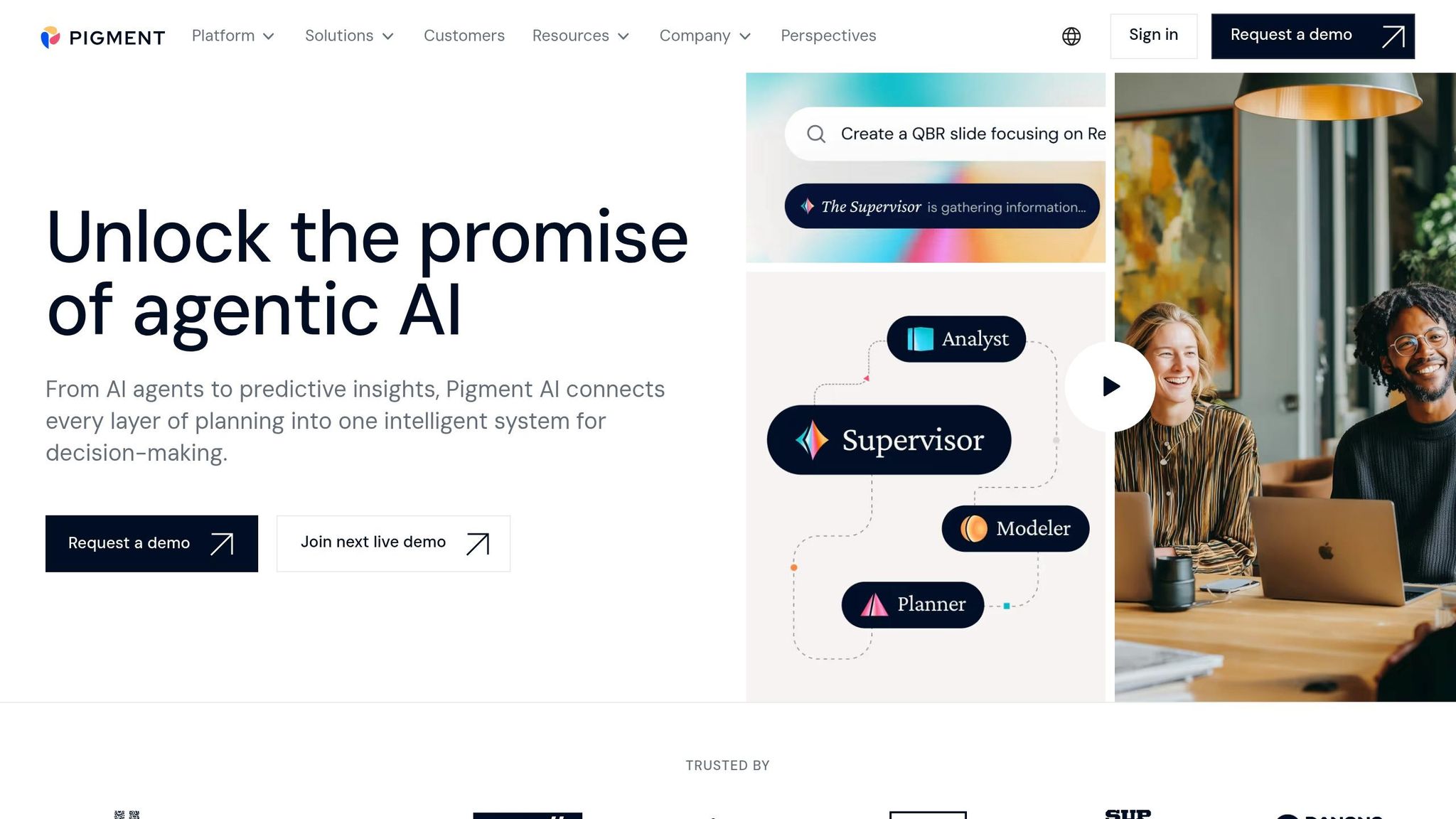
Pigment's AI Planning Assistant specializes in rolling forecasts, automated trend analysis, and real-time adjustments. Its Analyst Agent automates variance analysis, explaining significant financial discrepancies - crucial for businesses needing quick insights into performance gaps.
The platform also supports integrated headcount planning and "what-if" simulations, letting teams test how changes in factors like pricing or hiring affect their financial models. Collaboration features allow multiple stakeholders to work on forecasts simultaneously, with real-time updates.
Pigment has a 4.6/5 rating on G2, with users praising its modern interface and flexible modeling capabilities. However, its proprietary syntax can pose a learning challenge. Positioned as a premium option in BPM Partners' 2025 matrix, it’s best suited for larger enterprises or well-funded companies.
These platforms showcase a range of tools that finance teams can use to enhance their risk forecasting strategies, each catering to different business needs and budgets.
When selecting an AI forecasting tool, it's important to find one that not only fits your current needs but also adapts as your business grows. Growth-stage companies often face resource limitations and shifting demands, which can make an ill-suited platform obsolete in as little as 18 months.
On average, tech companies use 3.2 finance tools per finance employee, leading to silos and version control problems[5]. This fragmentation can drive up costs and slow decision-making. For mid-market tech companies - those with revenues between $50 million and $500 million - finance tech stacks typically cost between $200,000 and $800,000 annually[5]. Before adding new tools, it’s worth considering whether consolidating existing platforms could streamline operations and reduce expenses.
For any AI tool, smooth integration with your existing systems - like NetSuite, Sage Intacct, or Salesforce - is a must. However, integration can significantly increase costs, with license fees potentially rising by 30%–50%[5]. Look for tools that offer governed connectors to pull real-time data efficiently.
Customization is just as critical. Your forecasting tool needs to align with your revenue model, whether it's subscription-based, usage-based, or a hybrid approach. Off-the-shelf templates often fail to capture the complexities of multi-product portfolios or intricate contracts. Tools with no-code automation allow finance teams to design custom workflows without requiring extensive data science support or a fractional CFO[13].
"The effectiveness of AI in risk management relies on access to high-quality, unified data and proper integration with existing financial systems and processes."
– Kristina Russo, CPA, MBA, NetSuite[1]
A scalable and adaptable platform is equally important to meet your evolving forecasting needs.
A tool that works well today but can't grow with your business becomes a liability over time. Cloud-native platforms offer scalability, enabling you to manage larger datasets and activate additional features as your business expands[7]. The best tools connect data across multiple sources, allowing them to identify trends across products, regions, and channels[11].
Scenario planning is another must-have. Tools that can run thousands of "what-if" simulations using Monte Carlo methods provide a deeper understanding of potential outcomes compared to static models[4]. Additionally, implementation speed matters. Some platforms can deliver results in just weeks, while others require months of setup and configuration[12]. For growth-stage companies, quicker implementation means faster ROI and the ability to pivot if the tool doesn’t meet expectations.
These capabilities ensure the tool you choose supports both your immediate needs and long-term goals.
Financial data is among your company's most sensitive information, so security should be non-negotiable. At a minimum, any AI tool should meet SOC 2 compliance standards and use encryption both in transit and at rest[9][2]. For businesses handling customer payment data or preparing for audits, these features are essential.
As your company grows, auditability becomes even more critical. Look for tools that provide clear data lineage and immutable audit logs, so every forecast can be traced back to its source data and assumptions[9][3]. This transparency is crucial for boards, investors, and auditors who need to understand not just the predictions but the reasoning behind them. With "black box" models posing risks, platforms offering Explainable AI (XAI) features - such as audit trails, confidence intervals, and transparent rankings of feature importance - are increasingly valuable[10][3].
Role-based security controls add another layer of protection, ensuring that sensitive financial data is accessible only to authorized users[12]. As more stakeholders gain access to planning tools, granular permissions help maintain security while supporting collaboration. These measures are essential for safeguarding your forecasts and aligning with modern risk management practices.
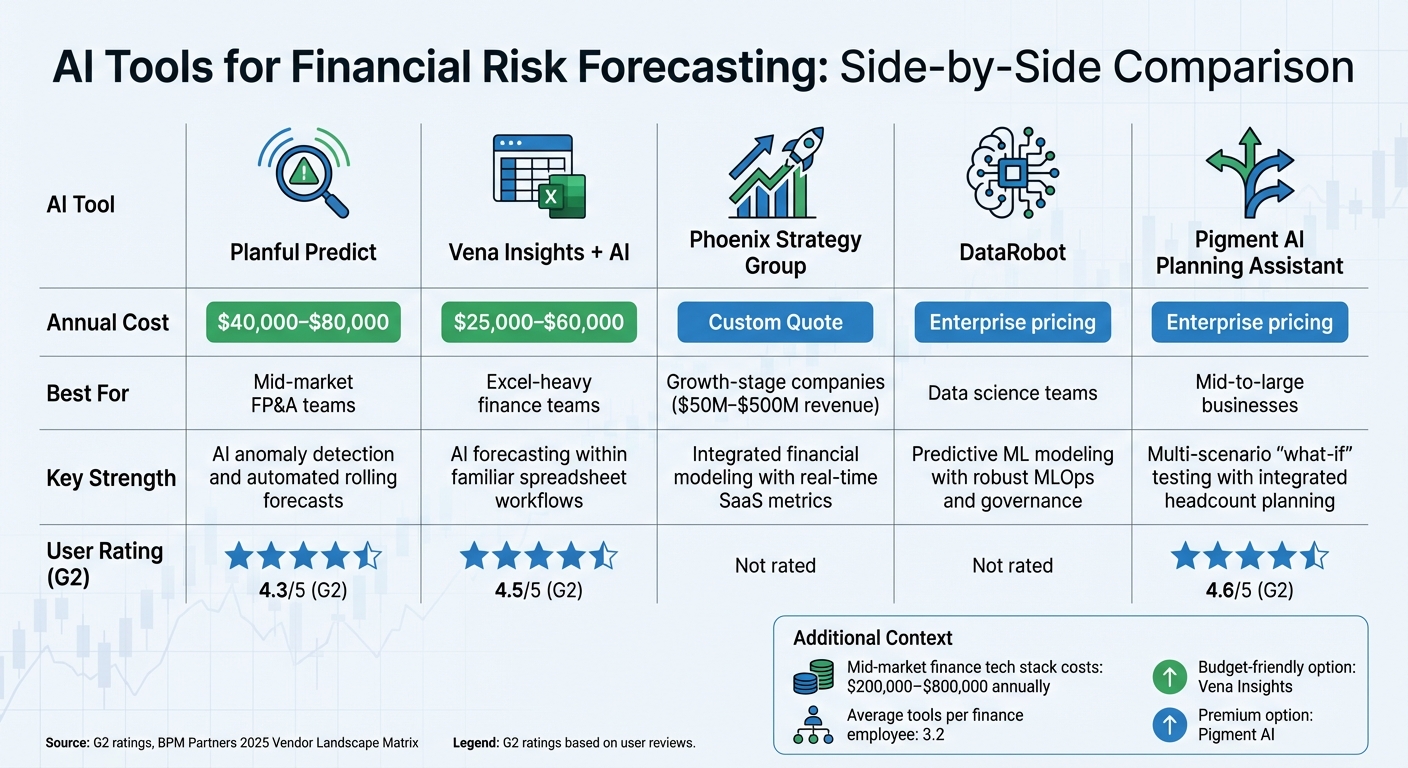
AI Financial Risk Forecasting Tools Comparison: Features, Pricing & Best Use Cases
Choosing the right AI tool depends on factors like company size, budget, and forecasting needs. Here's a breakdown of how different platforms address these requirements:
| Tool | Annual Cost | Best For | Key Strength | User Rating |
|---|---|---|---|---|
| Planful Predict | $40,000–$80,000 | Mid-market FP&A teams | AI anomaly detection and automated rolling forecasts | 4.3/5 (G2)[8] |
| Vena Insights + AI | $25,000–$60,000 | Excel-heavy finance teams | AI forecasting within familiar spreadsheet workflows | 4.5/5 (G2)[8] |
| Phoenix Strategy Group's AI-Driven Solutions | Custom Quote | Growth-stage companies ($50M–$500M revenue) | Integrated financial modeling with real-time SaaS metrics | - |
| DataRobot | Enterprise pricing | Data science teams | Predictive ML modeling with robust MLOps and governance | - |
| Pigment AI Planning Assistant | Enterprise pricing | Mid-to-large businesses | Multi-scenario "what-if" testing with integrated headcount planning | - |
This comparison highlights how each tool’s features can support proactive risk management, especially for growing companies.
For companies generating $50 million to $500 million in revenue, finance tech stacks often range between $200,000 and $800,000 annually[5]. Tools like Vena Insights provide a more affordable entry point for mid-market teams, while Planful Predict offers advanced features like rolling forecasts and scenario planning at a higher cost. Aligning your financial strategy with the tool’s capabilities is essential to maximize value.
Accuracy is another key factor. For instance, Energent.ai’s specialized model achieved a 94.4% accuracy rate when extracting risk signals from unstructured documents, compared to 76.4% for OpenAI agents[2][6]. This level of precision is critical when financial forecasting depends on interpreting contracts, loan agreements, or regulatory filings.
The time it takes to implement a platform can significantly impact ROI. Some tools are ready to deliver results within weeks, while others may require months of setup. For growth-stage companies, faster deployment translates into quicker returns and greater agility in responding to market changes.
The financial world is evolving rapidly, and AI tools are changing the game for growth-stage companies. These tools allow businesses to shift from reactive reporting to proactive risk management, spotting potential problems before they arise[2]. The real question isn’t whether to adopt AI - it’s about finding the right tools that match your company’s scaling goals.
AI-powered forecasting offers 92–97% accuracy, a big leap from the 60–70% accuracy of manual spreadsheets[14]. This leap in precision leads to tangible benefits: emergency borrowing costs drop by an average of 35%[14], and working capital efficiency improves by 12–18%[14].
"As CFO, you're not just buying algorithms - you're buying faster, safer decisions." - Christopher Good, CFO expert[4]
Phoenix Strategy Group's AI solutions tackle the unique hurdles growth-stage businesses face. These tools link operating plans with real-time cash flow insights, align revenue projections with headcount planning, and adapt risk models to shifting market conditions[14][8]. By automating routine tasks, they free up FP&A teams to focus on strategic, high-value decisions[4][3].
The benefits are hard to ignore. Companies using AI data agents save three hours per risk professional every day[6]. Meanwhile, those sticking with manual processes risk falling behind, especially during volatile market shifts, where delays can lead to severe losses[2]. For businesses aiming to scale, secure funding, or prepare for an exit, adopting AI tools shortens planning timelines and builds agility into decision-making - all without sacrificing control[4].
To stay ahead, it’s crucial to act now. Start with one or two key areas, like revenue forecasting or managing cash flow in inflationary environments, and aim to demonstrate measurable results within 90 days[4][3]. The sooner you integrate AI into your operations, the better positioned you’ll be to navigate future market changes and maintain a competitive edge.
To make the most of AI for risk forecasting, start with accurate and high-quality data. This includes sources like historical financial records, market trends, regulatory filings, credit reports, and operational documents. Reliable predictions depend on clean and well-organized data - poor-quality data can lead to serious missteps.
It's also crucial to address governance and security requirements, especially when dealing with sensitive information. Combining internal and external data sources can help you create forecasts that align closely with your organization's unique risk profile.
Implementing an AI forecasting tool usually takes anywhere from 1 to 3 months, depending on how complex your data systems are and the scale of the deployment. The process involves several key steps: integrating the tool with your financial data, tailoring the models to fit your needs, and training your team to use it effectively. While some tools promise deployment in just a few weeks, achieving a complete setup - including thorough testing and validation - often takes a bit longer to ensure everything runs smoothly and aligns with your organization's objectives.
To ensure AI forecasts are both secure and reliable, it's essential to implement a structured governance framework. Start by setting up strict access controls and role-based permissions to limit who can interact with the system. This reduces the risk of unauthorized changes or data breaches. Additionally, data lineage tracking helps keep tabs on how data flows through the system, ensuring transparency.
Using explainable AI models is another key step. These models make it easier for stakeholders to understand how forecasts are generated, building trust and accountability.
For auditing purposes, maintain detailed logs that capture inputs, parameters, and decisions throughout the forecasting process. These logs serve as a reliable audit trail, making it easier to review and evaluate the system's performance.
Finally, automated monitoring tools can play a big role in identifying anomalies or unauthorized access. These tools not only enhance security but also help ensure compliance with regulatory standards. Together, these measures create a solid foundation for secure and auditable AI forecasting.