Published on
May 28, 2026


Supply chain disruptions can wreak havoc on your cash flow, especially if you're not prepared. Here's what you need to know:
The key takeaway? Plan ahead, monitor cash flow metrics like the Cash Conversion Cycle (CCC), and set up safeguards before disruptions hit. Waiting until a crisis strikes limits your options and increases financial strain.
Supply chain disruptions ripple through every aspect of a business's finances, from inventory management to payment cycles and operational expenses. These disruptions create a cascade of challenges that strain cash flow.
When supply chains falter, businesses often abandon the "just-in-time" (JIT) inventory strategy in favor of a "just-in-case" (JIC) approach. This shift means stockpiling extra inventory to prevent production delays or empty shelves. However, this safety stock ties up cash that could otherwise be used for critical needs like paying vendors, covering payroll, or funding growth initiatives.
In 2025, nearly half (49%) of large corporations reported preserving cash as a buffer against unpredictable price changes and demand, while 46% focused on reducing excess inventory to free up liquidity [7]. Adding to this challenge, tariff increases - some reaching 15% to over 40% in certain regions - prompted businesses to front-load orders, further inflating inventory levels and exacerbating cash flow issues [4][7].
"The trade-off is real: inventory buffers tie up working capital, but shortages cost more." - iBanFirst [1]
This overstocking not only locks up working capital but also leads to longer delays in converting inventory back into cash.
The cash conversion cycle (CCC) tracks how long it takes for a business to turn its inventory investments into cash from sales. Supply chain disruptions stretch this cycle at every step. Delays in lead times mean goods stay in transit longer, and incomplete or late deliveries can cause customers to postpone payments, compounding the strain on cash flow [3].
When inventory sits idle, it incurs daily costs tied to demand and unit prices [5]. For companies operating on slim profit margins, even a two-week delay can significantly increase their working capital needs. To make matters worse, businesses often face additional costs to address urgent demands caused by these delays.
When primary suppliers fail to deliver, businesses are forced to make tough decisions: wait and risk running out of stock or pay higher costs for expedited shipping or alternative sourcing. For example, during the Hormuz crisis in early 2026, major carriers imposed war risk surcharges ranging from $1,500 to $4,000 per container [8]. Switching from ocean freight to air freight, a common workaround, further drives up per-unit costs [6].
The timing of these expenses creates a cash flow crunch. Businesses must pay surcharges, expedited fees, and tariffs upfront, while the revenue from these shipments is delayed. This mismatch often forces companies to dip into credit lines just to maintain operations [8][2].
"Working capital is not destroyed in a single event. It erodes through timing gaps. Cash goes out faster than it returns, across multiple fronts, at the same time." - CE Interim [8]
Between 2025 and 2026, about 60% of U.S. companies saw logistics costs rise by 10% to 15%, driven by tariffs and supply chain adjustments [2]. For businesses lacking pre-arranged credit facilities, these rising costs can push already tight cash reserves into a crisis.
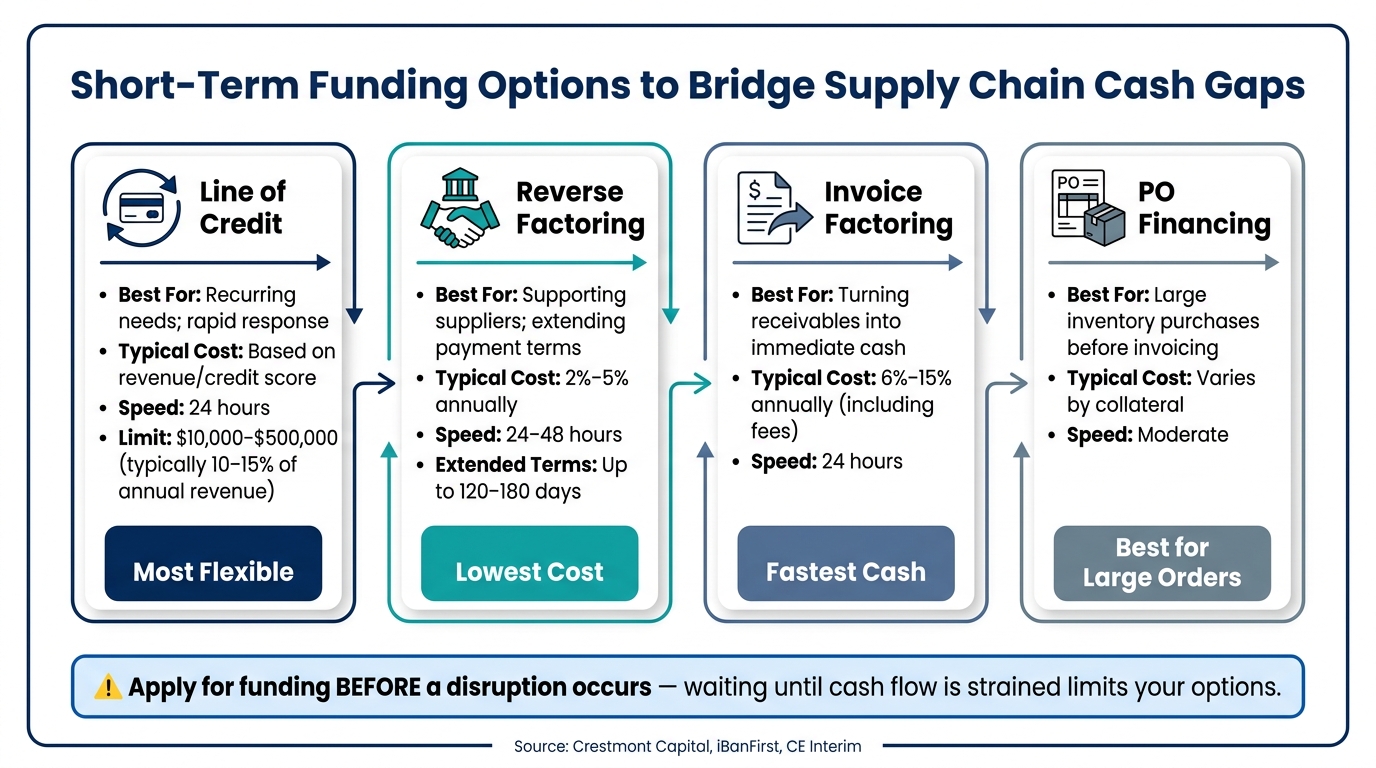
Supply Chain Disruption: Funding Options to Bridge Cash Flow Gaps
When disruptions hit, managing cash flow becomes a critical challenge. By adopting proactive financial strategies, businesses can better navigate these turbulent times.
In times of supply chain uncertainty, sticking to an annual budget just won’t cut it. A 13-week cash flow forecast is a practical tool for managing short-term liquidity. It offers a week-by-week snapshot of cash inflows and outflows, giving finance teams enough time to address potential shortfalls before they escalate into full-blown crises.
"The 13-week cash flow forecast becomes the single most important tool in a volatile environment." - Excellence Accounting Services [3]
To go beyond short-term planning, consider rolling forecasts. Unlike static annual plans, these are updated monthly or quarterly with real-time data, helping you stay adaptable. Pair this with scenario-based planning, where you prepare multiple forecasts for different situations - like supplier disruptions or rising shipping costs. Yet, surprisingly, only 2 in 10 organizations fully integrate scenario planning into their supply chain strategies [9].
Another underutilized strategy is setting action triggers ahead of time. For instance, you could decide that if duty rates increase by 10%, a pre-funded response plan is automatically activated. This approach eliminates delays caused by decision-making during a crisis.
While forecasting helps identify cash flow gaps, the next step is to address them through efficient working capital management.
Start by tightening up your receivables. Adjust customer payment terms, send invoices promptly, and follow up on overdue accounts to speed up cash collection. A shorter collections cycle means cash comes in faster, reducing strain.
On the payables side, renegotiating supplier payment terms can provide much-needed flexibility. For example, extending payment terms from 30 to 60 or even 90 days can help preserve cash flow without taking on new debt. Reverse factoring is one structured way to achieve this. In this arrangement, a buyer’s bank pays the supplier early at a low rate (based on the buyer’s credit), while the buyer gets extended payment terms of up to 120–180 days [11]. Supply chain financing discount rates typically range from 2% to 5% annually, making it a cost-effective option [11].
Inventory management is another area to optimize. Use ABC analysis to categorize your stock. Prioritize safety stock for essential “A” items while keeping less-critical “C” items lean. This helps balance operational needs with the cost of tying up working capital.
By focusing on receivables, payables, and inventory, businesses can strengthen their cash flow defenses and better withstand supply chain disruptions.
Even with solid forecasting and working capital practices, timing gaps can still occur. Pre-arranged funding can act as a safety net to maintain liquidity during these moments.
"The single biggest mistake business owners make is waiting until a supply chain crisis has already hit before applying for financing." - Crestmont Capital [10]
A revolving line of credit is one of the most flexible funding options. Once established, it provides access to funds within 24 hours, allowing you to draw only what you need. For small businesses, credit limits typically range from $10,000 to $500,000, often set at 10%–15% of annual revenue [10].
If your company has outstanding invoices, invoice factoring can convert those receivables into immediate cash. While it’s a pricier option (6%–15% annually, including fees) [11], it can be a quick solution. For businesses with long production cycles, purchase order (PO) financing can help cover inventory costs before invoices are issued.
Here’s a quick comparison of these funding options:
| Financing Option | Best For | Typical Cost | Speed |
|---|---|---|---|
| Line of Credit | Recurring needs; rapid response | Based on revenue/credit | 24 hours |
| Reverse Factoring | Supporting suppliers; extending payment terms | 2%–5% annually | 24–48 hours |
| Invoice Factoring | Turning receivables into cash | 6%–15% annually | 24 hours |
| PO Financing | Large inventory purchases before invoicing | Varies by collateral | Moderate |
The key takeaway? Apply for funding before a disruption occurs. Waiting until cash flow is already strained can limit your options. Companies like Phoenix Strategy Group offer fractional CFO services to help businesses set up these funding structures ahead of time, ensuring you’re prepared for whatever comes next.
Quick fixes like forecasting or bridging credit gaps might ease cash flow pressures temporarily, but they don’t solve the deeper issues. To build financial stability over the long haul, businesses need to rethink sourcing strategies, inventory management, and how they integrate data.
One of the biggest risks companies face is over-reliance on a small group of suppliers. If more than 50% of your procurement budget is tied to just a few vendors, disruptions can hit hard [12].
"Not all concentration is risk - only critical-path concentration is." - CFO Bridge [12]
The key is to focus on critical-path inputs, which are essential materials concentrated in a single region or with one supplier. A good strategy here is dual-sourcing - qualifying at least one backup supplier in a different region. This approach avoids the complexity of managing too many vendors while still reducing risk.
To make smart decisions, use a weighted risk ranking system. Evaluate suppliers based on factors like financial stability, reliability, and lead time variability. Also, calculate substitution costs - the expenses and delays involved in switching suppliers - before a crisis forces you to act.
Another blind spot? Many companies only monitor Tier 1 suppliers (the ones they deal with directly). But Tier 2 and Tier 3 suppliers often carry hidden risks, especially when tariffs or regional issues come into play. In fact, only 42% of businesses have visibility into these deeper layers of their supply chain [12].
Once supplier risks are addressed, it’s time to rethink inventory strategies to better manage cash flow.
After tackling supplier vulnerabilities, businesses need to refine how they manage inventory. Lead times have grown significantly, from 65 days pre-2019 to 79 days in 2024 [12]. This increase pushes up Days Inventory Outstanding (DIO) and stretches cash conversion cycles. Meanwhile, inventory carrying costs can eat up 20% to 30% of the average inventory value annually [13]. But cutting inventory too much risks stockouts and lost sales.
A smart approach blends safety stock with automated decision triggers. Use a data-driven formula to calculate safety stock:
(Max Daily Usage × Max Lead Time) – (Avg Daily Usage × Avg Lead Time).
This method ensures buffers are based on actual data, not guesswork, and focuses on high-priority items.
Decision triggers can also streamline inventory management. For example, if a supplier’s lead time increases by 20%, an automatic reorder at a higher quantity can be triggered. This eliminates delays caused by manual oversight and ensures you’re always ahead of potential stockouts.
Supply chain visibility isn’t just a tech upgrade - it’s a critical investment in working capital.
"A manufacturer carrying $10 million in excess inventory as a buffer against uncertainty is paying somewhere between $2 million and $3 million per year for the privilege of not knowing what its supply chain is doing." - Wiss [13]
Connecting your ERP system with real-time supply chain data can make a huge difference. It updates inventory valuations, landed costs, and cash flow projections instantly. This level of accuracy helps businesses make better sourcing decisions and have more productive conversations with lenders. Companies that improved supply chain visibility reported a 15% to 20% boost in inventory turns [13], freeing up cash that would otherwise be tied up in excess stock.
Real-time data also allows for quicker responses to disruptions. Spotting issues early can cut expedited shipping costs - which are 3 to 5 times higher than standard freight - by 30% to 50% [13]. Tools like those offered by Phoenix Strategy Group integrate financial and supply chain data, giving teams the insights they need to act before minor disruptions escalate into major cash flow problems. This proactive approach strengthens short-term cash flow while building a more secure financial future.
Keeping cash flow steady isn’t just about good sourcing strategies - it’s about using the right metrics and governance practices to spot risks early and act on them. Without this, even the best plans can falter.
One of the most important metrics to track is the Cash Conversion Cycle (CCC). This measures how long cash is tied up between paying for inventory and collecting payments from customers. Any disruptions - like longer inventory holding times or shorter payment terms - can stretch this cycle, putting pressure on cash flow [12].
Within the CCC, two specific metrics deserve special attention:
In addition to the CCC, there are two forward-looking metrics you should monitor:
To stay on top of these metrics, consider using a unified dashboard that provides a real-time view of liquidity, working capital, and potential disruptions.
A well-designed dashboard does more than track financial data - it connects operational signals to cash flow outcomes. For example, combining lead time variability with DIO and DPO can give you a clearer picture of emerging risks [12].
An effective dashboard should provide insights across three key areas:
Tools like those offered by Phoenix Strategy Group can integrate these data points into a single view. By reviewing dashboards weekly or bi-weekly, you can shift from reacting to problems to proactively managing risks.
Of course, dashboards are just one part of the equation. You also need strong governance practices to ensure insights lead to action.
Metrics only matter if you act on them. That’s where structured governance comes in. Quarterly reviews, which include supplier concentration analysis and 13-week rolling stress tests, can help you address risks before they escalate [1] [3]. Assigning clear responsibilities to team members during these reviews ensures accountability.
Given that major supply chain disruptions happen approximately every 3.7 years and last over a month, regular stress testing is essential [1].
Supplier contracts also play a crucial role in governance. Negotiating risk-sharing clauses - covering areas like price adjustments, dual-sourcing, or fluctuating freight costs - can stop supplier issues from snowballing into cash flow crises [3]. Pair these measures with trade credit insurance to safeguard receivables if a key customer defaults due to their own supply chain challenges [3]. Together, these steps create a governance framework that can withstand unexpected challenges.
Supply chain disruptions happen more often than you might think. On average, major disruptions occur every 3.7 years, and by 2024, 80% of organizations reported feeling the operational strain [1]. The real question isn’t whether your business will face such challenges - it’s whether you’ll be prepared when they arrive.
What sets resilient businesses apart? They don’t wait for a crisis to act. Instead, they prepare in advance. This means creating cash flow forecasts that consider potential disruptions, managing working capital with care, diversifying suppliers, and using governance structures to turn data into actionable decisions. Laura Zindel, Director of Assurance at Wiss, puts it plainly:
"The disruption is not coming. It is already in your cost structure. The question is whether you have a documented, funded plan for when it accelerates, or whether you are still reacting quarter by quarter." [4]
Planning ahead also lays the groundwork for another key element: quick decision-making when disruptions hit.
Speed matters. For example, pre-approving emergency spending - like allocating $500,000 for alternative sourcing during a 45-day disruption - can turn a potential crisis into a manageable problem. Pair this with a funded liquidity reserve and clear triggers (such as a 10% increase in duty rates prompting a sourcing switch), and your business can stay agile [4].
To help businesses put these strategies into action, Phoenix Strategy Group partners with growth-stage companies to build financial systems that can handle uncertainty. From cash flow forecasting and working capital management to fractional CFO support and data integration, they focus on connecting supply chain insights to financial outcomes. If your business is grappling with supply chain challenges, having the right financial partner can make a measurable difference.
Keeping an eye on Key Risk Indicators (KRIs) can help you catch supplier or operational problems early - before they start impacting your cash flow. Be alert for signs like supplier delays, extended lead times, reduced responsiveness, or reluctance to commit to orders. On the internal side, watch for red flags such as spikes in emergency orders, mismatched inventory, or growing backlogs.
By centralizing your data, you can identify these risks 30–60 days in advance, giving you a critical window to put contingency plans in place. Companies like Phoenix Strategy Group specialize in helping businesses set up these systems to protect their liquidity.
Building a liquidity buffer tailored to the disruption scenario you’re analyzing is crucial. As supplier risks shift, make sure to adjust your buffer accordingly. Experts at Phoenix Strategy Group recommend conducting regular cash flow forecasts across multiple scenarios. This approach helps identify potential liquidity shortfalls early. Additionally, having a funded reserve with defined amounts and timelines for working-capital needs can ensure you're ready to act before liquidity challenges arise.
One way to improve your cash conversion cycle is by focusing on Days Inventory Outstanding (DIO). Lowering excess or slow-moving inventory directly reduces DIO, which means your cash isn't stuck in inventory for long periods.
Since the cash conversion cycle (CCC) is calculated as DIO + DSO − DPO, improving DIO shortens the time it takes to turn inventory into sales, freeing up cash for other business needs.