Published on
April 19, 2026


Want to grow revenue without chasing new customers? Focus on ARPU (Average Revenue Per User). For growth-stage businesses, improving ARPU is often more cost-effective than acquiring new users. Here are five proven strategies to boost ARPU:
Each strategy aligns pricing with customer value, leading to higher revenue per user. Whether it's through smarter pricing models, personalized offers, or bundling, these approaches can give your business the revenue lift it needs to thrive.
Tiered pricing lets you cater to various customer segments at the same time. By offering multiple pricing levels, you can appeal to both cost-conscious startups and high-spending enterprise clients, tailoring plans to match what each group is willing to pay. Interestingly, about 66% of SaaS companies now rely on tiered pricing as their main approach, while only 8% stick to flat-rate pricing [9].
The sweet spot for most B2B SaaS companies is 3 to 4 tiers. This keeps things straightforward while giving customers meaningful options [5][7]. Each tier should clearly communicate its value - don’t just settle for generic names like "Basic" or "Pro." Instead, describe how each plan benefits a specific audience. For example, instead of "Pro", you might say, "Growth – Designed for teams managing multiple projects" [6]. The goal? Make it easy for customers to see the added value of upgrading to a higher tier.
Usage-based pricing, on the other hand, ties costs to actual usage - think API calls, storage, or transactions. This model is becoming more popular, with adoption rates jumping from 24% in 2023 to 37% by 2025 [9]. It’s especially effective for infrastructure and developer tools, where customers feel they’re paying a fair price for what they use [7]. However, implementing this model requires robust systems for tracking and billing usage, along with clear dashboards to ensure customers aren’t shocked by unexpected charges [7][8].
"Pricing is the single most powerful lever for revenue growth in a SaaS business." - Eagle Rock CFO [7]
The financial impact of smart pricing is huge. For instance, a 10% price increase - without adding costs or losing customers - can more than double profits for a company with 20% operating margins [7]. Beyond that, how you structure and package your pricing can drive expansion revenue just as much as it affects initial customer acquisition [6]. Even small adjustments, like emphasizing upgrade opportunities on your pricing page, can encourage customers to move to higher tiers without needing to change your product. Both tiered and usage-based models are powerful tools for boosting ARPU by aligning what customers pay with the value they receive. Up next, we’ll look at how targeted upselling can further increase ARPU.
Upselling to your existing customers is a powerful way to increase ARPU (average revenue per user). Why? Because upselling to current customers has a 60-70% conversion rate, compared to just 5-20% for cold leads [11]. This makes it not only more effective but also more cost-efficient and faster than acquiring new customers.
Timing and relevance are everything. The best upsell opportunities arise when customers naturally reach a limitation - like hitting storage caps, user limits, or running into feature restrictions. For instance, automated alerts when usage reaches 80% capacity can prompt an upgrade that feels helpful instead of intrusive [11]. A great example is New World Hoiana, a 330-room resort in Vietnam. Between January and April 2025, they implemented automated tracking and trained their team, leading to a 60% year-over-year increase in upsell revenue and an ROI of 13.1x [11].
Certain strategies deliver better results. For example, order bumps convert at 37.8%, and one-click post-purchase offers convert at 14.6% [11]. Price matters too - upsells priced in the $51-$100 range hit a 16.2% conversion rate and deliver a 31.4% revenue lift [11]. To avoid overwhelming customers, cap upsell prices at 25% of the original purchase price [11].
Personalization is a game-changer. Offers tailored to actual customer behavior perform far better. In-app prompts based on real usage data convert at around 25%, while generic email campaigns struggle with less than 5% conversion rates [2]. Take HGS Financial Services as an example: by using speech analytics during customer calls, they identified upsell opportunities that generated $50M annually while boosting their Net Promoter Score by 70% [11]. The takeaway? Use customer data to craft offers that address specific needs, rather than relying on one-size-fits-all promotions.
Keep it simple. Offering too many upsell options can overwhelm customers, so limit choices to two or three [11]. Use side-by-side comparisons to clearly show what they’re missing in their current plan [10][11]. When upsells are aligned with genuine needs and presented at the right time, they feel less like a sales pitch and more like a helpful solution.
Up next, learn how customer segmentation can take personalization to the next level and further increase ARPU.
Customer segmentation takes upsell strategies to the next level by tailoring offers to specific groups, which can significantly boost ARPU. By dividing your customer base into categories based on factors like behavior, usage patterns, company size, or value, you can create pricing and promotions that feel customized rather than one-size-fits-all. The payoff? A 15-30% ARPU increase, as this approach aligns offers with actual customer needs [12][13].
Here’s some proof: Adobe segmented its Creative Cloud users into usage tiers, which led to an ARPU jump of 18%, from $52.99 to $62.64 per month. Similarly, HubSpot’s strategy of offering tailored add-on bundles increased ARPU by 22%, moving from $89 to $109 per month. These examples highlight how segmentation directly impacts revenue. Personalized offers not only encourage upgrades but also make targeted pricing models more effective.
To get started, consider tools like Mixpanel, Amplitude, or Segment.io. Begin with 3-5 behavioral segments, such as power users, casual users, and at-risk customers. Use RFM analysis (Recency, Frequency, Monetary value) to decide who gets what offer. For instance, high-usage customers might be prompted with premium upgrades, while low-engagement users could receive introductory discounts or win-back offers. A/B testing these offers and automating their delivery through your CRM can streamline the process [14][15].
What’s great about segmentation is how easily it scales. Once automated through cloud-based platforms, it can manage millions of users with minimal added cost. Growth-stage companies often see returns within 3-6 months. This method resonates with customers, as 71% expect personalized interactions, and 76% report frustration when they don’t get them [16].
To measure success, track ARPU growth, conversion rates on offers (aim for +20-30%), churn reduction, and segment-specific customer lifetime value. For growth-stage businesses, services like those offered by Phoenix Strategy Group can help turn customer data into actionable, revenue-generating insights through segmentation.
Up next: Discover how bundling products and value-added services can complement these personalization strategies.
Bundling products and services is a smart way to boost ARPU without pushing customers into strict tier upgrades. It simplifies choices, reducing decision fatigue, and can lead to revenue increases of 5–15% for growth-stage companies [1].
Take a page from companies like Duolingo, which extended its offerings beyond language learning to include subjects like math, music, and chess. This move contributed to a 41% revenue growth and higher paid subscriptions by 2025 [4]. Similarly, ClassPass expanded its focus from fitness classes to include wellness and beauty options, and by 2021, 55% of New York's listings on the platform were non-fitness venues [4].
Value-added services (VAS) also play a key role in increasing revenue. Features like priority support, identity protection, or faster data access can encourage existing users to spend more. For example, Array's "Identity Protect" add-on saw a 96% adoption rate among Beem’s fintech users, creating a fresh revenue stream through embedded security features [17]. In fintech, where acquiring a single user can cost between $200 and $500, these add-ons can be critical to achieving profitability [17].
"Bundling works best when it reduces complexity and makes value feel obvious." – Bain & Company [1]
To make bundling successful, consider a "Good-Better-Best" pricing model. By pricing a multi-service bundle slightly below your highest-tiered single service, you can make the bundle the most appealing choice [18]. Use behavioral data to identify which services customers prefer to combine and automate upgrade prompts at key usage milestones [1]. One telecom provider that leveraged behavioral segmentation and bundling saw a 19% increase in postpaid upgrades within just 90 days [1]. Once automated, bundles can scale easily with minimal operational effort [1].
Measure your success by tracking ARPU growth, bundle adoption rates (aim for 20% or higher), and churn rates between bundled and single-product users. If managing complex customer data feels overwhelming, services like Phoenix Strategy Group’s FP&A and data engineering can help pinpoint the most effective bundle combinations.
Up next, let’s dive into how data analytics and predictive modeling can fine-tune your revenue strategies.
Data analytics and predictive modeling transform customer behavior into actionable strategies. By analyzing patterns like usage habits, purchase frequency, and engagement signals, businesses can pinpoint customers who might churn, upgrade, or respond to specific offers. This approach has been shown to reduce churn by 15–20% and increase ARPU (average revenue per user).
Predictive analytics plays a crucial role in driving revenue growth. Companies leveraging these tools report 68% higher ARPU growth. A great example is Dropbox, which discovered that 30% of its free users were likely to upgrade. By targeting these users with tailored emails, Dropbox achieved an additional 12% conversion rate, boosting ARPU by 22% [19].
To make this work, integrate CRM, usage, and financial data into a single platform. Start with RFM segmentation (Recency, Frequency, Monetary value) and create churn prediction models using tools like Python's scikit-learn. While initial setup might take 3–6 months and require data engineering expertise, cloud platforms like AWS or GCP can scale data capacity by 10x without a corresponding jump in costs [16]. This unified approach simplifies data management and enhances predictive accuracy.
Key metrics to monitor include churn rate, customer lifetime value (CLV), and ARPU uplift. For example, maintaining a CLV-to-ARPU ratio above 3x and keeping monthly churn below 5% often aligns with a 15% ARPU increase. Use A/B testing to refine predictive recommendations and focus on upselling to power users based on their projected lifetime value. Incorporate RFM insights into your predictive models to further fine-tune your strategies.
For more advanced results, consider the services of groups like Phoenix Strategy Group, which specialize in FP&A and data engineering. They can help integrate your unique data sources, potentially improving prediction accuracy by 20–35%. By combining predictive analytics with tiered pricing, personalized offers, and bundling strategies, you can build a more robust ARPU growth plan. Start small - focus on one metric, such as lifetime value, to achieve quick wins, and then expand your models over time.
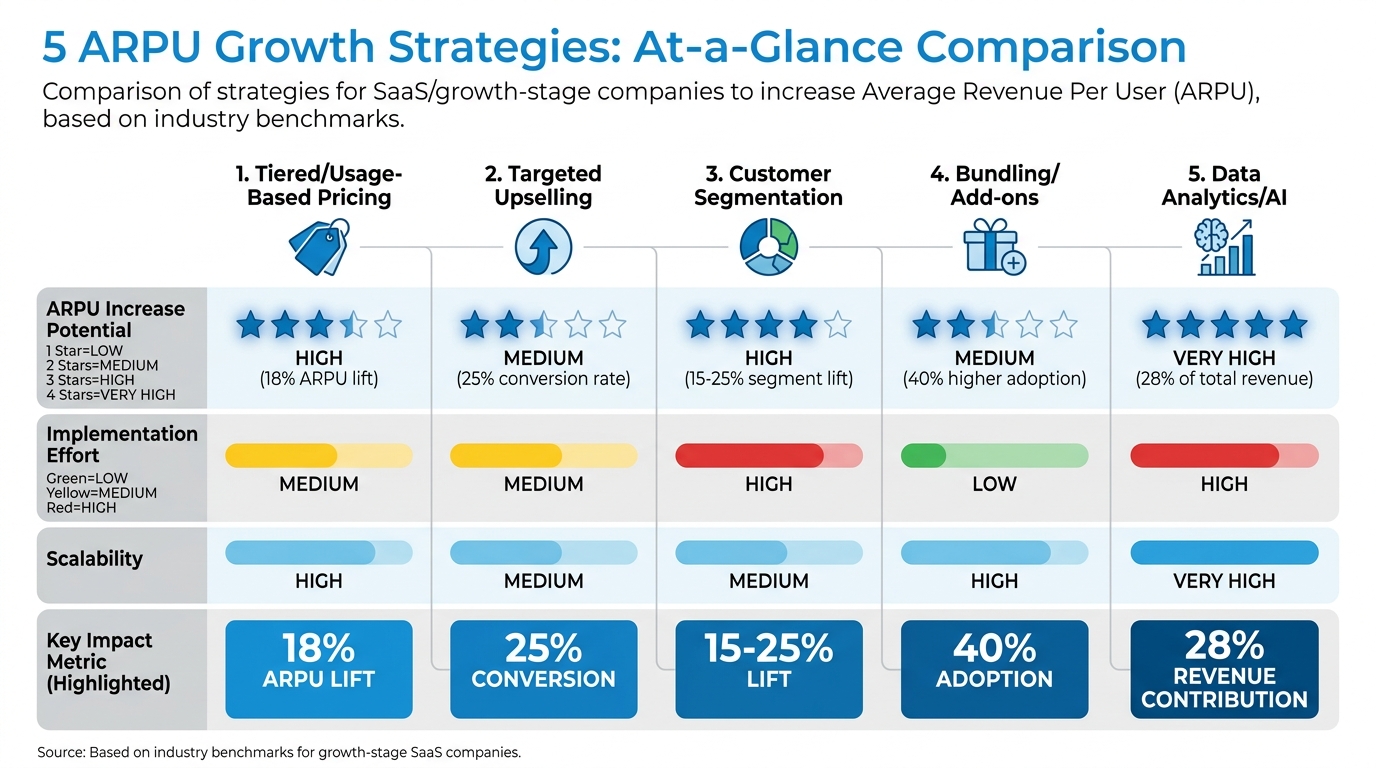
ARPU Growth Strategies Comparison: Impact, Effort, and Scalability
Here’s a quick side-by-side comparison of the ARPU strategies we’ve covered, summarizing their benefits and challenges. This breakdown can help you decide which approach aligns best with your business’s growth phase, resources, and timeline.
Tiered and usage-based pricing can deliver an 18% ARPU lift and works well across a broad customer base [2]. However, it requires careful mapping of customer progression and A/B testing to ensure success. The main hurdle? Adapting to shifts in customers' willingness to pay as your product evolves [1].
Targeted upselling achieves a 25% conversion rate when using personalized in-app prompts, compared to less than 5% for generic email campaigns [2]. Success hinges on using behavioral triggers and solid CRM data. The key challenge? Avoiding tactics that might alienate loyal users [3].
Data analytics and predictive modeling stand out for scalability. Companies using advanced AI for personalized recommendations have reported these efforts contribute 28% of their total revenue [2]. That said, this strategy demands significant expertise in data engineering. For businesses struggling with complex data integration, Phoenix Strategy Group offers FP&A and data engineering services to help.
Bundling and value-added services are easier to implement and lead to 40% higher adoption rates [2]. This makes it an attractive option for businesses looking to enhance ARPU without heavy resource investments.
The table below provides a snapshot of these strategies, making it easier to weigh their potential impact and implementation demands.
| Strategy | ARPU Increase Potential | Implementation Effort | Scalability | Impact |
|---|---|---|---|---|
| Tiered/Usage-Based Pricing | High | Medium | High | 18% ARPU lift [2] |
| Targeted Upselling | Medium | Medium | Medium | 25% conversion rate [2] |
| Customer Segmentation | High | High | Medium | 15–25% segment lift [2] |
| Bundling/Add-ons | Medium | Low | High | 40% higher adoption [2] |
| Data Analytics/AI | Very High | High | Very High | 28% of total revenue [2] |
Boosting ARPU isn't just about chasing short-term wins - it's about creating long-term, value-driven growth that adapts to your customers' changing needs. Strategies like tiered pricing and predictive analytics each play a part in ensuring sustainable growth. This focus is especially important for growth-stage companies, where increasing value from existing customers is often far more cost-effective than constantly acquiring new ones.
The secret to success? Relying on data to guide your decisions. As Alice Muir Kocourková from RevenueCat puts it:
"Earn engagement, then monetize it. That's how established subscription businesses turn retention improvements into sustainable ARPU growth" [4].
Understanding how your customers spend, use your product, and their willingness to pay is crucial for applying these strategies effectively. For instance, companies that personalize the customer experience across the lifecycle often see revenue increases of 5–15% [1] when they utilize precise, actionable data.
However, for many growth-stage companies, the real hurdle isn't knowing what to do - it's having the right financial infrastructure and expertise to execute effectively. This is where strategic financial advisory services come into play. Phoenix Strategy Group offers tailored support, combining fractional CFO services with data engineering expertise. Their approach ensures you're not just tracking revenue but actively using financial data to make smarter growth decisions. As one client observed:
"When you put the Right Data in front of an Empowered Team, they get better" [20].
Think of ARPU as an ongoing optimization process [3]. Regular A/B testing, pricing experiments, and behavioral analysis help fine-tune the balance between delivering customer value and driving revenue. The companies that succeed are those that treat ARPU as a flexible tool - constantly adjusting as their products grow and customer needs evolve.
Start by focusing on segmentation - a key step that helps you craft targeted growth strategies and boost monetization for your current users. By breaking down your audience into distinct groups, you can customize your offerings and pricing to better meet their needs, ensuring you’re driving the most value from each segment.
To adjust prices without driving customers away, focus on clear communication and thoughtful timing. Give customers a heads-up at least 60-90 days beforehand. Present the change as a "value adjustment" and take the time to explain why it's happening. Highlight the benefits they’ll continue to receive.
To ease concerns, consider offering flexible options like annual contracts. This can help reassure customers and reinforce trust. Staying transparent and consistent throughout the process is key to keeping 85-95% of your customers while avoiding any sense of shock or unfairness.
To anticipate upgrades and churn effectively, hone in on critical data such as customer segmentation, usage patterns, revenue contribution, retention rates, and behavior trends. These metrics provide valuable insights into which customers are likely to either upgrade or churn. With this information, you can craft targeted strategies to boost average revenue per user (ARPU) and enhance overall customer engagement.