Published on
March 17, 2026


Customer Acquisition Cost (CAC) is the total cost of gaining a new customer, and for growth-stage companies, managing CAC effectively is key to scaling profitably. If your CAC is too high relative to customer value, you're losing money with every acquisition. This guide breaks down a step-by-step process to calculate, analyze, and reduce CAC while improving profitability.
Key Takeaways:
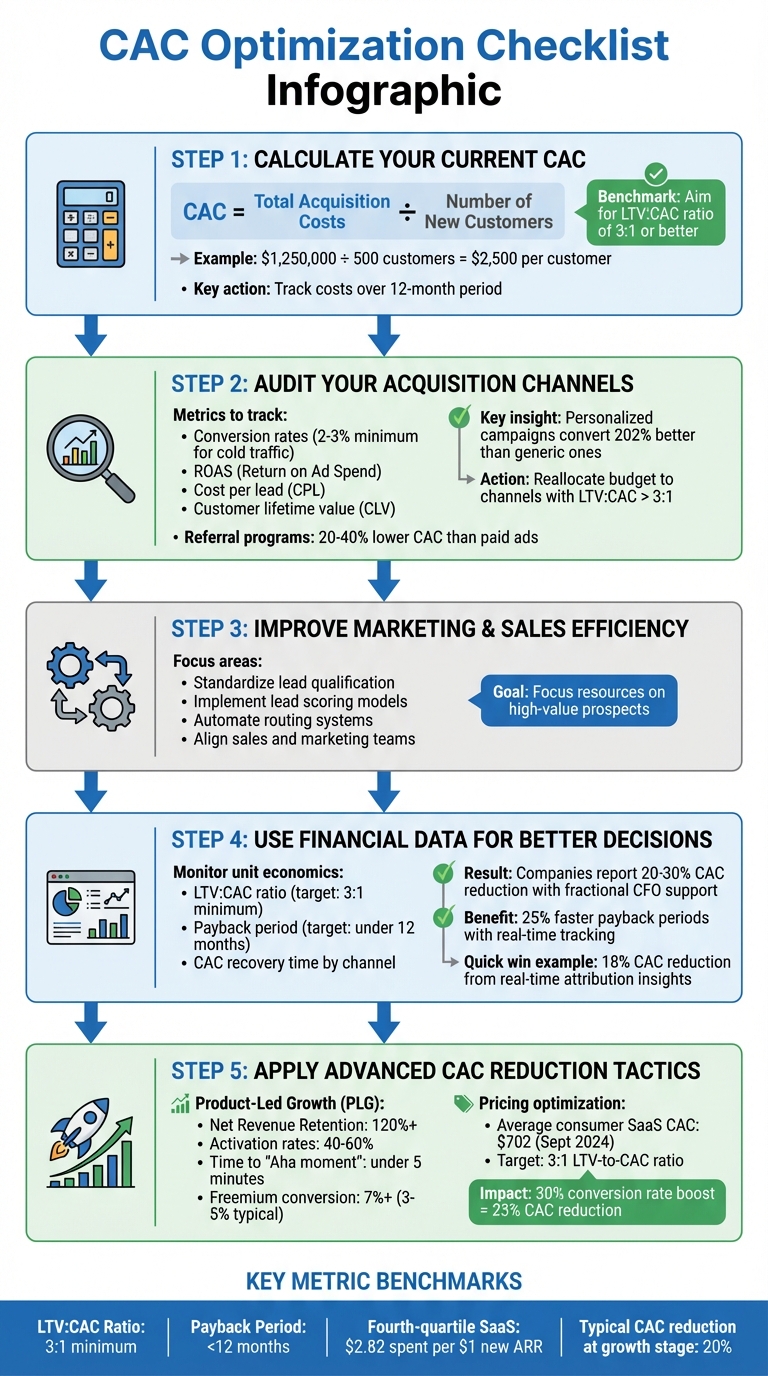
5-Step CAC Optimization Process for Growth-Stage Companies
Start by collecting every expense tied to acquiring customers. This includes things like marketing team salaries, sales team compensation, CRM software fees, analytics tools, agency charges, paid advertising budgets, content creation costs, and onboarding expenses. Many growth-stage companies tend to overlook indirect costs, such as the resources spent on customer support for new users or nurturing leads that don’t convert. Ignoring these can lead to underestimating your actual CAC [4][8].
For SaaS companies, your list should include everything from marketing campaigns and paid ads on all platforms to sales reps' full compensation packages and the resources allocated to onboarding new customers [8]. To get a clear and accurate picture, track these costs over a defined 12-month period, such as January 1, 2025, through December 31, 2025. This approach helps account for seasonal variations [7]. Once you have the total, calculate your CAC by dividing these cumulative costs by the number of new customers acquired during that same period.
After gathering all the numbers, use this formula: CAC = Total Acquisition Costs / Number of New Customers Acquired. Let’s say your total acquisition costs for the year were $1,250,000, and you brought in 500 new customers. The calculation would be $1,250,000 ÷ 500, giving you a CAC of $2,500 per customer [7][8].
It’s important to stick to consistent time periods when tracking your CAC. This consistency allows you to spot trends, such as the typical 20% reduction in CAC that growth-stage companies experience as they fine-tune their marketing channels and build brand awareness [1][2].
Once you know your overall CAC, break it down by acquisition channel to identify areas for improvement. Segmenting your CAC by channel - such as paid search, paid social, organic SEO, referrals, partnerships, and email campaigns - can show which channels provide the best return. For instance, you might discover that paid social has a CAC of $4,500 per customer with lower retention rates, while organic SEO costs $1,800 per customer but delivers a higher lifetime value [1][7].
You can also segment by customer type and deal size. For example, enterprise customers may have higher upfront costs but often bring in greater lifetime value compared to smaller accounts. To put this into perspective, service-based businesses typically see CACs ranging between $500 and $2,000 for small to mid-market clients acquired through digital channels [1]. Compare your segmented CAC results to industry benchmarks, aiming for an LTV:CAC ratio of 3:1 or better. If your ratio falls below this, it’s a sign to reassess your targeting strategy or channel mix [5][6].
Once you’ve calculated and segmented your overall CAC, the next move is to evaluate how each acquisition channel is performing.
Dive into the data for each channel by analyzing key metrics. Tools like CRMs and analytics platforms, especially those with AI-driven multi-touch attribution, can help you track important numbers like traffic volume, conversion rates, cost per lead (CPL), cost per acquisition (CPA), return on ad spend (ROAS), and customer lifetime value (CLV). For many early-stage B2B SaaS companies, CAC can run 3–5 times higher than annual recurring revenue (ARR) during growth phases [9].
Switching from last-click attribution to multi-touch attribution can uncover insights you might miss otherwise. For instance, AI analytics often show that personalized campaigns convert 202% better than generic ones, highlighting where to focus your efforts [9]. Pay attention to red flags like low conversion rates (below 2–3% for cold traffic), negative ROAS, or channels that eat up a large chunk of your budget but contribute less than 10–20% of total conversions. These insights will help you decide where to shift your budget for better outcomes.
Once you’ve identified underperforming channels, it’s time to reassign resources to the ones delivering better results. Focus on channels with an LTV:CAC ratio above 3:1 and high ROAS. In the B2B SaaS world, channels with CAC payback periods under 12 months should take priority. Platforms like Discord, for example, can be a cost-effective option for reducing CAC while improving customer retention.
You might also want to shift resources from broad paid social campaigns to organic strategies like SEO and content marketing. These tend to offer higher conversion rates and lower costs over time. Retargeting campaigns can be particularly effective, often delivering 2–3 times higher conversions compared to cold traffic [10]. Keep an eye on your adjusted Marketing Efficiency Ratio (aMER) to ensure your spending aligns with revenue goals [3]. And don’t hesitate to cut ties with channels that consistently fail to perform.
Referral and partnership programs are often a goldmine for reducing CAC, typically delivering 20–40% lower costs compared to paid ads [10][4]. Start by auditing your referral program. Look at metrics like participation rates, referral conversion rates, and the CLV of referred customers - these customers often have higher lifetime value than those from other sources. Using unique referral links in your CRM can help you track performance accurately. Automating referral invites post-purchase is another way to boost participation.
These programs also bring a trust factor that complements other acquisition strategies. Partnerships with established brands can enhance credibility without breaking the bank. Social media collaborations, especially those driven by team engagement, offer free exposure with minimal effort [4]. Compare the costs of these channels to your paid acquisition efforts. For instance, if you’re spending $2 in CAC for every $1 of new ARR through paid ads - a common benchmark in SaaS - referrals and partnerships might be a smarter investment [9]. Keep an eye on metrics like cost per partnered lead, activation rates, and ROI to decide whether to double down on these channels.
Once you've fine-tuned your acquisition channels, the next step is to focus on making your sales process more efficient. This is a critical move for bringing down your customer acquisition cost (CAC). A major part of this involves improving how your marketing and sales teams work together. One effective way to do this is by standardizing the lead qualification process, which helps your team zero in on high-value prospects.
When lead qualification is inconsistent, your team can end up wasting time and resources chasing low-quality prospects. To avoid this, implement a lead scoring model. This tool helps identify high-intent leads quickly and ensures they’re prioritized. Pair this with an automated routing system to direct these high-priority leads to the right team members without delay. It's also important to regularly review and audit your lead scoring model. If high-scoring leads aren’t converting as expected, it’s a sign that adjustments are needed.
The ultimate goal is to move beyond basic CRM usage and create a fully integrated system that brings marketing and sales into alignment. This approach not only improves efficiency but also sets the stage for sustainable growth. As your business expands, make sure your lead scoring models are equipped to handle an increasing number of leads effectively [11].
After refining your sales and marketing strategies, it's time to dive into financial data. Why? Because tracking the right metrics turns CAC (Customer Acquisition Cost) management into a precise, data-driven process. This approach helps growth-stage companies catch issues early and make smarter decisions about where to allocate resources.
CAC becomes far more meaningful when you pair it with metrics like customer lifetime value (LTV) and payback periods. Keep an eye on your LTV:CAC ratio (aim for at least 3:1), payback period (ideally under 12 months), and CAC recovery time across different acquisition channels. If your LTV:CAC ratio dips below 3:1, it could indicate inefficient spending. Similarly, a payback period exceeding 12 months can lead to cash flow challenges that slow growth.
To make this data actionable, use dashboards to visualize trends. Line charts can help track CAC over time, bar charts can show performance by channel, and alerts can notify you when key thresholds are breached - like CAC climbing above $400 per customer or payback stretching beyond 10 months. For instance, a SaaS company used such dashboards to identify that reallocating budget from paid ads to content marketing improved their LTV:CAC ratio from 1.5:1 to 4:1. This proactive adjustment saved them thousands in unnecessary spending.
Not every growth-stage company has a full-time CFO, but having access to CFO-level insights is critical. While tracking metrics is important, interpreting them to guide strategy is where financial expertise comes in. Fractional CFOs or FP&A (Financial Planning and Analysis) professionals can forecast cash flows, run "what if" scenarios (e.g., “What happens if CAC increases by 20%?”), and uncover inefficiencies that your internal team might overlook.
Companies that collaborate with fractional CFOs often report 20-30% reductions in CAC thanks to smarter budgeting decisions. For example, Phoenix Strategy Group provides fractional CFO services tailored for growth-stage companies focused on optimizing CAC. Their approach combines unit economics analysis with cash flow forecasting and real-time CAC tracking. Clients have seen 25% faster payback periods after adopting their M&A-ready financial models and data-driven strategies. Weekly reviews with their team allow businesses to quickly identify underperforming channels and shift resources to higher-ROI activities.
Monthly financial reports just don’t cut it when it comes to optimizing CAC. Instead, connect your CRM (like HubSpot or Salesforce), ad platforms (Google Ads, Facebook), billing systems (Stripe, Chargebee), and analytics tools through APIs or integration platforms. This creates a unified, real-time view of acquisition costs and customer conversions.
Real-time data allows for immediate action. For example, one e-commerce company integrated their systems and spotted a 22% spike in CAC from a failed campaign within hours. They paused the campaign immediately, preventing further losses. Similarly, a tech firm reduced CAC by 18% after real-time attribution revealed that organic channels were outperforming paid ads. Quick adjustments like these separate companies that actively optimize CAC from those that merely track it.
Level up your approach to cutting Customer Acquisition Costs (CAC) by implementing strategies designed for long-term growth. These methods focus on building a strong, sustainable acquisition framework rather than chasing short-term wins.
Once you’ve got a handle on your financial data and acquisition channels, it’s time to focus on strategies that promote organic growth. One proven approach is Product-Led Growth (PLG), where your product itself becomes the driving force behind customer acquisition. Instead of relying heavily on costly ads or large sales teams, users naturally discover your product’s value through self-service experiences. This not only lowers CAC but also turns your product into a key marketing tool.
Some of the best PLG companies report Net Revenue Retention rates of 120% or more [12]. The key to success in this model is identifying the moment when a user first experiences the product’s core value - often called the "Aha moment." As Josh Sturgeon, Co-Founder of EmberTribe, puts it:
"Product-led growth (PLG) is a business strategy where the product itself serves as the primary driver of customer acquisition, activation, retention, and expansion." [12]
To make PLG work, focus on improving activation rates, which typically range between 40% and 60% [12]. The best products help users reach their "Aha moment" in under five minutes [12]. Take Figma, for example: its collaborative design features naturally encourage users to share files, creating an organic growth loop that introduces new users effortlessly. Features like content sharing, referral incentives, and collaboration tools can help replicate this kind of growth.
Track Product Qualified Leads (PQLs) - users whose behaviors demonstrate high purchase intent. Use tools like Mixpanel or Amplitude to analyze your activation funnels and identify where users drop off. If you’re running a freemium model, aim for conversion rates of 7% or higher, though 3-5% is more common [12].
Another way to lower CAC is by increasing the value each customer brings. When customers generate more revenue, you can afford higher acquisition costs while keeping your unit economics in check. For reference, the average consumer SaaS CAC was around $702 as of September 2024 [13]. Companies with solid upsell strategies often achieve a 3:1 LTV-to-CAC ratio [13].
Start by reviewing your pricing structure. Tiered pricing works well because it caters to different customer needs, while usage-based pricing aligns costs with the value customers receive. This makes upgrades feel natural rather than forced.
Introduce upsell and cross-sell opportunities right after users experience your product’s core value. For example, if a user quickly realizes the benefits of your product, they’re more likely to respond positively to an upgrade offer. Track expansion revenue (from upsells and cross-sells) separately from new customer revenue to see how well your product drives growth over time.
Looking over the checklist - from calculating CAC to implementing advanced cost-cutting tactics - it’s clear that achieving lower acquisition costs is all about combining data-driven insights, efficient channel management, and financial expertise. Start by calculating your CAC and breaking it down by channel. Then, take a hard look at your acquisition strategies to pinpoint what’s delivering results and what’s wasting money. From there, refine your marketing and sales processes by focusing on lead qualification and personalized outreach.
The best companies don’t leave CAC optimization to chance. They rely on real-time financial data and consistent reviews. Take HubSpot, for example. They became the second-fastest SMB SaaS company to IPO by mastering CAC efficiency. Their scalable content hub drove inbound sales, showing how organic channels can slash acquisition costs while fueling growth [6]. On the other hand, businesses that adopt daily CAC modeling and team reviews outperform those sticking to monthly updates [3].
Improving channel efficiency can lead to tangible results. For instance, boosting your conversion rate by 30% can cut your CAC by 23%, even if your marketing spend stays the same [1]. Pay attention to activation rates, reduce time-to-value, and invest in organic growth strategies like SEO and content marketing. For comparison, fourth-quartile SaaS companies spend $2.82 for every $1 of new ARR. With precise modeling and channel refinement, you can outperform these benchmarks [3]. A disciplined focus on financial metrics naturally sets the stage for better channel performance.
Phoenix Strategy Group specializes in helping growth-stage companies implement these strategies. They offer fractional CFO services, FP&A systems, and real-time financial tools to give you the clarity needed for smarter decisions. Their services include bookkeeping, unit economics analysis, and cash flow forecasting, all supported by tools like the Integrated Financial Model and Monday Morning Metrics. Whether you’re scaling operations, preparing for fundraising, or fine-tuning your revenue engine, having a financial partner ensures you’re making informed, confident choices.
Start today by taking one step from this checklist. Track your CAC by channel, set up regular team reviews, or shift to daily modeling to capture real-time changes [3]. Building these habits now can lead to lower acquisition costs and faster growth.
When figuring out your Customer Acquisition Cost (CAC), make sure to account for all sales and marketing expenses. This includes things like advertising, salaries, software tools, and commissions. But that's not all - be sure to include indirect overhead costs, such as rent and the salaries of non-sales staff. Including these factors will give you a more precise picture of your actual customer acquisition costs.
To ensure your marketing efforts are cost-effective and aligned with your growth objectives, evaluate channels based on customer acquisition cost (CAC), return on investment (ROI), and how well they support your goals. Prioritize channels with a strong CAC-to-LTV ratio - aim for at least 3:1 for profitability.
Use analytics tools to monitor CAC trends closely. This will help you spot underperforming channels that may be draining resources. If a channel consistently shows high CAC and low ROI, it might be time to cut it and shift those resources toward channels delivering better results. The goal is to maximize efficiency and drive sustainable growth.
To keep an eye on Customer Acquisition Cost (CAC) in real-time, it's important to use tools that can pull in data from multiple sources and present it clearly. Key tools include CRM systems, billing or accounting software, and marketing platforms. These tools work together by feeding data into a centralized dashboard. From there, you can track important metrics like CAC, Monthly Recurring Revenue (MRR), and gross margin. This setup is especially useful for growth-stage companies, as it helps pinpoint inefficiencies and make quick, informed decisions.