Published on
April 30, 2026


Raising Series A funding is harder than ever. Only 15% of seed-funded startups secure Series A within two years - a steep drop from 31% in 2018. Investors now demand more proof of growth, product-market fit, and financial discipline. If you’re struggling to secure Series A, here are five key lessons to avoid common pitfalls:
Takeaway: Series A success requires precise execution across metrics, leadership, and investor alignment. Build a repeatable growth engine, track key metrics weekly, and prepare thoroughly for due diligence.
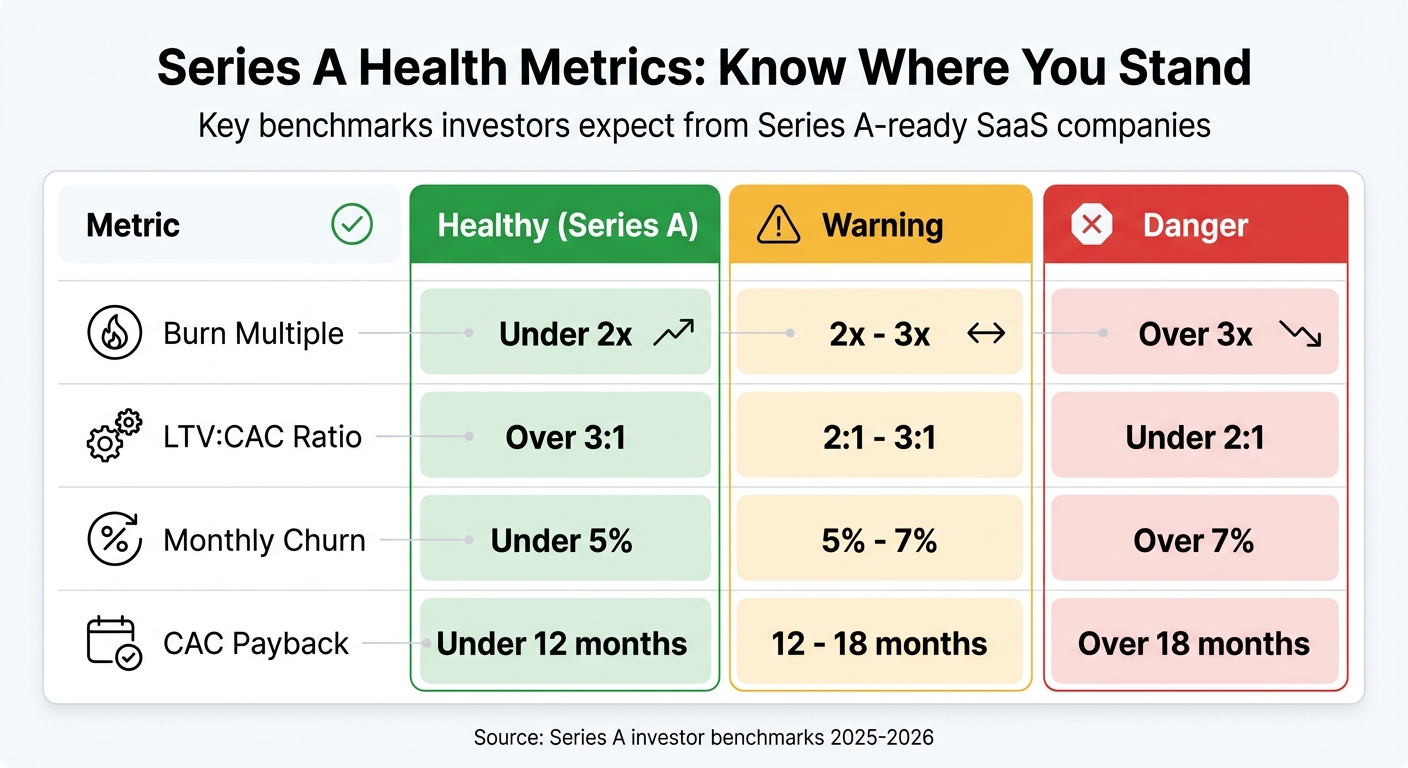
Series A Funding Health Metrics: Benchmarks for SaaS Startups
Startups often miss out on Series A funding due to one glaring issue: a lack of product-market fit. In fact, 52% of startups fail for this reason [9]. The product may function well, but it fails to address a problem that customers care enough about to spend money on.
Too often, founders create solutions that seem interesting but aren’t essential. Take Corq, for example - a Zoom add-on for customer research created by Alexander Hanthorn. By Fall 2022, Corq had grown to 300 users across 120 organizations, charging $22.50 per month. Despite this traction, the startup shut down because product managers preferred manual analysis over Corq’s automated insights. The product was viewed as a "vitamin" - a nice-to-have rather than a must-have solution [11].
"Proprietary technology must be at least 10× better than its closest substitute in some important dimension… anything less… will be perceived as a marginal improvement and will be hard to sell." - Peter Thiel [9]
Another pitfall is the "death zone" of traction. This happens when a startup shows some growth, but not enough intensity to secure Series A funding. Consider Gretel, a Barcelona-based startup led by Martí Gou. The company raised nearly $1 million and worked with 150 companies over 2.5 years. Despite three pivots and positive user feedback, Gretel shut down in July 2024. The problem? Their average order value stayed below $500, and they couldn’t establish a repeatable acquisition channel with sustainable economics [12].
The bar for Series A funding has risen sharply. By 2025, the median ARR for funded Series A startups was $2.5 million, up from $1.5 million in 2021 [6]. Investors now expect Net Revenue Retention (NRR) of 120%+ and monthly churn below 5% [6][8]. If your growth is flat or your customers don’t stick around, you’re not showing the product-market fit needed to attract institutional investors.
Securing Series A funding is about more than just revenue - it’s about demonstrating a repeatable growth engine with solid unit economics. As the funding landscape tightens, the benchmarks have become even tougher.
Retention is critical. If your churn rate is 7% monthly, you’re losing 58% of your customer base annually [8]. That creates a growth ceiling no amount of new customer acquisition can overcome. Healthy Series A startups keep monthly churn below 5% and achieve NRR of 120%+, meaning existing customers are expanding their usage enough to offset any losses [6][8].
Your LTV:CAC ratio is another key indicator of sustainability. A healthy SaaS benchmark is 3:1 or higher, meaning the lifetime value of a customer is at least three times what you spend to acquire them. Ratios below 2:1 suggest you’re spending too much to acquire customers who don’t stick around [8]. Similarly, your CAC payback period should be under 12 months. If it takes 18 months or more to recoup acquisition costs, you’re burning cash faster than you’re creating value [8].
Burn multiple measures how efficiently you’re using capital. The best-performing Series A startups keep burn multiples under 2x, meaning they spend less than $2 for every $1 of new annual recurring revenue. If your burn multiple exceeds 3x, you’re in the "danger zone" [8].
| Metric | Healthy (Series A) | Warning | Danger |
|---|---|---|---|
| Burn Multiple | Under 2x | 2x - 3x | Over 3x |
| LTV:CAC Ratio | Over 3:1 | 2:1 - 3:1 | Under 2:1 |
| Monthly Churn | Under 5% | 5% - 7% | Over 7% |
| CAC Payback | Under 12 months | 12 - 18 months | Over 18 months |
Beyond these metrics, investors also value forecast fidelity - your ability to predict revenue within ±10-15% variance. If your projections swing wildly by 25-50%, it signals you don’t fully understand your growth engine [5].
"The companies that closed Series A rounds in 2025 all had one thing in common - they could point to a specific, repeatable growth motion. Not a hypothesis. Not a promising channel. A proven engine with predictable unit economics." - Priya Kapoor, Partner, Sequoia Scout Program [6]
These metrics highlight why product-market fit is essential for Series A funding. But metrics alone aren’t enough - founders need to act on customer insights to refine their product.
Reaching product-market fit requires being highly responsive to customer feedback. While metrics validate your growth engine, customer insights guide the necessary pivots. A common mistake is pivoting based on investor feedback rather than actual market data. Another trap is relying on false positives from early adopters whose enthusiasm doesn’t reflect the broader market [7].
The key is understanding whether your solution is a "painkiller" - addressing a critical problem - or just a "vitamin." For instance, Workstream.io, founded by Nicholas Freund, spent four years and $7 million developing a data workflow tool. Despite multiple pivots and adjustments based on customer feedback, the product remained nonessential. As Edmund Helmer, Director of Analytics at Mountaintop Studios, put it, the tool’s value didn’t justify the effort of adopting a new system [9].
To validate product-market fit, ensure customers are willing to pay for a solution that reduces costs, saves time, or increases revenue [12]. If you’re prioritizing user retention over revenue validation, you risk chasing vanity metrics.
One effective strategy is conducting quarterly ICP (Ideal Customer Profile) reviews using CRM data. Look for patterns in customers who convert quickly and retain well, and adjust your marketing and sales targeting accordingly [10]. Analyze closed-won versus closed-lost deals to identify which customer segments truly value your product.
Before scaling your sales team, document your founder-led sales process to prove it’s repeatable and scalable. What discovery questions resonate? How do you handle objections? Which features provide the fastest time-to-value? If your customer acquisition depends heavily on founder relationships instead of a replicable process, you haven’t achieved true product-market fit [10].
Finally, apply the 3-Meeting Test before launching a formal fundraising effort. Take three informal meetings with investors to get honest feedback. If all three point out gaps in your metrics, focus on improving those numbers before continuing to pitch [6]. The data will guide your next steps - you just need to listen.
Even with a solid product-market fit, team issues can derail a Series A round. Investors frequently cite "team risk" as their top concern, ranking it even higher than market or technology risks [14]. The stats tell a clear story: 70% of startups facing co-founder conflicts eventually fail [14], and in the Indian startup ecosystem, such conflicts account for 20% of all failures [14].
When co-founders overlap on tasks or ignore critical responsibilities due to undefined roles, execution takes a hit [13]. Investors see leadership friction as a major red flag - it can slow down funding, weaken investor confidence, and even lower valuations or kill deals altogether [4]. Tackling these team challenges is essential before formalizing roles.
Another common hurdle? Founders resisting the shift from founder-led sales to scalable systems. A striking example is Plus Ultra Capital Partners walking away from a $15 million Series A deal in January 2026. Despite strong ARR and NRR, the deal fell apart because the founders refused to adopt "forecast fidelity" or hire a fractional Chief Revenue Officer (at $25K–$30K per month) to professionalize their sales process. Plus Ultra noted that the startup's "near-final" contracts lacked access to key decision-makers, leading to revenue swings of 25–50% per quarter [5].
"Forecasts don't need to be perfect. They need to be owned. That's the difference between prediction and control." - Pablo Grodnitzky, Managing Partner, Plus Ultra Capital Partners [5]
Premature hiring is another pitfall. Bringing on a VP too early can cost $200,000 and set back execution by a year, draining Series A funds and creating operational bottlenecks [15].
Formalizing roles early is critical to avoiding conflicts that can sink a startup. Co-founder agreements should cover responsibilities, equity vesting, and exit terms - addressing these details proactively can save a lot of pain later [14]. Workshops to define roles can also help clarify who handles what, reducing confusion [13].
Weekly check-ins are another simple but effective tool. They help teams catch and resolve overlapping responsibilities before they harm execution. For example, if two co-founders are both handling customer support or investor pitches, resources get wasted, and confusion builds [13]. Assign clear ownership of key areas like revenue targets, the product roadmap, and investor relations.
To attract and retain top talent, consider using share options. Not only does this align incentives, but it also signals stability to investors, which is crucial during a Series A round [4]. Additionally, a well-thought-out 12-month hiring plan that identifies the "superheroes" needed to scale can demonstrate foresight during due diligence.
Avoid the "hire fast, fire fast" mindset. Every hire in the early stages is critical, and a bad fit can destabilize the team, lower morale, and slow progress [16]. Take Mi Libreta as a cautionary tale. Founded in September 2019, this fintech startup raised $25,000 from accelerators but shut down by September 2021. The absence of an in-house CTO forced them to outsource app development, while misaligned founder commitment compounded their challenges [17].
A unified, well-structured founding team not only avoids internal conflicts but also inspires confidence in investors, which is essential for securing funding.
In addition to defining roles, startups need disciplined financial oversight to meet investor expectations. By Series A, the focus shifts from raising capital to managing operational complexity and execution [15]. Investors expect accurate revenue forecasts - with a variance of no more than ±10–15% - to ensure disciplined operations [5]. This requires moving beyond intuition and adopting structured financial systems.
Fractional CFO services can provide the financial expertise needed without the $200,000+ price tag of a full-time hire [15]. These services can help create unit economics dashboards, board reporting templates, and rolling 12-month financial models - key tools that separate successful funding rounds from desperate ones [15].
To maintain financial discipline, track a weekly dashboard of five key metrics: MRR Growth, CAC/LTV, Payback Period, Gross Margin, and Burn Multiple [15]. Pair this with a monthly board rhythm, using a concise 10–12 slide deck to communicate both wins and challenges. Transparency ensures there are no surprises for investors [15].
Phoenix Strategy Group offers fractional CFO services tailored to growth-stage companies. From weekly KPI tracking to integrated financial models, these services provide the expertise needed to hit revenue targets consistently - without the risks of over-hiring too soon.
"At Series A, your constraint shifts from capital to complexity and execution." - Eagle Rock CFO [15]
After establishing product-market fit and strong leadership, having solid traction metrics is the final piece to prove your growth is both dependable and scalable. Weak metrics can derail your Series A funding efforts. Investors are looking for predictability, and the standards have risen. By 2026, SaaS companies need $3 million or more in ARR to be considered Series A–ready, a jump from the $1.5–$2 million range seen in previous years [20].
But hitting that revenue milestone alone isn’t enough. If your metrics signal inefficiency or unpredictability, it raises red flags. The shift from “growth at all costs” to prioritizing capital efficiency has redefined what investors value. A healthy Burn Multiple now ranges between 1.0 and 2.0, with anything above 3.0 being a major concern [19]. Cash flow problems remain a leading reason for failure - 82% of startups cite it as a primary cause [8], often due to tracking the wrong metrics or missing early warning signs.
Investors won’t settle for aggregate numbers. They’ll want segmented data - details on unit economics broken down by customer type, channel, and cohort. This helps uncover whether growth is truly sustainable or if unprofitable segments are being hidden by overall figures [15].
"One of the biggest red flags at the Series A round is having outlier customers. Outlier customers suggest that you don't have repeatability." - Michael Skok, Co-founding Partner, Underscore VC [3]
Key metrics like gross retention rates need to exceed 85%, and net revenue retention (NRR) should be over 100% [19]. Even a seemingly small monthly churn of 5% can snowball into a 46% annual customer loss [8], which undermines the predictability investors count on.
Your pitch deck is your first chance to impress, and investors spend an average of just 3 minutes and 44 seconds reviewing it [3]. Every slide needs to deliver clear, data-backed evidence of traction - there’s no room for fluff. The most effective decks stick to 10–13 slides, focusing on critical metrics. Overloading slides with information can dilute your message [3].
Start with market trends and your competitive positioning. Investors want to see that you’ve carved out a “beachhead” market - a specific segment you dominate before expanding [19]. This shows repeatable success, not just one-off wins. Highlight growth metrics, such as a month-over-month (MoM) growth rate of 10–15%, which is the baseline for SaaS companies [15][19].
Unit economics should take center stage. Investors expect to see benchmarks like an LTV/CAC ratio of 3:1 or higher and a CAC payback period under 12 months. Break these numbers down by customer segment - such as SMB versus Enterprise - to show you understand where your profitability lies.
Increasingly, investors include finance and accounting professionals who will scrutinize your data. Startups that present clear retention and profitability figures raise 25% more funding than those that don’t [3].
Make sure your data room is ready before you pitch. If it takes longer than a week to provide a complete data room, it signals a lack of preparation [18]. A poorly organized data room can call your operational readiness into question and weaken your case for funding.
While a data-rich deck sets the tone, consistent tracking of metrics over time will reinforce your story with investors.
A polished pitch deck is just the beginning. To build investor trust, you need ongoing performance monitoring. Create a weekly KPI dashboard to show that you’re running your company with discipline, not just instinct [5].
This dashboard should be a single page updated weekly, covering five key metrics: MRR Growth, CAC/LTV Ratio, Payback Period, Gross Margin, and Burn Multiple [15]. Share it with your leadership team and review it in a weekly meeting.
"Forecasts don't need to be perfect. They need to be owned. That's the difference between prediction and control." - Pablo Grodnitzky, Managing Partner, Plus Ultra Capital Partners [5]
Pair this dashboard with a 13-week cash forecast to manage both short-term cash flow and long-term financial health [20]. Monthly deep-dive analyses should reconcile your cap table, bank statements, and financial models. This prevents discrepancies that could derail deals during due diligence [20].
Conduct variance reviews to identify and address forecast misses. Investors expect you to predict near-term revenue within a ±10–15% range [5]. Missing this benchmark suggests flaws in your pipeline qualification process. Frameworks like MEDDICC can help tighten your deal stages and improve forecast accuracy. Regular win/loss analyses can also refine your approach to conversions, feeding valuable insights back into your tracking system [5].
Finally, switch to accrual-basis accounting at least six months before seeking funding [20]. Cash-basis accounting is a red flag during Series A due diligence because it doesn't align revenue with service delivery periods, leading to distorted financial statements. Investors expect GAAP-compliant financials, and a last-minute switch can create unnecessary risks. Proper accounting practices are a key part of proving your operational readiness.
For startups needing extra support, Phoenix Strategy Group offers fractional CFO services to help implement these systems, ensuring you’re prepared to showcase your traction to Series A investors.
Even with impressive metrics and a polished pitch deck, approaching the wrong investors can derail your Series A before it even begins. Fundraising isn't just about securing a check - it’s about finding investors whose goals align with your business. On average, closing a Series A requires 50 to 80 investor meetings [22]. Meeting with misaligned investors wastes both time and momentum.
One of the biggest pitfalls is pitching to venture capitalists (VCs) who may seem like a good fit but don’t match your sector, geography, or stage. For instance, founders often target firms that have already backed a competitor or whose check size doesn’t align with the amount being raised [4]. Investors typically won’t move forward unless your funding needs meet their minimum investment threshold [21]. Another misstep is failing to create competitive tension. Reaching out to one investor at a time - or waiting for a decision before approaching others - shifts leverage entirely to the VC. To build urgency, aim to schedule 5–10 meetings within the same week [23]. Without this alignment, your efforts risk falling short of investor expectations.
The numbers paint a challenging picture: only 30–45% of seed-funded startups make it to a Series A round [22]. The gap between seed and Series A has grown wider in recent years. Between 2024 and 2025, while seed funding surged, Series A rounds either plateaued or declined, creating a significant imbalance between supply and demand [1]. This has led to heightened selectivity among investors, where even small delays in responding to data requests, inconsistent answers, or a slow meeting cadence can signal poor preparation and kill momentum [22][4]. A delayed data room, for example, can be a red flag for investors [23].
"Capital follows control - not charisma, not potential, not pipeline slides." - Pablo Grodnitzky, Managing Partner, Plus Ultra Capital Partners [5]
The solution lies in targeting investors whose mandates and criteria align with your business. Start by creating a focused list of 40–60 potential investors, filtering by stage, sector, and geography [22][23]. Organize this list into three tiers:
Dive into each firm’s portfolio to confirm they haven’t already invested in a direct competitor and that their typical check size matches your round. Series A rounds in 2025–2026 typically range from $5 million to $15 million, with a median of around $10 million [22].
Warm up relationships over 1–2 months before officially launching your fundraising. Leverage introductions from existing investors or advisors - cold outreach rarely works [22]. For Series A, investors expect to see at least 2× to 3× year-over-year revenue growth and are increasingly prioritizing capital efficiency over aggressive growth. Avoid setting unrealistic valuations based on outdated market highs; SaaS companies, for example, are generally valued at 8–12× ARR [23]. Overvaluation might feel like a win in the moment but can create long-term issues. Founders typically give up 15–25% equity during a Series A round [22]. Focus on finding investors who not only understand your market but can also offer strategic guidance. Keep in mind regional differences - San Francisco VCs often prioritize rapid growth, while those in New York or London may emphasize efficiency and unit economics.
Strong traction metrics and a capable founding team are important, but a well-organized due diligence process is equally critical. Once you’ve identified the right investors, preparation becomes your top priority. Investors want to see "Forecast-Market Fit" (FMF), which reflects your ability to predict near-term revenue with a variance of ±10–15% [5]. Missing forecasts without understanding why signals a lack of control and can derail deals, even if your growth metrics are otherwise strong. Weekly forecast reviews can help demonstrate consistency and accountability.
Your data room should be fully prepared before your first meeting. Include essentials like a 3-year financial model, monthly profit-and-loss statements for the past 24 months, and a fully diluted cap table [23]. Any disorganization or missing documents could make it impossible to close a round within the typical eight-week timeline [23][4]. Remember, investors spend an average of just 3 minutes and 44 seconds reviewing a pitch deck [3], so clarity and accessibility are key.
"A slowdown inside a VC firm is a signal in itself: if everyone around the committee table isn't aligned, the default answer becomes no." - Ian Merricks, Founder, VenturePath [4]
Ensure all intellectual property (IP) assignments are in order, obtain a current 409A valuation, and manage your cap table using professional tools. A "broken" cap table - where more than 15% of equity is held by non-operational founders or advisors - is a major red flag [24]. To avoid this, use templates like the Founder/Advisor Standard Template (FAST), which ties equity vesting to performance over two years.
Investors will often make informal reference calls to former colleagues and partners not listed as references. Address any potential issues upfront to control the narrative [24]. If your forecasting process is inconsistent, consider hiring a fractional Chief Revenue Officer (CRO) to establish discipline before launching your raise. At the Series A stage, investors shift their focus from founder vision to operational systems, so demonstrating a predictable cadence is far more important than relying on individual heroics [5].
For startups needing extra help with financial modeling, cap table management, or forecast rigor, Phoenix Strategy Group offers fractional CFO services and FP&A tools to help you prepare for due diligence and meet investor expectations.
Even startups with a solid product-market fit and steady traction can stumble during a Series A if their pricing or cost management lacks transparency. Investors want to see that every dollar spent yields consistent returns - and that your pricing reflects the value you provide. One of the most common pitfalls? Underpricing. Founders often set prices too low to attract customers quickly, but this approach can backfire. It can signal low value, attract the wrong audience, and ruin unit economics before the business even takes off [25]. On the other hand, overly complex pricing - like too many tiers, custom deals for a large portion of customers, or confusing add-ons - can make it tough to identify which segments are truly profitable [15].
Nearly 90% of startups fail because they misjudge market demand or fail to understand their actual costs [3]. For example, a direct-to-consumer brand tracked by CentSight in March 2026 spent $420,000 on ads over a year, ignoring its true unit economics. While the stated Customer Acquisition Cost (CAC) was $29 for a $55 order, the actual contribution margin - after accounting for returns, shipping, and processing - was only $4.10. This meant a loss of $24.90 per customer [26]. Investors typically look for an LTV/CAC ratio of at least 3:1, a CAC payback period of 9–12 months, and gross margins above 70% for B2B SaaS companies [15][3]. This lesson ties into earlier discussions on traction metrics by showing how pricing and cost controls directly impact unit economics.
"Revenue is vanity. Profit is sanity. Every financial decision should start with 'what does this do to margin?' not 'what does this do to revenue?'" - Gerald Hetrick, Founder, CentSight [26]
The key to addressing pricing issues is discipline. Keep pricing simple - limit it to no more than three tiers to maintain clarity on which segments are driving profitability [15]. For instance, a SaaS founder who hadn’t adjusted prices in three years introduced a 15% price increase. While this caused a 4% customer churn, it ultimately boosted net revenue by $200,000 annually [26]. Regular price adjustments are necessary to account for rising operational costs, such as salaries and support overhead [15]. Avoid overly customized pricing models that obscure which segments are profitable.
A clear pricing strategy, much like strong traction metrics, reinforces predictable unit economics. Segment your unit economics to identify unprofitable areas. Founders often underestimate CAC by leaving out key expenses like salaries, commissions, and overhead. True CAC should encompass all costs involved in acquiring a customer [3]. Additionally, calculating LTV based on gross margin (rather than total revenue) provides a more accurate view of profitability [3]. For example, one SaaS founder reduced blended CAC from $180 to $110 in just two quarters by reallocating $8,000 per month from high-cost Google Ads (CAC $320) to referral programs (CAC $22) and content marketing (CAC $45) [26]. This type of channel-level analysis is essential for extending runway and demonstrating efficient capital use to investors.
Beyond pricing, disciplined cost management strengthens your financial foundation. Maintain a 12-month rolling financial model that forecasts revenue by segment, tracks costs by department, and monitors the cash conversion cycle to avoid misleading paper profitability. Update this model monthly [15]. Investors increasingly focus on forecast accuracy, expecting near-term revenue to fall within a ±10–15% variance [5]. Missing forecasts without understanding why signals a lack of operational control.
Evaluate every new hire carefully to avoid draining your runway [15]. For example, a CEO raised a $5 million Series A while keeping burn rates at $70,000 per month. By reviewing unit economics weekly, the CEO realized a newly hired VP of Sales was only operating at 50% of the efficiency of founder-led sales. This insight led to a pause in further hiring. By the end of 12 months, the company had achieved $3.6 million in ARR while retaining $4.2 million in cash, setting the stage for a $12 million Series B at a $90 million valuation [15]. Use your KPI dashboard weekly to maintain operational control and stay on track.
For startups needing support with building financial models, tracking unit economics, or implementing FP&A systems, Phoenix Strategy Group offers fractional CFO services and real-time financial data synchronization to help manage costs and extend your runway.
Raising a Series A round in 2026 is no small feat. It takes more than just a bold vision - it requires concrete proof of product-market fit, a strong team, consistent traction, alignment with the right investors, and careful cost management. The standards are higher than ever: only 15% of seed-funded startups make it to Series A within two years, a sharp drop from 31% in 2018. On top of that, the median time to secure Series A funding has stretched to 26 months [2]. Investors now seek startups that demonstrate scalable and controlled growth.
The five lessons discussed in this article serve as a guide to help you evolve your startup into an investable, institution-ready company. From achieving product-market fit to mastering financial discipline, each area demands focus and improvement. One standout metric is demonstrating "Forecast-Market Fit", or the ability to meet revenue targets with a ±10–15% variance - a clear signal of operational reliability [5]. Additionally, addressing architecture debt, filling leadership gaps, and fine-tuning unit economics (like achieving an LTV/CAC ratio of at least 3:1) can significantly reduce perceived risks for potential investors [3].
"Capital follows control - not charisma, not potential, not pipeline slides." - Pablo Grodnitzky, Managing Partner, Plus Ultra Capital Partners [5]
To prepare effectively, consider conducting a pre-diligence audit at least 90 days before meeting investors. This will help you uncover and resolve any technical or financial issues. Establish a habit of weekly KPI tracking to demonstrate consistency and predictability. Use a scorecard to evaluate your business against common investor concerns - if your score falls below 70–80%, it’s worth pausing your fundraising efforts to strengthen your foundation [4]. This level of preparation transforms fundraising from a gamble into a controlled, strategic process.
For startups seeking help with financial modeling, fractional CFO services, or Series A readiness, Phoenix Strategy Group offers tailored solutions. Their expertise in FP&A systems, data room setup, and investor targeting equips founders with the tools to showcase forecast accuracy, manage burn rates, and meet the accountability standards that Series A investors expect.
With a disciplined approach, the challenging road to Series A becomes more manageable. Build a business that instills confidence - where every dollar drives measurable outcomes, every forecast is backed by data, and every decision reflects the maturity of a company ready to scale.
Product-market fit happens when your product addresses a genuine need in the market and connects deeply with your audience. How can you tell if you've hit this sweet spot? Look for these signs:
Beyond the numbers, qualitative feedback matters too. Things like glowing testimonials or customers referring others to your product are powerful signs of PMF. Another key clue? If your growth is primarily fueled by organic demand - rather than relying heavily on marketing - it’s a clear indicator that your product naturally aligns with what the market wants.
Tracking the right metrics is essential before reaching your Series A funding. The five key performance indicators (KPIs) to monitor on a weekly basis are:
These KPIs provide a snapshot of your company's traction, operational efficiency, and financial health, preparing you for productive conversations with investors and future funding rounds.
When preparing your Series A data room, it's crucial to include a well-organized collection of documents that reflect your company's operational progress and preparedness for growth. Here's what to focus on:
A clear and secure data room setup not only makes it easier for investors to review your business but also shows that you're organized and ready for the next stage of growth.