Published on
April 30, 2026


Yes, they do. Sustainable buildings cost more upfront - typically 3% to 12.5% more - but deliver better long-term returns. Here's why:
While conventional buildings save on construction costs, they face rising energy bills, lower rents, and potential devaluation due to non-compliance with stricter regulations. Sustainable properties, on the other hand, offer higher returns, reduced risk, and growing tenant demand.
Quick Comparison:
| Factor | Sustainable Buildings | Conventional Buildings |
|---|---|---|
| Initial Costs | 3%-12.5% higher | Lower |
| Operating Costs | 9%-33% lower | Higher |
| Rental Income | 3%-31% rent premium | Lower rents, risk of "brown discount" |
| Asset Value | 88% increase (2020–2025) | Declining value |
| Regulatory Risks | Compliant with emissions standards | Fines and retrofitting costs |
For those weighing long-term gains over short-term savings, green-certified buildings are a smarter choice.
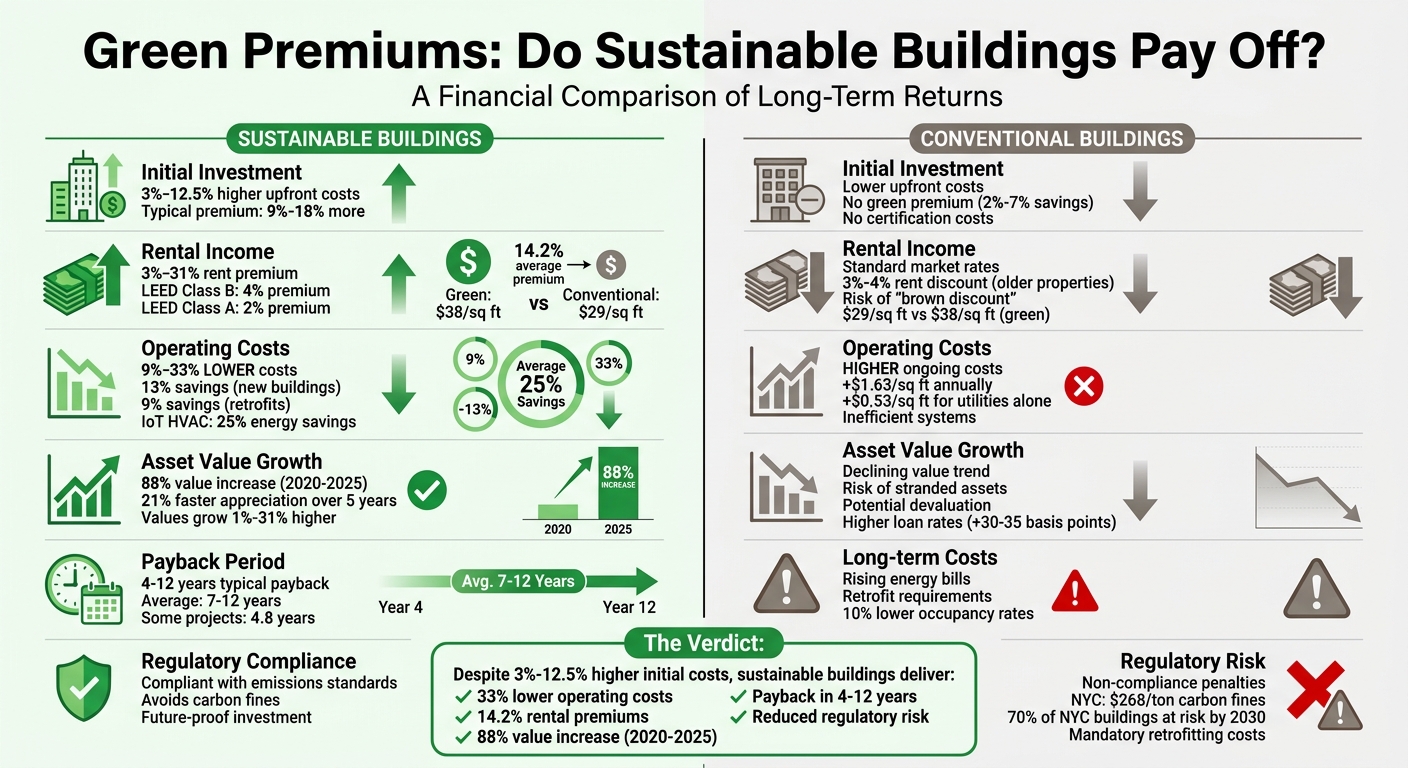
Sustainable vs Conventional Buildings: Cost and ROI Comparison
Building sustainable homes comes with a higher initial price tag, typically 9% to 18% more than traditional construction costs [6]. For example, a 2,500-square-foot home might cost an additional $45,000 to $65,000 on top of a base price of $375,000 to $500,000. Upcoming energy codes in 2025 are expected to add another $10,000 to $30,000 to construction costs [7].
The main contributors to these higher costs include:
However, this cost gap is shrinking as supply chains improve [5]. Federal incentives also ease the burden - like the 30% solar tax credit available through 2032, which significantly reduces solar installation expenses [6].
For example, in June 2025, a 2,200-square-foot net-zero home in Colorado was built for $485,000, including a $45,000 solar system. This home now generates 102% of its annual energy needs, saving the owners $3,200 annually on utility bills. The payback period for the green upgrades? Just 8.5 years [6].
These upfront costs pave the way for long-term savings and increased property value and business valuation, which we’ll explore further below.
Sustainable buildings are highly attractive to tenants, often filling vacancies faster and earning higher rents. For instance, Class B office buildings with LEED certification enjoy a 4% rent premium, compared to a 2% premium for Class A buildings [1]. This trend is especially pronounced in suburban areas, where only 40% of office spaces are LEED-certified. Tenants increasingly prefer these greener options, particularly as they align with employee preferences for workplaces closer to home [1].
"LEED-certified buildings command a 3.7% rent premium when controlling for location, building age, and renovations." - CBRE [3]
The benefits of sustainable buildings extend well beyond the initial investment, with significant reductions in monthly operating costs. On average, sustainable construction reduces operating expenses by 13% for new buildings and 9% for retrofitted ones [8]. Incorporating IoT-enabled HVAC systems can lead to energy savings of up to 25% annually [8].
Here’s a real-world example: A 1920s Vermont farmhouse underwent a $180,000 Passive House retrofit, slashing heating costs by 85% - from 1,200 therms to just 180 therms per year. The renovation also boosted the home’s appraised value by $75,000 [6]. Additionally, recommissioning HVAC systems can achieve comparable energy savings to major upgrades but at a fraction of the cost - about 1/20th [3].
Though the upfront costs of sustainable buildings are higher, the long-term financial returns make them worthwhile. Between 2020 and 2025, the value premium for green-certified buildings in the U.S. increased by 88% [2].
Most green investments pay for themselves within 7 to 12 years [6]. Lower maintenance costs - typically 20% to 30% less - are another advantage, thanks to the use of more durable materials [6]. Meanwhile, traditional properties face growing regulatory challenges. For instance, New York City’s Local Law 97 imposes a $268 fee per metric ton of carbon emissions that exceed annual limits [2], turning inefficiency into a costly liability.
Conventional buildings may save on initial costs, but their long-term financial outlook often pales in comparison to sustainable alternatives. Lower upfront expenses come with trade-offs like higher operating costs, lower rental income, and declining asset value over time.
One of the biggest draws of conventional buildings is their lower initial investment. Developers and buyers avoid the additional 2% to 7% "green premium" that comes with features like high-performance windows, advanced HVAC systems, and renewable energy systems [2]. They also skip paying for certifications like LEED or WELL, keeping upfront costs minimal. This approach appeals to investors who prioritize immediate cash flow or operate within tight budgets, as it focuses on reducing short-term expenses [9].
Conventional properties often fall short when it comes to rental income. On average, they generate about $29 per square foot, significantly less than the $38 per square foot seen with green-certified buildings. Additionally, older properties experience rent discounts of 3% to 4%, with declines reaching up to 5% per decade [1]. As younger generations like Gen Z and Millennials increasingly prefer eco-friendly spaces, conventional buildings face rising vacancy rates [3]. This trend makes it harder for these properties to stay competitive and maintain consistent income streams.
Operating conventional buildings can be expensive. These properties typically incur $1.63 more per square foot annually in combined costs for operations, maintenance, utilities, and janitorial services [10]. Inefficient HVAC systems and poor insulation alone add about $0.53 per square foot to utility bills [10].
"Energy inefficiency has become a major risk factor, with lenders now factoring potential retrofit costs and emissions penalties into loan terms and property valuations."
– Michael Harrington, Real Estate Analyst [2]
The financial risks don’t stop there. Conventional buildings are increasingly labeled as "stranded assets", meaning they may require substantial investments just to comply with new regulations or remain marketable [3]. Their occupancy rates can lag up to 10% behind energy-efficient properties, further squeezing profitability [10]. These higher operating costs and vacancy risks make conventional assets less appealing over time.
Conventional buildings often struggle to maintain their value in a market that increasingly rewards sustainability. From 2020 to 2025, green-certified properties saw an 88% value premium [2], while energy-efficient buildings now sell for 1% to 31% more than their conventional counterparts [10]. Additionally, lenders are beginning to penalize properties without energy certifications, charging interest rates that are 30 to 35 basis points higher than those for certified buildings [10]. This so-called "brown discount" underscores the growing financial risks of conventional buildings, turning short-term savings into long-term liabilities.
When comparing sustainable and conventional buildings, several key factors stand out in terms of financial performance, operational efficiency, and market appeal:
| Factor | Sustainable Buildings | Conventional Buildings |
|---|---|---|
| Initial Investment | Construction costs are 3% to 8% higher [4] | Standard construction costs |
| Annual Operating Costs | Typically 33% lower operating costs [4] | Average operating expenses |
| Rental Income | LEED-certified buildings command a 3.7% rent premium after adjusting for location and age [1]. Rent premiums range from 3% to 16% [2]. | Standard market rates, but may face a "brown discount" |
| Energy Efficiency | Reduce energy costs by up to 38%, with automation cutting expenses by as much as 25% [5,10] | Higher energy costs due to less efficient systems |
| Asset Appreciation | Values grow 21% faster over five years, with an 88% increase in value between 2020 and 2025 [5,2] | Risk of "brown discount" and potential value decline |
| Occupancy & Retention | Shorter vacancy periods (28 days vs. 45 days) and higher tenant retention (87% vs. 72%) [4] | Lower tenant retention and longer vacancies |
| Financing Terms | Access to interest rate reductions of 0.15% to 0.35% and better loan-to-value ratios [4] | Standard financing terms apply |
| Regulatory Risk | Strong compliance with carbon caps and building performance standards | At risk of non-compliance, such as 70% of NYC buildings potentially failing to meet 2030 standards under Local Law 97, with fines of $268 per metric ton [3,2] |
These differences clearly illustrate why sustainable buildings are becoming a smarter investment choice. They not only deliver lower operational costs but also offer higher returns through rent premiums, faster asset appreciation, and better financing terms. On the other hand, conventional buildings are increasingly burdened by rising regulatory costs, higher energy expenses, and potential devaluation due to non-compliance.
For Class B office buildings, the benefits of sustainability are even more striking. LEED certification yields a 4% rent premium compared to just 2% for Class A properties. With only 40% of suburban office stock certified, this creates a competitive edge for green-certified properties in specific market segments [1]. These advantages underline the long-term financial gains of investing in sustainable buildings over traditional options.
Sustainable buildings consistently outperform traditional properties across key financial metrics. Despite their 3% to 8% higher upfront costs, these buildings deliver returns that more than justify the investment. With average payback periods ranging from 4 to 6.8 years through operational savings alone [4][11], the long-term financial benefits are undeniable. Beyond this payback period, the advantages compound - operating cost savings of 33% and rental premiums of 14.2% contribute to a 21% faster asset appreciation over five years [4].
Real-world examples back up these numbers. For instance, CapitaLand's One George Street retrofit achieved payback in just 4.8 years, boasting a 12.3% internal rate of return (IRR) by cutting energy use by half [11]. Similarly, Lendlease's Barangaroo South project in Sydney managed to significantly reduce embodied carbon with a construction cost premium of less than 1.5% [11]. These outcomes illustrate the tangible financial upside of sustainability in major commercial developments.
In addition to financial returns, sustainable buildings help mitigate regulatory risks. As stricter emissions standards emerge, conventional properties face penalties and the risk of the "brown discount" [3][2]. On the other hand, green-certified assets enjoy 31% higher risk-adjusted returns and demonstrate reduced volatility during economic downturns [4].
"For investors seeking optimal risk-adjusted returns while positioning for future market evolution, green building investments represent a strategic imperative rather than an optional enhancement." - Acerazeppa Financial Analysis Team [4]
Looking ahead, market trends suggest a shrinking window for gaining a competitive edge. By 2026, green construction costs are expected to align closely with those of traditional methods [4]. For developers and investors considering new projects or retrofits, the evidence strongly supports prioritizing sustainability features now. Acting sooner rather than later ensures access to these financial and operational benefits before sustainability becomes the industry norm.
Upgrading windows is one of the quickest ways to see a return on investment when it comes to energy-saving improvements. By enhancing energy efficiency, these upgrades help lower utility bills, making them a smart and practical choice for homeowners looking to save money while reducing energy consumption.
NYC Local Law 97 introduces a new challenge for building owners by transforming carbon emissions into a direct financial burden. This law ties excess emissions to annual fines of $268 per ton, which can have a serious impact on a building’s net operating income (NOI).
Here’s why this matters: These fines don’t just hit the bottom line - they also erode property value. For instance, a fine of $50,000 per year could reduce a building’s asset value by $1 million, assuming a 5% cap rate. That’s a significant loss for any property owner.
On the flip side, compliance with these regulations isn't just about avoiding fines. Buildings that meet the requirements often command higher rents and see increased property values, making it a win-win for both environmental responsibility and financial performance.
Owners can get a sense of rent premiums or potential "brown discounts" by diving into market data and sustainability metrics. For instance, in the U.S., buildings with LEED certification often command rent premiums of about 31%, while properties with poor performance can experience valuation declines ranging from 5% to 15%. By keeping tabs on tenant demand, comparable properties in the area, and certification levels, owners can better understand the financial upsides - or risks - associated with their assets.