Published on
February 16, 2026


Want to know if your loyalty program is worth the investment? Calculating ROI (Return on Investment) is the key. Here's the gist:
(Net Profit / Total Program Costs) × 100.For example, if your program generates $75,000 in incremental revenue, costs $30,000 to run, and has a 60% gross margin, the ROI would be 50%. A "good" ROI typically falls between 100% and 300%.
Why it matters: Without tracking ROI, you can’t tell if your program is boosting revenue or just giving away discounts. By analyzing costs and revenue, you can refine your program for better results.
Let’s break it down further.
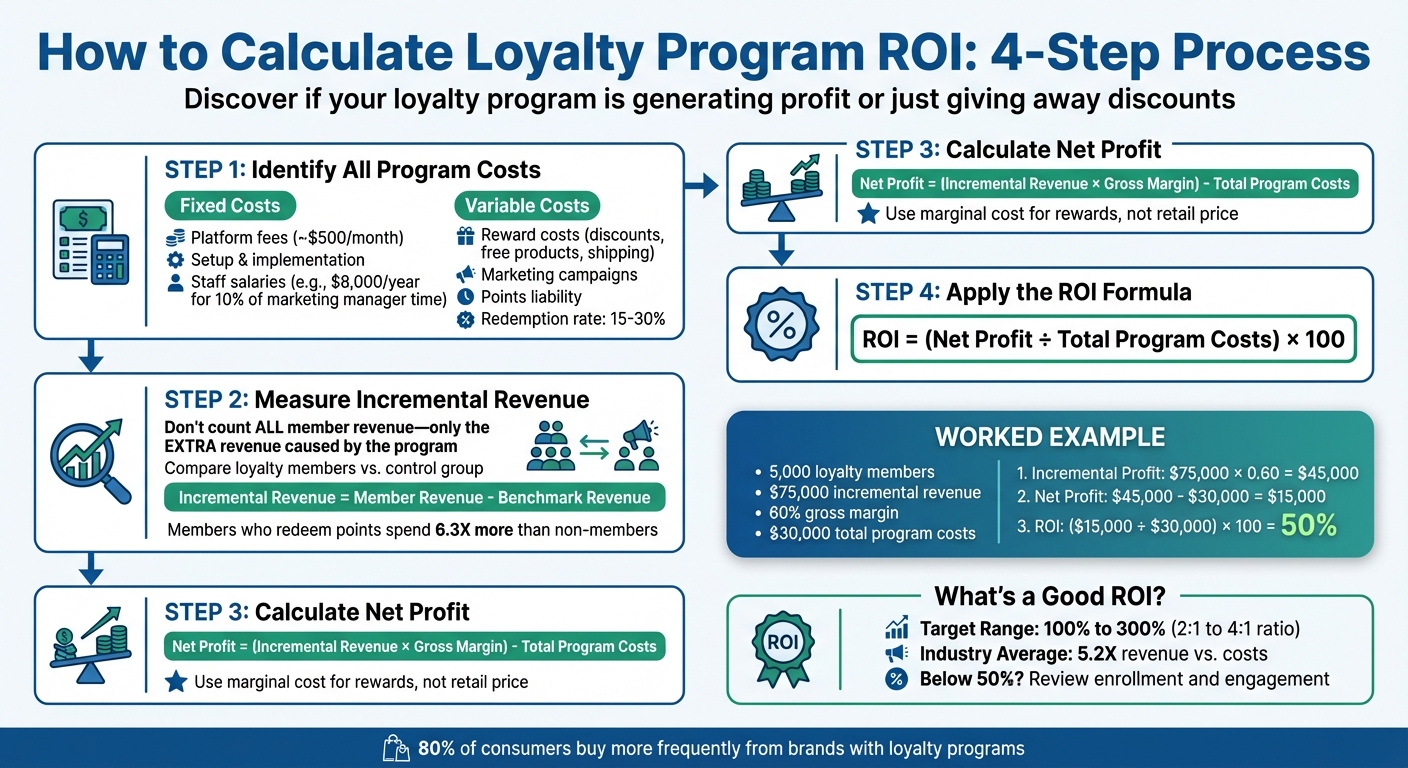
4-Step Process to Calculate Loyalty Program ROI with Example
To calculate ROI effectively, you first need to pinpoint all the costs associated with your loyalty program. While many mid-market companies focus on the obvious expenses, they often overlook hidden costs such as staff time and operational overhead. Ben Salomon, Growth Marketing Manager at Yotpo, explains:
A true cost calculation includes direct costs like platform fees and reward values, plus indirect costs like your team's time for management, marketing, and customer service. [8]
Fixed costs are consistent regardless of how many customers participate or redeem rewards. These include your SaaS subscription fees (often starting around $500 per month for mid-market platforms), one-time setup and implementation costs, and salaries for employees managing the program. For instance, if 10% of a marketing manager's $80,000 annual salary is allocated to the program, that equates to $8,000 per year in fixed labor costs [8].
Variable costs, on the other hand, change based on program activity. The largest variable expense tends to be the cost of rewards - this includes discounts, free products, and shipping fees redeemed by members. Marketing expenses can also vary depending on the frequency of campaigns or seasonal promotions. A typical redemption rate for loyalty programs ranges from 15% to 30% [8]. Another key variable cost is points liability, which represents the value of earned but unredeemed points. This depends on your "earn-to-burn" ratio and needs to be closely monitored to avoid financial strain [8][4].
Breaking these costs into clear categories helps you better understand the financial scope of your program.
A structured table is an excellent way to organize and visualize all expenses, making it easier to spot areas where costs might increase. Below is a simple framework to categorize loyalty program costs:
| Cost Category | Description | Cost Type | Frequency |
|---|---|---|---|
| Platform & Tech | SaaS subscription, API integrations, hosting | Fixed | Monthly/Annual |
| Setup & Design | Strategy, branding, initial technical setup | Fixed | One-time |
| Reward Costs | COGS for free products, discounts, shipping fees | Variable | Ongoing |
| Marketing | Launch campaigns, social ads, email assets | Variable | Ongoing |
| Labor (People) | Program management, support, staff training | Fixed | Ongoing |
| Operations | Fraud monitoring, legal compliance, points liability | Variable | Ongoing |
To get a more accurate picture of your annual costs, consider amortizing one-time setup fees over 12 to 24 months [5]. Don’t forget to factor in a portion of employee salaries for tasks related to the program [8][1]. This thorough breakdown of costs will be crucial as you move on to calculate your program's ROI in the following steps.
After outlining your costs, the next logical step is figuring out the additional revenue your loyalty program generates. Simply summing up loyalty member revenue can paint an overly optimistic picture, as it often reflects a bias toward high-value customers[4]. Mollie Woolnough-Rai from LoyaltyLion explains:
"If we simply add up revenue from loyalty program customers, our numbers will be misleadingly rosy." [4]
The real goal is to pinpoint incremental revenue - the extra income directly attributable to your program that wouldn’t exist otherwise. This approach gives a clearer picture of your program’s actual financial impact.
Building on your cost analysis, focus on the revenue differences between loyalty members and non-members. Key metrics like Average Order Value (AOV) and purchase frequency are essential. For instance, if loyalty members have an AOV of $85 and purchase 4.2 times annually, compared to non-members with an AOV of $70 and 2.8 yearly purchases, there's a clear difference in behavior. The challenge is determining whether your loyalty program caused these differences.
A proven way to assess causality is to use a control group - randomly selected customers who aren’t part of the loyalty program. This method is considered the gold standard for measuring impact[7]. Another option is comparing loyalty members to "look-alike" non-members or analyzing the same customers’ spending patterns before and after they joined the program[4].
Studies show that loyalty members in the U.S. and Canada consistently spend more than non-members[3]. Additionally, customers who redeem loyalty points at least once have a 6.3 times higher lifetime spend compared to non-members[2].
To calculate incremental revenue, use this simple formula:
Member Revenue - Benchmark Revenue [4]
The benchmark could be pre-enrollment spending or the average revenue from a control group.
For example, if 5,000 members each generate $85 on average, while the control group averages $70, the incremental revenue per member is $15. Multiply that $15 by 5,000 members to get $75,000 in incremental revenue annually.
To determine incremental profit, apply your gross margin percentage to the incremental revenue, then subtract the program's reward and discount costs[7]. For instance, with a gross margin of 60% and $30,000 spent on rewards, the incremental profit would be:
($75,000 × 0.60) - $30,000 = $15,000
This profit figure - not total member revenue - will be the key to calculating your program's true ROI in the next step.
Now that you've calculated your incremental profit in Step 2, the next step is to figure out your program's net profit. To do this, subtract the total program costs (from Step 1) from the incremental profit. Keep in mind, you've already factored in your gross margin to account for the cost of goods sold (COGS) when calculating incremental profit.
The formula looks like this:
Net Profit = (Incremental Revenue × Gross Margin) – Total Program Costs [1][5][7]
Here's a key point: when calculating reward costs, always use their marginal cost (the actual cost to you, including COGS, shipping, and fulfillment) instead of the retail price. For instance, while a $50 gift card costs you $50, a product with a $50 retail price might only cost $20 to fulfill.
Once you've determined your net profit, you're ready to calculate ROI.
With net profit in hand, calculating ROI becomes straightforward. Use this formula:
ROI = (Net Profit / Total Program Costs) × 100 [5][7]
Let’s break it down with an example. Suppose 5,000 members generate $75,000 in incremental revenue. With a 60% gross margin, the incremental profit comes to $45,000. Subtracting $30,000 in total program costs leaves a net profit of $15,000. The ROI calculation would be:
ROI = [($45,000 – $30,000) / $30,000] × 100 = 50%
Fredrik Selander of Voyado simplifies it as:
Loyalty program ROI = (incremental profit − program costs) ÷ program costs [7].
Examining different cost structures can shed light on how your ROI responds to changes in spending and efficiency, a process often managed by fractional CFO services. A "good" loyalty program ROI typically falls between 2:1 and 4:1 (or 100% to 300%) [7]. On average, loyalty programs generate about 5.2 times more revenue than they cost [2].
Here’s a comparison of ROI under varying cost scenarios:
| Scenario | Incremental Profit | Total Program Costs | Net Profit | ROI (%) |
|---|---|---|---|---|
| Low Cost | $200,000 | $50,000 | $150,000 | 300% |
| Medium Cost | $200,000 | $100,000 | $100,000 | 100% |
| High Cost | $200,000 | $150,000 | $50,000 | 33.3% |
This table highlights how the same incremental profit can lead to drastically different ROIs depending on program costs. If your ROI is below 50%, it could indicate issues like insufficient enrollment (not enough members participating) or low engagement (members aren’t altering their behavior) [4].
One of the biggest pitfalls in calculating loyalty program ROI is confusing correlation with causation. Just because a customer is part of your program doesn’t mean every dollar they spend is a direct result of that program. Many businesses wrongly attribute all member revenue to their loyalty initiative, which can inflate ROI figures and hide deeper performance issues [1].
The best way to prove causation is by using a holdout group - a random sample of customers who aren't enrolled in the program. Comparing their spending habits to program members' can help you pinpoint the actual incremental revenue generated by the program [1]. Without this control group, it’s nearly impossible to measure the program's true impact accurately.
Another common oversight is failing to account for hidden costs. Fredrik Selander, Head of Growth at Voyado, highlights this issue:
"Loyalty program ROI is often misunderstood. Many brands still equate it with total member revenue or broad engagement stats. But that's not what investors or finance teams care about." [7]
It’s also crucial to include indirect costs like staff time and points liability in your calculations. Keep in mind that negative early results might not indicate failure - they could simply reflect the natural growth curve of a new program [2].
Getting attribution right not only improves your ROI calculations but also helps you identify ways to cut costs and fine-tune rewards.
Once you’ve nailed down the true incremental revenue from your program, the next step is to optimize costs and refine your rewards strategy. If your ROI isn’t meeting the industry benchmark of 2:1 to 4:1, it’s time to dig deeper. Start by checking if your margins are being eroded. For example, excessive earn rates or blanket discounts might be rewarding purchases that would’ve happened anyway, instead of encouraging new sales [1].
Switching to experiential rewards - like early access, exclusive content, or expedited services - can keep customers engaged without relying on heavy discounts [1]. For example, these types of rewards have been shown to increase the average order value of loyalty members by 33% [7].
You can also adjust earn rules by product category to protect your margins. Offer fewer points for low-margin products and use tiered incentives to reserve premium rewards for your most profitable customers [1].
On the operational side, simplify your tech stack. Using a single retention platform instead of multiple tools can cut integration costs and improve data accuracy. Renegotiate software contracts to match your actual usage, and automate repetitive tasks - like welcome emails or point-expiry reminders - to save on labor costs [1].
Lastly, consider implementing a point expiration policy. This helps reduce outstanding liabilities while encouraging members to re-engage. A healthy redemption rate typically falls between 20% and 30% [8], while about 48.6% of earned points are redeemed on average [2]. If your liability is growing, automated reminders can prompt members to redeem their points before they expire, keeping your program on track financially.
To calculate the ROI of a loyalty program, follow these steps:
Keep in mind that ROI tends to increase over time. A 12–14 month timeframe is often needed to account for repeat purchase cycles and to offset initial setup costs [2]. As Tim Khud, Growth & Marketing Lead at Growave, explains:
Loyalty program ROI is measurable and improvable, but only when you combine disciplined measurement with the right program design and the right platform to run and track it [1].
On average, loyalty programs deliver 5.2X the revenue compared to their costs [2]. Additionally, 80% of consumers report that they engage with and buy more frequently from brands that offer loyalty programs [6]. However, these outcomes depend on tracking the right metrics and avoiding common pitfalls, such as incorrect attribution. If your results fall short, it may be time to consult financial experts.
If your ROI isn't meeting expectations or if you're struggling to separate baseline sales from program-driven growth, it's wise to seek professional financial advice. While the ROI formula itself is simple, isolating incremental revenue and navigating financial complexities - like points liability and revenue recognition - requires specialized knowledge.
Mid-sized companies, in particular, can benefit from outside expertise to manage challenges such as unredeemed points, tax considerations on rewards, and margin sensitivity analyses. Firms like Phoenix Strategy Group (https://phoenixstrategy.group) provide fractional CFO services, FP&A support, and expertise in areas like data engineering and financial modeling. Their services ensure that your calculations are accurate and that your loyalty program remains financially viable.
Don’t rush to conclusions about your program’s performance. If the numbers don’t align with expectations, bring in financial experts to help. With a solid measurement framework and the right guidance, your loyalty program can become a powerful engine for profitable growth.
To demonstrate that your loyalty program was responsible for the increase in performance, focus on measuring incremental revenue, margin, and customer lifetime value. It's crucial to highlight causation by tracking key metrics like activation rates, redemption activity, and repeat purchases. Use data to clearly show how the program directly influenced these improvements, ensuring the results are attributed to the loyalty program itself - not outside influences.
When calculating ROI for loyalty programs, teams often miss considering the entire spectrum of program expenses. This includes not just the direct costs like rewards and technology but also indirect costs such as management and operational overhead. Overlooking these factors can result in misleading ROI evaluations.
You should give it 6 months to a year before diving into ROI evaluation. Why? This timeframe gives customers the chance to learn about the program, sign up, and shift their buying patterns. By waiting, you'll get a clearer picture of how the program truly influences customer behavior and your bottom line.