Published on
February 16, 2026


Data migration during FinTech exits is one of the riskiest and most complex processes companies face. Mistakes can disrupt operations, lead to fines, and damage customer trust. Here's what you need to know:
To succeed, use careful planning, mock migrations, automation tools, and rollback strategies. A smooth migration not only avoids pitfalls but also ensures business continuity and compliance.
Data migration during FinTech exits comes with its own set of challenges, including security risks, regulatory hurdles, and operational disruptions. These risks can lead to financial losses and damage a company's reputation if not handled properly.
The migration process often exposes financial data to potential security breaches. During these transitions, sensitive information can be at risk due to overly broad or extended access permissions. Without strict role-based access control (RBAC) and time-limited privileges, unauthorized access becomes a major concern.
To protect data, organizations typically rely on encryption - TLS 1.2+ for data in transit and AES-256 for data at rest [1]. However, unstructured data stored in shared drives, email archives, or platforms like SharePoint often escapes these safeguards, leaving gaps in security [1].
"Reliable data migration - executed under tight security controls - is mission-critical to a smooth cut-over. Errors or breaches can halt operations, trigger regulatory fines, and erode customer trust."
– Umbrex Carve-Out Playbook [1]
To enhance security, FinTech companies are adopting architectures that separate the control plane from the data plane. This approach ensures sensitive customer data remains within regulated environments, such as private VPCs, even during complex migration projects [4]. Other measures like least-privilege access, mock migrations in staging environments, and real-time data loss prevention (DLP) monitoring can help detect and address potential breaches early.
While securing data is vital, companies must also address the intricate web of regulatory requirements.
Navigating regulatory demands is another significant challenge during data migration. Compliance failures can result in hefty fines, especially with evolving regulations like the EU's Digital Operational Resilience Act (DORA). Effective January 2025, DORA mandates that financial institutions maintain detailed, tested plans for data migration and service continuity. Regulators may even demand evidence of readiness within 48 hours [5].
Achieving "functional equivalence" is a key requirement, meaning data on the new platform must not only be transferred but also verified for integrity through audit trails and cryptographic logs [4][5]. Under DORA, providers deemed "critical" by European Supervisory Authorities risk being barred from serving EU financial institutions if they fail compliance checks [5].
"DORA judges you on execution, not documentation."
– Jim Kutz, Data Analytics Expert, Airbyte [5]
Data sovereignty adds further complexity. Regulations like GDPR and PCI-DSS impose strict rules on how financial data is transferred across systems and borders. Additionally, the upcoming EU Data Act, effective in 2027, will ban exit fees, strengthening the legal framework for data portability [5]. For FinTech companies, addressing these regulatory risks is as important as maintaining operational efficiency during an exit.
Operational disruptions during data migration can have far-reaching consequences. For example, TSB Bank's 2018 migration failure disrupted online banking for 5.2 million customers, resulting in a £49.1 million ($60.3 million) fine and over £327 million ($401.8 million) in customer compensation [6]. Similarly, RBS faced a £56 million ($68.8 million) fine after a 2012 IT failure left 6.5 million customers without account access for weeks [6].
Post-migration performance issues are another concern. Poorly configured new systems may struggle to handle production workloads, especially if stress testing is neglected. Nearly half of data professionals cite legacy systems as the biggest hurdle in migration projects [6]. Deutsche Bank's "Project Unity", which aimed to integrate Postbank's legacy IT systems, faced delays spanning 13 years, underscoring the complexity of such endeavors [6].
Coordination failures often amplify these risks. Misaligned objectives between teams or regions can lead to errors during critical migration windows. For instance, failing to align data-freeze periods with key financial events - like payroll or month-end closings - can cause disruptions that ripple through the organization [1]. Adding to the challenge, a growing IT skills gap is projected to affect over 90% of organizations globally by 2026, further complicating migration efforts [6].
To minimize these risks, companies should adopt a structured approach. This includes conducting multiple mock migrations in non-production environments, opting for phased migrations over "big bang" cutovers, maintaining parallel processing during transitions, and having a rollback plan ready to restore operations quickly if needed [1][6][7].
FinTech companies often grapple with deeper structural issues tied to outdated technology and poor data quality. These challenges tend to surface during critical moments, such as exit preparations or when integrating with an acquirer's infrastructure. At these junctures, legacy system flaws can stand out as major weaknesses, potentially deterring buyers.
Legacy systems are a significant obstacle during data migration. Many of these systems rely on outdated mainframe architectures that weren't designed to support modern API integration [2][11]. Financial data is often scattered across various platforms, such as those for check images, loan documentation, and compliance records, making consolidation a daunting task [8][9].
Maintaining these systems isn't cheap. Annual maintenance costs range from $10,000 to $100,000 [9]. For mergers or exits, traditional data conversion projects can cost anywhere from $40,000 to $250,000, depending on the system's complexity and environment [9]. These expenses grow by about 7.8% each year as systems continue to age [10].
"Today much of the institutional knowledge needed to modernise legacy system has been lost, and staff are close to or at retirement age."
– Nick Hampson, Vice President of Product Management, Izlabs [10]
This loss of expertise, often referred to as a "brain drain", adds another layer of difficulty. As original developers retire, organizations lose critical knowledge and documentation, making modernization efforts even more challenging [10]. This often results in "conversion paralysis", where institutions delay upgrades despite dissatisfaction. For instance, one-third of financial institutions are unhappy with their current core technology providers, and among banks with less than two years left on their contracts, nearly 60% report dissatisfaction [8].
These outdated systems also contribute to major inconsistencies in data management, compounding the problem.
On top of legacy system challenges, poor data quality creates equally pressing issues. Migrating from older databases (like DB2) to modern platforms (such as MSSQL or PostgreSQL) often uncovers mismatched naming conventions, incompatible file formats, and broken data relationships [2]. These discrepancies can cause mapping failures, delaying or even halting migration projects.
Inconsistent data formats also increase operational and compliance risks. For example, mismatched formats can make it harder to properly classify data, leading to potential violations of GDPR or KYC regulations [2][12]. In severe cases, these issues can lower a company's valuation or even jeopardize a deal entirely [12].
To mitigate these risks, companies should prioritize data profiling before starting any migration. This involves analyzing source data to identify and resolve conflicts or anomalies [2]. Establishing a "Golden Data Source" - a unified and reliable source for critical data - can help align teams and ensure consistency across the organization [2]. Additionally, segmenting data by its importance (e.g., immediate access, infrequent access, or archival) can help cut conversion costs while keeping essential records accessible [8][9].
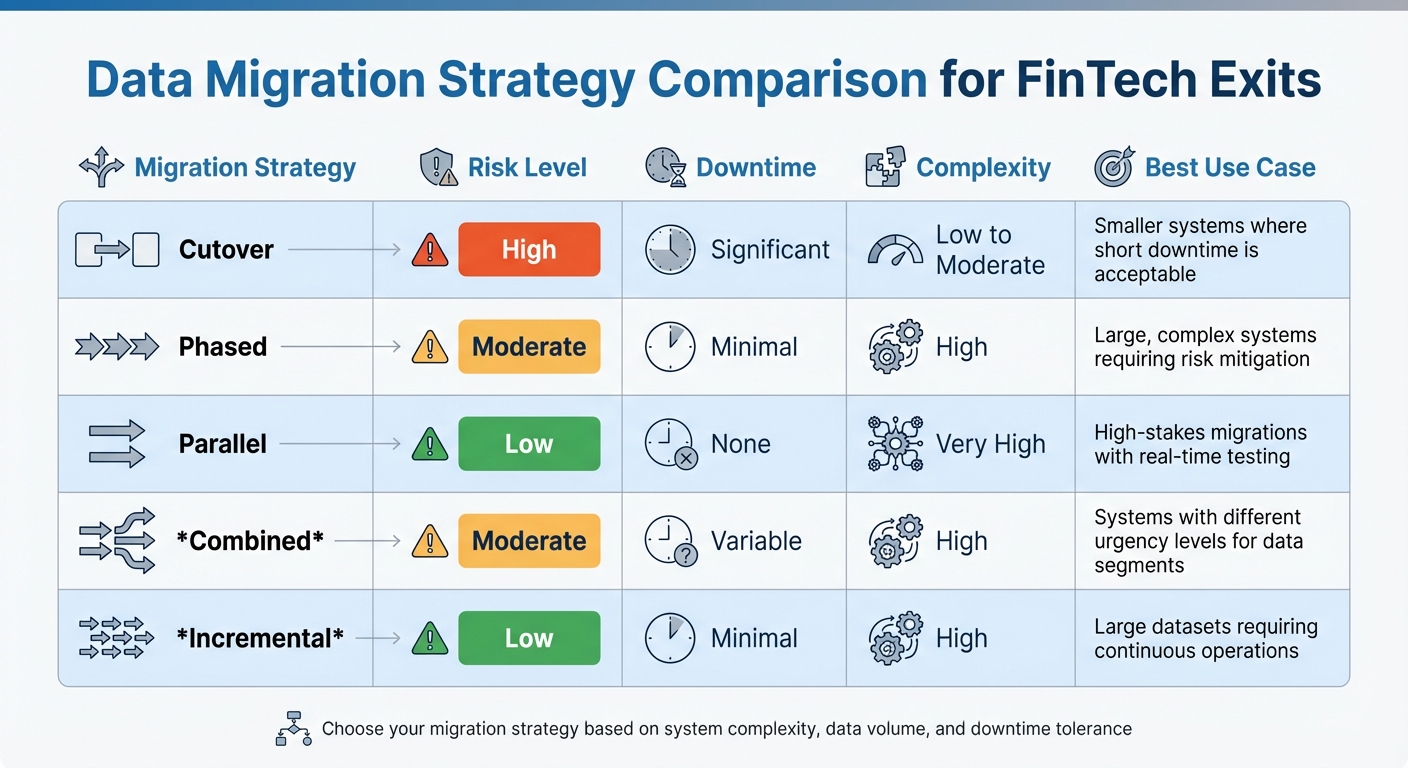
Data Migration Strategy Comparison for FinTech Exits
Tackling legacy systems and data quality challenges requires more than just picking a migration strategy - it demands a methodical approach to minimize risks, downtime, and recovery hurdles. The strategy you choose will shape how smoothly the migration unfolds.
Your migration method should align with your system's complexity, data volume, and tolerance for operational disruption. Here are the main options:
For industries like FinTech, where regulatory compliance is critical, phased or parallel approaches are often favored to safeguard data integrity. Philipp-Andrin Sgier, Manager Technology & Data at PwC Switzerland, emphasizes:
"A successful data migration depends on a comprehensive plan that encompasses all critical factors. These include the chosen approach, precise timing, a stable design phase, resource planning, and robust cross-functional collaboration" [17].
| Migration Strategy | Risk Level | Downtime | Complexity | Best Use Case |
|---|---|---|---|---|
| Cutover | High | Significant | Low to Moderate | Smaller systems where short downtime is acceptable [16] |
| Phased | Moderate | Minimal | High | Large, complex systems requiring risk mitigation [16] |
| Parallel | Low | None | Very High | High-stakes migrations with real-time testing [16] |
| Combined | Moderate | Variable | High | Systems with different urgency levels for data segments [16] |
| Incremental | Low | Minimal | High | Large datasets requiring continuous operations [16] |
To prepare, conduct multiple rehearsals to identify potential issues and refine timelines [15][3]. A detailed run book - outlining each step, responsible parties, and estimated durations - ensures everyone knows their role [3]. Lock in your system design before building to avoid scope creep during the migration process [17].
These steps create a solid foundation for leveraging automation and validation tools effectively.
Manual migration is prone to errors, and the costs can be steep. On average, companies lose $13 million annually due to poor data quality, while 44% of data engineers' time is spent on manual pipeline maintenance [18]. Automation can help reduce these inefficiencies and limit human error.
Here’s how automation can make a difference:
For example, in 2025, Oldcastle Infrastructure successfully migrated from on-premises SQL Server and NetSuite to a Snowflake cloud warehouse, saving $360,000 annually in engineering costs [18]. Similarly, Tinuiti moved millions of data points to an AWS S3 data lake, cutting manual pipeline maintenance by 80% and saving 150 hours per month [18].
To ensure accuracy, integrate automated checks like row counts, schema compatibility tests, and validation pipelines. Managed ELT tools with pre-built connectors can also reduce engineering workload [18]. Before a full migration, test small data batches through the pipeline to confirm connections and permissions [3].
With automation managing precision and speed, the next critical step is planning for a safe rollback in case things don’t go as planned.
Even with meticulous planning, migrations can encounter unexpected hurdles. A reversible migration plan ensures your business can recover from disruptions, data issues, or compliance problems [1][17]. The goal is to define clear "back-out" triggers so the team knows when to revert to the legacy system.
Here’s how to make reversibility work:
Maintaining detailed audit logs and run books for ETL processes is crucial for tracking discrepancies between source and target systems [1][15]. For FinTech companies, migration failures can lead to redoing Know Your Customer (KYC) checks, adding significant operational burdens [14].
Stakeholder alignment is key. Document rollback triggers and secure written approvals from functional and compliance teams at every stage. This ensures the "point of no return" is reached only with full consensus [1][15].
For FinTech firms planning an exit, a robust rollback strategy isn’t just about mitigating risks - it’s a strategic move to ensure continuity and compliance. Expert advisors like Phoenix Strategy Group (https://phoenixstrategy.group) can provide tailored guidance to navigate regulatory challenges while minimizing downtime.
After completing a migration, it’s crucial to focus on measures that reinforce system reliability and ensure compliance. These steps help prevent potential issues and maintain trust with customers.
Post-migration, keeping a close eye on system performance and data integrity is non-negotiable. Use real-time dashboards, set up a 24/7 hypercare team, and deploy automated reconciliation tools to quickly catch and fix any data mismatches [19][20][11][2]. Go beyond surface-level checks - verify every account balance, transaction, and customer detail to ensure everything aligns perfectly with the target system.
Within 3–6 weeks after the migration, conduct mop-up sweeps to handle accounts that were locked or missing consent during the initial transition. This step ensures no customer data gets overlooked. Additionally, confirm that your new servers can handle not just current data but also projected growth for the next three years. Failing to plan for future capacity can lead to performance issues as your business expands.
Once the migration is complete, reinforce compliance and security protocols. Start by performing penetration tests, rechecking access controls, and validating encryption methods. Archive closed accounts according to regulatory requirements [1][11].
Revoke any broad access privileges granted to contractors or developers during the migration. The new system should enforce strict segregation of duties and follow least-privilege principles. For closed accounts that weren’t migrated, export them to secure cloud storage with searchable metadata (like customer ID or closing date) to ensure compliance.
Update data quality rules in the new system to catch ongoing issues, such as incorrect foreign exchange rates or balance errors. Any leftover data on legacy systems must be securely wiped or archived in line with retention policies. This often requires formal destruction certificates to meet regulatory standards. A cautionary tale: In 2022, Morgan Stanley faced a $35 million fine from the SEC for failing to properly erase sensitive client data before reselling hard drives after a migration [13]. This highlights how overlooking post-migration security can have serious consequences, even if the migration itself seemed successful.
A formal post-migration review is essential for documenting outcomes, validating transformation logic, and noting any deviations from the original plan [1]. Regulators often require detailed records of how data was managed during migration, so keeping thorough documentation is critical [1][11].
"Documenting these tasks well... will also be necessary for the post-project audit that will likely take place after the hypercare phase ends." - KPMG [15]
Maintain backups of both the source and target systems from the migration day. These backups are invaluable for comparing data states and investigating discrepancies. Document validation tasks and cutover statuses thoroughly to support future audits or regulatory inquiries [3][15].
Use these reviews to uncover hidden failures - issues that might not be immediately visible but could cause compliance or security problems down the line [13]. For FinTech companies, especially those planning acquisitions or exits, strong post-migration governance is a must. Advisors like Phoenix Strategy Group (https://phoenixstrategy.group) can assist in ensuring your documentation and compliance processes meet the expectations of both regulators and potential acquirers.
Data migration during FinTech exits requires careful planning, precise execution, and strict attention to security and compliance. The risks are significant - missteps can disrupt operations, invite regulatory fines, and erode deal value. As Umbrex highlights, "Reliable data migration - executed under tight security controls - is mission-critical to a smooth cut-over" [1].
Key factors for success include establishing strong governance from the outset. Assign a dedicated Data Migration Lead and Data Security Officer, run at least two mock migrations in non-production environments, and classify all data based on sensitivity [1]. Timing is critical - coordinate data-freeze windows with essential business activities like payroll or financial close to avoid unnecessary disruptions. To safeguard sensitive information, implement least-privilege access controls [1].
The rewards of a well-executed migration go far beyond the transition itself. As Experian puts it, "Data migration is the foundation for realising the full potential of the merger. It turns two separate organisations into one cohesive business, ready to grow and innovate" [22]. Clean, secure data paves the way for faster integration, smarter decision-making, and enhanced deal value for both parties [21][22].
For FinTech companies facing the challenges of an exit, expert guidance can make all the difference between a smooth transition and costly setbacks. Phoenix Strategy Group (https://phoenixstrategy.group) specializes in M&A advisory services, providing growth-stage companies with the technical expertise and strategic insights needed to ensure secure and compliant data migrations.
The formula for success is straightforward: establish strong governance, tap into specialized expertise, and uphold rigorous security and compliance standards at every step. With the right approach and support, your data migration can shift from being a potential risk to a powerful advantage.
To show data accuracy to regulators, keep a comprehensive audit trail that includes documented steps for validation and verification. This should cover details like mapping, transformation processes, testing records, and metrics collected at every stage of the migration. These measures play a key role in maintaining data integrity and meeting compliance requirements.
When it comes to minimizing downtime during a migration, a phased or incremental approach is often the way to go. By breaking the process into manageable stages, this method helps reduce disruptions to daily operations and ensures your business keeps running without major hiccups. It also provides an opportunity to test each phase thoroughly, making it easier to spot and resolve potential issues before they escalate, keeping everything on track.
A rollback plan is your safety net during a migration, ensuring you can revert to the previous system if something goes wrong. Here's what it should include:
These elements work together to minimize risks and maintain business operations without major disruptions.