Published on
June 12, 2026


Growth can hurt cash before it helps cash. I can be posting more sales and still feel pressure if payroll, inventory, and vendor bills are due now while customers pay 60, 90, or 120 days later.
Here’s the short version: if I want to grow without constant cash stress, I need to hold reserves, watch cash flow management every week, set a reserve target that fits my model, and stress test that target before trouble hits. That matters because 38% of startups run out of cash before reaching stability, and 82% of small business failures point to cash flow problems.
If I had to boil the article down to a few points, it would be this:
A few warning signs stand out fast: runway under 3 months, slower collections, delayed vendor payments, heavy credit use, and last-minute payroll moves. If I see those, I know the business is reacting instead of planning.
The main takeaway is simple: cash reserves give me room to keep growing without making every surprise feel like a crisis.
Growth can look good on paper and still put your cash under pressure.
Hiring is a common example. Benefits, equipment, software, and onboarding costs push burn up before any new revenue shows up. You spend first, then wait for the return.
Receivables can make that gap even worse. If your customers pay on 60- to 120-day terms, you're fronting their payment cycle while your own bills keep landing on time. 60% of small businesses run into cash flow issues during periods of rapid growth [2]. In many cases, the problem comes down to timing: money goes out now, but money comes in later.
For product businesses, inventory adds one more squeeze. Seasonal stock builds mean buying months before peak demand. So cash leaves the business long before sales bring it back.
A business can also get squeezed when too much revenue depends on one customer. If more than 30% of your revenue comes from a single client [1], a delayed payment can hit hard. One slow invoice can turn into a cash crunch fast.
Project-based businesses deal with a similar issue. Billing is often uneven, and revenue may not land until a project wraps up. If a few deals drag on, cash can dry up in the middle of busy periods. That's why milestone billing and upfront payments matter so much when demand starts climbing.
By the time a cash problem appears in a month-end report, it's often already urgent. The clues tend to show up earlier. You just need to watch them week by week.
| Warning Sign | What It Signals |
|---|---|
| Cash runway dropping below 3 months [1] | Immediate need to reassess spend or accelerate collections |
| Longer collection times | Customers are taking longer to pay than before |
| Frequent vendor payment delays | Outflows are outpacing available cash |
| Heavy reliance on credit lines for funding operations | Reserves are already depleted |
| Last-minute spending freezes to make payroll | The business is in reactive mode, not planned mode |
A simple move here is a 30-minute weekly cash review with sales, operations, and finance. That meeting gives you an early read on pressure points before they turn into a scramble. It also helps you test whether your reserve target still fits what the business is dealing with right now. Those weekly cash signals shape how much reserve you need.
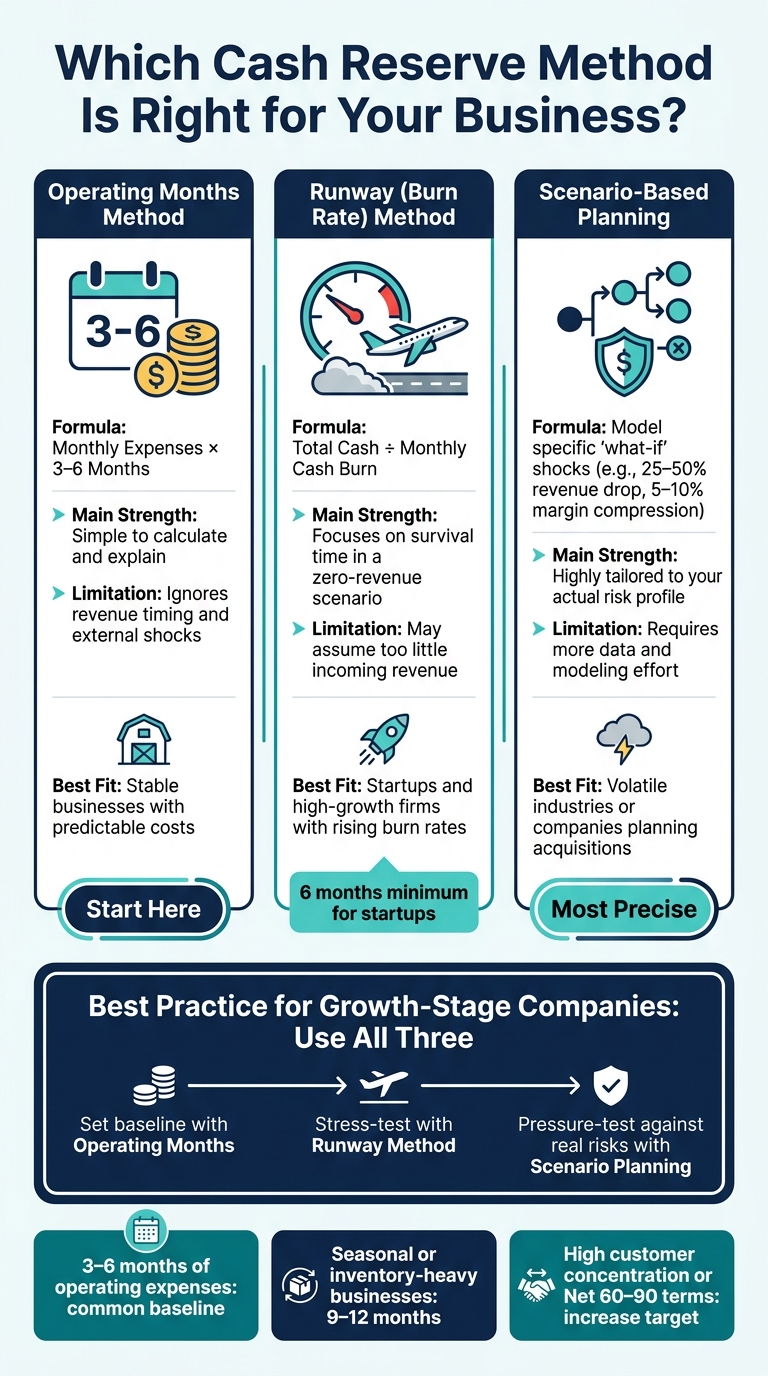
Cash Reserve Sizing Methods: Which Approach Fits Your Business?
Once you know where cash gets tight, the next step is figuring out how much to keep in reserve. There are three practical ways to do that. The best one depends on the weekly cash signals you’re already watching and how your business actually moves money.
The operating months method is the simplest place to start. Add up your monthly operating costs and multiply by a target number of months. A common baseline is 3 to 6 months of operating expenses [3][4][5]. It’s simple, direct, and easy to explain to a team or board.
The runway method adds another layer. Divide total cash by monthly cash burn to estimate runway in months. This is especially helpful if you’re not profitable yet or if you’re growing fast and burn keeps rising. For startups, six months of runway is a common minimum [9].
Scenario-based planning is the most tailored option. You model specific shocks, like a drop in revenue or slower customer payments, and then calculate how much cash you’d need to keep operating [4]. It takes more work, but it gives you a much closer look at whether your baseline reserve can handle the risks you’re most likely to face.
It also helps to split operating reserves from capital reserves. Operating reserves cover day-to-day cash shortfalls. Capital reserves are meant for expansion, acquisitions, or major asset replacement [4].
Your reserve target should match the way cash comes in and goes out of the business. That means looking closely at receivables timing, inventory cycles, and customer concentration.
A professional services firm with steady collections can often stay near the lower end of the 3–6 month range.
An inventory-heavy business is dealing with a different setup. Large upfront purchases and uneven production runs can stretch the time between cash out and cash in. In that case, 6 months may fall short. Seasonal businesses, in particular, should think about holding 9 to 12 months of expenses to cover fixed costs during slow periods [6][7].
Reserve needs also go up when customer concentration is high or receivable cycles are long. If a small group of customers drives most of your revenue, or if you invoice on Net 60 or Net 90 terms, you need more cash on hand to cover those timing gaps [8].
The right method depends on how predictable your cash cycle is. Each one works best in a different situation.
| Method | How It's Calculated | Main Strength | Limitation | Best Fit |
|---|---|---|---|---|
| Operating Months | Monthly expenses × 3–6 months | Simple to calculate and understand | Doesn't reflect revenue timing or shocks | Stable businesses with predictable costs |
| Runway (Burn Rate) | Total cash ÷ monthly cash burn | Focuses on survival time in a zero-revenue scenario | Can assume too little revenue | Startups and high-growth firms with high burn rates |
| Scenario-Based | Modeling specific "what-if" shocks | Highly tailored to your actual risk profile | Requires more data and modeling | Volatile industries or companies planning acquisitions |
For most growth-stage companies, a blended approach works best. Use the operating months method to set a baseline. Then use the runway method to stress-test that number. After that, use scenario planning to see how your reserve holds up under the risks most likely to hit your business.
Once you’ve set the target, the next step is building reserves without slowing growth.
Don’t trade growth for reserves. The better move is to free up cash that’s already stuck inside the business before you touch anything that helps bring in revenue.
Start with the fastest lever: billing timing. Tightening milestone billing pulls cash forward into reserves. If you collect 30% to 50% upfront and invoice the minute each milestone is reached, you can shorten Days Sales Outstanding (DSO).
Payment options matter too. Accept ACH, cards, and digital payments so customers have fewer reasons to delay. Then add automated reminders at 3, 7, and 14 days past due to cut down on manual chasing. If collections still move too slowly, an early-pay offer like 2/10, net-30 gives buyers a clear reason to pay sooner.
On the outflow side, stretch supplier terms when you can. Moving key vendors from net-30 to net-45 keeps cash in your account longer. Corporate cards for approved spend can also push cash out by one billing cycle. That improves timing without pulling back on growth spend.
Once cash starts coming in sooner, direct that money into reserves before adding new spend.
A lot of growth-stage companies drain reserves the same way: they hire and spend based on revenue they expect to land, not revenue that has already shown up. The answer isn’t to stop investing. It’s to phase spending against clear, measurable targets instead of hopeful projections.
Before approving a new hire or a major software contract, ask a simple question: what revenue milestone triggers this spend? That one filter can keep spending tied to what the business has earned, not what it hopes to earn next.
It also helps to rank spend by expected return. That protects the highest-payoff investments and slows lower-priority commitments.
Sweep 15% to 30% of monthly surplus cash into reserves before you expand discretionary spend [3]. If the month is strong, move the surplus into reserves first.
A reserve target only works if you can tell whether you’re on pace to reach it. For that, you need a view of cash at least 13 weeks out, not just a look back at last month’s numbers.
A 13-week cash forecast gives you time to deal with a shortfall before it becomes a crisis. Pair that with a rolling budget and a short weekly cash review, and you’re far more likely to catch bottlenecks early instead of scrambling after the fact.
The forecast shouldn’t just report the reserve balance. It should actively protect the target by flagging when incoming collections or spending choices put that balance at risk.
Use the forecast to pressure-test the reserve too. Check whether it can hold up through a revenue dip or a stretch of slower collections.
A reserve target sounds nice on paper. But it only starts to matter when you pressure-test it. That’s where stress testing comes in.
A 13-week forecast is useful, but by itself, it doesn’t tell you much about how the business holds up when conditions change. Stress testing turns reserves into an operating control, not just a number on a slide.
Stress testing means asking a simple question: what happens to our cash position if things go sideways?
Start with a base case, then build a small set of downside scenarios next to it. Common tests include:
For each case, map out three things:
That last number should drive decisions. If runway drops to four months of core expenses, treat that as the action threshold.
And “action” shouldn’t be vague. Define it ahead of time. That can mean freezing non-critical hires, shifting roles to contract or fractional CFO support, deferring lower-ROI projects, or pushing harder on collections. When those responses are written down in advance, management is more likely to stay calm and make clean decisions under pressure.
Once the scenarios are clear, turn them into policy.
Set a reserve target that fits your operating cycle. Also set a hard floor of three to four months of core expenses, with board approval required to go below that level.
This matters because reserves aren’t idle cash sitting on the sideline. They’re an active control for handling cash pressure during growth.
Give clear ownership to one person, usually the CFO, controller, or finance lead. That person should own cash reporting and scenario updates.
The review rhythm matters just as much as the policy itself. Review the reserve balance weekly and review the full policy monthly. The monthly review should go deeper and cover:
That cadence turns reserves from a static target into a live control that management uses on a regular basis.
Rapid growth can create cash pressure even when revenue is going up. Reserves give the business room to keep investing without betting the company on every quarter going exactly to plan.
The right target depends on your business model and stage. But the part that gives the target teeth is the discipline: forecasting, stress testing, and reviewing cash weekly and monthly. When reserves are built into the operating plan, they help protect growth through volatility.
Review cash flow and working capital trends from the past 8 to 12 weeks. Look closely at accounts receivable, inventory, and accounts payable. If growth is pushing those balances up and they’re getting tougher to control, or if day-to-day liquidity feels shaky, your reserve target may be set too low.
It helps to set a few alert thresholds so you can spot trouble early. Good examples include:
Those signals can give you an early heads-up before a cash squeeze turns into a bigger problem.
Cash reserves should cover unexpected costs.
That includes things like emergency repairs, sudden equipment replacements, costs during revenue slowdowns, surprise inventory needs, and time-sensitive chances such as bulk discounts.
They usually should not be used for routine operating expenses.
Use reserves instead of cutting spend for unexpected emergencies or rare opportunities with clear financial upside.
This can include emergency repairs, revenue shortfalls, supply chain disruptions, or time-sensitive investments.