Published on
April 20, 2026


Cloud costs are now a major financial concern for businesses, especially in the financial sector. With 32% of cloud spending wasted, FP&A teams must move beyond outdated, reactive processes to reduce inefficiencies like idle resources, over-provisioning, and poor visibility. By linking cloud costs to business metrics (e.g., cost per customer), forecasting with real-time data, and collaborating with engineering teams, companies can cut expenses and improve margins. For example, Boeing saved $958,250 in 90 days by aligning billing data with resource usage.
Key takeaways:
FP&A teams can transform cloud cost management into a financial advantage by implementing these strategies and fostering cross-team collaboration.
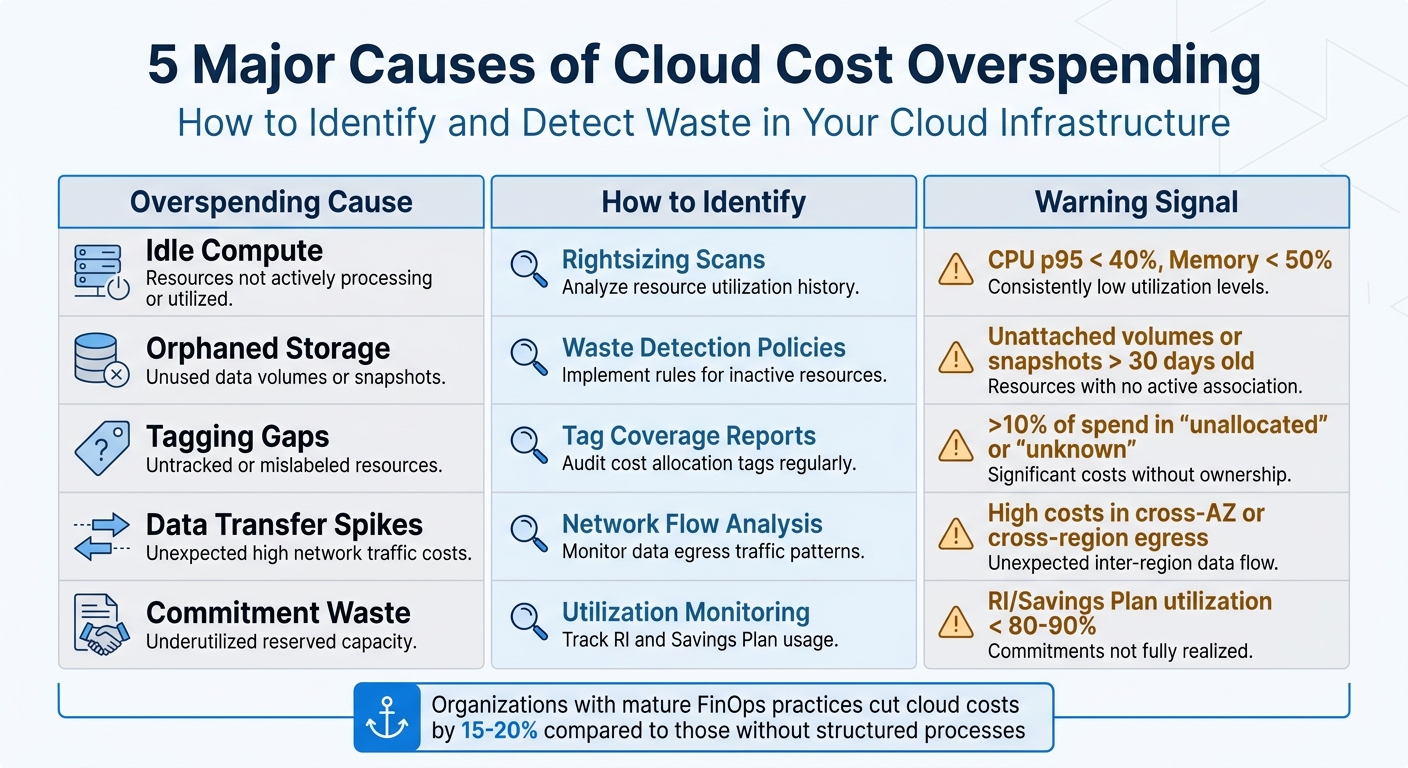
Cloud Cost Overspending Causes and Detection Methods
Financial organizations face unique challenges when it comes to managing cloud costs, which can significantly affect their profit margins. Research shows that these firms overspend on cloud infrastructure by an average of 35% due to issues like unmanaged sprawl and poor cost visibility [5]. In fact, about 32% of cloud spending is wasted [3]. The root causes? Resource sprawl and over-provisioning are at the top of the list.
One major culprit is resource sprawl. Teams often leave behind unused resources, such as detached EBS volumes, snapshots, unattached Elastic IPs, and idle load balancers [3][5]. Without automated cleanup processes, these "orphaned" resources pile up and inflate costs. On top of that, engineers frequently over-provision cloud instances to avoid service-level objective (SLO) failures. This results in underutilized resources, with CPU usage often falling below 40% [2][3].
Adding to the problem is a lack of visibility into cloud spending. Poor tagging practices and the complexities of using multiple cloud providers - like AWS, Azure, and GCP - make it hard to track expenses. Each provider uses its own billing formats and SKU mappings, leaving a significant portion of costs in "unallocated" categories. This lack of clarity makes it difficult for financial planning and analysis (FP&A) teams to forecast accurately or make informed strategic decisions. As Gartner aptly notes:
Cloud cost overruns are less about tooling gaps and more about operating model mismatch [4].
Another cost driver is inefficient data management. Some organizations store data in expensive "Hot" storage tiers indefinitely, failing to implement lifecycle policies that could reduce costs. Others face unexpected data transfer fees when traffic moves between Availability Zones or regions [2][5]. Additionally, mismatches between workload demand and Reserved Instances or Savings Plans - known as commitment gaps - further contribute to waste [3].
Here’s a quick look at the main causes of overspending, how they can be detected, and the signs to watch for:
| Overspending Cause | Identification Method | Typical Signal |
|---|---|---|
| Idle Compute | Rightsizing Scans | CPU p95 < 40%, Memory < 50% [2] |
| Orphaned Storage | Waste Detection Policies | Unattached volumes or snapshots > 30 days old [3][5] |
| Tagging Gaps | Tag Coverage Reports | >10% of spend in "unallocated" or "unknown" [3] |
| Data Transfer Spikes | Network Flow Analysis | High costs in cross-AZ or cross-region egress [2] |
| Commitment Waste | Utilization Monitoring | RI/Savings Plan utilization < 80-90% [3][5] |
The silver lining? Financial organizations that adopt mature FinOps practices often cut cloud costs by 15-20% compared to those without structured processes [5]. Even better, 78% of organizations report reducing costs by over 20% within six months of implementing a FinOps framework [5]. This underscores the value of shifting from reactive cleanup to proactive cloud cost management.
Addressing inefficiencies in cloud spending requires a proactive approach. Effective FP&A teams, often supported by a fractional CFO, go beyond tracking expenses - they tie cloud costs to business outcomes, use real-time data for forecasting, and collaborate with engineering to implement sustainable changes. Here's how to shift from reactive cost-cutting to strategic optimization.
Think of your cloud bill as more than just a list of charges - view it through the lens of unit economics. Track metrics like cost per customer, cost per transaction, or cost per feature to determine whether rising expenses reflect growth or unnecessary waste [6].
Start by connecting cloud spending to specific product features. Which features enhance customer engagement? Which ones drain resources without adding value? Identifying areas like idle storage or oversized compute instances allows businesses to align costs with real workloads and reduce waste [2].
Analyzing customer segments can also reveal profitability patterns. For example, breaking down costs by SMB versus Enterprise customers helps you rank accounts by margin contribution. This insight not only guides sales teams on where to focus but also informs pricing strategies based on the actual cost to support each customer type [1]. Companies at the "Walk-level" of FinOps maturity should aim for at least 90% allocatable spend [3].
Here are some key metrics to monitor:
| KPI | Purpose | Target/Benchmark |
|---|---|---|
| COGS as % of Revenue | Identifies abnormal product functionality or usage | Stable or declining percentage |
| Allocatable Spend % | Measures tagging and ownership mapping success | ≥90% (Walk-level maturity) |
| RI/SP Coverage | Tracks percentage of resources covered by commitments | 60–85% |
| RI/SP Utilization | Ensures purchased commitments are being used effectively | >90% |
By tracking these metrics, FP&A teams can translate technical cost data into actionable business insights.
Traditional monthly invoices only show past spending. Instead, focus on forecasting key usage signals that drive future costs, such as active users, API requests, batch jobs, or storage growth. Anchoring forecasts to these patterns is more effective than relying on trailing averages [8].
Use real-time dashboards and budget alerts to catch spend spikes early, keeping forecast variance within 10–15% for steady workloads [7][8]. For example, monitoring a sudden jump in GPU usage can help identify and address waste before it impacts the bottom line [7][4].
To streamline efforts, normalize billing data across providers like AWS, Azure, and GCP into a unified format. Consolidating currencies and discount attributions ensures a single source of truth. Additionally, require teams to document planned architectural changes or feature rollouts in advance, so forecasts can be adjusted proactively [8]. Weekly 30-minute reviews with engineering leads can help explain forecast deviations and uncover optimization opportunities [7][8].
As Steve Ferreira, Director of Sales Engineering at CloudZero, explains:
I like to think of the cloud bill sort of like your utility bill. It doesn't tell me if the oven's on, it doesn't tell me if the refrigerator's on. It doesn't tell me what's on. But I need to know what it is so I can turn that off [6].
Reducing cloud costs isn't just a finance issue - it requires collaboration between finance, engineering, and product teams [2][11]. Take Lyft, for example. In 2022, they hired six dedicated FinOps engineers to partner with their infrastructure teams. Over 18 months, this collaboration cut AWS costs by $52 million, yielding a 758% ROI on the headcount investment [9].
Start by ensuring visibility through tagging. Work with IT to enforce resource tagging - such as identifying owner, environment, and cost center - at the point of creation. Tags like application__c and owner_email__c help automatically route costs to the right business owners [3]. Daily "showback" reports delivered via Slack or Microsoft Teams can make cloud spending tangible for engineering teams [10][11].
Focus on the biggest cost drivers. Typically, compute instances, storage, and data transfer fees account for 80% of cloud expenses. Use a risk matrix to prioritize optimization tasks, starting with low-risk actions like deleting unused storage before tackling high-risk architectural changes [9][11]. Automated guardrails - like blocking oversized instances in development or shutting down non-production resources after hours - can help maintain cost discipline [10][11].
Mallory Woehler, Director of Strategic and Financial Planning at Ping Identity, highlights the importance of collaboration:
The better you learn to speak the language of your engineers, the better you can work with them to understand cost drivers and encourage them to help you improve the financial picture [6].
This collaborative mindset is key to creating FP&A centers of excellence that drive ongoing cloud cost optimization.
Establishing a Center of Excellence (CoE) is a smart step for organizations looking to maintain consistent progress in cloud cost management. Optimizing cloud expenses isn’t something you do once and forget - it’s an ongoing effort. A CoE acts as a vital link between finance, engineering, and product teams, ensuring cost decisions are proactive and aligned with broader business goals rather than just reacting to the latest bill.
A well-run CoE brings together a mix of skilled professionals - financial analysts, fractional CFO services, data scientists, engineers, and project managers - to turn financial insights into actionable strategies. This structure is key to scaling financial systems effectively. Executive sponsorship is equally important; having a senior leader champion the CoE’s work ensures that cost-saving initiatives get the attention they deserve, even when priorities compete.
Organizations typically choose one of three models for managing their CoE:
The CoE operates within a continuous cycle: Inform → Optimize → Operate. Here’s how it works:
This structured approach fosters collaboration and ensures measurable improvements in cloud cost efficiency over time.
Mallory Woehler, Director of Strategic and Financial Planning at Ping Identity, emphasizes the value of investing in FinOps expertise:
If you really look at how much a FinOps person is able to save the company, and then we look at the cost to hire that person, you have your case made... the ROI has been 5x what I even presented in my business case [6].
Phoenix Strategy Group takes financial planning and analysis (FP&A) to the next level by transforming cloud cost management into actionable financial strategies. With a focus on mid-market companies, they offer services that integrate technical cloud spending into broader financial goals. Their approach combines deep financial expertise with advanced data engineering, helping businesses pinpoint where their cloud budget is going and uncover ways to cut unnecessary expenses.
By applying core FP&A principles, Phoenix Strategy Group maps cloud costs to metrics like cost per customer, feature, or transaction. This detailed mapping helps leadership teams understand which parts of their operations drive cloud expenses and where adjustments will have the most impact. To support this, they build infrastructure using AWS tools like data lakes, AWS Glue, Redshift, and Amazon QuickSight, enabling real-time financial dashboards for better decision-making [1].
This detailed cost mapping also strengthens forecasting. Their "Victory Plan" uses historical data to set realistic targets that align with a company’s growth goals [13]. Over the past year, they’ve helped clients raise over $200 million and supported more than 240 portfolio companies [13]. Rob Mulvin, Founder and CEO of All Pro Shade, shared his experience:
As a home service business owner, understanding complex financials and Unit Economics always seemed overwhelming - until we started working with Phoenix Strategy Group.
Phoenix Strategy Group also uses AI to analyze historical data and create forecasts in minutes, giving teams a clearer picture of how cloud costs will evolve as the business grows [12]. They employ Robotic Process Automation to handle repetitive tasks like data reconciliation and report formatting, allowing finance teams to focus on cutting costs strategically [12].
Phoenix Strategy Group offers two service tiers to help businesses optimize cloud costs, tailored to meet the needs of companies at different stages of growth. These plans align with their proactive FP&A approach, ensuring businesses can manage cloud expenses sustainably.
The Growth Plan includes essential services like forecasting, budgeting, cash flow management, and support for fundraising - critical for companies scaling their cloud infrastructure alongside revenue. The Enterprise Plan builds on this foundation with additional features like M&A advisory, integrated financial modeling, and advanced data engineering, making it ideal for businesses dealing with complex multi-cloud setups or preparing for acquisitions [13].
| Feature | Growth Plan | Enterprise Plan | Optimization Advantage |
|---|---|---|---|
| Forecasting & Budgeting | ✓ | ✓ | Predict cloud spending based on business growth scenarios |
| Cash Flow Management | ✓ | ✓ | Prevent cloud cost overruns from affecting liquidity |
| Fundraising Support | ✓ | ✓ | Show investors disciplined cost management |
| Integrated Financial Model | - | ✓ | Connect cloud costs directly to revenue and EBITDA |
| Data Engineering | - | ✓ | Create real-time dashboards for cloud cost insights |
| M&A Advisory | - | ✓ | Optimize cloud architecture for acquisitions or exits |
Both plans stress the importance of integrating finance and engineering teams, breaking down silos that often lead to unpredictable cloud spending [13]. David Darmstandler, Co-CEO of DataPath, highlighted the impact of this approach:
As our fractional CFO, they accomplished more in six months than our last two full-time CFOs combined. If you're looking for unparalleled financial strategy and integration, hiring PSG is one of the best decisions you can make.
Cloud cost optimization turns financial visibility into actionable savings. According to research, organizations that treat cloud spending as a continuous effort - rather than an occasional cleanup - can cut storage costs by 15–30% by consistently applying lifecycle rules and tiering strategies [2]. This ongoing process involves three key steps: gaining visibility and proper allocation, eliminating waste through rightsizing, and maintaining efficiency with strong governance practices [2].
The rise of AI-powered FinOps is reshaping how businesses handle multi-cloud environments. By leveraging AI-driven workflows, companies can significantly improve the accuracy of anomaly detection while cutting down analysis time [2]. This automation allows finance teams to shift their focus from tedious manual tasks, like spreadsheet reconciliation, to making strategic decisions that drive value.
Collaboration between finance and engineering teams is essential for optimal resource tagging and management [2]. Phoenix Strategy Group exemplifies this approach by combining financial expertise with integrated technology. Their real-time dashboards link cloud spending directly to business metrics, transforming cloud cost management from a reactive task into a proactive, strategic advantage.
To maintain alignment between financial and operational goals, disciplined routines are key. Successful organizations establish a rhythm that includes weekly reviews of rightsizing opportunities, monthly assessments of commitments, and daily checks for cost anomalies [2]. Alongside automated waste removal and standardized multi-cloud data, this structured approach ensures both sustainable growth and controlled infrastructure expenses.
Start by implementing a clear tagging policy. Tags play a crucial role in ensuring visibility, accountability, and accurate cost allocation across your cloud resources. By tagging resources effectively, you can track and manage cloud expenses with greater precision, making it easier to identify opportunities to optimize your cloud spending.
FP&A teams can predict cloud expenses by diving into real usage data with techniques like variance analysis, scenario modeling, and total cost of ownership (TCO) analysis. These methods uncover spending trends and inefficiencies, offering a clearer picture of where costs are headed.
Using tools like tagging and centralized dashboards adds another layer of insight, delivering real-time visibility into both usage and expenses. This makes forecasts more precise and actionable. On top of that, leveraging cloud cost management frameworks allows teams to fine-tune their predictions by aligning them with the latest usage patterns.
To keep cloud costs in check without compromising security or accessibility, consider using storage policies such as automated tiering, lifecycle management, and orphaned resource cleanup. These approaches help cut expenses by:
These strategies strike a balance between saving money and maintaining secure, accessible data.