Published on
February 20, 2026


Modern financial software relies on custom API integrations to automate data exchange between systems like accounting, payment processing, and reporting tools. This ensures faster operations, fewer errors, and scalability for businesses handling complex transactions. Here's why it matters:
Example: A European bank replaced manual SWIFT queries with real-time balance APIs in 2019, improving visibility and efficiency.
However, security and compliance are crucial. Poorly secured APIs can expose sensitive financial data, costing businesses an average of $591,404 per breach in the U.S. (2024 data). To mitigate risks, companies should implement robust authentication (OAuth 2.0, mTLS), encryption (TLS 1.2+, AES-256), and compliance measures like PCI DSS 4.0.
Custom API integrations aren't just technical upgrades - they're essential for businesses aiming to streamline processes, reduce costs, and gain a competitive edge in today's fast-paced financial landscape.
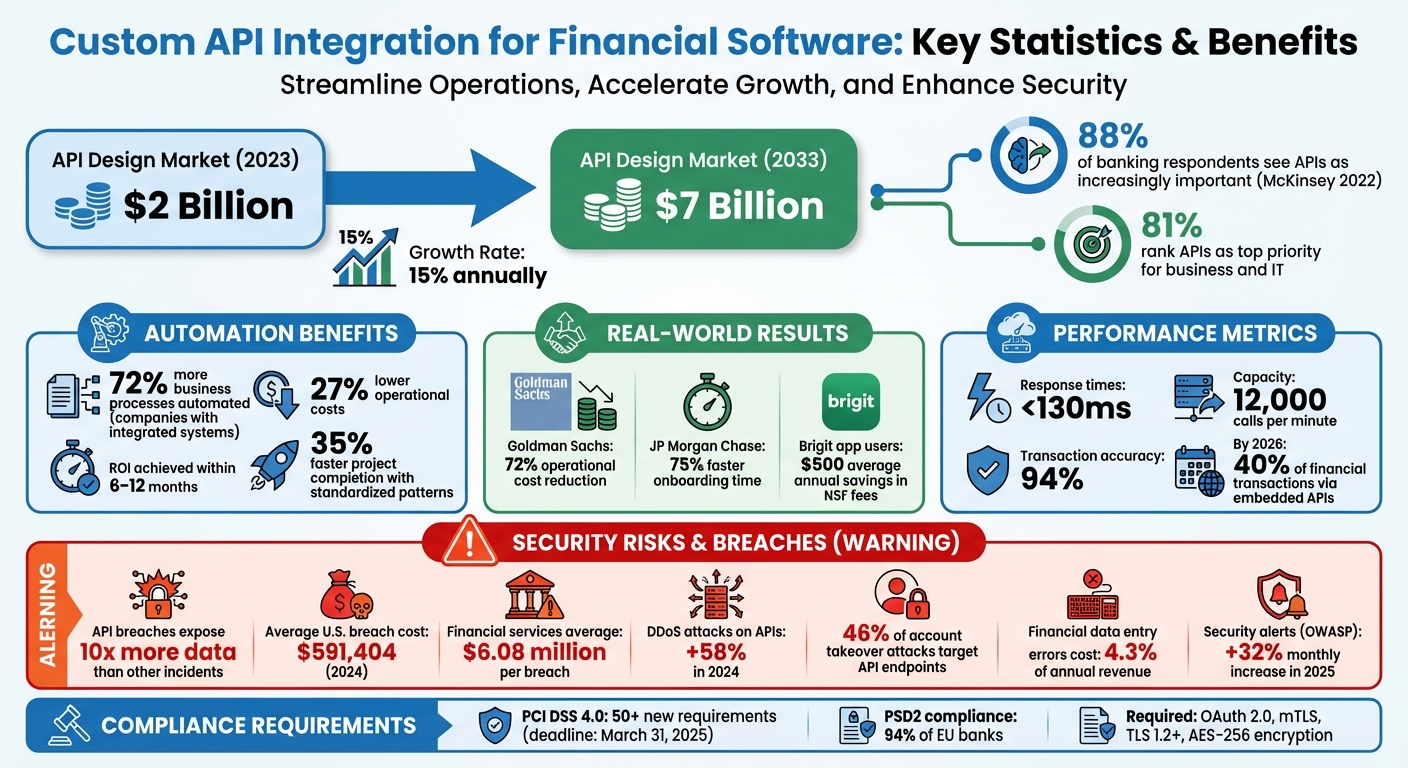
Custom API Integration Benefits and Security Statistics for Financial Software

Custom API integration enhances the speed, accuracy, and capacity of financial software, becoming especially important as businesses grow beyond basic accounting needs. By streamlining data flows, these integrations significantly improve operational efficiency and support scalability.
Real-time data flow is a game-changer for financial management. Custom APIs eliminate the need for manual data transfers by enabling direct communication between systems like payment gateways, CRMs, and accounting software. This creates a seamless process where transactions are automatically recorded in your general ledger within seconds.
"APIs push updates instantly as transactions happen, so your team always works with the latest info. That's key for managing cash flow, budgets, and forecasts." – Codence[6]
A McKinsey survey from 2022 revealed that 88% of banking respondents see APIs as increasingly important, with 81% ranking them as a top priority for both business and IT[6]. The demand for real-time data has also grown due to regulatory changes, such as the EU and UK’s move to T+1 settlement, which requires highly efficient, automated trade flows that traditional batch processing cannot handle[4].
Custom integrations leverage event-driven synchronization via webhooks, triggering instant updates whenever payments clear or invoices are paid. This approach replaces outdated batch processes, which often delay financial reporting by hours or even days. With live dashboards, leadership teams and fractional CFOs can access up-to-the-minute information on cash positions, receivables, and key performance indicators without waiting for month-end reconciliations.
Manual data entry is one of the biggest culprits behind financial inaccuracies[6].
"Typing mistakes, duplicate entries, or missed updates are the top causes of financial errors. API connections sync data directly from one system to another, so what you see is accurate and consistent across platforms." – Danielle Borges, Business Development Director at Codence[6]
Custom integrations go beyond simple data transfers by automating validation and reconciliation processes. Companies with integrated systems automate 72% more business processes compared to those without[2]. These integrations enforce validation rules, ensuring that customer records, tax codes, and account codes are accurate before creating transactions. This prevents costly errors and reduces the need for manual corrections[1].
Additionally, custom solutions address idempotency issues, ensuring that retries caused by network failures don’t lead to duplicate invoices or double-counted revenue[1].
As businesses grow, their transaction volumes and operational complexities increase. Custom API integrations are designed to handle these challenges. Unlike manual processes that struggle to scale, these integrations adapt to higher transaction volumes without requiring additional staff. Companies with API integrations report 27% lower operational costs due to increased automation[2].
For growth-stage companies managing multiple subsidiaries, varying tax jurisdictions, or complex cost center hierarchies, custom APIs can handle these complexities seamlessly. Generic connectors often fall short in supporting such multi-entity structures, but custom solutions are built to adapt as businesses expand into new markets or add product lines[7].
Custom integrations also include features like message queues and background processing to manage traffic surges during peak periods. For example, an e-commerce platform processing 5,000 orders on Black Friday - compared to its usual 500 - can rely on APIs to queue and process transactions efficiently, avoiding system overloads. This ensures smooth operations, prevents duplicate invoices, and maintains visibility, which are critical for customer satisfaction and revenue[8].
The investment in custom integrations often pays off quickly, with many organizations seeing measurable ROI within 6–12 months[8]. Standardized integration patterns can also accelerate project completion by 35%[2].
Custom API integrations offer impressive benefits, but they also come with risks, particularly when handling sensitive financial data. A breach in an API can expose 10 times more data than other types of security incidents. The financial impact is staggering, with the average cost to address an API breach in the U.S. reaching $591,404 in 2024. Additionally, DDoS attacks targeting APIs surged by 58% in 2024, and nearly half (46%) of account takeover attacks now focus on API endpoints[11].
To fully leverage API integrations, addressing the inherent security risks is essential. Strong authentication is the backbone of secure API usage. Protocols like OAuth 2.0 and JSON Web Tokens (JWT) ensure that only verified users and systems can access financial data[10][12]. Further, Proof Key for Code Exchange (PKCE) safeguards against authorization code interception, while short-lived access tokens - ideally expiring every 15 minutes - minimize exposure in case of compromise[12]. For server-to-server calls, Mutual TLS (mTLS) adds an extra layer of certificate-based authentication to prevent impersonation[12].
Data encryption is another key element. Using TLS 1.2+ for data in transit and AES-256 for data at rest keeps sensitive information secure[10][12]. API gateways streamline authentication and filter requests before they reach core systems, while input validation prevents vulnerabilities like SQL injection and Cross-Site Scripting (XSS)[10].
"A poorly implemented API can undo years of trust and damage a brand's reputation. That's why secure API integration isn't just a technical requirement - it's a business imperative." – API Pilot[10]
Broken Object Level Authorization (BOLA) is a major vulnerability, occurring when APIs fail to verify proper authorization for user-supplied IDs. Every function interacting with a data source must implement robust authorization checks to prevent unauthorized access[9]. Similarly, outdated or undocumented APIs often lack security updates, making them prime targets for attackers[9][11].
| Security Layer | Implementation Method | Purpose |
|---|---|---|
| Transport | TLS 1.2+, mTLS | Protects data in transit and verifies identity |
| Authentication | OAuth 2.0, JWT, PKCE | Confirms user/system identity |
| Authorization | RBAC, Scoped Tokens | Limits access to necessary data |
| Traffic Control | Rate Limiting, Throttling | Prevents DoS attacks and resource exhaustion |
| Validation | Input Sanitization, JWKS | Blocks injection attacks and validates tokens |
Handling financial data requires strict compliance with regulatory standards. For instance, PCI DSS 4.0 introduced over 50 new requirements, including mandatory automated vulnerability testing for public-facing APIs, with full implementation required by March 31, 2025[13]. In Europe, PSD2 enforces Strong Customer Authentication (SCA), which uses at least two factors like passwords, devices, or biometrics to verify user identity[13].
The Financial-grade API (FAPI) standards build on OAuth 2.0 and OpenID Connect to provide enhanced security for financial data exchanges. These include signed request objects, client-specific token binding, and mandatory mTLS for production environments. With over 94% of EU banks now PSD2-compliant, these frameworks are widely adopted[13].
"Getting compliance right protects customer data, avoids penalties, and maintains trust." – Dan Barahona, APIsec[13]
Regular audits are crucial to maintaining compliance. Cataloging all APIs - public, private, and third-party - helps eliminate outdated endpoints that may lack security patches. In 2025, security alerts related to the OWASP framework rose by 32% monthly, highlighting the growing need for robust API security measures[11]. Financial service providers spend an average of $6.08 million per breach, underscoring the importance of proactive compliance measures[13].
Integrating Static Application Security Testing (SAST) and Dynamic Application Security Testing (DAST) into CI/CD pipelines ensures vulnerabilities like BOLA are addressed early in development[13]. This "shift left" approach embeds security into the integration process, avoiding expensive fixes later on[11].
While compliance safeguards data, ensuring APIs can handle increasing transaction volumes is equally critical.
As transaction volumes increase, APIs must scale efficiently while maintaining security and performance. Caching frequently accessed data reduces server strain and speeds up response times. Meanwhile, rate limiting and throttling help prevent system overloads during peak usage and protect against denial-of-service attacks[10][11][14].
A microservices architecture allows organizations to scale specific services, such as payment processing, without overburdening the entire system. API gateways centralize traffic management, authentication, and security policies, simplifying monitoring and enforcement across endpoints[10][14].
Real-time observability is indispensable for managing performance. Monitoring latency, resource usage, and error rates enables early identification of bottlenecks, ensuring system stability[14]. IP allowlisting for trusted providers ensures smooth financial data refreshes without triggering unnecessary multi-factor authentication challenges[12].
The API design market's rapid growth - from $2 billion in 2023 to a projected $7 billion by 2033 - reflects the increasing complexity of financial systems and the demand for scalable integration solutions. Organizations that prioritize both security and performance from the outset avoid costly retrofits and retain customer trust as they expand.
Building a custom API integration for financial software requires careful planning and execution. For growth-stage companies, it's essential to create systems that address immediate needs while being flexible enough to scale as the business grows. This guide walks through three main phases: defining objectives, selecting tools, and deploying the integration with a focus on safety and reliability.
Start by outlining the specific purpose of your financial software. Are you creating a lending platform that analyzes financial statements? Or maybe an expense management tool that categorizes transactions automatically? Each use case will demand different types of data. For example, real-time balance checks are crucial for avoiding non-sufficient funds (NSF) fees, while budgeting tools rely heavily on historical transaction data.
Take Brigit, a financial health app, as an example. In 2021, they integrated a balance-check API to monitor user accounts. This allowed them to provide interest-free cash advances of up to $250, helping users avoid overdraft fees and saving them an average of $500 annually in NSF fees and interest costs [5].
Next, determine your data modeling strategy. You can opt for canonical models, which standardize data from various sources into a single schema, simplifying internal processes. Alternatively, provider-specific models retain detailed data but can complicate workflows. A hybrid approach is often the most practical - normalize core fields like amount, date, and status while preserving raw data for unique cases [1]. This balance reduces reconciliation errors and improves data handling. If your integration involves writing data back to accounting systems, establish strict validation rules upfront to avoid issues like missing account codes or tax fields, which can lead to costly reconciliation problems [1].
Synchronization requirements are another critical consideration. Event-driven systems using webhooks can minimize external latency, ensuring a smooth user experience [1]. Once you've defined your goals and data structure, the next step is choosing the right APIs and tools for the job.
The choice between direct and unified APIs will shape your integration's architecture. Direct APIs, such as those for QuickBooks or Stripe, offer full control and access to specific features but require ongoing maintenance. Unified APIs, on the other hand, allow you to connect to multiple platforms through a single interface, cutting development time significantly - by as much as 72%, from 240 hours to just 68 hours [15].
Pay close attention to rate limits. For instance, QuickBooks may allow 500 requests per minute, while HubSpot caps at 100 requests every 10 seconds [16]. Implement strategies like exponential backoff and staggered writes to stay within these limits, especially during peak usage. Modern financial APIs can deliver response times under 130ms and handle up to 12,000 calls per minute, provided your system is built to support such performance [15].
Security is non-negotiable in financial software. Prioritize tools that comply with standards like OAuth 2.1, token binding (RFC 8705), and quantum-resistant encryption. With embedded API solutions expected to handle 40% of all financial transactions by 2026, robust security measures are more important than ever [15].
To ensure stability, keep your integration in a dedicated layer separate from your core application. This isolation prevents issues like provider outages or rate limits from affecting your main services. Use serverless functions (e.g., AWS Lambda) for lightweight tasks or containerized workers on Kubernetes for more resource-intensive operations, such as bulk reconciliations [16].
| Component | Purpose | Key Considerations |
|---|---|---|
| Authentication Layer | Manage OAuth renewals | Encrypt tokens; refresh proactively; rotate secrets [16] |
| Data Orchestration | Normalize and queue records | Use event-driven workers; design idempotent jobs [16] |
| Monitoring & Alerting | Detect sync failures | Send actionable alerts (e.g., via Slack/Email); archive payloads [16] |
| Middleware Stack | Handle transformations | Use Node.js or Python SDKs for speed [16] |
Begin development in a sandbox environment. Use separate API credentials and endpoints to ensure that test data doesn't interfere with live financial records [18]. Stress-test the system with at least 200 concurrent connections to uncover performance bottlenecks before going live [15].
For write operations, implement idempotency keys to prevent duplicate transactions if an API call is retried due to timeouts or errors [15]. Automate token renewal processes to maintain continuous synchronization, as tokens often have limited lifespans - QuickBooks tokens expire after one hour, while HubSpot tokens last six hours [16].
Incorporate API tests into your CI/CD pipeline to catch breaking changes from providers. Use correlation IDs to trace issues across system boundaries and set up real-time alerts with circuit breakers to pause API calls if error rates spike [18][15].
Before a full rollout, conduct a pilot phase with a small group of users. This allows you to identify unexpected issues, such as workflow inefficiencies or data discrepancies, without disrupting the entire organization. While modern financial APIs achieve 94% accuracy in categorizing transactions, human oversight during the pilot phase ensures your specific needs are met [15].
Pay close attention to rounding rules and field-level validations. Errors in financial data entry can cost businesses an average of 4.3% of their annual revenue. Misaligned rounding logic between systems can also lead to discrepancies [15]. Lock critical fields to prevent manual edits from overriding automated processes, and maintain audit trails for compliance [16]. A thorough testing and deployment process lays the groundwork for a reliable, scalable integration.
Ensuring the reliability of financial software goes beyond integration and security - it requires ongoing maintenance and the ability to scale effectively. Even minor disruptions can lead to reporting errors, compliance breaches, or lost revenue, so constant attention is key.
Effective monitoring is essential for maintaining software stability. This includes tracking metrics like the last successful data sync and queue depth. As Apideck puts it:
"If you can't answer 'is accounting sync healthy right now?' for a given customer, you don't have observability; you have logs" [1].
Implementing correlation IDs (e.g., through X-Request-Id) helps trace API transactions. For example, if a payment fails in QuickBooks, correlation IDs allow you to track the issue back through its entire flow, identifying whether the problem lies in your code, the network, or the provider's system [20].
Replace vague error messages with specific, actionable ones. Instead of showing "invalid request", inform users with messages like, "This invoice cannot be created because the accounting period for March 2026 is locked", or "The tax code 'VAT-20' does not exist in your QuickBooks account" [1].
Monitor performance across four key areas:
This comprehensive approach allows you to quickly detect and resolve issues [19][20]. Once monitoring is solid, the next step is managing API updates and version control.
Staying compatible with API updates is crucial for uninterrupted operations. Providers like Stripe demonstrate that long-term stability is possible - they’ve maintained compatibility with every API version since 2011 [21]. APIs function as communication agreements that:
"can't be changed without considerable cooperation and effort" [21].
Adopt a clear deprecation policy with defined timelines, ensuring you migrate before older versions are retired. Use HTTP headers like Deprecation and Sunset to notify systems of upcoming changes programmatically [22][20].
Before retiring an old API version, monitor adoption rates to ensure critical financial reporting traffic has safely transitioned. Integrate contract tests into your CI/CD pipeline to catch breaking changes from providers before they reach production. Running these tests regularly - whether during deployments or on a set schedule - helps detect silent upstream changes [17][19].
When providers update schemas (e.g., renaming invoice_date to issued_date), a canonical data model acts as a buffer. This approach allows you to adjust the mapping layer without altering your core application, ensuring smooth transitions [1][23].
With version control in place, the focus shifts to handling increased transaction loads as your business grows.
Scalability is vital for maintaining efficiency as transaction volumes increase. Instead of batch processing, use incremental synchronization. By fetching only records modified since the last sync - via timestamps or cursor-based pagination - you reduce unnecessary data handling [1].
Load balancers can distribute traffic effectively, while stateless workers ensure consistent request handling. For bulk reconciliations, consider using Kubernetes to deploy containerized workers that scale automatically based on queue depth [19].
Implement second-layer rate limiting to manage high-volume customers without exceeding your API quota. For example, if a provider allows 500 requests per minute and you serve 50 customers, allocate up to 10 requests per customer per minute [17].
Keep an eye on sync lag to ensure data is up-to-date. If delays exceed acceptable thresholds (e.g., more than 5 minutes for real-time reporting), it may signal infrastructure issues. Structured logging with timestamps and status codes can help pinpoint bottlenecks using monitoring tools [19][20].
The API design market, valued at $2 billion in 2025, is projected to grow to $7 billion by 2033, with a 15% annual growth rate [14]. This rapid expansion highlights the growing complexity of financial systems, making strong maintenance and scalability practices essential for success.
Custom API integration brings together scattered financial tools into a cohesive, scalable system. By automating data flows, reducing manual errors, and keeping your accounting system as the dependable source of truth, these integrations set the stage for precise reporting and smarter decision-making.
Consider this: Goldman Sachs slashed operational costs by 72%, while JP Morgan Chase reduced onboarding time by 75% through standardized API implementations[1][3]. These examples highlight the real-world benefits of effective integration strategies.
"The decisions you make in architecture, data modeling, sync strategy, and error handling determine whether your integration is a competitive advantage or an ongoing source of incidents." – Kateryna Poryvay, Apideck[1]
Creating a dedicated integration layer, adopting canonical data models, and designing systems to handle failures are key steps to ensuring reliability as transaction volumes grow. These decisions lay the foundation for sustainable business expansion.
For growth-stage companies, the challenge isn't just building integrations - it’s building them effectively while maintaining focus on core goals. Phoenix Strategy Group offers a blend of financial expertise and data engineering skills to help businesses implement integration strategies that support scaling, fundraising, and exit readiness. Their approach ensures financial systems provide real-time insights into critical metrics like unit economics and cash flow forecasting.
As market needs shift, investing in solid API integrations turns financial systems into strategic assets. Companies that prioritize these efforts are better positioned to seize emerging opportunities and secure a long-term edge in their industries.
When deciding between a custom API and a unified API, it all comes down to what your business needs most. A custom API is built specifically for your unique workflows, offering tailored security measures and functionality. It's perfect if your requirements are highly specific and demand precise customization.
On the other hand, a unified API streamlines things by providing a single, standardized interface that connects multiple systems. This approach simplifies management and makes it easier to scale as your operations grow.
So, if your focus is on achieving exact customization, a custom API is the way to go. But if broader compatibility and ease of integration are more important, a unified API might be the better choice.
The source of truth refers to the most precise, complete, and verified financial data available. Achieving this often relies on real-time integration and validation processes, which help maintain consistent, high-quality data across all systems.
To protect financial APIs from start to finish, it's best to use a multi-layered security strategy. Start with strong authentication methods like OAuth 2.0, JWT (JSON Web Tokens), and multi-factor authentication (MFA) to verify user identities. Next, ensure data remains secure during transmission by using encryption protocols such as TLS 1.3 and AES-256. Implement role-based access controls to limit access based on user roles and responsibilities.
On top of that, keep an eye out for suspicious activity by using logging and anomaly detection tools. Safeguard your API endpoints with measures like IP allowlisting and rate limiting to block unauthorized access and prevent overuse. By combining these strategies, you can create a strong defense against both unauthorized access and evolving threats.