Published on
February 20, 2026


Scenario planning helps CFOs prepare for supply chain disruptions by simulating 'what-if' situations, like supplier shutdowns or demand spikes. Instead of relying on static forecasts, this method links operational changes to financial outcomes, offering insights into costs, cash flow, and risks. For example, companies use tools to analyze scenarios such as tariff increases or production delays, enabling them to make data-driven decisions and protect profits.
Key takeaways:
With scenario planning, CFOs can better manage risks, maintain service levels, and prepare for sudden changes in supply chains.
Scenario planning is about preparing for multiple possible futures instead of relying on a single prediction [7]. In supply chains, this means running "what-if" simulations across areas like sourcing, production, logistics, and demand to understand how changes in one area affect the entire network [1]. CFOs often ask, "What could happen, and how should we respond?" [8].
This method turns hypothetical scenarios - such as trade restrictions, climate-related disruptions, or sudden demand shifts - into actionable insights like capacity changes, lead-time adjustments, or tariff impacts [7]. For instance, a CFO might analyze how export controls could affect Taiwan's semiconductor supply, which accounts for 92% of advanced chips under 10nm [9].
"The goal isn't to predict a single future, but to understand trade-offs across several credible ones so leaders can act with confidence when conditions shift." - e2open [1]
In volatile markets, scenario planning becomes essential for CFOs. For growth-stage companies, this is especially important because static plans quickly become outdated due to factors like tariff changes, port delays, or labor shortages [8]. Without this approach, untested assumptions and limited visibility can cost businesses up to 15% of their revenue [6]. Scenario planning allows CFOs to move from simply reacting to risks to proactively preparing for them by evaluating potential impacts on margins, cash flow, and long-term growth [3].
It also helps CFOs gauge internal readiness - whether the company can handle growth operationally or has enough financial flexibility to weather tighter liquidity [6]. Additionally, it identifies "no-regret" actions that work well across most scenarios while setting clear triggers to adjust strategies as needed [7].
For example, a $5 billion global electronics company modeled four scenarios and discovered a 3–5 week window where their Time-to-Recover exceeded their Time-to-Survive. By taking proactive steps like multi-tier mapping and setting up a "warm" nearshore assembly line, the company maintained service levels above 96% and cut expedited freight costs by 25% when export controls were enforced nine months later [7]. This highlights how scenario planning can safeguard revenue and improve resilience through thoughtful preparation.
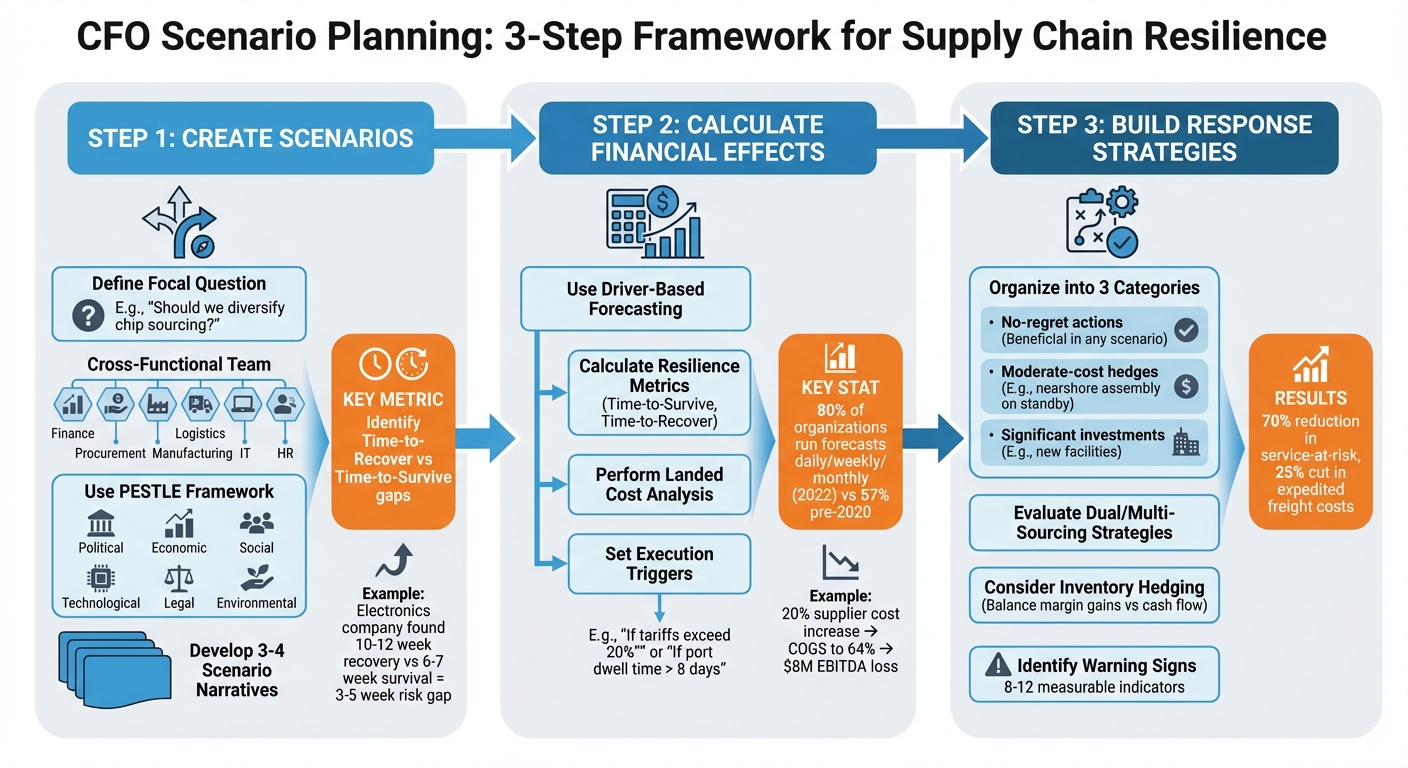
3-Step CFO Scenario Planning Process for Supply Chain Resilience
Start by defining a clear focal question - what critical decision are you trying to address? For example, you might ask, "Should we diversify chip sourcing over the next three to five years?" [7]. Choose a time frame where structural changes could significantly impact your business. Then, bring together a cross-functional team, including members from finance, procurement, manufacturing, logistics, IT, and HR, to ensure that your financial projections align with operational realities [5][7].
Use the PESTLE framework (Political, Economic, Social, Technological, Legal, Environmental) to identify macro forces that could disrupt your supply chain. Focus on the forces that are both highly impactful and highly uncertain - these are your critical uncertainties [5][7]. For instance, if your suppliers are concentrated in specific regions, this geographic dependency needs thorough analysis.
Develop three to four scenario narratives that challenge your current assumptions [7]. For example, a $5 billion global consumer electronics company explored scenarios involving "Trade Regimes" and "Operational Volatility" for its display and chip supply chain. They discovered that their Time-to-Recover was 10–12 weeks, while their Time-to-Survive was only 6–7 weeks, exposing a dangerous 3–5 week gap [7]. These scenarios gave their CFO the clarity needed to take action and stabilize finances.
Once you’ve outlined the scenarios, the next step is to assess their financial impact.
To connect supply chain metrics to financial outcomes, use driver-based forecasting. Link validated drivers like revenue growth, labor costs, and inflation to your scenarios [5]. Calculate resilience metrics such as Time-to-Survive and Time-to-Recover to evaluate risks to service levels, backlog trends, and revenue [7].
Perform landed cost analyses that account for both direct and indirect disruption costs. For example, one company faced a 20% supplier cost increase, which pushed their cost of goods sold (COGS) to 64% of revenue and caused an $8 million EBITDA loss. Passing these costs onto customers improved gross margin to 45%, but it also risked a drop in sales volume [2]. Modeling these trade-offs helps you understand how price changes might influence customer behavior and overall sales [3].
Set up execution triggers - specific thresholds that signal when to act. For example, triggers could include "if tariffs exceed 20%" or "if port dwell time goes beyond eight days" [7][3]. By 2022, 80% of organizations were running forecasts daily, weekly, or monthly, compared to just 57% before 2020 [10]. This shift toward frequent forecasting allows CFOs to stay prepared for rapid changes.
Once financial impacts are clear, it’s time to develop actionable response strategies.
Organize your responses into three categories: "no-regret" actions, moderate-cost hedges, and significant investments [7]. No-regret actions, like improving cybersecurity, are beneficial in any scenario. Moderate-cost hedges, such as maintaining a nearshore assembly line in standby mode, require some investment. Significant investments, like constructing new facilities, demand larger financial commitments [7]. One electronics company used this framework to gain board approval for nearshoring 25% of its assembly operations and pre-qualifying a second chip supplier. These actions reduced their service-at-risk by 70% and cut expedited freight costs by 25% [7].
Evaluate dual-sourcing or multi-sourcing strategies to avoid over-reliance on specific regions, especially for critical components. Consider inventory hedging by bulk-buying essential materials, but weigh the potential margin gains against storage costs and cash flow constraints [2]. For instance, a full inventory hedge might maximize margins but require an immediate $6 million cash outlay, whereas a partial hedge (buying 15% of needed stock) offers a more balanced approach [2].
Identify 8–12 measurable indicators - such as port delays, tariff changes, or supplier credit ratings - that can act as warning signs for when to activate your contingency plans [7]. This step ensures that scenario planning moves beyond theory and becomes a practical, actionable tool for responding to real-world shifts.
CFOs are moving beyond static annual plans, which often fall apart when assumptions shift, and are embracing dynamic, driver-based models. These models link operational metrics - like vendor rates, inventory spending, and labor costs - directly to financial outcomes. A "driver tree" framework is commonly used to connect key areas such as Revenue (pricing, pipeline), COGS (supplier rates, inventory), OPEX (headcount, compensation), and Cash Flow (DSO/DPO). This method enhances strategic planning, especially in unpredictable markets, by tying real-world operations to financial projections [5][11].
Integrating real-time data into these models significantly improves decision-making speed. For example, in October 2025, Walmart's Corporate Controller, David Chojnowski, shifted the company’s scenario planning from monthly to nearly daily updates. By using AI-powered models, Walmart was able to analyze pricing, inventory, and supplier data to align their strategies with competitor actions and market trends [4].
Modern FP&A platforms make it possible to adjust forecasts instantly. If supplier costs rise by 20%, for instance, CFOs can immediately see how this impacts COGS, gross margins, and overall profitability. They can even test scenarios like passing a 10% cost increase to customers, determining whether this approach maintains breakeven even if sales volumes drop to 92% [2].
Another essential component of effective modeling is incorporating supply chain resilience metrics, such as Time-to-Survive and Time-to-Recover. These metrics help quantify how long a business can operate during disruptions. CFOs are also setting up "signposts and triggers", like monitoring port dwell times or tariff changes, to decide when to adjust strategies. By February 2026, it’s expected that 30% of finance leaders will enhance scenario planning, and 25% will rely on AI-driven insights to guide their decisions [4][7].
To navigate the growing complexity of these models, many companies are turning to specialized fractional CFO services for additional expertise.
As financial modeling evolves, growth-stage companies often seek the expertise of fractional CFOs to manage this complexity. These professionals provide the strategic insight needed to shift from reactive cost-cutting to proactive scenario planning [3][5]. For example, Phoenix Strategy Group offers services like cash flow forecasting, KPI development, and FP&A system integration. Their approach ensures that financial models align with operational realities, spanning procurement, logistics, and HR [5][12].
Fractional CFOs are especially skilled at identifying "no-regret" moves - strategies that deliver consistent results across various scenarios. They also define clear triggers for activating contingency plans. Phoenix Strategy Group, for example, uses an Integrated Financial Model to link factory data, such as capacity and yield rates, directly to financial planning. This ensures forecasts account for the complexities of supply chains, transforming finance into a strategic hub, as noted by Kyle Trainor [12].
Unexamined assumptions and limited visibility can quietly erode up to 15% of annual revenue [6]. Fractional CFOs address these challenges by implementing automated reporting tools, reducing manual data reconciliation, and generating actionable insights. They also prepare scenario summaries tailored for board-level discussions, helping leadership evaluate financial risks and liquidity needs under varying supply chain conditions [5][6][12]. This blend of precision and operational expertise proves invaluable for businesses navigating critical strategic decisions.
Supply chain disruptions require flexible and responsive planning - static annual plans simply can't keep up. Finance leaders who safeguard their companies' financial health rely on dynamic models that connect real operational metrics to cash flow, simulate multiple scenarios ahead of potential crises, and use clear triggers to adjust production, pricing, or vendor agreements as needed.
The numbers speak for themselves: 72% of global finance leaders have reported disruptions or delays stemming from supply chain issues, pandemic aftershocks, or inflationary pressures [13]. On top of that, untested assumptions and limited visibility can quietly erode as much as 15% of annual revenue [6]. For example, Walmart has embraced a more agile approach, shifting from monthly to near-daily scenario planning as of October 2025. By leveraging AI, they now analyze pricing, inventory, and competitor trends in real time [4].
For growth-stage companies, the hurdle often lies in accessing the expertise needed to create these dynamic, driver-based models without assembling a full executive team. Services like those provided by Phoenix Strategy Group offer a solution. They specialize in streamlining dynamic financial modeling and scenario planning, helping businesses tackle complexity with tailored frameworks, integrated models, and real-time data synchronization. Their approach enables finance teams to move beyond manual data entry, focusing instead on generating strategic insights. This shift allows companies to identify "no-regret" moves that hold up across various scenarios while stress-testing cash flow under even the most extreme conditions.
To get ahead of potential challenges, begin by mapping out scenarios that tackle the most pressing risks to your supply chain. These could include supply interruptions triggered by geopolitical tensions, trade restrictions, tariffs, extreme weather events, or supplier breakdowns. By concentrating on these high-impact threats, CFOs can develop contingency strategies that protect financial health and bolster the supply chain's ability to adapt and endure.
CFOs have the ability to turn disruption data into actionable financial insights by leveraging scenario planning. This process involves modeling various potential outcomes to evaluate their effects on critical financial metrics like cash flow, EBITDA, and margins.
For example, CFOs can create multiple scenarios based on disruptions - such as a supply chain breakdown or sudden changes in demand. These simulations allow them to predict how such events might ripple through the company's finances. Armed with this knowledge, they can make informed strategic adjustments, whether that means tweaking sourcing strategies, revising pricing structures, or optimizing inventory policies. The goal? To maintain financial stability and build resilience against uncertainty.
Sudden shifts in the supply chain, such as increased supplier costs, shipment delays, or changes in tariffs, can create significant challenges. These situations call for quick adjustments, including real-time scenario modeling and flexible planning, to ensure operations remain stable and responsive.